02.4004.4318
CALL US!
8:30 - 17:30
Mon-Fri

: antonio malavasi

Italy’s New VAT Rule on Staff Secondments: The 2026 Roll-Over Risk for Foreign Groups

For decades, Italy treated the secondment of personnel between group companies as outside the scope of VAT whenever the recipient simply reimbursed the seconding entity for the employee’s gross cost. That rule has now been repealed. From 1 January 2025, every cross-charge for seconded staff is a VAT-relevant supply of services, regardless of whether a markup is applied. Throughout 2026, foreign groups with pre-existing secondment agreements are reaching the moment when those legacy contracts expire or get renewed — and that is precisely when the new regime kicks in for them.

What changed and why

The change was driven by the Court of Justice of the European Union. In San Domenico Vetraria (Case C-94/19, 11 March 2020), the Court ruled that an Italian subsidiary’s reimbursement of the parent’s cost for a seconded director constituted consideration for a service, and that Italy’s exemption was incompatible with EU VAT law. Italy resisted alignment for almost five years.

The legislative fix arrived with Article 16-ter of Decree-Law 131/2024 (the so-called Salva-infrazioni decree), converted into law by Law 166/2024. It repeals the old domestic carve-out (Article 8, paragraph 35 of Law 67/1988) and brings Italy fully in line with the EU framework. The Italian Revenue Agency then issued Circular 5/E of 16 May 2025, which is now the operational reference for both groups and their auditors.

The transitional regime — and why 2026 is the pinch point

The new rule does not retroactively rewrite contracts. It applies to secondment agreements entered into, or renewed, on or after 1 January 2025. Agreements signed up to 31 December 2024 continue to be governed by the old VAT-out treatment until they expire.

In practice, this creates a rolling cliff edge. A foreign group that signed an intercompany secondment agreement in mid-2024 may have lived through 2025 untouched, but every renewal date in 2026 — common for annual or biennial contracts — flips that arrangement into the new regime. Many treasury and tax teams will only discover the change when they receive the first VAT-charged invoice from their Italian counterparty.

What VAT now applies to

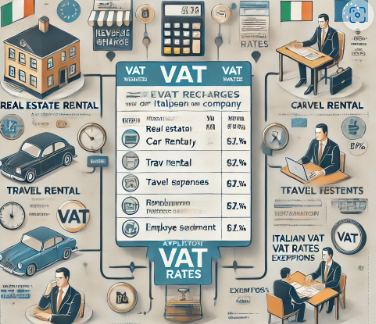
Under the new regime, the entire cross-charge for a seconded employee — gross salary, social security contributions, severance accruals, fringe benefits — is subject to standard 22% Italian VAT. The presence or absence of a markup is irrelevant. Even purely cost-neutral arrangements, historically very common between European parent companies and their Italian subsidiaries, are now caught.

The supply qualifies as a B2B service governed by Article 7-ter of the Italian VAT Code. Where the recipient is a foreign business, the supplier issues an invoice without Italian VAT and the recipient applies VAT in its own country under reverse charge. Where the recipient is an Italian VAT-registered company receiving staff from abroad, the Italian recipient self-applies VAT under the reverse-charge mechanism.

Where the real cost lands

For groups whose Italian recipient entity has full VAT recovery, the cash impact is timing-only — VAT is debited and credited in the same period. The pain point is for sectors with limited input VAT recovery: banks, insurance companies, asset managers, healthcare operators, education providers, and pure holding entities. For them, the secondment VAT becomes a real, non-recoverable cost — an immediate margin compression that did not exist a year ago.

There is also a documentation cost. Circular 5/E confirms that proper intercompany secondment agreements, with clearly defined remuneration, duration, and scope, are essential to avoid requalification by tax inspectors as either a different type of service (which may have different place-of-supply rules) or, in worst cases, as evidence of a hidden permanent establishment.

Final Considerations

Foreign groups operating in Italy should treat 2026 as a year of contract renewal triage. Every legacy intercompany secondment arrangement should be reviewed: when does it expire, what is the renewal mechanism, who absorbs the VAT, and does the Italian recipient have full VAT recovery. Where the Italian counterparty has restricted recovery, the entire economic logic of using a secondment instead of a local hire — or a service contract — should be revisited. As always, this is a context where general comfort is no substitute for tailored advice.

Italy’s IRES Premiale: The 2026 Distribution Trap for Italian Subsidiaries of Foreign Groups

Italian subsidiaries of foreign groups that elected Italy’s IRES Premiale for fiscal year 2025 — cutting their corporate income tax rate from 24% to 20% — now face a hard compliance deadline that affects every dividend decision their foreign parent makes through the end of 2026. Distribute the wrong reserve at the wrong time, and the four-percentage-point saving is clawed back in full, with the difference owed at the standard 24% rate.

The trap is easy to miss because the reduced rate looks, on paper, like a one-shot benefit already locked in by year-end accounts. It is not. The benefit becomes definitive only after a second-year holding period that runs all the way to 31 December 2026 for calendar-year taxpayers.

What the IRES Premiale actually is

The IRES Premiale was introduced by Italy’s 2025 Budget Law (Law No. 207/2024). For the tax period following the one in progress as of 31 December 2024 — typically fiscal year 2025 — companies that meet a strict combination of profit-retention, reinvestment, and employment conditions pay corporate income tax at 20% instead of 24%.

The conditions are cumulative. The company must allocate at least 80% of its 2024 net profit to a dedicated reserve. At least 30% of that reserve (and a minimum of 24% of 2023 profits) must be deployed into qualifying Transition 4.0 and Transition 5.0 capital assets, with a floor of €20,000. The workforce, measured in Annual Work Units, cannot fall below the average of fiscal years 2022–2024, and the company must hire new permanent employees equal to at least 1% of the headcount as of 31 December 2024 (a minimum of one new hire).

These are not light conditions, and they are paired with two long-tail forfeiture rules that companies routinely underestimate.

The distribution embargo

The first forfeiture rule is the one that catches international groups off guard. The 80% reserve created out of 2024 profits is treated as non-distributable until the end of the second tax year following the year of the benefit. For a calendar-year company, that means the reserve cannot be paid out — directly or indirectly — before 1 January 2027.

Distributing the reserve, or any amount that reduces it, before that date triggers the loss of the IRES Premiale. The company must repay the tax saved, recalculated at the ordinary 24% rate, with interest. There is a narrow corrective option to reconstitute the reserve before year-end, but that is fact-specific and rarely available in practice once a dividend has been resolved upon.

Why this matters for foreign parents

For Italian subsidiaries of foreign multinationals, dividend timing is rarely a purely Italian decision. Foreign parents often expect their Italian operations to upstream cash to fund group treasury, repay intercompany loans, or finance acquisitions. The IRES Premiale puts a hard fence around any 2024-profit reserve through the end of 2026 — and Italian rules treat distributions broadly. Branches and Italian permanent establishments of non-resident companies fall under the same regime: amounts attributed to the head office that reduce the dedicated reserve are assimilated to a profit distribution and trigger forfeiture.

A second forfeiture trap applies to the qualifying assets themselves. If the new Transition 4.0 or 5.0 assets are sold, transferred outside Italy, or diverted to non-business use within five tax periods, the benefit is also lost. Cross-border restructurings, intra-group asset transfers, and migrations of equipment to other jurisdictions all need to be screened against this rule for the entire holding period.

A Note for U.S. Citizens

U.S. parents and U.S. shareholders should pay attention to the timing mismatch the embargo creates. Deferring distributions out of the Italian subsidiary to preserve the IRES Premiale can shift the year in which Subpart F, GILTI, or PFIC consequences arise on the U.S. side, and may compress the foreign tax credit available against U.S. tax in any single year. U.S. citizens who hold Italian companies through pass-through structures should also model the interaction between Italian dividend timing and U.S. cash-flow assumptions before assuming the 4-percentage-point Italian saving falls through to net group tax.

Practical points

For groups that elected the regime, the priorities through end-2026 are clear. Map every reserve in the Italian sub’s equity and identify which one carries the IRES Premiale tag. Keep ordinary dividends limited to other distributable reserves — pre-2024 retained earnings, share-premium reserves, or current-year profits that do not feed the protected pot. Document any intercompany cash movements that could be re-characterised as a distribution. And before any cross-border asset transfer, confirm that the qualifying assets stay within the regime’s perimeter.

Final Considerations

The IRES Premiale is one of the most generous corporate tax breaks Italy has offered in recent years, but the value is fully captured only by groups that hold the line through the end of 2026. For Italian subsidiaries of foreign owners, that requires coordinated planning between the local management, the group treasury, and the international tax function — well before the next dividend cycle. Specialist advice is strongly recommended before resolving any distribution, asset transfer, or workforce change involving an entity that took the 20% rate.

Italy’s Elective 15% CFC Tax: 2026 Guidance Simplifies Compliance for Multinational Groups

On 31 March 2026 the Italian Revenue Agency issued long-awaited guidance on the elective 15% tax introduced into Italy’s Controlled Foreign Company (CFC) regime by the 2023 international tax reform. The new measure offers Italian-controlled foreign subsidiaries a simplified route to satisfy the CFC effective-taxation test, replacing a notoriously complex calculation with a flat 15% charge on accounting profits. The April 2026 clarifications confirm retroactive effect from 1 January 2024 and resolve several open questions on eligibility, duration, and the treatment of dividends.

Why the CFC test was a problem

Italian CFC rules attribute the income of a low-taxed foreign subsidiary directly to its Italian parent, even if no dividend is paid. The “low tax” threshold is set at 15% effective taxation, calculated as the ratio between the foreign company’s tax burden (current taxes, deferred taxes, and any portion of the qualified domestic minimum top-up tax under Pillar Two) and its accounting pre-tax profits. In practice, this calculation requires reconciling local GAAP financials, jurisdiction-specific tax adjustments, and Pillar Two figures every year — a heavy compliance exercise for groups with multiple foreign subsidiaries.

How the elective 15% regime works

Instead of running the full effective-tax-rate test, the Italian parent may elect to pay a substitute tax of 15% on the net accounting profit of the controlled foreign company, grossed up for current and deferred taxes, asset write-offs, and provisions. The election deems the standard CFC test satisfied, removing the need to attribute the foreign company’s income to the Italian parent.

The regime has three key design features confirmed by the new guidance. The election lasts three financial years, is irrevocable for the entire period, and renews automatically unless expressly revoked. It applies on an all-or-nothing basis: once chosen, it covers every CFC of the group whose passive income exceeds one-third of total revenue. The foreign company’s financial statements must be certified by locally authorised professional auditors, and those audited figures must feed into the Italian parent’s standalone or consolidating accounts.

If control is lost during the three-year period, or if the audit-certification requirement is no longer met, the option ceases — and where the audit failure affects one entity, the cessation extends to all CFCs of the group simultaneously.

Practical takeaways for foreign-owned and Italian groups

The retroactive application from 1 January 2024 is significant: groups can revisit financial years already filed and, where the 15% substitute tax produces a more favourable outcome, recover an unduly burdensome CFC inclusion through amended returns.

The choice between the elective 15% and the standard ETR test is rarely automatic. The flat regime tends to be advantageous where the foreign jurisdiction has timing differences that distort the standard ETR — large deferred tax movements, accelerated depreciation, asset write-offs — but where the underlying business is genuinely active. By contrast, where the foreign tax burden already comfortably exceeds 15% in cash terms, the standard test remains preferable because no Italian substitute tax is due at all.

Profit distributions from CFCs covered by the election receive coordinated treatment: the substitute tax paid at parent level is taken into account when dividends flow up, preventing the economic double taxation that would otherwise arise.

Final Considerations

The elective 15% regime is one of the most concrete simplifications introduced by Italy’s recent international tax reform, and the April 2026 guidance closes most of the operational gaps that had discouraged groups from opting in. For multinational groups with Italian holding structures — and for foreign-headed groups whose Italian parent or sister entity controls subsidiaries in lower-tax jurisdictions — the 2024 retroactive window is a real opportunity to reduce both compliance cost and tax exposure.

The interaction with Pillar Two, with double tax treaties, and with the CFC and anti-deferral rules of other jurisdictions is highly fact-specific. Anyone considering the election, or revisiting prior CFC inclusions, should run the numbers under both methods and obtain professional advice before filing.

Foreign Employers and Italy’s Permanent Establishment Risk: What Hiring an Italian Remote Worker Really Means

A foreign company that allows even a single employee to work from Italy on a regular basis can, under Italian rules, end up with a permanent establishment (PE) in the country — and with it, Italian corporate tax, VAT registration, payroll obligations, and a tax filing footprint it never planned for. After several years of post-pandemic remote-work normalisation, the Italian Revenue Agency has made clear that home-based work for a foreign employer is not a neutral arrangement: it is a fact pattern that must be analysed carefully before anyone signs a contract.

The legal framework starts with Article 162 of the Italian Income Tax Code (TUIR) and the OECD Model Tax Convention’s PE definition embedded in Italy’s treaties. A PE arises whenever a foreign enterprise has a fixed place of business in Italy through which its activity is carried on in whole or in part — or whenever a person habitually concludes contracts on its behalf in Italy (the so-called agency PE). Both routes are now actively scrutinised in remote-work scenarios.

When Does a Home Office Become a Fixed Place of Business?

Italian Tax Authority guidance — most notably Circular Letter 33/E of 2020 and Ruling 596/2021, repeatedly cited in subsequent practice — sets out the framework. A home office is not automatically a PE, but it can become one if four conditions converge: the worker carries out core revenue-generating activities (not just preparatory or auxiliary support); the employer effectively has the home at its disposal (for instance, by reimbursing rent, requiring its use, or providing office equipment that turns the space into a de-facto branch); the activity is sufficiently continuous; and there is no genuine alternative workplace abroad.

What this means in practice is that the substance of the role matters far more than its label. A back-office IT engineer running internal systems is unlikely to create a PE. A sales director negotiating contracts with Italian or European clients from her Milan apartment almost certainly does. The Italian Revenue Agency consistently applies a “substance over form” test during audits, and Italian tax courts have followed suit.

The Agency PE Trap

Even more dangerous than the fixed-place test is the agency PE route. A foreign company can be deemed to have a PE in Italy if a person — even one without formal signing power — habitually plays the principal role in the conclusion of contracts that are then routinely approved by the foreign head office without material change. Post-2017 OECD updates, transposed into Italy’s recent treaties, deliberately broadened this concept to capture commissionaire and similar arrangements. A remote sales manager living in Italy who manages the customer pipeline end-to-end is exposed even if all paperwork is signed abroad.

What an Italian PE Triggers

Once a PE is found, the consequences cascade. The foreign company must register a branch in Italy, allocate profits to it under transfer pricing principles, file Italian corporate tax (IRES at 24% plus IRAP at around 3.9%), register for Italian VAT and issue Italian e-invoices, and operate Italian payroll withholding for the local employee. Penalties for unregistered PEs are severe: undeclared income is subject to assessments going back up to seven years, plus penalties typically of 90%–180% of the tax due, plus criminal exposure once the omitted-tax threshold is crossed.

Practical Risk Mitigation

There is no single bullet-proof shield, but several measures materially reduce exposure: a written employment contract that confines the Italian role to internal or auxiliary functions; explicit prohibition on negotiating, finalising, or signing contracts with clients from Italy; absence of any “Italy office” designation on business cards, websites, or LinkedIn profiles; a clear alternative workplace abroad that the employee uses regularly; and avoidance of employer-paid rent or dedicated office equipment that could anchor a “fixed place” finding. For higher-risk roles, an Employer of Record (EOR) structure or a properly registered Italian branch is often the cleanest answer.

A Note for U.S. Citizens and U.S. Companies

The Italy–U.S. tax treaty contains its own PE article that broadly tracks the OECD model, but the U.S. dimension adds layers. A U.S. company with a hidden Italian PE has filing obligations on Form 8858 (for the Italian branch) and may face overlapping U.S. and Italian taxation that the foreign tax credit only partly resolves — particularly when state income tax is in play. For the U.S. citizen working remotely from Italy, the issue is reversed: even if the employer is shielded from PE because of careful role design, the individual still faces full Italian residence-based taxation on worldwide income, which is why the Impatriati regime, the new-resident lump-sum, or the 7% retiree regime are usually evaluated alongside the PE analysis.

Final Considerations

Italian PE risk is a quiet but expensive trap for foreign companies that adopt remote-work flexibility without legal review. The arrangement that looks costless to HR can produce a seven-year tax exposure for the parent. Before authorising an employee to work from Italy — even occasionally — foreign companies should obtain a written PE risk assessment, document the role boundaries, and revisit the analysis whenever the worker’s responsibilities expand. Specialist Italian tax advice is not optional in this area; it is the difference between a clean cross-border arrangement and a multi-year reconstruction.

Italy’s Flat Tax and Impatriati Regimes: The 2026 Window to Combine Both Closes from 2027

For several years, two of Italy’s most powerful inbound tax regimes — the non-dom flat tax for new residents and the new impatriati regime for inbound workers — could be applied together by the same taxpayer. That combination has produced striking outcomes for high earners: foreign passive income capped at a flat annual fee, and Italian-source employment or self-employment income taxed on only half of its amount. Decree-Law 38 of 27 March 2026 has now closed that door. From the 2027 tax year, anyone transferring tax residence to Italy must choose between the two regimes. Anyone who establishes Italian residence by 31 December 2026 keeps the combination intact for the full statutory duration of both regimes.

How the two regimes complement each other

The non-dom flat tax, governed by Article 24-bis of the Italian Income Tax Code, allows new residents to pay a fixed annual amount on all foreign-source income, regardless of size. The lump sum currently sits at €300,000 per year for the main applicant and €50,000 for each family member, for up to fifteen years. The regime targets high-net-worth individuals with significant offshore investments, dividends, capital gains, royalties, or rental income from abroad.

The new impatriati regime, introduced by Article 5 of Legislative Decree 209/2023, addresses a different tax base: Italian-source employment or self-employment income. Eligible inbound workers exclude 50% of that income from the IRPEF base for five years, with a 60% exemption available for parents who relocate with minor children. The annual income cap is €600,000.

Because the two regimes carve up the income map without overlap, combining them has been legitimate since the 2024 reform. The Italian Revenue Agency confirmed the cumulability in late-2025 guidance, treating the legislative silence on the point as an implicit green light. That silence is now over.

What the new rule actually says

DL 38/2026 introduces an explicit ban on cumulation, but only on a forward-looking basis. Taxpayers who establish Italian tax residence by 31 December 2026 continue to apply both regimes side by side for the full statutory duration of each. The protection is permanent and is not a phase-out. Taxpayers who transfer tax residence to Italy from 1 January 2027 onwards may elect either the flat tax or the impatriati regime, but not both. The election will be effectively binding for the duration of whichever regime is chosen.

The regime for professors and researchers is unaffected and remains separately combinable with other incentives.

What this means in practice

For anyone weighing an Italian move, the practical question is whether to bring it forward so the residence transfer takes effect before 2027. Italian tax residence is established when, for the majority of the tax year (more than 183 days), the individual maintains residence, domicile, or registered presence in Italy. For a 2026 move, this typically requires physical relocation by early July 2026 at the latest, supported by registration with the local anagrafe and consistent evidence that the personal and economic centre of life has shifted.

The combination is most valuable for taxpayers who have substantial foreign passive income — which the flat tax shelters at a flat €300,000 — and who will earn significant Italian-source professional or executive income, which the impatriati regime taxes on only half of its amount. For taxpayers whose profile is heavily weighted to only one of these two income streams, the choice imposed from 2027 will have a more limited financial impact, but the calculation should still be run carefully before any decision.

A Note for U.S. Citizens

U.S. citizens remain subject to worldwide taxation by the IRS regardless of where they reside. The flat tax can be treated as a creditable foreign tax in Italy, but its lump-sum nature complicates the per-country and per-basket allocation of the Foreign Tax Credit on Form 1116. Pairing it with the impatriati regime — under which half of Italian-source income is exempt from IRPEF — typically lowers the Italian tax actually paid on that portion, which in turn reduces the credit available against U.S. tax. In some scenarios this mechanically transfers part of the Italian saving into additional U.S. tax. A bilateral simulation, year by year and for the full intended duration of the regimes, is indispensable before relying on the combination as a planning strategy.

Final Considerations

The 2026 deadline is firm but the planning is not always simple. Establishing Italian tax residence, securing the flat tax election, and documenting eligibility under the impatriati regime are three distinct processes, each with its own timing and evidentiary requirements. For internationally mobile taxpayers considering Italy, this calendar year is the last opportunity to lock in the most generous version of the framework. Specialist advice that integrates both Italian and home-country tax positions is strongly recommended before any commitment is made.

The Italian Impatriati Regime in 2026: A Practical Overview for Workers Relocating to Italy

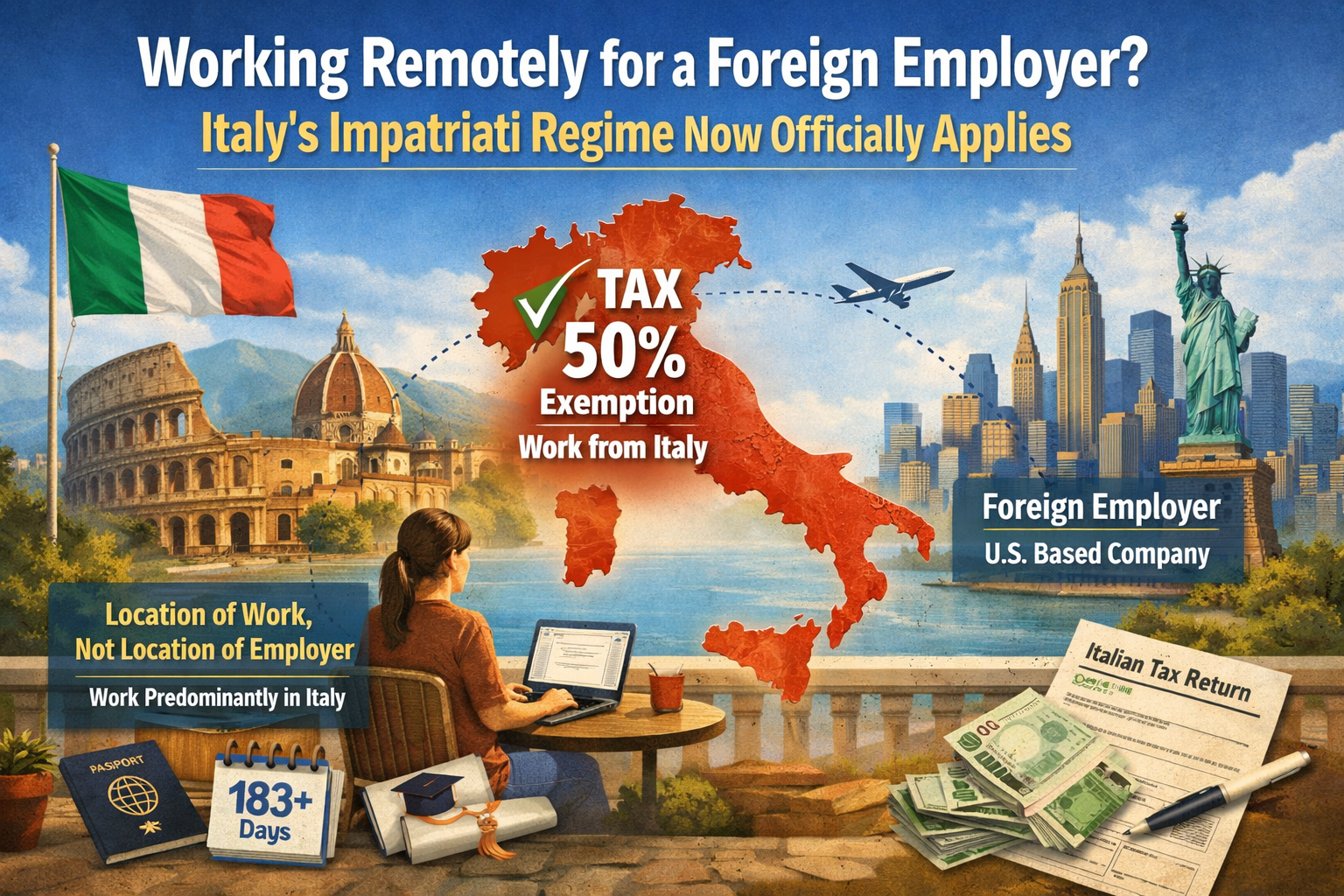
The Impatriati Regime is Italy’s main preferential tax incentive for qualified professionals who move their tax residence to the country. Restructured in 2024 and confirmed for 2026, it reduces the taxable base of Italian-source employment and self-employment income for a set number of years. Compared with the pre-2024 version, the current regime is more selective: lower exemption, shorter duration, stricter eligibility, and an income cap. ( FOR FULL DETAILS CLICK HERE )

Who Can Access the Regime

To qualify in 2026, an individual must simultaneously meet five conditions. The first is the transfer of tax residence to Italy under Italian domestic rules. The second is not having been an Italian tax resident in the three tax years preceding the transfer; this look-back period is extended to six years, or seven in some cases, if the worker continues to work in Italy for the same employer or the same group they worked for abroad.

The third condition is a commitment to remain an Italian tax resident for at least four years: losing residence earlier triggers recapture of the benefit with interest. The fourth is that work must be performed mainly in Italy — more than 183 days in the tax year. The fifth, and most restrictive, is the high qualification or specialization requirement: the worker must hold a qualification recognised under EU rules on regulated professions or on highly qualified employment (the EU Blue Card framework), or have equivalent specialised competences. Generic or low-skill roles are excluded.

Eligible Income

The regime applies to Italian-source employment income and self-employment income from arts and professions, including directors’ fees for duties performed in Italy. Business income from sole traders and partnerships, as well as passive income such as dividends, interest, capital gains and rental income, is not eligible and is taxed under the ordinary rules.

Benefits and Duration

The standard benefit is a 50 percent exemption of eligible income from IRPEF: only half is subject to Italian progressive income tax, and the same reduced base also applies to regional and municipal surtaxes. The exemption increases to 60 percent if the worker has a minor dependent child at the time of transfer or becomes a parent during the benefit period, provided the child resides in Italy.

The regime is capped at 600,000 euro of eligible income per year; any excess is fully taxed at ordinary rates. The duration is five tax years, starting from the year of transfer. Unlike the previous version, no extensions are available, not even where children or real estate purchases previously triggered a five-year extension.

Practical Points Before the Move

Eligibility turns on documentation. Returning Italian nationals must formally cancel their AIRE registration; foreign nationals must complete anagraphic registration with the Italian municipality. A codice fiscale is required, as is evidence of foreign residence during the look-back period — foreign tax returns, contracts, utility bills, AIRE certificates. Employees then submit a written request to the Italian employer, who applies the reduced withholding on monthly payroll; self-employed professionals apply the reduction directly in the annual tax return.

Common pitfalls include missing the 183-day test because of frequent remote working abroad, miscalculating the extended six- or seven-year look-back for those staying with the same group, and failing to document the high qualification requirement, which the Italian Revenue Agency is increasingly auditing. The regime is not combinable with the forfettario flat-tax regime, the 7 percent retiree regime for Southern Italy, or the lump-sum flat tax for new residents.

A Note for U.S. Citizens

U.S. citizens and green card holders continue to be taxed by the United States on worldwide income regardless of residence, and must keep filing Form 1040, FBAR and, where applicable, Form 8938. Because the Italian exemption reduces the Italian tax paid, the Foreign Tax Credit available to offset U.S. liability is lower, and residual U.S. tax may actually increase. The Italy–U.S. treaty’s saving clause preserves U.S. taxing rights over its citizens, so treaty relief is limited. Italian mutual funds and certain insurance wrappers are typically classified as PFICs and trigger punitive U.S. taxation and heavy reporting, and Italian complementary pensions may not qualify as tax-favoured plans under U.S. rules. A coordinated U.S./Italy projection before relocating is essential to model FTC, FEIE, state tax exit, and investment restructuring options.

Final Considerations

The 2026 Impatriati Regime remains a powerful incentive, but it rewards careful planning. Residence timing, documentation, the high qualification test and the interaction with other regimes can materially change the net benefit — and for U.S. persons the analysis must always be run on both sides of the Atlantic. Professional advice before the move is strongly recommended.

Italy’s 2026 Short-Term Rental Reform: Three-Property Threshold, CIN Enforcement, and EU Platform Reporting

Italy has restructured the tax and regulatory framework for short-term rentals from 1 January 2026, with a second wave of changes arriving in May 2026 under EU Regulation 2024/1028. The combined effect is a tighter environment for anyone letting a property for stays under 30 days — and a particularly important moment for international owners who rely on platforms such as Airbnb, Booking.com and Vrbo to reach guests.

The three-property threshold

The 2026 Budget Law has lowered the threshold at which short-term rental activity is classified as a business from five properties to three. Owning or managing three or more properties used exclusively for lettings of less than 30 days now triggers mandatory VAT registration, opening of a Partita IVA, social security contributions to INPS, and full business accounting.

This is a significant change. Small foreign investors who built a portfolio of three or four Italian apartments for vacation rental — a very common profile among international buyers — are automatically reclassified as businesses from this year, even if they previously enjoyed the straightforward cedolare secca treatment.

Cedolare secca: what stays and what changes

For non-professional hosts (one or two properties), cedolare secca remains available. The rate is 21% on the first property and 26% on each additional property, applied on gross rental income in lieu of IRPEF and local surtaxes. A proposal during the 2026 Budget Law debate to raise the first-property rate to 26% was dropped, so the pre-2026 structure has survived for the smallest landlords.

Owners above three properties lose access to cedolare secca entirely. Rental income falls into ordinary business taxation, subject to IRPEF on progressive brackets, IRAP in certain cases, and VAT where the activity takes on a hotel-like character (breakfast, cleaning between guests, reception desk).

CIN and the end of anonymous listings

Every property offered for short-term tourist use must now display a CIN (Codice Identificativo Nazionale) issued by the national accommodation database. Platforms are required to verify CIN compliance and delist properties without one. Fines for CIN violations range from €800 to €8,000 per property. Over 620,000 CINs were issued in the first year of operation — an indicator of just how actively the authorities are enforcing the new regime.

May 2026: EU platform reporting kicks in

From 20 May 2026, EU Regulation 2024/1028 requires platforms to transmit booking data directly to national authorities on a monthly basis. Owner identity, property address, number of nights booked, and amounts received will all flow automatically to the tax authorities. Foreign owners who, under previous opacity, were informally relying on platform payouts to a foreign bank account should assume that this data is now visible to the Agenzia delle Entrate in real time — and that any mismatch between declared income and reported bookings will be pursued.

Practical points for international owners

Anyone holding two properties and considering a third should run the numbers carefully — the tax, accounting and social-security burden of crossing the business threshold can easily outweigh the marginal return on a single extra unit. A different corporate structure (such as an Italian SRL) may work better at scale, but brings its own regime and compliance costs. For owners already at or above three properties, the priority is proper VAT registration and bookkeeping from day one of 2026 — corrective filings later in the year are possible but expensive.

A Note for U.S. Citizens

U.S. citizens remain taxable on worldwide rental income regardless of Italian residency status. Italian tax paid under cedolare secca or IRPEF is generally creditable in the United States via the Foreign Tax Credit, but cedolare secca’s flat structure sometimes produces mismatches with U.S. Schedule E mechanics, where expenses are normally deductible against gross rent. Properties held through Italian companies, or bank accounts used to receive rental payouts, can also trigger FBAR, FATCA, and in some cases PFIC reporting. These layers should be planned together before any scaling of Italian rental activity.

Final Considerations

The 2026 reform does not make short-term rental unattractive in Italy, but it ends the informal era. Owners who cross the three-property threshold, owners approaching it, and owners of even a single property without a CIN all face concrete compliance steps this year. Professional advice is strongly recommended before restructuring or expanding a portfolio.

Impatriati Regime and Minor Children: Why Families Moving to Italy Can Now Access the 60% Exemption More Easily

A recent clarification from the Italian Revenue Agency has expanded how the impatriati regime interacts with one of its most attractive features: the enhanced exemption for taxpayers with minor children. Response No. 82 of March 20, 2026 addressed a practical question that had been troubling international families and their advisors — whether the enhanced benefit applies when the children are already tax resident in Italy before the parent actually returns. The answer is yes, with significant consequences for planning a family relocation.

The current inbound workers regime, set out in Legislative Decree 209/2023, reduces the taxable base on Italian-source employment and self-employment income. The standard benefit cuts the taxable portion to 50% of income produced in Italy, applied for five tax years and capped at a maximum eligible income of €600,000 per year. For a worker returning under qualifying conditions, this halves the IRPEF burden on Italian earnings for half a decade, which is why the regime has become central to relocation planning for international professionals.

The Enhanced Benefit for Families

Where the taxpayer has at least one minor child who is tax resident in Italy, the taxable base falls further, from 50% to 40%. In practical terms, this means 60% of Italian-source income is exempt from IRPEF instead of 50%. The enhanced benefit is also triggered by the birth or adoption of a child during the five-year incentive window — in which case the improved treatment applies from the tax period in which the event occurs and continues for the remaining eligible years.

The benefit requires the child to be tax resident in Italy, and that residence must be maintained throughout the benefit period. If the child later leaves Italy, the enhanced treatment ceases from the year in which that condition is no longer satisfied.

t requires the child to be tax resident in Italy, and that residence must be maintained throughout the benefit period. If the child later leaves Italy, the enhanced treatment ceases from the year in which that condition is no longer satisfied.

What the March 2026 Clarification Adds

The key point in Response No. 82/2026 is the timing of the child’s residence. The Revenue Agency confirmed that it is not necessary for the child’s transfer to Italy to coincide with, or follow, the parent’s relocation. A minor child who was already resident in Italy before the incoming worker actually qualifies as a resident triggers the enhanced benefit, provided Italian residence is preserved for the duration of the regime.

This matters in real-life patterns the firm sees often: a parent who spent recent years working abroad while the family remained in Italy; a couple where one spouse relocated ahead of the other with the children; or international families who sent children to Italian schools before committing to a full household move. Under the previous reading, some practitioners were cautious about claiming the enhanced 60% exemption in these scenarios. The 2026 clarification removes that uncertainty.

The same ruling reaffirms a second important point: the regime is compatible with smart working for a foreign employer. A worker who returns to Italy while continuing the same employment relationship with a non-Italian company may still qualify, provided the activity is performed predominantly from Italian territory and the other statutory conditions — including the foreign residence requirement prior to transfer — are satisfied.

A Note for U.S. Citizens

Because the United States taxes its citizens on worldwide income regardless of residence, a U.S. citizen benefiting from the Italian impatriati regime still files a U.S. return. The enhanced 60% Italian exemption means a smaller amount of Italian tax is paid on the same gross Italian income, which in turn reduces the Foreign Tax Credit available on the U.S. return. The practical result is that the Italian saving can translate into a higher residual U.S. liability rather than a straightforward net reduction in total tax. FBAR and FATCA obligations remain unchanged. A coordinated U.S.–Italy projection is essential before assuming the headline benefit will flow through to cash savings.

Final Considerations

The impatriati regime is one of the most powerful tools Italy offers to international workers, and the enhanced rate for families makes it particularly relevant to households planning a long-term move. The March 2026 clarification opens the door to a broader set of scenarios, but the rules on tax residence, timing of the transfer, and the child’s continued Italian residence leave no room for improvisation. Anyone considering a move — or already inside the five-year window — should have the family’s situation reviewed before filing decisions are locked in.

Selling Into Italy From Abroad: The July 2026 Customs Shake-Up for Low-Value Parcels

On 1 July 2026 two separate but overlapping reforms will change the cost structure of shipping low-value goods into Italy from outside the European Union. The EU will introduce a flat €3 customs duty on every item in parcels valued up to €150 sent to consumers, and Italy will simultaneously raise its own handling fee from €2 to €3 per parcel to align with the EU measure. For any foreign company that relies on direct-to-consumer shipping into the Italian market — US, UK, Swiss or Asian sellers especially — the break-even maths changes materially, and the window to restructure is short.

The Italian fee has actually been in place since 1 January 2026. It applies to non-EU low-value consignments cleared through Italian customs, regardless of the declared value of the goods. It is charged per parcel, not per item, and is collected by the customs clearance agent from the importer of record — in most B2C cross-border sales, that is the end consumer. The increase to €3 scheduled for 1 July 2026 is not a new fee but an adjustment of the existing charge so that the Italian administrative cost matches the new EU duty.

The EU-level reform is more disruptive. The flat €3 customs duty is an interim measure, introduced ahead of the full abolition of the €150 de minimis exemption expected in 2028. Unlike the Italian handling charge, the €3 duty is assessed per item and is based on the tariff classification of the goods. A single parcel containing three distinct SKUs with different tariff headings will therefore attract €9 in customs duty, before VAT and before Italy’s €3 handling fee.

Who absorbs the cost

In a standard non-EU B2C shipment using IOSS (Import One Stop Shop), VAT is pre-collected at the point of sale by the seller. IOSS continues to work under the new rules for the VAT piece, but the customs duty and the handling fee are in addition. Sellers outside the EU have three practical choices. They can pass the combined cost (up to €6 per parcel, plus duty-per-item) on to the Italian consumer at checkout, which is transparent but damages price competitiveness. They can absorb it into the sale price, which compresses margins. Or they can restructure the supply chain — holding stock inside the EU, shipping business-to-business into an EU warehouse, and fulfilling the Italian consumer from within the single market, which removes the import event entirely.

Routing alternatives are narrower than they appear

Because Italy’s handling fee is triggered only when goods are physically cleared at an Italian customs office, it is possible in theory to route shipments through another EU entry point (for example Germany or the Netherlands) and transit them to Italy under intra-EU movement rules. In practice, other Member States are introducing their own handling charges aligned to the EU reform, so the arbitrage window is closing. Foreign sellers should model the total landed cost country by country rather than assuming a single optimised route.

A Note for U.S. Citizens

For U.S.-based sellers shipping directly to Italian consumers, the practical impact is immediate: the Section 321 de minimis logic that allows low-value shipments into the U.S. duty-free has no EU analogue from July 2026. Any seller currently operating on the assumption that parcels under €150 reach Italy duty-free should update their checkout flow and customer communications before the July deadline. U.S. sellers should also verify that their IOSS intermediary is ready to collect the flat €3 duty alongside VAT; if not, duty becomes payable on arrival and parcels may be held pending payment.

Final Considerations

The July 2026 reforms are not about revenue — the EU is aligning its treatment of low-value imports with the reality that the €150 threshold has become a compliance loophole. For foreign sellers the strategic question is no longer “how do I minimise per-parcel friction?” but “where should my European stock actually sit?” Sellers with meaningful Italian volume should evaluate a warehouse inside the EU, IOSS readiness, and tariff-classification discipline well before the deadline. Each of these choices has VAT, customs, and permanent-establishment implications that need to be modelled together, not in isolation.

Foreign companies selling into Italy are encouraged to review their customs and VAT position with qualified advisers before the July 2026 changes take effect.

Italy’s Avviso Bonario: What It Is and What to Do When You Receive One

An avviso bonario is a preliminary notice issued by the Italian Revenue Agency (Agenzia delle Entrate) when automated or formal checks of a tax return reveal possible irregularities. It is not yet a formal assessment and not yet a tax bill — it is an invitation to either pay what the Agency believes is due, or demonstrate why the Agency is wrong, at substantially reduced penalties. For foreign residents and international businesses operating in Italy, handling it correctly is essential: ignoring the notice almost always leads to enforcement action at a much higher cost.

When and How It Arrives

The avviso bonario is generated after one of two types of control performed on a return already filed:

The automated check (controllo automatizzato), under Article 36-bis of Presidential Decree 600/1973 for direct taxes and Article 54-bis of Presidential Decree 633/1972 for VAT, is a computerised matching between what was declared and what was actually paid or withheld.

The formal check (controllo formale), under Article 36-ter, is a deeper review where the Agency verifies supporting documentation for deductions, tax credits, withholdings and other specific items on the return.

The notice usually arrives two to three years after the return was filed. For taxpayers who filed independently, it is delivered by registered post or made available in the taxpayer’s online tax account (cassetto fiscale). For those who filed through an accountant or a CAF, the notice is transmitted electronically via the Entratel channel directly to the intermediary, who is expected to forward it promptly.

Which Taxes and Contributions Are Covered

Avvisi bonari can concern virtually every tax or contribution managed through the Italian tax return: IRPEF and IRES (personal and corporate income tax), IRAP, VAT, cedolare secca on rental income, IVIE and IVAFE on foreign real estate and financial assets, regional and municipal surcharges, substitute taxes on investment income, and withholding taxes. They also cover INPS social security contributions reported through the tax return, which is particularly relevant for self-employed professionals and holders of a partita IVA.

Payment Terms and Reduced Penalties

The key advantage of resolving an avviso bonario is a significant reduction of the statutory penalty.

For automated checks, the penalty is reduced to one-third of the ordinary amount. For formal checks, the reduction is to two-thirds. Following the 2024 reform of the Italian penalty system, the base penalty for omitted or insufficient payment is 25 percent for violations committed from 1 September 2024 onwards (it was 30 percent before that date). In practice, the effective penalty after reduction is approximately 8.3 percent for automated controls and 16.7 percent for formal ones, plus interest accrued from the original deadline to the date of payment.

To benefit from the reduction, the taxpayer must pay within 30 days from receipt of the notice. When the notice is routed through a tax intermediary, the effective deadline is 90 days from the Agency’s transmission date.

Since January 2025, installment plans have been standardised: up to 20 quarterly installments are now available regardless of the amount due. Missing the first installment — or any two later ones in a row — causes the entire balance to become immediately payable with full penalties.

What to Do If You Receive One

The first step is to check whether the figures are correct. Common triggers include F24 payments not properly matched to the return, missing or misreported withholdings, documentation not transmitted by third parties (for example, medical expenses or mortgage interest), and double-counting of tax credits.

If the notice is correct, payment is made with the pre-filled F24 form attached to the communication, or through an installment request submitted via the taxpayer’s online account.

If the notice contains errors, the taxpayer or their advisor can file a CIVIS request — an online service dedicated to the review of avvisi bonari — attaching documentation that supports the original return. The 30-day payment deadline is not automatically suspended, so the request should be filed immediately. In the majority of cases, a well-documented CIVIS submission leads to full or partial cancellation of the notice.

Ignoring the avviso bonario is the worst possible option. After the deadline, the sum is referred to Agenzia delle Entrate Riscossione, and a formal cartella di pagamento is issued with full penalties, statutory interest and collection fees. At that point, the reduced-penalty benefit is permanently lost, and recovery may include wage or bank account attachments.

A Note for U.S. Citizens and Other Foreign Taxpayers

Expats frequently receive avvisi bonari because of mismatches in the reporting of foreign income, foreign tax credits, or assets held abroad (quadro RW). Before paying, it is always worth checking whether the underlying issue is a genuine additional liability or a reporting mismatch that can be corrected. In many cross-border situations, the notice can be cancelled by producing evidence of foreign withholding tax actually paid or of treaty-based relief. U.S. citizens should be especially careful: an Italian adjustment can change the Foreign Tax Credit position on Form 1116, and any correction on the Italian side may require a corresponding amendment in the U.S. return to preserve the credit.

Final Considerations

An avviso bonario is not yet a legal dispute — it is the final opportunity to resolve a tax position at a reduced cost and without litigation. The 30-day window is short, but it is almost always enough either to pay, to request installments, or to challenge the figures through CIVIS. Given the cross-border complexity that typically affects expats and foreign companies in Italy, the most effective course of action is to involve a qualified Italian tax professional as soon as the notice is received — well before the deadline, rather than after.

U.S. Trusts and Italian Tax Residency: The 2026 Ruling That Redefines Interposition for Inbound Beneficiaries

U.S. Trusts and Italian Tax Residency: The 2026 Ruling That Redefines Interposition for Inbound Beneficiaries

A recent ruling by the Italian Revenue Agency — Response to Ruling Request No. 81 of 18 March 2026 — sets a sharper standard for how foreign trusts are treated once a beneficiary becomes tax resident in Italy. The decision concerns a Delaware irrevocable trust, classified as a “complex trust” and fiscally autonomous in the United States, whose principal beneficiary was preparing to move to Italy. The Agency concluded that the trust was fiscally interposed — meaning it does not exist as a separate taxpayer for Italian purposes — and that all of its income and assets must be reported directly by the beneficiary. The ruling is an important signal for any international family considering relocation to Italy with an existing U.S. trust structure.

The case in brief

The trust was established in 2024 under Delaware law. It held U.S. financial assets and an interest in a New York LLC owning real estate. The settlor had retained a testamentary power to designate, via will or fiduciary instrument, the ultimate recipients of the trust capital. The beneficiary, still non-resident at the time of the request, asked the Revenue Agency to confirm that — once she moved to Italy — the trust would be treated as a non-interposed entity, i.e. as a separate taxable layer between her and the underlying assets.

The Agency disagreed. Even though the trust was irrevocable, discretionary, and administered by an independent trustee, the residual powers retained around the final destination of the capital were enough, in the Agency’s view, to displace the trust’s fiscal autonomy.

Why the trust was recharacterised

The ruling confirms a principle that has been consolidating in Italian tax practice: a trust earns independent fiscal relevance only when real divestment of control has occurred — not merely when the paperwork says so. The Agency looks through the structure and tests whether any party (settlor or beneficiary) still holds meaningful influence over how the assets are managed or distributed.

Three elements proved decisive. First, the testamentary designation clause, which allowed the settlor to reshape the final destination of the trust capital. Second, the possibility that the beneficiary could indirectly influence distributions through will or fiduciary arrangements. Third, the conditioned discretion of the trustee, whose autonomy was not absolute in practice.

The ruling is significant because it extends the concept of interposition to formally correct, properly drafted structures. A trust that looks irrevocable and discretionary on paper can still be disregarded for Italian tax purposes if influence over the assets survives, even in latent or testamentary form.

What this means for an inbound beneficiary

If the Italian Revenue Agency recharacterises a foreign trust as interposed, the fiscal consequences fall squarely on the Italian-resident beneficiary. The trust effectively disappears as a taxable subject, and the beneficiary must report all trust income — interest, dividends, capital gains, rental income — in the Italian personal tax return, as if the assets were held directly; disclose the underlying foreign assets through the Quadro RW monitoring framework; and pay IVIE on the foreign real estate and IVAFE on the foreign financial assets held in the trust.

This treatment applies from the first year of Italian tax residency.

A Note for U.S. Citizens

U.S. citizens face a particularly delicate overlap. Under U.S. rules, a Delaware complex trust is typically a separate taxpayer filing Form 1041, while a grantor trust is transparent to the settlor. Italy, by contrast, may ignore both classifications and look straight through to the beneficiary. The result can be a mismatch in who is taxed on what, and when — creating friction in the Foreign Tax Credit mechanism and potentially leaving trust income unrelieved under the Italy–U.S. treaty. FBAR and FATCA obligations continue regardless of how Italy classifies the trust, and the beneficiary may end up with parallel — and partly inconsistent — reporting duties on both sides of the Atlantic. Structures set up before relocation should be stress-tested well in advance.

Practical points before moving to Italy

Anyone planning a move to Italy with an existing foreign trust should review the deed for any retained powers — including testamentary designation, letters of wishes with binding effect, or informal influence over the trustee. Removing or properly insulating these elements prior to the transfer of residence is often the difference between fiscal opacity (trust taxed as a separate entity) and full pass-through to the beneficiary.

Final Considerations

Ruling 81/2026 does not change the law, but it narrows — clearly and publicly — the space in which a foreign trust can claim fiscal autonomy once its beneficiary becomes Italian-resident. For U.S. families in particular, the interaction between Italian interposition doctrine and U.S. trust classification deserves careful, personalised review before the move. Specialist advice is strongly recommended, ideally at least twelve months ahead of the change in tax residency, to allow structural adjustments where needed.

Italy’s 2026 PEX Reform: New Thresholds for Capital Gains on Minority Stakes in Italian Companies

Italy’s 2026 PEX Reform: New Thresholds for Capital Gains on Minority Stakes in Italian Companies

Italy’s 2026 Budget Law (Law 199/2025) has reshaped the way capital gains on shareholdings are taxed at the corporate level. Starting 1 January 2026, the Participation Exemption (PEX) — the long-standing regime that exempts 95% of qualifying capital gains from corporate taxation — applies only when new size thresholds are met. For holding companies, entrepreneurs, and cross-border investors, this is not a technical footnote: it is a structural change that affects deal economics, exit strategies, and how minority investments are held.

What the PEX Regime Does

Under Article 87 of the Italian Income Tax Code (TUIR), capital gains realised by an IRES taxpayer on the sale of a qualifying shareholding are 95% exempt, meaning only 5% of the gain is subject to Italy’s 24% corporate income tax — an effective rate of just 1.2%. The same regime applies by extension to EU and EEA companies selling Italian participations, provided they have no permanent establishment in Italy. Until the end of 2025, the core PEX requirements were qualitative: the subsidiary had to be a genuine operating business, resident in a non-blacklisted jurisdiction, with the shareholding held for at least 12 months and classified as a financial fixed asset.

What Changed in 2026

The 2026 Budget Law keeps the qualitative conditions but adds a quantitative gate. From 2026 onward, the 95% exemption on capital gains is available only if the shareholding disposed of meets at least one of the following:

A direct or indirect participation of at least 5% of the share capital or voting rights, or

A shareholding with a tax value of at least €500,000.

If neither threshold is satisfied, the capital gain is fully taxable at the ordinary 24% IRES rate — a dramatic jump from the 1.2% effective rate most groups are used to. The same thresholds mirror those now applicable to intercompany dividends under Law 199/2025, creating a unified regime for both distributions and exits.

Who Is Most Affected

The reform hits minority investments hardest. The clearest losers are holding companies and corporate investors whose stake in an Italian target sits below 5% and whose tax basis is under €500,000. This is a common profile in several situations: founders whose shareholding has been diluted across successive funding rounds; early-stage investors in startups that have since raised significant capital; family holding structures with small strategic positions; and corporate venture arms holding observer-sized stakes. On exit, these investors now face a full 24% corporate tax on the gain instead of the familiar 1.2% effective rate.

Club Deals and Joint Investments

Club deals — where several investors pool capital into a single special-purpose vehicle to acquire a target — are particularly exposed. If the pooled SPV holds 5% or more of the target, PEX applies at the SPV level; the problem arises when individual investors in the SPV hold below-threshold indirect positions through their own corporate vehicles. The Italian Parliament has signalled, through Chamber Act 2750/2025, that legitimate club-deal structures should not be treated as abusive. Detailed implementing guidance is still awaited, and investors structuring club deals in 2026 should document the business rationale of each layer carefully.

A Note for U.S.

U.S. citizens and U.S.-based investors holding Italian participations through corporate vehicles need to reassess the after-tax economics of their Italian positions. A gain that was once taxed at 1.2% in Italy and credited against U.S. federal tax under the Foreign Tax Credit rules is now potentially taxed at 24% in Italy. Depending on the structure, this may generate excess foreign tax credits, shift the residual U.S. liability, or trigger review under anti-hybrid and PFIC rules where investments sit inside non-U.S. holding companies. The Italy–U.S. tax treaty does not override these domestic Italian thresholds. Any restructuring should be modelled jointly by Italian and U.S. advisors before the next disposal event.

Final Considerations

For groups that hold Italian investments strategically through corporate entities, the 2026 PEX reform is a reason to revisit the tax basis and percentage of every participation on the books. Where minority stakes fall below both thresholds, options include consolidating holdings, stepping up the tax basis through elective revaluations when available, or timing disposals in light of the new rules. As always with Italian tax reform, the qualitative conditions of PEX still matter and must be verified alongside the new quantitative gate. Professional advice is essential before any disposal, reorganisation, or cross-border restructuring affecting Italian participations.

Italy’s Digital Nomad Visa: What Remote Workers Need to Know About Tax and Social Security

Italy formally launched its Digital Nomad Visa under Legislative Decree 4/2022, and in early March 2026 the government published long-awaited implementing guidelines that clarify who qualifies, what documentation is required, and — crucially — how Italian tax and social security rules apply. If you are working remotely for a client or employer based outside Italy and considering a move, understanding the tax framework is at least as important as securing the visa itself.

Who the Visa Is For

The framework distinguishes between two categories of applicant. Self-employed digital nomads are freelancers or sole traders who provide services to clients outside Italy. Remote workers are employees of a foreign company who carry out their duties entirely from Italy. Both categories require an initial residence permit valid for up to one year, renewable, but the documentation and compliance obligations differ.

To qualify, applicants must demonstrate a minimum annual income of approximately €28,000 — some consulates apply a stricter threshold in practice — along with private health insurance covering at least €30,000, a confirmed rental contract or property deed, and evidence of at least six months of relevant professional experience. Family members (spouse and dependent children) receive co-terminous residence permits and gain access to Italy’s national health service once the principal permit is issued.

How Italian Tax Works for Digital Nomads

Contrary to what some online guides suggest, Italy does not have a dedicated tax regime for digital nomad visa holders. Ordinary Italian tax rules apply from the moment you become an Italian tax resident — which occurs once you spend more than 183 days in Italy in a calendar year, register at the municipal registry office, or establish your habitual abode in Italy.

For self-employed digital nomads, the most immediately useful structure is the flat-rate regime (regime forfettario). Eligible freelancers pay a substitutive tax of 5% on a deemed percentage of gross revenues for the first five years, rising to 15% thereafter, provided annual income does not exceed €85,000. Compliance is significantly simplified, as there is no VAT to charge clients abroad and accounting requirements are minimal.

Employees or those who do not qualify for the flat-rate regime are subject to ordinary progressive income tax (IRPEF) at rates up to 43%. Some remote workers who relocate to Italy may separately qualify for the inbound workers regime (regime impatriati), which exempts 50% of qualifying employment or professional income from IRPEF for five years. However, this regime has its own eligibility conditions — including prior foreign residence of at least two of the previous three years, a commitment to remain in Italy for at least four years, and a qualification or specialisation requirement — and it must be applied for separately. Holding the digital nomad visa does not automatically confer access to it.

Social Security: A Frequently Overlooked Obligation

Self-employed visa holders must register with INPS and pay contributions to the Gestione Separata (separate social security fund) at a rate of approximately 26% on net taxable income. This adds substantially to the cost of working in Italy as a freelancer and is often underestimated at the planning stage.

For employees of foreign companies, the applicable social security framework depends on whether Italy has a totalization agreement with the employer’s home country. Where such an agreement exists — as it does with the United States — contributions may remain payable in the home country rather than in Italy for a defined period.

The Permanent Establishment Risk for Employers

One of the most significant tax risks of the digital nomad framework does not fall on the individual at all: it falls on the foreign employer. When an employee works from Italy continuously and at the employer’s direction, Italian tax authorities may classify the worker’s home office as a fixed place of business — creating a permanent establishment of the foreign company in Italy and exposing the employer’s profits to Italian corporate tax. This risk is particularly acute for employees who set up Italian tax residency on a long-term basis. Foreign employers with staff relocating under the digital nomad visa should assess their permanent establishment exposure before approving the arrangement.

A Note for U.S. Citizens

U.S. citizens are taxed by the United States on their worldwide income regardless of where they live, so moving to Italy does not eliminate the U.S. filing obligation. Italy and the United States have a double tax treaty, and Italian taxes paid on income also subject to U.S. tax are generally creditable against U.S. federal tax via the Foreign Tax Credit (Form 1116). However, the flat-rate regime (forfettario) presents a complication: because it operates as a substitutive tax rather than a standard income tax, the IRS may not treat it as a creditable foreign income tax, meaning forfettario users could face both Italian and U.S. tax on the same income without full offset. This point deserves specific analysis before choosing the forfettario option. FBAR and FATCA reporting obligations for Italian financial accounts also continue to apply regardless of which Italian tax regime is chosen.

Final Considerations

Italy’s Digital Nomad Visa gives remote workers a clear legal pathway to live and work in Italy that did not exist before. The tax picture is more complex than the visa rules alone suggest: choosing the right Italian tax structure, understanding the social security obligations, assessing the permanent establishment risk to your employer, and managing any home-country obligations simultaneously all require careful planning. The interaction between the digital nomad visa and Italy’s various incentive regimes is an evolving area, and proposed changes to the Budget Law could alter the landscape further in the near term. Professional advice tailored to your specific situation — covering both Italian and home-country tax — is essential before making the move.

Non-EU Companies in Italy: The €50,000 VIES Guarantee Is Mandatory and Here to Stay

Non-EU Companies in Italy: The €50,000 VIES Guarantee Is Mandatory and Here to Stay

Since April 2025, any company incorporated outside the European Union or the European Economic Area that conducts intra-Community VAT transactions through Italy has been required to provide a financial guarantee of at least €50,000. The obligation was introduced by a Ministerial Decree issued in December 2024, entered into force on April 15, 2025, and survived its first serious legal challenge in early 2026. Foreign companies that have been waiting for a court-ordered reprieve should no longer count on one.
What Is VIES and Why It Matters
The VAT Information Exchange System (VIES) is the EU-wide database that identifies entities entitled to apply zero VAT on cross-border sales and purchases between registered businesses. Active VIES listing is essential for any company involved in intra-Community supply chains: without it, every cross-border sale to an EU buyer is subject to full Italian VAT, and the ability to purchase goods zero-rated from EU suppliers disappears. For companies that rely on European trade flows, exclusion from VIES is a serious operational disruption.
Who Must Provide the Guarantee
The obligation falls exclusively on non-EU and non-EEA companies that operate through an appointed fiscal representative in Italy. This is the key distinction. EU-based companies can register for Italian VAT directly and are exempt from the guarantee. Companies based in the United States, the United Kingdom (post-Brexit), Canada, Switzerland, and other non-EEA countries cannot use direct VAT registration and are legally required to appoint a fiscal representative — a locally based individual or entity jointly and severally liable for their Italian VAT obligations. It is this class of companies that must now post the guarantee.
What the Guarantee Requires
Three forms of security are accepted under the MEF Decree of December 4, 2024: a deposit in Italian government bonds or state-backed securities, an insurance surety bond, or a bank guarantee issued under Law No. 348/1982. The minimum amount is fixed at €50,000, with no possibility of reduction based on company size or transaction volume. The guarantee must be issued in favour of the director of the Revenue Agency’s Provincial Office at the fiscal representative’s tax domicile and must remain valid for a minimum of 36 months. For new registrations, the guarantee must be in place from day one. Companies already listed in VIES when the obligation was introduced had until June 13, 2025 to comply; those that failed to do so face automatic exclusion from the VIES database.
The Court Challenge and Its Outcome
A coalition of approximately 20 non-EU businesses — primarily Chinese e-commerce traders supported by two trade associations — filed an appeal with the Regional Administrative Court of Lazio (TAR Lazio), arguing that applying the same €50,000 threshold to all foreign companies regardless of risk profile violated the proportionality principle under both Italian and EU law. After a hearing held on January 28, 2026, the TAR Lazio issued Ruling 4986/2026 dismissing the appeal on procedural grounds: the challengers had filed outside the 60-day deadline running from the publication of the December 2024 decree. The court did not rule on the merits of the proportionality argument, but no suspension was granted and the obligation has remained fully in force throughout. The practical message for any company still watching the litigation is straightforward — the legal window for challenge has closed, and compliance is the only viable path.
A Note for U.S. Companies
For U.S. businesses entering the Italian market or already holding Italian VAT registration through a fiscal representative, the guarantee requirement creates a concrete and recurring compliance cost. The annual premium for an insurance surety bond — the most commonly used form — typically falls between 1.5% and 4% of the guaranteed amount, translating to roughly €750 to €2,000 per year. This should be factored into Italian market-entry budgets. U.S. companies with existing VIES registrations that have not yet submitted the guarantee are exposed to deregistration at any time, which would immediately affect their ability to conduct zero-rated intra-EU transactions. Given the joint and several liability structure, non-compliance also creates reputational and financial risk for the Italian fiscal representative, which can strain an otherwise workable professional relationship.
Final Considerations
The €50,000 VIES guarantee has moved from a contested new regulation to settled law. For any non-EU company that sells goods or services cross-border within the EU via Italy, or that sources from EU suppliers using Italian VAT registration, implementation is now the only question on the table. Companies that have not yet complied should act without further delay. Those planning Italian market entry for the first time should build the guarantee requirement — and its ongoing cost — into their setup timeline from the outset. A qualified Italian tax adviser can identify the correct guarantee form, verify the submission requirements at the relevant Revenue Agency office, and coordinate with the fiscal representative to ensure the obligations are met correctly on both sides.

Italy’s Inheritance and Gift Tax Reform: What International Families Need to Know

Italy’s Inheritance and Gift Tax Reform: What International Families Need to Know

Italy has overhauled its rules on inheritance and gift taxation through two legislative decrees — Decree 139/2024 and Decree 123/2025 — with the most significant changes taking effect on January 1, 2026. For expats, foreign nationals with property in Italy, and international families with cross-border estate plans, the reform introduces both meaningful opportunities and new compliance obligations.
Tax Rates Are Unchanged — But the Thresholds Just Got Better
Italy’s headline inheritance and gift tax rates remain the same: 4% for transfers to spouses and direct descendants (children, grandchildren), 6% for siblings and other relatives up to the fourth degree, and 8% for unrelated beneficiaries. What changed is how the tax-free threshold — called the franchigia — is calculated.
Under the old system, a mechanism known as the coacervo required the tax authority to aggregate all lifetime gifts made to a beneficiary with whatever they ultimately received through inheritance. A child who received a €600,000 gift from a parent during their lifetime had only €400,000 of their €1 million threshold left when the parent died. This aggregation rule, abolished as of January 1, 2026, had long been criticised as penalising families who used gifting as part of their estate plan.
From 2026 onward, gifts and inheritances each carry their own separate €1 million threshold per qualifying beneficiary (spouse or direct descendant). A child can now receive up to €1 million in lifetime gifts and still benefit from a full €1 million threshold upon inheritance. For siblings, the separate thresholds stand at €100,000 each. In practical terms, this change doubles the potential tax-free transfer capacity between generations for families who use both instruments.
Trusts: Now Expressly Addressed in Italian Succession Law
For the first time, Italy’s succession tax legislation expressly addresses the treatment of trusts. Previously, the framework had developed through administrative circulars and case law, leaving considerable uncertainty for international structures.
The new rules confirm that transfers of assets via trust are subject to inheritance and gift tax whenever they result in a gratuitous enrichment of beneficiaries. Crucially, the reform gives trustees and settlors a planning choice: they may elect to trigger the tax at the time assets are contributed to the trust, or defer it until assets are distributed to beneficiaries. Where beneficiaries are not yet identified, the 8% rate — applicable to transfers between strangers — applies by default. Once the tax is paid at either stage, subsequent distributions in the same kinship category are not taxed again.
The territorial rules for trust taxation follow the settlor’s residency at the time assets are contributed to the trust, not at distribution. If the settlor was an Italian tax resident when the assets entered the trust, Italian succession tax applies to all transferred assets, wherever located. Non-resident settlors face Italian tax only on Italian-sited assets.
Self-Assessment Is Now the Taxpayer’s Responsibility
Another structural change affects how the tax is collected. Under the previous system, the Agenzia delle Entrate calculated the tax owed and issued a formal notice. The reform shifts this obligation to the taxpayer: heirs and beneficiaries must now calculate, declare, and pay the inheritance tax themselves, within 90 days of the succession opening. The tax authority retains a two-year window to challenge the calculation. Electronic filing is required in most cases, though non-resident heirs may still submit declarations by registered mail.
This change increases the importance of getting professional advice promptly after a death, since errors in self-assessment can lead to penalties.
Cross-Border Estates: Who Is Taxed on What
Italy’s territorial scope for inheritance tax follows the residence of the deceased at the time of death, not the location of the assets. If an Italian tax resident dies, their worldwide estate — including foreign bank accounts, foreign real estate, and financial investments held abroad — is subject to Italian succession tax. Conversely, if a non-resident dies but owned property in Italy, only the Italian assets are within scope. Beneficiaries who are themselves Italian residents must report and pay tax on all assets received from an Italian-resident decedent, regardless of where those assets are physically located.
There is no bilateral inheritance or estate tax treaty between Italy and most countries, including the United States. Families with assets in multiple jurisdictions should model the combined tax exposure carefully.
A Note for U.S. Citizens
U.S. citizens are subject to U.S. federal estate and gift tax on their worldwide assets, regardless of where they live. Unlike the Italy-U.S. income tax treaty, there is no Italy-U.S. estate and gift tax treaty. This means a U.S. citizen who is an Italian tax resident may face both Italian inheritance/gift tax and U.S. estate or gift tax on the same transfer, with limited mechanisms to avoid double taxation.
Italy’s rates — 4% to 8% — are substantially lower than the U.S. federal estate tax rate of 40% on amounts above the exemption. The U.S. does provide a foreign death tax credit under Section 2014 of the Internal Revenue Code for foreign estate taxes paid on assets that are also subject to U.S. estate tax, but this credit has specific limitations and does not always provide full relief. For gifts, the interaction is more complex: Italy now taxes certain gift transactions that the U.S. would treat as taxable gifts, but the tax systems operate independently.
U.S. citizens in Italy who hold assets in trust structures — particularly grantor trusts used in U.S. estate planning — should review how the new Italian trust taxation rules interact with their existing structures.
Final Considerations
The 2026 reform makes Italy’s succession tax framework more transparent and, for many families, more generous in terms of available exemptions. The abolition of the coacervo is a genuine planning improvement. At the same time, the shift to self-assessment raises the stakes for accurate compliance, and the new trust rules introduce mandatory analysis for anyone with a trust structure linked to Italy.
For international families — particularly those with assets, heirs, or residency ties in multiple countries — the practical impact of these changes depends heavily on individual circumstances. Professional advice is recommended before making gifts, establishing trusts, or updating cross-border estate plans in light of the new framework.

Italy’s 2026 Crypto Tax: What the 33% Rate Means for Residents and Expats

Italy’s 2026 Crypto Tax: What the 33% Rate Means for Residents and Expats

Italy’s approach to taxing digital assets has shifted decisively with the 2026 Budget Law. The changes are significant enough that anyone living in Italy who holds cryptocurrency — or who is considering moving to Italy and has crypto holdings — needs to understand the new rules before the current tax year produces taxable events.

The New 33% Capital Gains Rate

From January 1, 2026, capital gains on most crypto-assets — including Bitcoin, Ether, and dollar-denominated stablecoins such as USDT and USDC — are subject to a 26% substitute tax that was already in place since 2023. That rate has now been raised to 33%. The increase was introduced by the 2026 Budget Law and applies to all disposal events: selling crypto for euros or other fiat currency, swapping one crypto for another, and using crypto to pay for goods or services.

The 33% rate aligns crypto gains more closely with the tax treatment of other speculative financial income under Italian law, a clear signal of the government’s intention to treat digital assets as a permanent and fully taxed asset class.

The €2,000 Threshold Is Gone

Until the end of fiscal year 2024, Italian tax residents could realize crypto gains of up to €2,000 per year without owing tax. That exemption was abolished from fiscal year 2025 onward. It does not return in 2026. Every euro of realized gain is now taxable, regardless of how small the transaction.

For occasional holders who previously relied on staying below the threshold, this change demands attention even for modest portfolio activity.

Euro Stablecoins: A Lower Rate

The 2026 Budget Law creates a specific carve-out for electronic money tokens (EMTs) — digital instruments that maintain a fixed parity with the euro and are issued under the EU’s MiCAR regulation. These include euro-denominated stablecoins such as EURC and EURS. Capital gains on these instruments are taxed at 26% rather than 33%, a meaningful difference for traders who regularly move between volatile assets and stable reserves.

Dollar-pegged stablecoins do not qualify. The preferential rate is limited to euro-denominated tokens that meet MiCAR’s reserve and licensing requirements.

The 18% Redetermination Option

The Budget Law also offers a one-time option to redetermine the cost basis of crypto holdings as of January 1, 2026 by paying an 18% substitute tax on the portfolio’s value at that date. This effectively resets the acquisition cost to the current market value, reducing the taxable gain on any future sale. For long-term holders sitting on large unrealized gains, this can substantially reduce the effective tax burden when they eventually sell — though it requires paying the 18% charge upfront.

The decision of whether to exercise this option requires calculating the likely future gain against the immediate cost, and it is most attractive when the existing cost basis is very low relative to current value.

Reporting: Quadro RW and Quadro RT

Italian tax residents must report foreign-held crypto assets in Quadro RW of the Redditi PF return. This form is used both for monitoring purposes and, in many cases, for calculating the IVAFE wealth tax on financial assets held abroad. The applicable IVAFE rate and whether it applies to crypto assets held on foreign platforms should be confirmed for each specific situation, as the rules in this area have been subject to revision. Where assets are held on Italian-licensed platforms, reporting requirements may differ.

Quadro RT is used to declare capital gains and losses. Losses can be carried forward to offset gains in the following four tax years, provided they are declared in the year they arise.

Failure to complete either form carries substantial penalties: non-reporting of foreign assets can result in penalties of 3% to 15% of the undisclosed amount, in addition to fixed sanctions.

A Note for U.S. Citizens

On the U.S. reporting side, crypto held on foreign exchanges may qualify as a specified foreign financial asset under FATCA, requiring disclosure on Form 8938 if aggregate foreign financial assets exceed the applicable filing threshold ($50,000 for individuals filing a return in the United States). FBAR reporting for foreign crypto accounts remains a developing area: FinCEN has signaled its intention to extend FBAR requirements to foreign virtual asset accounts, and U.S. citizens should monitor this closely given proposed rules currently pending finalization.

The combination of Italian income tax, potential IVAFE on foreign-held assets, U.S. federal tax obligations, and parallel reporting requirements under both systems makes cryptocurrency one of the more complex compliance areas for U.S. nationals in Italy.

Final Considerations

The 2026 changes mark a clear shift toward treating crypto-assets as mainstream financial instruments under Italian law, with the rates and reporting requirements now reflecting that approach. The abolition of the €2,000 exemption and the increase to 33% mean that even moderate holders face meaningful tax obligations that did not exist under prior rules.

Anyone with Italian tax residency and crypto holdings should review their position, confirm their cost basis documentation, and evaluate whether the 18% redetermination option makes sense in their individual circumstances. The interaction between Italian and foreign tax obligations — particularly for U.S. citizens — adds further layers that are best addressed with professional advice before the end of the tax year.

Foreign Assets and Italian Tax Residency: A Practical Guide to Quadro RW, IVAFE, and IVIE

Foreign Assets and Italian Tax Residency: A Practical Guide to Quadro RW, IVAFE, and IVIE

Becoming an Italian tax resident does not only affect how your income is taxed — it also triggers a set of obligations relating to assets you continue to hold abroad. Anyone who transfers their tax residency to Italy and retains a foreign bank account, investment portfolio, property, or equity stake must comply with Italy’s foreign asset monitoring and wealth tax framework. Failing to do so carries significant penalties. This article provides a practical overview of what is required and what it costs.

The Monitoring Obligation: Quadro RW

Every Italian tax resident who holds financial or non-financial assets outside Italy at any point during the tax year must disclose them in Quadro RW, a dedicated section of the Italian personal income tax return. The purpose is twofold: it gives the tax authorities visibility over assets held offshore, and it serves as the basis for calculating the two wealth taxes described below.

Assets subject to disclosure include foreign bank and deposit accounts, brokerage accounts, stocks and bonds held outside Italy, shares in foreign companies, investment funds domiciled abroad, foreign real estate, foreign pension accounts, cryptocurrencies held on foreign platforms, and precious metals or valuables kept outside Italian territory. The list is broad, and the Italian Revenue Agency interprets it expansively.

The reporting threshold for foreign bank accounts is an average annual balance exceeding €5,000. In practice, however, any account that at any point during the year exceeds a daily balance of €15,000 must also be reported for monitoring purposes, even if the average stays below the threshold. For all other financial assets — securities, funds, equity interests — there is no minimum threshold: they must be reported regardless of value.

Until recently, Quadro RW was only available in the longer Redditi PF form, which many employed workers were not required to file. From the 2024 tax period onward, the equivalent section — Quadro W — has been incorporated into the simplified 730 form, making compliance accessible to a broader group of taxpayers, including employees and pensioners.

IVAFE: Wealth Tax on Foreign Financial Assets

IVAFE (Imposta sul Valore delle Attività Finanziarie Estere) is an annual wealth tax levied on financial assets held abroad. The standard rate is 0.2% per year, applied to the market value of the assets as at 31 December of the relevant tax year, or the average value where no year-end market price is available.

For foreign current and savings accounts, the tax is calculated differently: a flat charge of €34.20 per account per year applies, rather than a percentage. IVAFE on bank accounts is not due if the average annual balance does not exceed €5,000.

Assets held in or through jurisdictions on Italy’s list of non-cooperative tax territories are subject to a higher rate of 0.4% — double the standard charge. This applies where the financial intermediary or the asset itself is located in a blacklisted country.

IVAFE is calculated and paid through the annual tax return. A credit is available for any similar wealth taxes paid to a foreign government on the same assets, avoiding outright double taxation — though the mechanics of the credit vary depending on the country and the nature of the asset.

IVIE: Wealth Tax on Foreign Real Estate

IVIE (Imposta sul Valore degli Immobili situati all’Estero) is the equivalent charge applied to real estate owned outside Italy. Since the 2024 tax year, the rate has been 1.06% per year, following an increase from the previous 0.76% introduced by the 2024 Budget Law.

The taxable base is generally the purchase price of the property, or its cadastral value if available in the relevant foreign country. Where neither is available, the market value at the relevant date is used. A reduced rate of 0.40% applies to property used as the taxpayer’s principal residence abroad, with a €200 deduction.

As with IVAFE, a credit is available for property taxes paid in the country where the real estate is located, which in many cases eliminates or substantially reduces the Italian charge.

Penalties for Non-Compliance

The consequences of failing to file Quadro RW are material. For assets held in EU or EEA countries, the penalty ranges from 3% to 15% of the undisclosed asset value. For assets held in non-EU countries, the range rises to 6% to 30%. Where the country involved is on Italy’s list of non-cooperative jurisdictions, penalties are doubled again. In addition, the statute of limitations for undisclosed foreign assets is extended beyond the ordinary term, giving the Revenue Agency more time to raise assessments.

A Note for U.S. Citizens

U.S. citizens living in Italy face a parallel disclosure system on top of the Italian obligations. FBAR (FinCEN Form 114) requires reporting any foreign financial account to the U.S. Treasury if the aggregate value of all foreign accounts exceeds $10,000 at any point during the calendar year. Form 8938 (FATCA) requires disclosure of specified foreign financial assets above thresholds that vary by filing status and residency. Both obligations exist independently of Quadro RW — the same accounts and assets may need to be reported in all three filings. The Italian and U.S. systems do not exchange information automatically in a way that substitutes for compliance on either side.

Final Considerations

For anyone who has recently moved to Italy and retains assets abroad — whether a bank account in their home country, a brokerage account, a pension fund, or a property — the RW obligation applies from the first year of Italian tax residency. The interaction between IVAFE, IVIE, and any foreign wealth taxes already paid requires careful calculation. Professional advice is strongly recommended before filing, particularly for complex asset structures or assets held in non-EU jurisdictions.

Impatriati Regime: Moving from Southern to Northern Italy Has Retroactive Tax Consequences

Impatriati Regime: Moving from Southern to Northern Italy Has Retroactive Tax Consequences

Italy’s inbound workers tax regime (regime degli impatriati) offers significant income tax relief to professionals and employees who transfer their residency to Italy after a qualifying period abroad. For those who settle in one of Italy’s southern regions, the benefit is even greater — but a ruling issued by the Italian Revenue Agency in March 2026 makes clear that relocating north mid-way through the relief period comes at a cost, and that cost runs backwards in time.

The Enhanced Benefit for Southern Regions

Under the rules applicable to workers who returned to Italy before 2024, the standard impatriati regime exempts 70% of qualifying income from IRPEF — meaning only 30% is subject to ordinary income taxation. For workers who transfer their residency to one of eight specified southern regions (Abruzzo, Molise, Campania, Puglia, Basilicata, Calabria, Sardinia, and Sicily), the exemption rises to 90%, with only 10% of qualifying income taxed. This enhanced relief was designed not just to attract workers to Italy, but to channel them specifically into regions where the economy needs a boost.

The legislation conditions this 90% rate on one key requirement: the worker must maintain residency in the qualifying southern region for the entire five-year duration of the benefit. What happens if they don’t was, until recently, less clear in practice.

What Ruling 76/2026 Decides

The case underlying the ruling involved a professional who returned to Italy in 2023 and established residency in Puglia, applying the 90% exemption from the outset. In 2024 they began a new employment with a Rome-based employer, and in 2025 they transferred their registered residency to Lazio. They asked the Revenue Agency three questions: does the move end all impatriati benefits, when exactly does the change take effect, and must prior years be corrected?

The Agency’s answer, issued on 11 March 2026, addresses all three points.

On the first question, the news is positive: moving to a non-qualifying region does not terminate the entire impatriati regime. The worker retains the standard 70% exemption for the remaining years of their five-year window. Only the enhanced 90% tier is lost.

On the second and third questions, the answer is considerably harsher. The Agency holds that the loss of the 90% benefit does not operate only from the date of the move, nor only for future tax years. It applies retroactively from the very first year of Italian residency. The reasoning is that the enhanced rate was never truly earned: the legislation requires uninterrupted southern residency throughout the entire benefit period, and since that condition was not ultimately met, the taxpayer never had the right to the 90% rate in the first place.

The Practical Consequence: Amending Prior Returns

For the worker in the ruling, this means the 90% rate applied to 2023 — the year of return, when they genuinely lived in Puglia — must be unwound. An amended tax return (dichiarazione integrativa) is required for that year, recalculating taxable income at the 30% standard level rather than the 10% enhanced level. The resulting additional tax, plus interest and penalties under Art. 1, comma 2, D.Lgs. 471/1997, must be paid. The voluntary disclosure mechanism (ravvedimento operoso) is available if the conditions are met, which can reduce the penalties.

The Agency adds a further, final point: a subsequent move back to a southern region would not restore the 90% exemption. What matters is continuous and unbroken residency in a qualifying region from the moment of first return. Once that continuity is broken, it cannot be reconstructed.

A Note for U.S. Citizens

U.S. citizens who applied the 90% exemption and claimed Italian taxes paid as a Foreign Tax Credit on their U.S. returns will need to consider the knock-on effect. Amending an Italian return to report higher taxable income and pay more Italian tax also means revisiting the U.S. returns for the relevant year — the FTC calculation will change. Depending on the amounts involved and whether the taxpayer was in an excess credit or excess limitation position, the U.S. tax impact could go in either direction. Professional advice covering both jurisdictions is essential before filing any amended return.

Final Considerations

Ruling 76/2026 draws a strict line: the enhanced southern-region benefit is all-or-nothing over the full five years. Workers who chose their Italian location partly with the 90% exemption in mind should treat any planned internal relocation as a tax event requiring prior analysis, not just a change of address. If a move north is under consideration, calculating the retroactive adjustment and the cost of regularising prior years before committing is strongly advisable. A specialist review at the planning stage is far less costly than correcting the position after the fact.

Intra-Group Service Costs in Italy: What the 2026 Cassazione Ruling Means for Multinational GroupsItaly’s

Intra-Group Service Costs in Italy: What the 2026 Cassazione Ruling Means for Multinational Groups


Italy’s Supreme Court has issued a landmark ruling that significantly tightens the conditions under which Italian companies within multinational groups may deduct costs charged by parent or affiliate entities. The decision — Cassazione n. 5753 of 13 March 2026, involving an Italian subsidiary of Shell — confirms and reinforces a demanding standard that applies to any company operating in Italy as part of a corporate group.
The Core Principle: Inerenza
Under Article 109 of the Italian Consolidated Income Tax Act (TUIR), a cost is only deductible if it is inerente — that is, genuinely relevant and connected to the income-generating activity of the Italian entity claiming the deduction. This is not a technicality; it is the foundational gatekeeper for any business expense deduction in Italy.
For intra-group charges, the principle operates with particular rigour. The mere existence of a cost-sharing agreement, an intercompany contract, or paid invoices is not enough. The Italian company must demonstrate that the services charged actually served its own business operations and produced — or were objectively capable of producing — a real economic benefit for the recipient.
The Benefit Test: What You Must Prove
The Cassazione in ruling n. 5753/2026 confirmed that the burden of proof falls entirely on the Italian subsidiary. To sustain the deduction, the company must be able to show:

-the precise nature and scope of the services received;
-that those services were actually performed and delivered to the Italian entity (not merely invoiced);
-the real and quantifiable benefit the subsidiary derived from them;
-adequate documentation of the associated costs and payments.

It is not sufficient to say that services formed part of a group-wide programme or that the parent’s overhead was allocated on a pro-rata basis. The Italian entity must be able to establish concretely what it received and why that service was useful to it specifically.
Shareholder Activities: What Cannot Be Recharged
A critical distinction confirmed by the ruling — and consistent with the OECD Transfer Pricing Guidelines — is the treatment of shareholder activities. These are services that the parent company performs in its own interest as a shareholder: strategic group oversight, corporate governance, consolidated accounting, group-level brand management, and similar activities that serve the structure as a whole rather than any particular subsidiary.
According to settled Italian case law and OECD guidance, these costs cannot legitimately be recharged to subsidiaries. They respond to the needs and interests of the parent, not those of the Italian entity. Including such charges in an intercompany cost allocation without adequate segregation exposes the entire set of deductions to challenge.
The Temporal Competence Issue
The ruling also reaffirmed the non-derogable nature of temporal competence rules under Italian law. A company cannot elect to claim a deduction in a different tax year to manage its tax results. Costs must be recognised and deducted in the period to which they economically belong. Attempting to absorb prior-year charges into a more convenient year — outside of the formal procedures for amended returns or refund claims — will not be accepted by the tax authorities or the courts.
Practical Implications for Group Companies in Italy
Any Italian entity that is part of a multinational group — whether the Italian operation is a subsidiary, a branch, or a principal structure — should review its intercompany arrangements in light of this ruling. The key risk areas are: cost-sharing agreements where the benefit to the Italian entity is not clearly documented; management fee structures where operational services and shareholder activities are not clearly separated; and historical deductions claimed under arrangements that pre-date current documentation standards.
The Revenue Agency has consistently challenged intra-group cost deductions where documentation is generic, and the courts have continued to uphold that approach. Ruling n. 5753/2026 gives added judicial weight to this line of enforcement.
A Note for U.S. entities
U.S. persons who own or manage Italian subsidiaries through U.S. parent entities face a layered compliance picture. On the Italian side, the rules described above apply fully. On the U.S. side, the IRS has its own transfer pricing regime under Section 482 of the Internal Revenue Code, which requires intercompany charges to reflect arm’s length pricing and to be supported by contemporaneous documentation. Where an Italian subsidiary is disallowed a deduction because the benefit test is not met, this can also affect the U.S. parent’s consolidated tax position, including the treatment of any income received as a management fee. U.S.-owned groups operating in Italy should ensure that their Italian transfer pricing documentation and their U.S. Section 482 documentation are aligned and mutually consistent. Specialist advice on both sides is strongly recommended.
Final Considerations
Ruling n. 5753/2026 does not introduce new law, but it consolidates and sharpens a rigorous judicial standard that Italian tax authorities are actively applying. For multinational groups with Italian operations, the message is clear: intercompany cost arrangements must be backed by substance, specificity, and contemporaneous documentation — not just contracts and invoices. Companies that review and strengthen their documentation now, and that clearly separate operational service charges from shareholder-level overhead, will be in a significantly stronger position in the event of an audit. Given the complexity of these issues, professional advice tailored to the group’s specific structure is essential.

Working Remotely for a Foreign Employer? Italy’s Impatriati Regime Now Officially Applies

Working Remotely for a Foreign Employer? Italy’s Impatriati Regime Now Officially Applies

One of the most frequent questions we receive from professionals considering a move to Italy is whether the impatriati regime — Italy’s 50% income tax exemption for inbound workers — applies when their employer is based abroad and they plan to work from home in Italy. In January 2026, the Italian Revenue Agency answered that question clearly.

The Ruling: Location of Work, Not of Employer

The Revenue Agency confirmed that the impatriati regime is fully available to employees who transfer tax residence to Italy and continue working remotely for a foreign employer, provided the activity is carried out predominantly from Italian territory. The principle is straightforward: what counts is where the work is actually performed, not where the employer is located. If you live and work in Italy — even if your contract is governed by foreign law or your payslips come from a company headquartered abroad — you can claim the 50% IRPEF exemption on your qualifying income for five years. This applies to the new impatriati regime in force since 2024. Qualifying workers who transfer residence to Italy can exclude 50% of their Italian-source employment or self-employment income from IRPEF, up to €600,000 per year, for five consecutive tax years.

Key Requirements

Under the reformed regime, the worker must transfer Italian tax residence and not have been resident in Italy for at least the three years immediately preceding the transfer. A degree (bachelor level or equivalent) is required for highly qualified or specialised roles. Work must be performed predominantly in Italy, meaning more than 183 days per year physically working from Italian territory. Notably, the new regime no longer requires the old “functional link” between the transfer of residence and the start of the qualifying work activity — making it easier for workers who return to Italy independently of any job change.

A Note for U.S. Citizens

U.S. citizens are taxed by the United States on their worldwide income regardless of where they live. Moving to Italy and claiming the impatriati exemption does not reduce the U.S. tax bill directly. However, Italian income taxes paid should in principle generate Foreign Tax Credits against U.S. liability — though the precise mechanics depend on how the income is characterised and on the applicable treaty provisions. U.S. citizens in this situation should seek advice from a professional experienced in both Italian and U.S. taxation before assuming the credits will offset in full.

Practical Points

Remote workers should keep records to demonstrate they worked predominantly from Italian territory: diary entries, travel records, and any documentation from the employer confirming the remote arrangement. If the foreign employer does not apply Italian payroll withholding, the worker self-declares the income and the impatriati exemption in their Italian annual tax return — the Revenue Agency has confirmed this is the standard approach. One consideration for employers: if a senior employee habitually concludes contracts on behalf of a foreign company from Italian soil, that company could inadvertently create a taxable presence in Italy. This is a corporate structuring question the employer’s own advisers should evaluate.

Final Considerations

The ruling removes a practical ambiguity that had discouraged many remote professionals from claiming a benefit they were entitled to. For professionals already resident in Italy and working remotely for a foreign employer — or planning such a move — the five-year clock starts from the first year of Italian tax residence, so timing matters. As always, cross-border situations require coordinated advice. The Italian regime is generous, but it does not operate in isolation from a taxpayer’s home-country obligations.

Italy’s Non-Dom Flat Tax Just Got More Expensive: What the €300,000 Lump Sum Means for New Residents in 2026


Italy’s new-resident lump sum tax regime — one of the most generous non-domicile regimes in Europe — has become significantly more expensive for anyone moving to Italy from 1 January 2026. The country’s 2026 Budget Law raised the annual substitute tax from €200,000 to €300,000, and doubled the charge for qualifying family members from €25,000 to €50,000 each. For high-net-worth individuals considering a move to Italy, this change reshapes the planning calculus — though it does not eliminate the regime’s substantial advantages.

What the Regime Offers

Introduced in 2017 under Article 24-bis of the Italian Tax Code (TUIR), the regime allows individuals who have not been Italian tax residents for at least nine of the previous ten years to replace ordinary Italian taxation on all foreign-source income with a single annual lump-sum payment. That payment is now €300,000 per year, irrespective of how much foreign income was actually earned. A British executive receiving £1 million per year in dividends from a UK holding company and a retired American collecting $80,000 in U.S. investment income both pay the same flat amount — provided they qualify.

The regime lasts for a maximum of 15 years. During that period, participants are also exempt from IVIE (the Italian wealth tax on foreign real estate) and IVAFE (the Italian wealth tax on foreign financial assets), and they have no obligation to disclose foreign assets in the annual Italian tax return. Foreign assets transferred by gift or inheritance are not subject to Italian inheritance or gift tax — only Italian-situated assets remain within scope.

Italian-source income, however, is taxed under ordinary Italian rules and is not covered by the regime.

Three Tiers, Three Cohorts

The evolution of the regime has produced three distinct cohorts of taxpayers, each grandfathered at the rate applicable when they opted in:

Individuals who established Italian tax residence and opted into the regime before 10 August 2024 continue to pay €100,000 per year for the remainder of their 15-year term. Those who opted in between 10 August 2024 and 31 December 2025 pay €200,000 per year. Anyone who transfers Italian tax residence on or after 1 January 2026 is subject to the new €300,000 rate.

Italy has consistently respected the grandfathering principle across these changes: no existing participant has been required to pay more than the amount in force at the time they opted in. This is a meaningful commitment — and one potential entrants should factor into their timing decisions.

How to Qualify and Apply

Eligibility rests on one primary condition: the individual must not have been an Italian tax resident in at least nine of the ten tax years immediately preceding their transfer to Italy. Nationality is irrelevant — U.S. citizens, UK nationals, and third-country nationals all qualify on the same basis.

The option is exercised through the Italian income tax return for the first year of Italian tax residence (or, in some cases, through a prior ruling request to the Italian Revenue Agency). Timely payment of the substitute tax by 30 June each year is an essential condition: failure to pay terminates the regime. There is no possibility of partial payment or instalment.

Family members can be included under the regime, each subject to a separate €50,000 annual charge. “Family members” for this purpose generally means spouses and dependent children, though the perimeter should be confirmed on a case-by-case basis.

The U.S. Angle: A Crucial Caveat

For U.S. citizens, the regime works differently than for most other nationalities — and the difference matters. The United States taxes its citizens on worldwide income regardless of where they live. A U.S. citizen who pays €300,000 to Italy under the lump sum regime will still owe U.S. tax on all foreign-source income under IRS rules. The Italian substitute tax is not a foreign tax credit eligible for offset against U.S. income tax in the normal way, because it is a lump sum, not a tax computed on the income itself.

This does not make the regime useless for Americans, but it does mean the analysis requires careful modelling. In practice, the regime is most advantageous for U.S. citizens with very large amounts of foreign income — where the €300,000 flat charge is modest relative to what Italian progressive rates (up to 43%) would otherwise produce — and who can structure their U.S. position efficiently. Any U.S. citizen considering the regime should obtain specialist U.S. tax advice alongside Italian advice.

For UK nationals, the picture has also changed. The abolition of the UK non-domicile regime in April 2025 removed a longstanding alternative. Italy’s lump sum regime is now one of the few credible non-dom frameworks available to UK-resident HNWIs looking to relocate, alongside Malta and Portugal. The higher €300,000 cost reduces its attractiveness at the margin, but the combination of lifestyle, the 15-year horizon, and the inheritance tax shelter on foreign assets still makes Italy competitive for those with substantial non-Italian wealth.

Is the Higher Cost Still Worth It?

At €300,000 per year, the break-even point relative to ordinary Italian taxation has moved. Under standard Italian rates, €300,000 per year in tax corresponds roughly to a taxable income of approximately €800,000 to €900,000, depending on deductions. For individuals with foreign income well above that level, the regime continues to offer substantial savings. For those with foreign income in the €300,000–€600,000 range, the calculation is more delicate and depends on income type, applicable treaties, and individual circumstances.

What the regime continues to offer that no standard tax position can replicate is certainty and simplicity: one annual payment, no ordinary IRPEF computation on foreign income, no IVIE or IVAFE filings, and no foreign asset disclosure.

Final Considerations

The €300,000 lump sum regime remains one of the most attractive non-domicile frameworks available in Europe, despite its increased cost. For high-net-worth individuals with substantial foreign income — particularly investment portfolios, passive business income, or real estate returns outside Italy — the regime can deliver significant tax savings and meaningful administrative simplicity over a 15-year horizon.

The grandfathering principle also creates a window of opportunity for individuals who are already planning a move to Italy but have not yet formalised their tax residence: the €200,000 rate is definitively closed, but understanding the rules, timing the transfer correctly, and filing the option accurately in the first tax year are all critical steps that require professional guidance.

U.S. citizens face additional layers of complexity due to U.S. citizenship-based taxation, and should not assume that the Italian treatment resolves their U.S. obligations. UK nationals navigating post-non-dom planning may find Italy’s framework worth serious consideration, but the comparison with other jurisdictions should be made with up-to-date advice on each.

Foreign Transparent Trusts and IVAFE: When the Beneficiary Is Not Taxable

Foreign Transparent Trusts and IVAFE: When the Beneficiary Is Not Taxable

Italian Revenue Agency Ruling No. 84/2026 provides important clarification on a nuanced issue in international tax: whether IVAFE (Italy’s tax on foreign financial assets) applies to Italian tax residents who are beneficiaries of foreign trusts.

The ruling is particularly relevant because it addresses a common scenario in practice—where a beneficiary of a “transparent” trust is entitled to receive income but has no control over, or ownership of, the underlying assets.

The case involves a U.S. citizen who became tax resident in Italy and is a beneficiary of an irrevocable U.S. trust. The trust is administered by an independent U.S.-based trustee, and its assets consist entirely of foreign financial investments, including funds, equities, ETFs, and bonds.

What ultimately matters, however, is not the composition of the portfolio but the beneficiary’s legal position. Under the terms of the trust deed, the beneficiary has no right to the trust capital, no management powers, no ability to influence the trustee, and no authority to dispose of the assets. His sole entitlement is to receive the income generated by the trust during his lifetime.

This distinction is crucial. The beneficiary does not hold any ownership interest or real rights over the trust assets. Instead, his position is more accurately described as a contractual or creditor-like right to receive income, rather than a proprietary interest in the underlying investments.

Against this background, the taxpayer sought confirmation that such a position does not fall within the scope of IVAFE, which applies to Italian residents holding foreign financial assets capable of generating taxable income.

In its analysis, the Revenue Agency focused on the core requirement for IVAFE to apply. The tax is triggered only where the taxpayer has a qualifying legal relationship with the assets—namely ownership, a real right, or actual holding (detention) of the financial assets.

In a trust structure, however, legal ownership of the assets rests exclusively with the trustee, who manages them and exercises powers broadly equivalent to those of an owner. The beneficiary, by contrast, has no direct relationship with the assets. He does not own them, cannot manage or dispose of them, and does not bear any investment risk.

This point is decisive. The Revenue Agency emphasizes that the beneficiary does not invest capital and is not exposed to the economic risk associated with the assets. As a result, his position cannot be treated as a financial investment for IVAFE purposes.

On this basis, the conclusion is straightforward: the beneficiary is not subject to IVAFE, as he neither owns nor holds the trust’s financial assets.

This interpretation is consistent with prior guidance concerning opaque trusts. While the ruling does not explicitly frame this as a general principle, it effectively extends the same reasoning to transparent trusts, confirming that the key factor is not how income is taxed, but who legally owns or controls the assets.

It is important to note, however, that the absence of IVAFE does not remove reporting obligations. An Italian-resident beneficiary must still disclose their interest in the trust under Italy’s foreign asset reporting rules (RW form), as it represents a relevant cross-border position.

In conclusion, Ruling No. 84/2026 reinforces a fundamental principle: wealth taxes on foreign financial assets require actual ownership or control. Where a beneficiary has no rights over the trust assets and is merely entitled to income, the basic condition for IVAFE is not met.

This clarification is particularly valuable in practice, as it sharpens the distinction between income taxation and wealth taxation and underscores the importance of carefully assessing the legal structure of a trust and the specific rights granted to its beneficiaries.

Goodbye Bureaucracy: The “EU Inc.” to End Long Wait Times for European Startups

The “EU Inc.” to End Long Wait Times for European Startups

For decades, expanding a business across the European Union meant navigating 27 different legal systems, a mountain of paperwork, and—most frustratingly—unpredictable waiting times. Whether it was the weeks required for a traditional Italian SRL or the complex notarization processes in Germany, the “long wait” has been the primary barrier to innovation.

That is finally changing. With the formal introduction of the EU Inc. (the Unified European Company) in March 2026, the European Commission has launched a direct strike against administrative delays.

The 48-Hour Revolution

The most significant breakthrough of the EU Inc. is the “48-hour rule.” Under this new regulation, entrepreneurs can incorporate a company online across the entire Union in less than two days. This replaces a process that previously took weeks or even months in certain member states.

How the “Long Times” are Being Cut:

  • Digital-First Identity: By using the eIDAS (European Digital Identity) framework, founders no longer need to appear physically before a notary or government official. Verification is instantaneous and cross-border.
  • The “28th Regime”: The EU Inc. functions as a simplified legal template that exists alongside national laws (like the SRL or GmbH). Because it is governed by a single EU Regulation, there is no need to wait for local courts to interpret national variations.
  • Low-Cost Entry: To further accelerate the process, incorporation fees have been capped at €100, removing the financial friction that often slowed down the initial filing phases.

Why This Matters Now

The fragmentation of 60 different company types across the EU was costing the economy billions in lost time. The EU Inc. provides a standardized “passport for businesses. Once registered, a company can operate in any member state without the need to “re-learn” local corporate law or wait for secondary approvals.

Current Status

As of March 2026, the legislative proposal is moving through the European Parliament. While national SRLs will remain an option for local businesses, the EU Inc. is positioned to become the default choice for any founder who values speed and scalability over traditional, slow-moving structures.

The Roadmap: When will “EU Inc.” arrive in Italy?

While the proposal was officially introduced in March 2026, the transition from a Brussels regulation to a functional “Italian” option involves a specific legislative cycle. Based on the standard EU “Ordinary Legislative Procedure,” here is the estimated timeline for implementation:

PhaseEstimated TimingDescription
1. EU ApprovalMid 2026 – Late 2026The European Parliament and the Council of the EU must reach a final agreement on the text of the Regulation.
2. Technical SetupEarly 2027Development of the unified digital portal and integration with national Business Registers (like the Italian Registro delle Imprese).
3. Italian AdaptationMid 2027Italy must align its internal procedures (and the role of notaries) to support the eIDAS digital identity verification for the new EU Inc.
4. Full LaunchLate 2027 / Early 2028The first EU Inc. entities are expected to be legally incorporable in Italy within the target 48-hour window.

Key Steps for the Italian Implementation:

  1. Digital Onboarding: Italy will need to fully activate the interoperability between its national digital IDs (SPID/CIE) and the European Digital Identity Wallet to allow “one-click” incorporation.
  2. Notarial Transition: A major shift will involve moving from traditional physical deeds to digital-native protocols. The Italian Notariat is already working on remote video-conferencing systems to comply with these faster EU standards.
  3. Automatic Tax ID: To meet the 48-hour goal, the Italian Revenue Agency (Agenzia delle Entrate) will need to automate the issuance of VAT numbers (Partita IVA) for EU Inc. companies, bypassing current manual checks that often cause the “long wait” times today.

Assignment of Assets to Shareholders in Italy (2026): Framework, Benefits and Key Considerations

Assignment of Assets to Shareholders in Italy (2026): Framework, Benefits and Key Considerations

In recent years, Italian tax legislation has periodically reintroduced a favorable regime allowing companies to assign certain assets directly to their shareholders under reduced taxation.

The 2026 Budget Law confirms this approach once again, offering a limited-time opportunity for companies to reorganize their asset structure in a more efficient manner from both a tax and corporate perspective.

Nature of the transaction

The assignment of assets to shareholders consists in the transfer of company-owned assets—most commonly real estate—to shareholders in lieu of cash distributions.

From an accounting standpoint, the transaction results in a reduction of the company’s net equity, while shareholders receive value in kind rather than in monetary form.

This mechanism is particularly relevant where companies hold assets that are no longer instrumental to their business activity, such as non-operational real estate or investments retained for purely patrimonial purposes.

Legislative rationale

The reintroduction of this regime reflects a clear policy objective.

Over time, a significant number of companies have accumulated assets that are not directly connected to their core business. The legislator aims to facilitate:

the simplification of corporate structures

the separation between operating activities and passive assets

the reduction of entities holding assets without a genuine business function

In this context, the regime represents a tool to promote greater transparency and efficiency in corporate asset management.

Tax treatment

The principal advantage of the regime lies in its tax treatment.

Under ordinary rules, the assignment of assets would generally trigger taxation on capital gains at standard corporate rates, in addition to indirect taxes.

The favorable regime replaces this with a substitute tax, typically applied as follows:

8% in ordinary cases

10.5% for non-operating companies

The taxable base is determined by the difference between the tax value of the asset and its transfer value.

For real estate, companies may opt to use the cadastral value, which is often lower than market value, thereby reducing the taxable base and overall tax burden.

Indirect tax benefits

In addition to the substitute tax, the regime provides for reduced indirect taxation.

Registration tax is generally applied at a reduced rate, while cadastral and mortgage taxes are often due in fixed amounts.

These reductions contribute significantly to the overall efficiency of the transaction when compared to ordinary disposal mechanisms.

Conditions and requirements

Access to the regime is subject to specific conditions.

In particular:

shareholders must already qualify as such by 30 September 2025

the transaction must be duly approved and formalized, including, where applicable, notarial deeds

careful consideration must be given to the tax implications at shareholder level

As a result, the operation requires proper planning and coordination across legal, accounting and tax profiles.

Deadlines

The regime is strictly time-limited, and compliance with deadlines is essential.

30 September 2026: deadline to complete the assignment and to pay 60% of the substitute tax

30 November 2026: deadline for payment of the remaining 40%

Failure to meet these deadlines results in the loss of the favorable regime and the application of ordinary taxation.

Practical relevance

In practice, the assignment of assets to shareholders may be particularly appropriate in situations such as:

the presence of non-operational real estate within corporate structures

the need to separate business activities from patrimonial assets

corporate reorganizations or preparation for liquidation

extraction of value by shareholders in a tax-efficient manner

It therefore represents not merely a tax measure, but a broader instrument of corporate and financial planning.

Italy – Shareholder Loans and Intra-Group Financing: Subordination under Article 2467 Civil Code

Italy – Shareholder Loans and Intra-Group Financing: Subordination under Article 2467 Civil Code

Shareholder loans are widely used to finance Italian companies, particularly within closely held businesses and multinational corporate groups. Italian law, however, provides a specific safeguard for creditors: in certain circumstances, shareholder loans may be subordinated to the claims of other creditors.

Recent case law from the Italian Supreme Court (Corte di Cassazione) has clarified the scope of this rule and confirmed that it may also apply to intra-group financing structures.

The Legal Framework

The relevant provision is Article 2467 of the Italian Civil Code, which governs shareholder loans in limited liability companies (S.r.l.).

Under this rule, the repayment of shareholder loans is subordinated to the satisfaction of other creditors where the financing was granted:

  • in the presence of an excessive imbalance between debt and equity, or
  • in a financial situation in which a capital contribution would have been reasonable instead of debt financing.

The rationale behind the rule is to prevent shareholders from supporting an undercapitalized or financially distressed company through loans rather than equity, thereby shifting the business risk onto external creditors.

Supreme Court Guidance

In Cass. civ., Sez. I, 8 July 2025, no. 18599, the Italian Supreme Court provided important clarification regarding the application of the subordination principle in the context of corporate groups.

The Court confirmed that the rule contained in Article 2467, read together with Article 2497-quinquies of the Civil Code, may apply not only to loans granted directly by shareholders but also to financing arrangements within a corporate group where a company exercises direction and coordination over another entity.

In particular, the Court emphasized that subordination may apply even where the financing is structured through intermediate group entities. In such cases, courts must look beyond the formal structure of the transaction and assess its economic substance, including the role of the controlling company and the financial condition of the subsidiary.

If the financing effectively replaces a capital contribution that should have been made to support the company, the resulting claim may be treated as subordinated.

Practical Implications for Corporate Groups

The decision highlights the need for careful planning of intra-group financing arrangements involving Italian companies.

Parent companies financing subsidiaries in financial difficulty should consider that:

  • intra-group loans may be recharacterized as subordinated claims;
  • courts will focus on the economic substance of the financing rather than its formal structure;
  • channeling financing through intermediate entities will not necessarily prevent the application of the subordination rule.

Where a subsidiary requires financial support in a distressed situation, equity injections may in some cases be more appropriate than shareholder loans.

Conclusion

The recent Supreme Court ruling confirms that Italian courts take a substance-over-form approach when assessing shareholder and intra-group financing.

For corporate groups operating in Italy, the decision serves as a reminder that shareholder loans granted in situations of financial imbalance may be subordinated to external creditors, particularly where the financing effectively replaces equity support.

Careful structuring of shareholder and intra-group funding remains essential to avoid unexpected limitations on repayment.

The Italian 7% Retiree Tax Regime: A Strategic Opportunity — Including for U.S. Citizens

The Italian 7% Retiree Tax Regime: A Strategic Opportunity — Including for U.S. Citizen

PDF memo here

Italy offers a highly attractive tax incentive for foreign retirees who choose to relocate to certain areas of Southern Italy. The regime, introduced by Article 24-ter of the Italian Income Tax Code, allows qualifying individuals to benefit from a 7% flat substitute tax on their foreign-source income for up to ten years.

The measure was designed to attract pensioners willing to establish their tax residence in smaller municipalities located in specific Southern regions. It combines a low and predictable tax burden with simplified compliance obligations, making it one of the most competitive retiree regimes currently available within the European Union.

Under this regime, individuals who receive a foreign pension and who have not been tax resident in Italy for at least five previous tax years may opt for a substitute tax equal to 7% on all foreign-source income. This includes not only pension income, but also foreign dividends, interest, capital gains and rental income. The substitute tax replaces ordinary progressive income taxation, which in Italy can exceed 40%, as well as regional and municipal surtaxes.

Italian-source income remains subject to ordinary taxation and is not covered by the 7% regime.

A decisive element of the regime is geographic location. The taxpayer must transfer tax residence to a municipality with fewer than 30,000 inhabitants located in one of the eligible Southern regions, such as Sicily, Calabria, Sardinia, Campania, Basilicata, Abruzzo, Molise or Puglia. If this territorial requirement is not met, the regime cannot be applied. The policy objective is clearly linked to encouraging demographic and economic revitalization in smaller Southern communities.Under Law No. 34 of March 11, 2026 (Article 26), the population threshold for eligible municipalities has been increased:

  • From 20,000 inhabitants ( previous ) → to 30,000 inhabitants (now)

This seemingly technical adjustment has a substantial practical impact:

  • 74 additional municipalities are now eligible
  • Broader geographic coverage across Southern Italy
  • Access to more developed towns with better infrastructure

Regions benefiting from the expansion include Campania, Sicily, Puglia, Sardinia, Abruzzo, Calabria and Molise.

Notably, newly eligible municipalities include internationally recognised locations such as:

  • Pompei
  • Noto
  • Ostuni
  • Milazzo

This marks a clear shift: the regime is no longer limited to small, often remote towns, but now includes fully functional urban centres.

An additional advantage of the regime concerns compliance obligations. During the period of application, foreign assets are exempt from Italian wealth taxes (IVIE on foreign real estate and IVAFE on foreign financial assets), and the taxpayer is exempt from the foreign asset reporting obligation normally required under Italian monitoring rules. This considerably simplifies annual tax compliance for retirees with diversified international holdings.

The regime can apply for up to ten consecutive years. It may be revoked by the taxpayer and automatically ceases if the eligibility conditions are no longer satisfied. Once terminated, it cannot be reactivated.

From a planning perspective, the regime can produce substantial tax savings. A retiree receiving significant foreign pension and investment income may reduce the effective Italian tax burden to a small fraction of what would otherwise apply under the ordinary progressive system. However, careful analysis remains essential. Double tax treaty interaction, foreign withholding taxes, and the timing of relocation during the tax year should all be evaluated before moving.

Special Considerations for U.S. Citizens

For U.S. citizens, the analysis becomes more complex because the United States taxes its citizens on worldwide income regardless of residence. A U.S. retiree relocating to Southern Italy under the 7% regime will still be required to file annual U.S. federal tax returns and report worldwide income.

The 7% Italian substitute tax does not eliminate U.S. taxation. Instead, coordination depends on the foreign tax credit (FTC) mechanism and the Italy–U.S. tax treaty.

In principle, the Italian 7% substitute tax qualifies as an income tax and may be creditable for U.S. purposes. However, the credit is subject to U.S. limitation rules. The foreign tax credit cannot exceed the portion of U.S. tax attributable to the same category of income. If the U.S. effective rate on that pension income exceeds 7%, a residual U.S. tax liability may remain.

In addition, differences in taxable base calculations between the two systems can affect the amount of usable credit. Each case requires modeling based on the nature of the pension (private pension versus U.S. Social Security), overall income levels, and treaty allocation rules.

Under the Italy–U.S. tax treaty, U.S. Social Security is generally taxable only in the United States. In such cases, the 7% regime would not override treaty allocation. Private pensions, however, may be taxed in Italy, triggering foreign tax credit considerations in the United States.

For U.S. retirees, therefore, the real question is not whether Italy taxes at 7%, but what the combined Italy–U.S. effective burden will be after applying treaty provisions and foreign tax credit limitations.

Final Considerations

The 7% Retiree Regime represents a powerful and predictable tax incentive for foreign pensioners willing to relocate to eligible Southern municipalities. For many non-U.S. retirees, it can significantly reduce overall taxation while simplifying compliance.

For U.S. citizens, the regime can still be attractive, but it requires coordinated cross-border planning. The headline 7% rate is only one part of the analysis. A proper evaluation must consider treaty interaction, U.S. foreign tax credit mechanics, and the overall combined tax position.

As with any international relocation, detailed planning is essential before making the move.

New Italian Inbound Workers Regime: Employer of Record Continuity and Extended Foreign Residence Requirement

New Italian Inbound Workers Regime: Employer of Record Continuity and Extended Foreign Residence Requirement

Italian Revenue Agency – Ruling No. 54/2026

The Italian Revenue Agency examined the application of the new inbound workers tax regime (Article 5, Legislative Decree No. 209/2023) in a case involving:

An Italian citizen resident in Switzerland for three tax years;

Employment abroad through a Swiss Employer of Record (EoR);

Relocation to Italy in 2025;

New employment in Italy for a different foreign operating company;

Formal employment contract signed with an Italian Employer of Record belonging to the same corporate group as the Swiss EoR.

The operating companies benefiting from the employee’s services were not related to each other.

The taxpayer argued that the ordinary three-year foreign residence requirement should apply, since the EoR performed only administrative/payroll functions and had no managerial authority.

Legal Framework

Under Article 5 of Legislative Decree No. 209/2023, the new inbound workers regime provides:

A 50% exemption on Italian-source employment income (up to EUR 600,000 annually);

A minimum foreign residence requirement of three tax years;

An extended requirement of six or seven tax years if, upon return, the employee works:

for the same employer, or

for a company belonging to the same corporate group (as defined under Article 2359 of the Italian Civil Code).

Position of the Revenue Agency

The Revenue Agency clarified that:

Continuity is assessed based on whether the employer (or group) before and after the relocation is the same;

This principle also applies when the formal employer is an Employer of Record;

It is irrelevant that the EoR performs only administrative functions;

It is irrelevant that the operating companies benefiting from the services are different and unrelated.

Since the Swiss and Italian Employers of Record belonged to the same corporate group, the Agency considered that continuity existed.

Conclusion

The ordinary three-year foreign residence requirement does not apply.

The taxpayer must satisfy the extended six-year foreign residence requirement to qualify for the new inbound workers regime.

Practical Implications

The ruling confirms a formal and structural interpretation of “group continuity,” focusing on corporate control relationships rather than on the substantive nature of the employment relationship.

This interpretation is particularly relevant for:

International mobility structures involving Employers of Record;

Multinational groups using payroll intermediaries;

Cross-border employment planning under the new Italian inbound workers regime.

Forfettario vs. Impatriati for U.S. Citizens in Italy: How Dual Taxation Shapes Expat Choices

Forfettario vs. Impatriati for U.S. Citizens in Italy: How Dual Taxation Shapes Expat Choices

For professionals and employees relocating to Italy, the regime forfettario and the regime degli impatriati are often seen as the two most attractive tax incentives.
From a purely Italian perspective, both regimes offer significant advantages.
However, for U.S. citizens, the decisive factor is not domestic taxation alone, but the interaction between Italian incentives and U.S. worldwide taxation.
This interaction profoundly affects the real economic outcome and, therefore, the strategic choices of expatriates.

The Dual Tax Framework
A U.S. citizen resident in Italy is subject to two tax authorities:
• The Italian system, administered by Agenzia delle Entrate, based on residence
• The U.S. system, administered by the Internal Revenue Service, based on citizenship
Both systems require the declaration of worldwide income.
As a result, any Italian tax benefit must be evaluated in light of its impact on U.S. taxation.

The Forfettario Regime in an International Context
Domestic Logic
The forfettario regime is designed as a simplified system for small professionals.
It applies a substitute tax and removes the need for detailed accounting.
Its structure is built around income containment and administrative ease.
Interaction with U.S. Rules
From the U.S. perspective:
• Income remains fully visible
• The substitute tax is largely ignored
• Taxation follows ordinary federal rules
However, the forfettario regime operates within an income ceiling that is structurally compatible with U.S. foreign income exclusions (FIE).
When residency requirements are met and currency conversion remains favorable, the entire Italian professional income may fall within U.S. exclusion mechanisms.
In these cases, the Italian benefit can be preserved at a global level.


The Impatriati Regime in an International Context
Domestic Logic
The impatriati regime reduces the taxable base of employment or professional income.
Only part of the income is subject to ordinary Italian taxation.
It is intended to attract skilled workers and managers.
Interaction with U.S. Rules
From the U.S. perspective:
• The full gross income is taxable
• The Italian reduction is ignored
• No structural coordination exists
The IRS does not recognize partial exemptions granted by foreign law.
It taxes economic income, not domestically reduced bases.
As a consequence, the portion exempted in Italy often becomes fully taxable in the United States, if above the FIE threshold.
Practical Implication
Under the impatriati regime:
• Italian taxes decrease
• U.S. taxes tend to increase proportionally
• Foreign tax credits weaken
In many cases, the Italian benefit is largely transferred to the U.S. tax base.
This makes the regime internationally inefficient for most U.S. citizens.

The Role of Exchange Rates
For both regimes, income must be converted into U.S. dollars for tax purposes.
Fluctuations in the EUR/USD rate may:
• Reduce the effectiveness of U.S. exclusions
• Increase residual U.S. taxation
• Destabilize long-term planning
This risk is more relevant for forfettario cases, where alignment with U.S. exclusions is essential.

Compliance and Risk Exposure
Both regimes require full U.S. reporting.
Relying solely on Italian compliance exposes expatriates to:
• Underreporting risks
• Accumulated liabilities
• Penalties and interest
• Difficult regularization procedures
The risk is structurally higher under the impatriati regime, where income levels are typically higher and credits weaker.

Conclusion
For U.S. citizens in Italy, the choice between forfettario and impatriati cannot be made on domestic grounds alone.
The forfettario regime may preserve its advantage when carefully integrated with U.S. exclusions and currency management.
The impatriati regime, while powerful domestically, is often neutralized internationally.
As a result:
• Forfettario supports globally efficient self-employment models
• Impatriati supports career-driven relocation with limited tax efficiency
For expatriates, the optimal decision depends less on Italian tax rates and more on long-term international coordination.
Without such coordination, both regimes risk becoming attractive on paper but ineffective in practice.

Please contact us for any further info !

Italy’s New Dividend Regime for Entrepreneurs and Cross-Border Investors (Law 199/2025)

Italy’s New Dividend Regime for Entrepreneurs and Cross-Border Investors (Law 199/2025)

The Italian Budget Law for 2026 (Law 199/2025) has profoundly reshaped the taxation of dividends received by entrepreneurs and companies.
The reform does not abolish the traditional participation-exemption system, but it radically changes its logic: from a general rule to a selective privilege, available only for “economically significant” shareholdings.

This shift has particularly strong consequences in cross-border structures, where dividend flows between Italy and foreign holding companies are now subject to stricter eligibility tests.

  1. The philosophy behind the reform

For decades, Italian tax law was built around a simple principle:
profits should not be taxed twice as they move up a corporate chain.

That principle was implemented through:

Article 59 of the TUIR for entrepreneurs and partnerships;

Article 89 of the TUIR for corporations (IRES taxpayers).

Dividends were largely exempt, regardless of the size of the participation.

Law 199/2025 keeps the same objective but changes the mechanism.
The exemption now depends on whether the shareholder’s stake represents a real economic investment rather than a mere portfolio holding.

From 1 January 2026, the Italian system introduces a “material participation” test.

  1. Entrepreneurs and partnerships (IRPEF business income)

Entrepreneurs and partnerships do not receive dividends as private investors: dividends become part of their business income.

Under the old regime, dividends were partially exempt almost automatically.
Under the new Article 59 TUIR, the rule is reversed:

Dividends are fully taxable,
unless the participation meets one of the following thresholds:

at least 5% of the company’s capital, or

a tax value of at least €500,000.

Only if one of these thresholds is met does the dividend enjoy partial exemption. In that case, only 58.14% of the dividend is taxed, while 41.86% is excluded from the tax base.

Small participations that fall below both thresholds are now taxed in full.

This is not a technical detail: it represents a shift from a “participation principle” to a capital-intensity principle.

  1. Corporations (IRES taxpayers)

The same philosophy is applied to corporate shareholders under Article 89 TUIR.

Previously, dividends received by Italian companies were almost always 95% exempt.

From 2026, that exemption survives only if the participation satisfies the same 5% or €500,000 threshold.

If it does, the dividend remains 95% exempt.
If it does not, the dividend becomes fully taxable.

Again, the logic is clear: Italy wants to grant tax neutrality only to structural investments, not to passive or fragmented holdings.

  1. Timing: when do the new rules apply?

The decisive factor is not when the profits were generated, but when they are distributed.

The new regime applies to all dividends whose distribution is approved on or after 1 January 2026.

This means that even profits accumulated years ago will fall under the new rules if they are distributed after that date.

  1. Why this matters even more in cross-border structures

This reform is particularly impactful for international investors and multinational groups.

a) Dividends received in Italy from foreign subsidiaries

An Italian entrepreneur or holding company receiving dividends from a foreign company must now verify whether its participation meets the 5% or €500,000 test.

Many international structures involve:

minority stakes,

layered holdings,

investment vehicles with small direct percentages.

Those dividends may now become fully taxable in Italy, even though they were previously sheltered by the participation exemption.

b) Dividends paid by Italy to EU and EEA shareholders

Italian law provides a reduced 1.20% withholding tax for dividends paid to companies resident in the EU or EEA.

Law 199/2025 makes this benefit conditional upon the same participation thresholds used for the dividend exemption.

If the EU shareholder does not hold at least:

5% of the Italian company, or

a participation with a tax value of €500,000,

the 1.20% withholding may no longer apply.

This creates a direct link between domestic exemption rules and cross-border withholding relief.

c) Indirect holdings and multinational chains

The law also introduces a sophisticated concept:
the participation test must be applied on a group basis.

This means:

indirect holdings inside a group must be taken into account,

but percentages must be “demultiplied” through the ownership chain.

In international holding structures, this often pushes the effective stake below 5%, even when the ultimate parent believes it controls much more.

This is one of the most technically sensitive aspects of the reform.

  1. What this reform is really about

This is not a tax increase in disguise.
It is a filter.

Italy is telling investors:

If you commit real capital and hold a meaningful stake,
the system will continue to protect you from economic double taxation.

If your investment is small, fragmented or purely financial,
dividends will be taxed like ordinary business income.

For cross-border investors, this creates a new imperative:
structure matters.

Holding percentages, investment size and corporate chains are no longer neutral. They now directly determine whether dividends are tax-efficient or fully taxable.

When Is a Foreign Company Really Italian? The Supreme Court Gives a Clear Answer

When Is a Foreign Company Really Italian? The Supreme Court Gives an (almost) Clear Answer

In judgment No. 32441 of 12 December 2025, the Italian Supreme Court confirmed a very important principle for international groups and foreign-based companies connected to Italy.

The case concerned a Luxembourg company that the Italian Tax Agency had tried to treat as tax-resident in Italy under the doctrine of “esterovestizione” — the idea that a company is only formally foreign but is in reality managed from Italy. On that basis, the Tax Agency had tried to tax the Luxembourg company’s profits in Italy for IRES and IRAP.

Both the first-instance tax court and the Lombardy Regional Tax Court rejected the assessment, holding that the Tax Agency had not proven that the company was actually run from Italy and that the Luxembourg company had its own real decision-making structure. The Tax Agency appealed to the Supreme Court, arguing that the lower courts had misunderstood how “effective management” should be assessed.

The Supreme Court rejected the appeal and sided with the taxpayer.

The Court made it very clear that, under Italian law and EU law, a foreign company can be treated as Italian-resident only if its “seat of administration”, meaning its effective management, is actually located in Italy. This is not a formal test and not a question of who owns the shares. It is a factual test based on where the company’s central management and administration really take place.

Most importantly, the Court reaffirmed that, in a group structure, the fact that an Italian parent or Italian shareholders give strategic direction to a foreign subsidiary is not enough to move the subsidiary’s tax residence to Italy. That kind of influence is normal in corporate groups and is protected by EU freedom of establishment. To qualify as esterovestizione, the Tax Agency must show something much stronger: that the foreign company is a purely artificial structure, a “letter-box” company, whose board and management have been effectively replaced by the Italian parent — in other words, that the parent has taken over the foreign company’s entrepreneurial and administrative powers so completely that the foreign entity no longer has real autonomy.

The Court also confirmed that the burden of proof lies with the Tax Agency. It is the tax authorities who must demonstrate that the foreign company is artificial and that its effective management is actually in Italy. If the taxpayer produces evidence of real activity, real directors, real meetings, and real decision-making abroad, that is enough to defeat an esterovestizione assessment unless the authorities can disprove it.

In this case, the courts found that the Luxembourg company had its own premises, directors, corporate governance, and decision-making in Luxembourg, and that the Tax Agency had not proven otherwise. Therefore, the company remained tax-resident in Luxembourg.

From a practical point of view, this judgment is very significant for international groups, holding structures, and expatriate-owned companies. It confirms that having an Italian parent, Italian shareholders, or strategic guidance from Italy does not automatically make a foreign company Italian-resident. What matters is whether the foreign company has real substance and real governance where it is established.

At the same time, it sends a clear message: if a foreign company is only a shell, with all real decisions taken in Italy, then Italian tax residence can still be asserted. But the authorities must prove it, and the proof must show genuine artificiality, not just control or influence.

In short, the Court has drawn a strong line between legitimate international corporate structures and abusive paper companies, giving much greater legal certainty to groups that build real operations abroad.

Italy’s 2026 New-Resident Tax Regime: Key Changes for International Taxpayers

Italy’s 2026 New-Resident Tax Regime: Key Changes for International Taxpayers

Italy continues to offer a special tax regime for individuals transferring their tax residence to the country after a prolonged period abroad. Commonly referred to as the new-resident flat tax regime, this incentive is designed to attract high-net-worth individuals and internationally mobile taxpayers by providing certainty and simplification in the taxation of foreign income.

With the 2026 Budget Law, the regime has been confirmed but significantly recalibrated.

Eligibility

The regime is available to individuals who:

  • become tax resident in Italy; and
  • have not been Italian tax residents for at least 9 of the previous 10 years.

Once elected, the regime may apply for a maximum period of 15 years.

How the regime operates

Taxpayers opting for the regime are subject to:

  • a fixed annual substitute tax on foreign-source income;
  • ordinary taxation on Italian-source income.

Foreign assets and income covered by the regime are excluded from Italian wealth taxes and related reporting obligations, offering a high degree of administrative simplicity.

What changes from 2026

For individuals transferring tax residence from 1 January 2026, the annual flat tax amounts are increased as follows:

  • €300,000 per year for the main taxpayer;
  • €50,000 per year for each qualifying family member included in the election.

The increase represents a substantial adjustment compared to prior years and directly affects the overall cost of accessing the regime.

What remains unchanged

The reform does not alter:

  • the eligibility criteria;
  • the duration of the regime;
  • the scope of income covered, which remains limited to foreign-source income.

Strategic considerations

The 2026 changes confirm Italy’s intention to maintain the new-resident regime while narrowing its focus. The regime remains attractive for individuals with significant foreign income or complex international structures, but the higher fixed tax requires a careful evaluation of expected benefits versus cost.

For prospective new residents, advance tax planning is essential to assess:

  • effective tax savings compared to ordinary Italian taxation;
  • interaction with double tax treaties;
  • timing of the transfer of residence.

Conclusion

Italy’s new-resident tax regime remains a key instrument in international tax planning, but from 2026 it is clearly positioned as a selective regime for high-income taxpayers. Proper structuring and professional advice are crucial to ensure that the regime is both accessible and advantageous under the updated framework.

Italian “First Home” Tax Relief for Italian Nationals Abroad: Clarification by the Revenue Agency

With Ruling No. 312/2025, the Italian Revenue Agency clarified the scope of the “first home” tax relief for individuals who have transferred their residence abroad for work purposes and are registered with AIRE.

Following the amendments introduced by Decree-Law No. 69/2023, the tax benefit is no longer linked to citizenship but to objective criteria, focusing on the individual’s personal and professional connection with Italy.

The ruling confirms that a person who:

  • moved abroad for work reasons,
  • previously lived or carried out any form of activity in Italy for at least five years (not necessarily continuously),
  • does not own other residential properties purchased with first-home benefits,

may apply the “first home” tax relief even if the property is not located in the municipality of birth or last Italian residence.

In particular, the Revenue Agency recognizes that the concept of “activity” includes education and university studies, even if unpaid. Therefore, purchasing a residential property in the municipality where the taxpayer completed their entire educational and university path qualifies for the tax relief, provided all other legal requirements are met.

Importantly, in these cases:

  • there is no obligation to transfer residence to the municipality where the property is located,
  • the property does not need to be used as a primary residence.

This interpretation significantly broadens access to the “first home” tax relief for Italians working abroad, strengthening the relevance of substantial personal and formative ties with a specific Italian municipality

Italy Confirms: Early Redemption of Pension Funds Is Taxable in Italy, Even for Expats

Italy Confirms: Early Redemption of Pension Funds Is Taxable in Italy, Even for Expats

In November 2025, the Italian Revenue Agency published Ruling No. 296/2025, which clarifies a crucial point for anyone living abroad with an Italian complementary pension fund. According to the Agency, when a taxpayer requests a full early redemption of the fund — before reaching the pension age required to access the actual pension benefit — this payment cannot be treated as a “pension” under international tax treaties.

The ruling explains that, in such cases, the payout is considered income similar to employment income, because the individual has not yet matured a true pension right. As a consequence, the payment falls under the treaty article governing employment income, not the article governing pensions. This means that even if the person now lives abroad and is registered with AIRE, the amount remains taxable in Italy, since the underlying work that generated the fund contributions was carried out in Italy.

For expatriates, the practical implication is very clear: an early redemption of an Italian complementary pension fund is not taxed exclusively in the foreign country of residence. Unless you have already reached pension age and matured the right to an actual pension benefit, Italy keeps its taxing rights. In short, an “early cash-out” does not transfer taxation abroad.

You can read the full official text of Ruling No. 296/2025 here:
https://www.agenziaentrate.gov.it/portale/documents/20143/9425539/Risposta+n.+296_2025.pdf/a2df818f-0e04-cc48-3757-7820dcf30b3c

Thinking of Moving to Italy? New Rules Favor Applicants from the U.S. with Italian Heritage

Thinking of Moving to Italy? New Rules Favor Applicants from the U.S. with Italian Heritage

Italy has updated the Decreto Flussi to create an easier pathway for descendants of Italian citizens to enter Italy for work outside the annual immigration quotas. The reform targets people of Italian origin who live in countries with a significant Italian diaspora, including the United States, and makes it simpler for them to relocate to Italy for employment.

The key change is that these individuals are no longer subject to the tight quota system that traditionally limits non-EU entries for work. For those in the USA with Italian ancestry, this means the process becomes more accessible, faster, and less uncertain, because the quota cap no longer applies to them.

The exemption, however, does not eliminate the standard employment requirements. To benefit from this channel, the person must still have a valid job offer from an employer in Italy. The employer must request the nulla osta (work authorization) through the official immigration portal. Once approved, the worker must enter Italy and sign the employment contract within the legally required timeframe.

In practice, the reform removes the hardest bureaucratic barrier—the quota limitation—while keeping intact the need for a genuine employment relationship. It is designed to encourage the return or relocation of people with Italian roots, especially from countries like the United States, by streamlining entry procedures and reducing administrative bottlenecks.

Italy Implements New Compliance Framework for the Global Minimum Tax (Pillar Two)

Italy Implements New Compliance Framework for the Global Minimum Tax (Pillar Two)

Italy has taken a decisive step in implementing the Global Minimum Tax (GMT) by introducing a structured set of compliance obligations for companies that belong to large multinational groups. The decree issued on 7 November 2025 defines how Italian entities must prepare, file, and pay the various components of the minimum tax under the OECD Pillar Two framework.

A key point clarified by the decree is who is actually subject to these obligations. The rules apply to Italian resident entities that are part of multinational or national groups with consolidated annual revenues of at least €750 million, calculated according to the criteria used for the group’s consolidated financial statements. This includes parent companies, controlled subsidiaries, permanent establishments in Italy of foreign groups, and Italian sub-holding companies. In practice, any Italian entity belonging to a group that meets the €750m revenue threshold will fall within the scope, regardless of its own individual size. Smaller Italian subsidiaries of a large multinational group are therefore fully covered by the GMT obligations even if their local turnover is modest.

For these qualifying entities, Italy now requires the submission of a dedicated “minimum tax return.” The model is a unified declaration consisting of a general section with identification and group information, plus annexes specific to each form of minimum tax introduced by domestic legislation. Importantly, the obligation to file applies even when no additional tax is due. This ensures full transparency for the Italian tax authorities and alignment with the global GloBE reporting structure.

The decree also outlines the technical rules for preparing the return. All amounts must be expressed in euros, with mandatory conversion for companies reporting in foreign currency. Payments will be executed via the F24 form using new tax codes issued by the Agenzia delle Entrate.

Deadlines have been set to balance the need for compliance and the complexity of implementation. As a general rule, the return must be filed within fifteen months of the end of the fiscal year. During the first year of application, this period is extended to eighteen months to help groups adapt their internal processes and coordinate with foreign headquarters.

Penalties align with Italy’s standard tax-administration framework, but the law provides a temporary “soft-landing”: for the first three years of the regime, penalties do not apply unless there is intentional misconduct or serious negligence. However, responsibility remains significant, as Italian entities may be jointly and severally liable alongside other relevant group companies.

For multinational groups operating in Italy, this marks the beginning of a new compliance environment. Companies must immediately verify whether the group exceeds the €750m threshold, identify the Italian entity responsible for filing, and adjust internal systems to collect the data required by the GloBE model. Coordination with parent companies becomes essential to ensure consistency between global minimum-tax calculations and the Italian return. Robust documentation practices will also be crucial, given the expected scrutiny from tax authorities during the first years of application.

In essence, the decree does not simply introduce a new tax form—it establishes a full reporting architecture for global minimum tax compliance in Italy. Groups falling within the threshold should begin preparing early, ensuring that data flows, governance structures, and cross-border communication lines are fully aligned with the new rules.

Cross-Border Pensions and Inheritance: Insights from Italy’s Ruling 290/2025

Cross-Border Pensions and Inheritance: Insights from Italy’s Ruling 290/2025

The Italian Revenue Agency, through Ruling No. 290/2025, has clarified the tax treatment of a lump-sum payout received in 2024 by an Italian tax resident as the heir of a U.S. voluntary pension account.
The full ruling is available here:

In the ruling, the Agency explains that the liquidation of the U.S. pension account—despite being funded entirely through voluntary contributions and unrelated to the Italian pension system—must be treated in Italy as pension income. Consequently, the amount received by the heir is subject to separate taxation, following the same rules that would have applied had the payment been made to the deceased person.

A central aspect of the ruling concerns the Italy–U.S. tax treaty. The Agency concludes that this type of lump-sum payout does not fall under the treaty article on employment-related pensions but under the article on “Other Income.” This provision assigns exclusive taxing rights to the country of residence of the beneficiary, meaning that Italy alone has the right to tax the payment.

For this reason, the U.S. withholding tax applied to the distribution should not have been charged. The Agency instructs the beneficiary to request a refund from the U.S. tax authorities and, if the refund is denied, to consider starting the treaty’s Mutual Agreement Procedure.

In essence, the ruling confirms that the entire gross amount of the distribution is taxable only in Italy under separate taxation, and any U.S. withholding must be reclaimed.

Psychologist Bonus 2025: How It Works, Who Can Apply, and What’s New

Psychologist Bonus 2025: How It Works, Who Can Apply, and What’s New

Applications for the so-called “psychologist bonus” can be submitted until November 14, 2025. This incentive, managed by INPS (the Italian National Social Security Institute), aims to support individuals who wish to begin psychotherapy but face financial difficulties.

Applications must be submitted exclusively online, either through the INPS portal (“Contribution for Psychotherapy Sessions – 2025 Applications”) or via the Multichannel Contact Center.

The measure was introduced in response to the growing psychological distress that emerged after the COVID-19 pandemic and the ongoing social and economic challenges. Established in 2022 under Decree-Law No. 228/2021 (Article 1-quater, paragraph 3), the bonus became a permanent measure in 2023 through Law 197/2022.

Eligible applicants are Italian residents with a valid ISEE (Equivalent Economic Situation Indicator) not exceeding €50,000. The benefit can be requested only once per year.

The amount granted varies according to income level:

ISEE up to €15,000 → maximum contribution of €1,500;

ISEE between €15,000 and €30,000 → maximum contribution of €1,000;

ISEE between €30,000 and €50,000 → maximum contribution of €500.

Once the application period closes, INPS will draw up regional and provincial rankings, ordered by ISEE value (from lowest to highest). In the event of a tie, priority is given to the earliest application submitted.

Beneficiaries will receive an INPS notification specifying the amount granted and a unique personal code. The accredited psychotherapist will use this code when issuing the invoice, and INPS will pay the professional directly — not the applicant.

The bonus must be used within 270 days from the publication of the ranking; after that period, the assigned code and related amount will be automatically cancelled.

Ritorna l’obbligo di iscrivere il domicilio digitale degli amministratori

Ritorna l’obbligo di iscrivere il domicilio digitale degli amministratori entro il 31 dicembre 2025

Dal 31 ottobre 2025 torna operativo l’obbligo per gli amministratori delle società di comunicare il domicilio digitale personale al Registro delle Imprese. Il termine e’ ora 31 Dicembre 2025
L’adempimento era già stato introdotto nel corso del 2025, ma la sua applicazione è stata successivamente rinviata a causa delle incertezze operative e interpretative emerse nella prima fase di attuazione.
Ora, la misura viene ripristinata con termini e modalità più chiare, nel quadro del processo di digitalizzazione dei rapporti tra Pubblica Amministrazione, imprese e loro rappresentanti legali.

Chi è obbligato
Sono tenuti a dotarsi e iscrivere il proprio domicilio digitale:

l’amministratore unico;

l’amministratore delegato;

in assenza di amministratore delegato, il presidente del consiglio di amministrazione.

L’obbligo si applica:

agli amministratori nominati a partire dal 31 ottobre 2025;

agli amministratori già in carica, che dovranno adeguarsi entro il 31 dicembre 2025.

Requisiti del domicilio digitale

Deve trattarsi di un indirizzo PEC personale, intestato all’amministratore come persona fisica.

Non può coincidere con il domicilio digitale già comunicato dalla società.

La mancata comunicazione potrà comportare il rifiuto dell’iscrizione o la sospensione della pratica presso il Registro delle Imprese.

Modalità di comunicazione
La comunicazione del domicilio digitale avverrà tramite pratica telematica al Registro delle Imprese.

Sanzioni
Il mancato rispetto dell’obbligo entro i termini stabiliti comporterà sanzioni amministrative e la sospensione o il rifiuto delle iscrizioni al Registro delle Imprese fino alla regolarizzazione del domicilio digitale.

Adempimenti operativi
Per consentire la corretta gestione dell’obbligo, i clienti dello Studio sono invitati a comunicare l’indirizzo PEC personale di ciascun amministratore soggetto all’obbligo.
È sufficiente inviare una semplice email allo Studio indicando l’indirizzo PEC personale dell’amministratore, che verrà utilizzato per l’iscrizione presso il Registro delle Imprese.
Lo Studio provvederà a verificare la conformità dell’indirizzo e ad effettuare la trasmissione telematica nei termini previsti.

Lo Studio resta a disposizione per chiarimenti

Understanding the Italian ISEE – Equivalent Economic Situation Indicator

Understanding the Italian ISEE – Equivalent Economic Situation Indicator

What is the ISEE?

The ISEE (Indicatore della Situazione Economica Equivalente) is the Equivalent Economic Situation Indicator, a tool used in Italy to assess a household’s overall financial condition.
It combines information about income, assets, family composition, and property ownership to produce a standardized index.

The ISEE does not represent an amount of money, but a score that reflects a family’s economic capability.
It is widely used by public authorities to determine eligibility for social benefits, tax reductions, and subsidized services.


What is it used for?

The ISEE is required in many situations, including:

  • Access to public childcare, schools, and universities (e.g., reduced tuition fees).
  • Applications for healthcare benefits and social assistance programs.
  • Discounts on utility bills (electricity, gas, water).
  • Applications for housing benefits or rent contributions.
  • Access to bonuses or economic aid (such as the Assegno Unico per i figli, “Universal Child Allowance,” or the Bonus Psicologo).

In short, the ISEE allows the government to ensure that financial aid and benefits are granted fairly — based on real economic need.


How the ISEE is calculated

The ISEE is based on two key components:

  1. Family income, including salaries, pensions, business income, unemployment benefits, etc.
  2. Family assets, including bank accounts, real estate, vehicles, and investments.

Both are adjusted according to the number and composition of family members (the so-called scala di equivalenza), which gives greater weight to families with more dependents or special conditions (such as disabilities).


How to obtain the ISEE

To get an ISEE certificate, you must complete a DSU (Dichiarazione Sostitutiva Unica) — a self-declaration that collects all relevant data.

You can obtain your ISEE in three main ways:

  1. Through a CAF (Tax Assistance Center):
    Bring your identification documents, fiscal code, latest tax return, and bank/property details.
    The CAF will prepare and submit the DSU on your behalf.
  2. Online through INPS (Italian Social Security Institute):
    • Access the INPS portal with your SPID, CIE, or CNS credentials.
    • Select “ISEE precompilato” (pre-filled ISEE).
    • Review or confirm pre-loaded data and submit.
    • The ISEE certificate is usually available within a few days.
  3. Through your accountant or authorized professional, who can file the DSU digitally and retrieve the ISEE for you.

Validity and updates

  • The ISEE certificate is valid until December 31 of the year in which it is issued.
  • It must be renewed every year, especially when applying for benefits or scholarships.
  • You can request an updated version (ISEE corrente) if your income changes significantly (e.g., job loss).

Final remarks

The ISEE is a cornerstone of Italy’s social and welfare system.
It ensures that public support is targeted and equitable, reflecting the real financial status of families.

For expats, students, and residents planning to apply for any kind of public benefit in Italy, obtaining the ISEE is a fundamental step — and often the first document required by public institutions.

Deferred bonuses and the end of the impatriate regime: the Italian Revenue Agency clarifies timing and taxation

Deferred bonuses and the end of the impatriate regime: the Italian Revenue Agency clarifies timing and taxation

The Italian Revenue Agency, through Ruling No. 274/2025, examined whether the impatriate regime can apply to deferred compensation — such as long-term incentive plans, stock options, or deferred cash bonuses — that are paid after the end of the preferential period and after the worker has moved abroad.
The question concerns employees who benefited from the impatriate regime while working in Italy but later left the country, receiving at a later stage certain deferred payments linked to their previous Italian employment. The key issue is whether such income, although economically connected to work performed in Italy during the eligible period, can still enjoy the tax relief once the regime has expired and the worker is no longer an Italian tax resident.

Agency’s reasoning and position
The Revenue Agency reaffirmed two guiding principles:

Cash principle: employment income is taxed when it is actually paid, not when it is earned. Therefore, if a deferred bonus or incentive is paid after the end of the five-year (or extended) impatriate period, or after the individual becomes non-resident, the preferential regime can no longer apply.

Source principle: even though the worker is no longer resident in Italy, the portion of income linked to work performed on Italian territory remains taxable in Italy as Italian-source income. In such cases, the Italian employer must operate the ordinary withholding tax, while the foreign country of residence will grant relief for any double taxation under the relevant tax treaty.

In summary
The Agency concluded that the impatriate regime is strictly temporal: it applies only to income received while the worker is both tax resident in Italy and within the benefit period. Deferred bonuses or stock plans paid later are still taxable in Italy — if connected to Italian work activity — but under ordinary taxation, without the impatriate exemption.

Phantom Share Plans in Italy

Phantom Share Plans in Italy

Nature and Legal Framework

Phantom share plans, also called virtual or shadow share plans, are long-term incentive arrangements that replicate the economic advantages of share ownership without involving the transfer of real equity. Participants do not receive actual shares or voting rights but are promised a future cash payment whose value depends on the increase in the company’s share value over a certain period.

These plans are typically used to reward and retain key employees, directors, or consultants, aligning their interests with the company’s performance while avoiding dilution of ownership. From a legal standpoint, phantom shares are contractual rights, not financial instruments, and are governed by general civil and employment law principles rather than by corporate law.


Tax Treatment in Italy

The tax classification of phantom share income depends on the beneficiary’s relationship with the company. For employees, the payment is treated as employment income under Article 49 of the Italian Income Tax Code (TUIR). For directors, it qualifies as income assimilated to employment income under Article 50, while for self-employed professionals or consultants it constitutes professional income under Article 53.

Taxation arises at the time of payment, not upon grant or vesting. The amount received is subject to ordinary IRPEF and related regional and municipal surcharges. When the recipient is an employee or director, the company acts as withholding agent and applies the corresponding social security contributions to INPS.

For professionals operating under a partita IVA, the income forms part of their professional earnings and is subject to social contributions either to Gestione Separata INPS or, where applicable, to the relevant Cassa di Previdenza professionale (for example, CPAs, lawyers and other regulated professions). VAT applies if the incentive is paid in connection with an activity performed under a VAT-registered business.

For the company, the cost of the phantom share payout is deductible for corporate income tax (IRES) purposes in the fiscal year in which the payment is made, pursuant to Article 95 TUIR. Since no actual shares are issued and no capital movement occurs, the plan does not trigger registration or capital duties.

Although the value of the payment is linked to share performance, the gain is always treated as income from employment or self-employment, never as a capital gain. This distinction determines both the applicable tax and social-security framework.


Interaction with the “Impatriate Regime”

Phantom share payments may, in some circumstances, benefit from Italy’s “regime degli impatriati” (the special tax regime for individuals transferring their tax residence to Italy). This regime provides for a partial exemption from IRPEF on income derived from employment or self-employment performed in Italy, at the percentage applicable under current law.

Because phantom share payments are considered remuneration directly connected with work activity, they may qualify for this favorable treatment if they relate to services performed in Italy after the individual has become an Italian tax resident and if payment occurs during the valid period of the regime.

If the phantom share plan instead relates to work carried out abroad before the transfer of residence, or if payment is made after the regime’s expiration, the incentive would fall outside the scope of the benefit and be fully subject to ordinary taxation. For this reason, it is crucial to document the link between the incentive and the Italian employment or professional activity, as well as to plan the timing of payment carefully.

Use of Cash for Travel Expense Reimbursements Incurred by Professionals and Billed to Clients ?

Use of cash for Travel Expense Reimbursements Incurred by Professionals and Billed to Clients?

1. Regulatory Premise

Starting from the 2025 tax period, the legislator introduced significant changes to the tax treatment of expense reimbursements billed by professionals to their clients. These updates affect two key areas:

  • the tax treatment for the professional;
  • the deductibility of the cost for the client (enterprise).

2. Tax Aspects for the Professional

2.1 Tax Relevance of the Reimbursement

Under Article 54, paragraph 2, letter b) of the Italian Income Tax Code (TUIR), reimbursements analytically billed by the client for expenses incurred by the professional do not contribute to taxable self-employment income. This means:

  • such reimbursements are not subject to income tax;
  • no withholding tax is due from the client.

2.2 Traceability Condition (new paragraph 2-bis)

The newly introduced paragraph 2-bis, added by Decree-Law 84/2025, states that the tax-exempt status of the reimbursement is conditional on the professional having paid the original expense using traceable payment methods. This condition is especially relevant when:

  • the reimbursement is not actually received (e.g. client insolvency);
  • the professional wishes to deduct the unreimbursed cost.

3. Tax Aspects for the Client

3.1 New Deductibility Rules (Article 108 TUIR)

Revised by the same Decree-Law 84/2025, Article 108 TUIR sets out in paragraphs 5-bis and 5-ter that:

  • Paragraph 5-bis: travel, lodging, and transportation expenses (including taxi services) incurred directly by the business are deductible only if paid using traceable means (e.g., bank transfers, credit cards, or systems listed in Article 23 of Legislative Decree 241/1997).
  • Paragraph 5-ter: this rule also applies to analytical reimbursements paid to professionals for expenses incurred during the execution of contracted services. Again, deductibility is conditional upon the client paying the professional via a traceable method.

3.2 Who Must Ensure Traceability?

The law refers generically to “payments”, but:

  • for expenses directly incurred by the enterprise (paragraph 5-bis), traceability concerns payments to the service provider;
  • for reimbursements to professionals (paragraph 5-ter), traceability applies to the payment made by the client to the professional, not to the original payment made by the professional.

4. Coordination with Article 54 TUIR

The rules align coherently:

  • Article 54 TUIR regulates the professional’s side, requiring them to use traceable methods only if they wish to avoid taxation or deduct unreimbursed expenses;
  • Article 108 TUIR applies exclusively to the client (enterprise) and requires traceability of the invoice payment.

There is no need for the professional to have used traceable methods for the client to claim the deduction.


5. Operational Considerations and Simplifications

5.1 No Verification Obligations for the Client

The client is not required to:

  • verify how the professional paid the expenses;
  • collect or store evidence related to the professional’s original payments.

It is sufficient that the invoice is paid using a traceable method, in order for the expense to be deductible.

5.2 Documentation Obligations for the Professional

Only the professional has an interest in ensuring payment traceability:

  • to exclude the reimbursement from their taxable income;
  • to deduct unreimbursed costs when applicable.

6. Final Remarks

  • The regulatory framework clearly distinguishes between the roles of the professional and the client.
  • Traceability is a condition for the client’s deduction, but it only applies to the invoice payment.
  • There is no obligation for the professional to use traceable payments to enable the client’s deduction.
  • The traceability obligation is relevant only for the professional’s own tax treatment.
  • The rules aim to simplify compliance for businesses, avoiding burdensome documentation of how the professional originally paid the expenses.

Extension of the “Impatriate Regime” for workers who moved to Italy in 2020: what happens after the first 5 years


🌍 Extension of the “Impatriate Regime” for workers who moved to Italy in 2020: what happens after the first 5 years

The so-called “impatriate regime” (Regime degli impatriati), ,aims to attract highly skilled workers to Italy by offering a significant tax incentive: partial tax exemption on employment, self-employment, and business income produced in Italy.


🔎 Standard duration: first 5 years

  • Workers who transferred their tax residence to Italy in 2020 benefited from the regime for five years, starting from the year they became tax residents in Italy.
  • For them, the last year of the initial benefit period was 2024.

📌 What happens after 2024?

As a rule, the regime expires after five years. However, Italian law allows an extension for an additional five years (up to a total of ten years), under specific conditions.


Conditions for the 5-year extension

To continue benefiting from a tax reduction from 2025 to 2029, the worker must meet at least one of the following conditions before the end of 2024:

1️⃣ Have at least one minor or dependent child, including those in pre-adoptive foster care.

2️⃣ Purchase a residential property in Italy after the move (or within the 12 months before the transfer).


💰 Tax benefit during the extension

  • During the first five years, eligible workers benefited from a 70% exemption on qualifying income (or even 90% for those working in southern Italy).
  • During the extension period, the tax exemption is reduced to 50%.
  • No lump-sum payment or additional contributions are required to access this extension (unlike the special rules for professional athletes).

📊 Summary table

PeriodExemptionConditionsPayment required?
First 5 years (2020–2024)70% (or 90% south)Residence abroad for ≥ 2 years + move to Italy + work mainly in ItalyNo
Additional 5 years (2025–2029)50%At least one minor child or residential property purchaseNo

💼 Procedural requirements

  • The worker must opt for the extension by indicating it in their 2025 Italian tax return (submitted in 2026).
  • It is advisable to inform the employer to ensure correct application of reduced tax withholdings.
  • Documentation proving the existence of the child or property ownership must be retained for potential tax audits.

📈 Example

Let’s assume:

  • A worker moved to Italy in 2020.
  • They have a minor child born in 2023.
  • Their last year of standard benefit is 2024.

In this case, they qualify to extend the regime from 2025 to 2029 with a 50% tax exemption, without paying any extra fee.


⚖️ Conclusion

✔️ Workers who moved to Italy in 2020 will see their initial 5-year benefit end in 2024.
✔️ If they have a minor child or bought a home in Italy, they can extend the benefit for another 5 years (2025–2029) at a 50% exemption rate.
✔️ No lump-sum contributions or additional costs are required.
✔️ Timely option and proper documentation are crucial to continue enjoying the benefit safely.


💬 Need support?

If you or your clients are eligible for the extension, it is highly recommended to plan in advance, check compliance, and prepare the necessary documentation.

Healthcare Transparency Under the Spotlight: Navigating the Sunshine Act

Healthcare Transparency Under the Spotlight: Navigating the Sunshine Act
The Italian Sunshine Act, introduced by Law 62/2022, is a major step forward in promoting transparency in the healthcare sector. It is designed to regulate and make public the economic relationships between companies operating in the health industry and healthcare professionals or organizations. Inspired by similar legislation in the United States and Europe, the law aims to:

Prevent corruption and conflicts of interest

Reinforce public trust in the healthcare system

Guarantee the right to access information on financial ties that may influence clinical or administrative decisions

At the heart of the law is the “Sanità Trasparente” (Transparent Healthcare) registry, an open-access platform managed by the Ministry of Health, where companies must publish detailed reports on all transfers of value (ToV) made to healthcare professionals or organizations.

📘 Legal Background: How the Law Evolved
The law came into force in June 2022, with a phased implementation plan. Within a few months, the Ministry was tasked with setting up the registry and defining its technical specifications. Public consultations followed in 2023, and by 2025 the first pilot tests of the online platform were initiated.

The official activation of the registry is expected by the end of 2025, triggering the obligation for companies to begin reporting data on a semiannual or annual basis, depending on the type of relationship.

🧑‍⚕️ Who Is Involved?
The legislation affects three main categories of stakeholders:

Producing Companies: Businesses that manufacture, distribute, or organize events in the human or veterinary health sector—including suppliers of goods and services, even if not strictly medical.

Healthcare Professionals: Not only doctors and nurses, but also administrative personnel and decision-makers who influence procurement or use of medical technologies and resources.

Healthcare Organizations: Hospitals, universities, research institutes, ECM providers, professional bodies, patient associations, and scientific societies.

💬 What Must Be Reported?
Companies must report electronically the following:

Transfers of value (money, goods, services, or other benefits) if they exceed certain thresholds:

Over €100 (single) or €1,000 annually for individuals

Over €1,000 (single) or €2,500 annually for organizations

Agreements that provide economic benefit (direct or indirect): participation in events, consultancy, training, research, etc.

Financial relationships: shareholdings, bonds, royalties related to intellectual property

Each report must include key data: beneficiary identity, value, reason, nature of the transfer, and intermediaries if applicable.

📅 Deadlines and Reporting Cycles
The law establishes two types of reporting cycles:

Semiannual reporting for agreements, transfers, and sponsorships

Annual reporting for shareholdings and royalties

Reports must be submitted in the period following the one in which the transaction took place. For example, a sponsorship in the first half of 2026 must be reported by December 2026.

🌐 The “Sanità Trasparente” Portal
The portal has two distinct user views:

A public area, accessible to anyone, where it is possible to search by beneficiary, agreement, or sanction

A company dashboard, for uploading XML files, validating data, checking for errors, and managing submissions

It is a comprehensive monitoring and transparency tool managed by the Ministry of Health.

🚨 Enforcement and Penalties
The Ministry of Health is responsible for enforcement, supported by the Carabinieri NAS (Health Protection Unit) and the Guardia di Finanza.

Companies are fully accountable for the accuracy and completeness of the information submitted.

Penalties include:

€1,000 + 20x the unreported value for missing ToV disclosures

€5,000 to €100,000 for false or incomplete information

50% reduction in fines for companies with annual revenue under €1 million

Names of fined companies will be published in the registry for at least 90 days

🛠️ Becoming Compliant: An Operational Approach
Complying with the Sunshine Act is not just about sending XML files. It requires an organizational shift:

Mapping all types of value transfers

Updating SOPs, contracts, and compliance models (e.g., 231 Model)

Involving key departments (legal, marketing, CRM, finance, compliance)

Digitalizing approval workflows and data collection

As one speaker emphasized: “Start from the organization, not the tool.”

✅ Digital Tools and Real-World Examples
The presentation showcased companies already investing in dedicated platforms to manage:

ToV tracking

Workflow approvals

XML reporting

Budget control and event oversight

A case study of Theras Group was highlighted. Starting in 2019, they built a full internal platform for managing transparency-related processes. By 2025, all ToV and event-related workflows were fully digital, compliant, and efficiently controlled.

🎯 Conclusion
The Sunshine Act presents a significant challenge—but also a unique opportunity. It invites companies to strengthen their internal governance, align with evolving ethical standards, and demonstrate a clear commitment to transparency and integrity.

Those who act early will not only comply with the law, but also enhance their reputation, competitiveness, and trustworthiness in the healthcare ecosystem.

Residence Registration: A Legal Obligation vs. a Voluntary Practice (like in the U.S)

Residence Registration: A Legal Obligation vs. a Voluntary Practice ( like in the U.S )

In many European countries (e.g., Germany, France, Italy), registering with the city or municipality is a legal obligation for all residents. This process, typically done shortly after moving into a new address, is essential because:

-It establishes your legal residence, which determines eligibility for public services (healthcare, education, local benefits).

-It allows local governments to maintain accurate population records.

-It connects you to local taxation systems and the correct voting district.

-It ensures you can receive official correspondence and perform key bureaucratic tasks (e.g., getting an ID, enrolling children in school).

Failure to register often results in administrative fines, difficulty accessing services, or even legal issues for residency-related processes (e.g., immigration compliance).

Contrast with the United States
In the U.S., there is no mandatory city registration system. The government does not maintain a centralized database of where every person lives. As a result:

-Proof of residency, as known in Europe, does not officially exist in a standardized way in the U.S.

-There’s no legal requirement to inform city or municipal authorities when you move.

-Instead, individuals must update their address with specific agencies when relevant (e.g., the DMV for driver’s licenses, local election boards for voting, IRS for taxes).

These updates are decentralized and rely on self-reporting, with little oversight unless fraud or benefits are involved.

This system is more flexible but creates gaps in population tracking and administrative coordination. It also means that residency is often “proven” by using ( usually more than one document is requested ) utility bills, lease agreements, or bank statements, since there’s no official certificate issued by a city.

When to Register
Within 20 days of moving to a new municipality (comune)

Where to Register
At the Ufficio Anagrafe (registry office) of the local municipality

Required Documents
-Valid ID or passport

-Tax code (Codice Fiscale)

-Proof of housing (rental contract, property deed, or hosting declaration)

-Proof of health insurance (for EU and non-EU citizens)

-Residence permit (for non-EU nationals)

Outcome
You are entered into the Anagrafe dei Residenti, Italy’s civil registry

-You receive a certificate of residence (certificato di residenza)

-Police verification may follow (they check if you actually live there)

NOTE : The above process does not automatically make you fiscally resident for the same year !

Fiscal Residency (Residenza Fiscale)
This refers to your tax residency status, governed by the Italian Revenue Agency (Agenzia delle Entrate). You are considered a fiscal resident if any one of the following is true for more than 183 days per solar year:

-Your registered legal residence is in Italy (from the Anagrafe – the process described above)

-Your habitual abode (physical presence) is in Italy

-Your center of economic or personal interests is in Italy

This determines:

-Where you pay income tax

-Whether you are taxed on worldwide income (if resident) or only Italian income (if non-resident)

Contrabbando di fatto? L’utilizzo in Italia di aeromobili immatricolati FAA tra normativa e realtà

Contrabbando di fatto? L’utilizzo in Italia di aeromobili immatricolati FAA tra normativa e realtà

Sintesi ragionata della sentenza Cass. Pen. n. 4980/2022
La vicenda ruota attorno all’utilizzo in Italia di elicotteri registrati negli Stati Uniti, attraverso strutture di trust, per i quali il Pubblico Ministero aveva disposto il sequestro preventivo. L’ipotesi era quella di contrabbando e mancato versamento dell’IVA all’importazione. Tuttavia, il Tribunale del Riesame di Asti ha annullato i sequestri, ritenendo che non sussistesse alcun reato.

A questa ordinanza si è opposto il PM, ricorrendo in Cassazione e sostenendo che vi fossero gli elementi per configurare almeno il fumus commissi delicti. Il suo ricorso si basa su due presupposti normativi fondamentali: l’art. 36, comma 4 del Testo Unico delle Leggi Doganali e l’art. 760 del Codice della Navigazione. Secondo questa impostazione, la cancellazione di un velivolo dal registro italiano (o da altro registro UE) e la sua iscrizione nel registro statunitense comporta automaticamente la perdita della qualifica di bene unionale, facendolo ricadere nella categoria di “merce estera”. Di conseguenza, se tale velivolo permane in Italia per più di sei mesi, si configura un obbligo di sdoganamento, e l’eventuale omissione equivale a evasione dell’IVA all’importazione, in violazione dell’art. 70 del DPR 633/1972.

La Corte di Cassazione ha accolto il ricorso, annullando l’ordinanza del Riesame e rinviando per un nuovo esame. Nella sua motivazione, la Corte ha evidenziato più criticità nella decisione di merito:

Qualificazione giuridica dell’IVA all’importazione
Sebbene l’IVA all’importazione sia tecnicamente un tributo interno, essa presenta tratti comuni con i dazi doganali. In quanto collegata all’ingresso fisico del bene nel territorio dell’Unione, la sua evasione rientra nella disciplina penalistica del contrabbando.

Significato dell’immatricolazione estera
La Corte ha ritenuto centrale il fatto che gli elicotteri fossero immatricolati negli Stati Uniti. Questo elemento, in assenza di iscrizione in un registro UE, è stato interpretato come prova che il bene non era mai stato nazionalizzato. L’utilizzo stabile sul territorio italiano non può quindi considerarsi legittimo senza aver prima assolto gli obblighi doganali e IVA.

I riferimenti normativi rilevanti

L’art. 760 del Codice della Navigazione prevede la cancellazione di un aeromobile dal registro italiano se viene iscritto in un registro estero.

L’art. 36, comma 4 del TULD stabilisce che l’iscrizione in un registro nazionale equivale a destinazione al consumo, mentre la cancellazione ne determina la perdita di tale status.

Prova dell’immissione in consumo
Secondo la giurisprudenza richiamata dalla Corte (sentenze n. 11976/2014, 25765/2021), l’immissione in consumo può ritenersi avvenuta solo con l’iscrizione nei registri pubblici di un Paese UE. In mancanza di questa iscrizione, l’IVA si considera non versata, anche se il bene è stato sdoganato altrove.

Durata della permanenza e ammissione temporanea
La normativa UE prevede che un velivolo immatricolato extra-UE possa restare in Italia in regime di “ammissione temporanea” per un massimo di sei mesi. Trascorso questo periodo, deve essere nazionalizzato. La Corte ha rilevato che i velivoli erano rimasti oltre tale limite, senza sdoganamento né regolarizzazione fiscale.

Doppia imposizione e principio di proporzionalità
Il Riesame aveva escluso la doppia imposizione, ma la Cassazione ha precisato che per invocare il principio occorre fornire prova concreta dell’avvenuto assolvimento dell’IVA in un altro Stato membro. In questo caso, tale prova mancava.

Una conclusione paradossale
Ciò che emerge da questa sentenza è un quadro giuridico in cui il rispetto formale delle registrazioni prevale sulla sostanza economica dell’operazione. Un aeromobile regolarmente acquistato e sdoganato in un Paese UE, ma poi immatricolato negli Stati Uniti, viene considerato “merce estera” e soggetto a nuove imposizioni fiscali solo per una questione di marche November.

Si crea così un paradosso: anche se il bene ha già assolto l’IVA e viene usato esclusivamente in Italia da soggetti italiani, è considerato come se non fosse mai entrato legalmente nell’Unione. In questo scenario, l’immatricolazione FAA viene trattata come una sorta di “re-importazione abusiva”, ignorando il fatto che spesso tale registrazione è dettata da esigenze tecniche o operative, non da intenti elusivi.

Il sistema, in definitiva, si rivela incapace di distinguere tra vera evasione e uso legittimo, finendo per colpire chi ha già assolto i propri obblighi in un altro Stato UE. Ne risulta un impianto normativo incoerente, che punisce la sostanza economica a favore di un formalismo rigido e scollegato dalla realtà del mercato aeronautico globale.

4% social security surcharge on invoices : What is it ?

4% social security surcharge on invoices : What is it ?
If you’ve received an invoice from an Italian consultant or freelancer, and there’s a 4% charge added to the net amount, here’s what it means:

It is not a tax or a penalty
The 4% line item is not a fine or extra fee. It’s a social security-related charge, required or allowed by Italian law depending on the type of professional issuing the invoice.

Two possible cases – what it means for you

Case A – The professional is part of a regulated profession (e.g. architect, lawyer)
The 4% is a mandatory contribution to their professional pension fund.

It’s called the “contributo integrativo”.

Italian law requires the professional to charge it to the client, even if the client is not in Italy.

This 4% does not increase their taxable income. On this 4% there is no witholding tax but it has VAT

You simply pay it as part of the invoice — you don’t need to do anything else.

Case B – The professional is a freelancer without a professional order (e.g. designer, consultant)
The 4% is optional and is used to partially offset their INPS social security costs.

It’s allowed by INPS (the Italian social security institute).

In this case, it is included in their taxable income. So the 4% has witholding tax , and of course VAT

Again, as the client, you just pay it as shown — no further action required on your side.

Why is it on your invoice?
In both cases, the professional is simply complying with the rules of the Italian social security system. The 4% charge helps cover pension contributions and is a standard item in many invoices from Italian professionals.

It is not VAT, and it is not negotiable if it’s mandatory. If it’s optional (INPS case), it may have been previously agreed as part of the overall fee.

What do you need to do?
Nothing special. Just:

Pay the invoice including the 4% charge.

Make sure it’s listed clearly in the invoice breakdown.

No extra forms, declarations, or withholding obligations apply — especially if you are based outside of Italy.

Lista dei Documenti per la Dichiarazione dei Redditi

Lista dei Documenti per la Dichiarazione dei Redditi

Con l’avvicinarsi della stagione dichiarativa, è fondamentale preparare in modo tempestivo e ordinato tutta la documentazione necessaria. Fornire i documenti completi e in tempo faciliterà notevolmente il processo di compilazione e invio della dichiarazione, ridurrà la necessità di chiarimenti e ti permetterà di beneficiare di tutte le detrazioni disponibili.

Consigliamo di stampare questo elenco e utilizzarlo come checklist durante la raccolta dei documenti.

In caso di dubbi o se durante l’anno ci sono stati cambiamenti nella situazione personale o finanziaria, chiediamo di farcelo sapere tempestivamente

Documenti di Identificazione Personale ( non necessari se gia’ Clienti dello Studio)
() Modello 730 o Modello Unico dell’anno precedente (inclusi modelli F24 di pagamento)
() Copia di un documento di identità (carta d’identità o passaporto)
() Codice Fiscale

Spese Mediche e Sanitarie
() Scontrini della farmacia (con Codice Fiscale e pagati con carta)
() Fatture per visite specialistiche e ticket sanitari
() Fatture o ricevute per spese veterinarie
() Spese funebri (con documentazione giustificativa)

Redditi da Lavoro e Situazione Finanziaria
() Dichiarazione bancaria degli interessi su mutui o prestiti
() CUD (Certificazione Unica) per redditi da lavoro o pensione
() Dichiarazioni dei redditi esteri con relativi pagamenti d’imposta

Immobili e Proprietà
() Visura catastale per immobili acquistati durante l’anno
() Copie di atti di compravendita di immobili effettuati nell’anno

Detrazioni e Crediti d’Imposta
() Certificazioni ENEA (per risparmio energetico 55% o 65%)
() Fatture e pagamenti per lavori di ristrutturazione edilizia (50%)
() Spese per mobili ed elettrodomestici legate alla ristrutturazione
() Quietanze di pagamento per assicurazioni sulla vita
() Ricevute di pagamento per rette scolastiche
() Spese per attività sportive dei figli (fino a 18 anni)
() Ricevute per donazioni ad ONLUS

Contributi e Previdenza
() Prove di pagamento per contributi previdenziali (INPS)
() Contributi per lavoratori domestici

Beni e Attività all’Estero
() Valore e descrizione di beni, partecipazioni, fondi o conti detenuti all’estero
() Disponibilità finanziarie estere ai fini delle imposte IVAFE/IVIE ( valore ad inizio e a fine anno)

Ringraziamo, e restiamo a disposizione per ogni chiarimento.

Tax Return Document Checklist

Tax Return Document Checklist

As tax season approaches, it’s essential to prepare the required documentation in a timely and organized manner. Submitting all documents promptly and in full will significantly streamline the preparation and filing process, reduce back-and-forth communication, and help ensure you benefit from all available deductions.

We recommend printing this list ( click on the PDF logo above) and using it as a checklist while gathering your documents.

Please contact us if you have any doubts or if your personal or financial situation has changed during the year.

Personal Identification Documents
() Mod. 730 or Mod. Unico from the previous year (include F24 payment forms)
() Copy of your ID or passport
() Tax ID Number (Codice Fiscale)

Medical & Health-Related Expenses
() Pharmacy receipts (with Codice Fiscale and paid by card)
() Invoices for specialist visits and health tickets
() Invoices or receipts for veterinary expenses
() Funeral expenses

Financial and Employment Income
() Bank declaration for loan interest paid
() CUD (Certificazione Unica) for employment or pension income
() Foreign income tax returns and related tax payment documents

Property and Real Estate
() Cadastral report for properties purchased during the year
() Copies of any real estate sales or purchases made during the year

Deductions & Tax Credits
() ENEA Certifications (for energy savings 55% or 65%)
() Invoices and payments for renovation work (50%)
() Invoices for deductions related to furniture and appliances
() Payment confirmations for life insurance
() School tuition payment receipts
() Proof of payments for children’s sport activities (for those under 18)
() Receipts for donations to ONLUS (non-profit organizations)

Social Security & Contributions
() Payment proof for social security contributions
() Contributions for domestic service workers (INPS)

Foreign Assets
() Value and description of assets, equity, funds, and accounts held abroad
() Foreign financial availability required for IVAFE/IVIE declarations

How to Open a Partita IVA ( individuals )

How to Open a Partita IVA ( individuals )

What Is a Partita IVA ?
The Partita IVA (VAT number) is a unique 11-digit identification number used by the Italian tax authority (Agenzia delle Entrate) to track the financial activity of self-employed individuals, freelancers, and businesses.

If you’re planning to:

Work as a freelancer or consultant

Run a sole proprietorship (ditta individuale)

Launch a small business or e-commerce site

Provide professional services in Italy,

The process to open it

  1. Choose the Type of Activity and ATECO Code
    (Each activity is classified under an ATECO code, a standard Italian business classification.)
  1. Choose Your Tax Regime
    You must select the appropriate tax regime:

Regime Forfettario (Flat-tax): for revenues up to €85,000/year. Fewer obligations, simplified taxation.

Regime Ordinario Semplificato or Ordinario: for higher revenues or more complex businesses.

  1. Register with the Agenzia delle Entrate
    Fill out and submit form AA9/12.

You can do this:

Online, through our office

In person at your local Agenzia delle Entrate office

THIS is the form

4-Register with INPS
If you are self-employed, you must register with the appropriate INPS fund:

    Gestione Separata (for freelancers without a professional register)

    Artigiani e Commercianti (for traders and artisans)

    This is essential to pay your social security contributions.

      5-(Optional) Register with the Chamber of Commerce
      Required for some activities (e.g., artisans, retailers)

      Required Documents
      Valid ID (and permesso di soggiorno if non-EU)

      Italian tax code (codice fiscale)

      ATECO code and business details

      How Long Does It Take?
      VAT certificate : same day

      INPS and Chamber of Commerce: typically a few days to a week

      Please contact our Offices for any assistance.

      Regime Forfettario in Italy (2025): The Flat-Tax Option for Expats

      Regime Forfettario in Italy (2025): The Flat-Tax Option for Expats

      If you’re an expat living in Italy and planning to work as a freelancer, consultant, or solo entrepreneur, the Regime Forfettario (Flat-Rate Tax Regime) might be an appealing option. It offers simplified taxation, fewer bureaucratic obligations, and lower overall costs — but it’s not for everyone, and it’s mutually exclusive with the Regime degli Impatriati.

      Here’s everything you need to know about this regime in 2025, including how it interacts with social security (INPS) and why choosing between tax regimes requires a strategic decision.

      What Is the Regime Forfettario?
      The Regime Forfettario is a favorable tax scheme for individuals (sole traders and freelancers) with relatively modest revenues. It simplifies compliance, eliminates many traditional tax obligations, and applies a flat-rate taxation model.

      Who Qualifies in 2025
      To be eligible for the Regime Forfettario in 2025, you must meet all of the following conditions:

      -Revenues or professional fees must not exceed €85,000 in the previous tax year.

      -Personnel costs (e.g., employees or collaborators) must stay under €20,000.

      -Additional income from employment or pensions must not exceed €35,000.

      -You must not control or participate in a company that operates in the same business sector.

      -Your activity must not be predominantly for a current or former employer.

      Who Is Excluded?


      You cannot use this regime if:

      -You surpass the income or personnel cost thresholds.

      -You operate in specific excluded sectors (e.g., real estate or financial investment).

      -You are also eligible for and using the “Regime degli Impatriati” — these two tax regimes cannot be combined.

      How Taxation Works
      – A flat tax rate of 15% is applied to a percentage of your gross income, called the “coefficiente di redditività” (profitability coefficient). This varies by activity (usually 40%–78%).

      Startups that meet certain conditions (e.g., no professional activity in the last 3 years) may qualify for a reduced 5% rate for the first 5 years.

      • No VAT obligations, no withholding tax on invoices, no IRAP (regional tax).

      INPS (Social Security) Considerations
      All self-employed workers in Italy must contribute to INPS, the national social security system. The way this works depends on your profession:

      Freelancers (without professional association)


      -Enrolled in the Gestione Separata INPS.

      -Contribution rate in 2025: approximately 26.07% of taxable income.

      -Taxable income = Gross revenue × profitability coefficient.

      Artisans and Traders
      Enrolled in the Artigiani e Commercianti INPS fund.

      – Pay a fixed minimum contribution (~€4,500–€4,800 annually), plus a 24% rate on income above €17,500.

      -Contributions are tax-deductible under the flat-rate regime.

      Example: Freelance Consultant with regular 15% tax rate
      Gross revenue: €50,000

      Coefficient of profitability (consulting): 78%

      Taxable base: €50,000 × 78% = €39,000

      Income tax (15%): €5,850

      INPS (26.07% of €39,000): €10,170

      Net income: ~€33,980

      Regime Forfettario vs. Regime degli Impatriati
      If you’re an expat recently relocated to Italy, you may also be eligible for the Regime degli Impatriati, a tax incentive offering:

      -50% tax exemption on employment or self-employment income

      -Valid for 5 years, extendable in some cases

      However, you must choose between the two — they are mutually exclusive:

      The Regime Forfettario is better suited for low to mid-income freelancers or those seeking simplicity.

      The Regime degli Impatriati may be more beneficial for higher earners or structured professionals with larger income streams.

      Key Decision Factors
      Expected gross income

      -Type of work (employment vs freelance)

      -Professional and personal tax residency status

      -Long-term plans in Italy

      Be Careful: You Might Lose Personal Tax Deductions

      One lesser-known downside of the Regime Forfettario is that you may not benefit from common tax deductions (known in Italy as oneri detraibili) if you don’t have other income subject to ordinary progressive taxation (IRPEF).

      Why?
      The Regime Forfettario applies a substitute tax (flat rate of 15% or 5%) instead of IRPEF.

      This means you’re not part of the regular income tax system, so you don’t get to offset deductible expenses like:

      Medical expenses

      Rent or mortgage interest

      University fees

      Dependent family expenses

      Contributions to pension schemes beyond INPS

      When Does This Matter?
      If you:

      Only have income under the Regime Forfettario, and

      Don’t have other income taxed under the standard IRPEF system (like employment income, pension, or property rentals),

      …then your deductible expenses can’t be used, because there’s no IRPEF to offset them against.

      How to Retain Some Deductions
      If you have dual income (e.g., freelance income under Forfettario and salaried income taxed normally), you can still benefit from deductions, but only on the IRPEF-taxed portion.

      In some cases, it might be worth evaluating whether staying in the ordinary tax regime allows you to recover more through deductions, especially if your deductible expenses are high.

      Final Advice
      The Regime Forfettario is one of the most expat-friendly options for solo professionals starting a business in Italy. However, choosing between this and the Regime degli Impatriati can significantly impact your net earnings and tax liability.

      Please consult us for any further details !

      L’uso di aeromobili immatricolati extra-UE da parte di residenti in Italia: aspetti legali, fiscali e doganali

      Introduzione
      Nel contesto dell’aviazione generale europea, l’utilizzo di aeromobili immatricolati al di fuori dell’Unione Europea (come quelli con marche svizzere per restare vicino a noi ) solleva numerose problematiche di natura fiscale, doganale e operativa, soprattutto quando tali velivoli sono pilotati o utilizzati da soggetti fiscalmente residenti nell’UE.

      Regole doganali per beni extra-UE
      L’Unione Europea considera gli aeromobili immatricolati in paesi terzi (non UE) come “beni esteri”. Quando questi aeromobili entrano nel territorio doganale dell’UE, sono soggetti al pagamento di dazi doganali (se applicabili) e all’IVA sull’importazione, salvo che beneficino di specifiche esenzioni.

      Secondo il Codice Doganale dell’Unione (Reg. UE 952/2013), l’unica deroga significativa a questo obbligo è l’ammissione temporanea. Tuttavia, l’art. 212 e seguenti del regolamento prevedono che tale regime si applichi solo se il bene è introdotto da un soggetto stabilito fuori dall’UE e utilizzato da persona anch’essa non residente.

      Quindi, un residente fiscale italiano non può utilizzare un aereo immatricolato extra-UE in ammissione temporanea (AT) ,proprio in quanto in questo caso l’ ingresso nel territorio doganale NON configura una AT .
      Se l’aereo è noleggiato (affittato) da un soggetto residente in Italia, il solo fatto che sia in leasing o affitto non elimina l’obbligo doganale. Anche in caso di contratto di locazione, se il velivolo viene introdotto e usato nel territorio dell’UE da un soggetto residente, si presume che debba essere importato, a meno che:
      il locatore sia effettivamente stabilito fuori dall’UE;
      il leasing sia operativo e reale;
      e sia possibile dimostrare l’uso limitato nel tempo, non continuativo, e senza disponibilità esclusiva.

      In pratica, il noleggio non esclude il rischio di sequestro se non accompagnato da un’effettiva struttura commerciale e da una tracciabilità conforme alle regole doganali. Le autorità valuteranno in particolare chi ha la disponibilità effettiva del mezzo e chi ne trae l’utilità economica.
      Conseguenze legali dell’uso irregolare
      L’uso di un aeromobile extra-UE da parte di un residente italiano senza importazione regolare è considerato una violazione doganale.
      Ai sensi del DPR 43/1973 (Testo Unico delle Leggi Doganali – TULD), può configurarsi il reato di contrabbando doganale (art. 292), con conseguente:
      sequestro del velivolo;
      applicazione di sanzioni amministrative o penali;
      obbligo di versamento dell’IVA dovuta e dei relativi interessi.

      Casi pratici e giurisprudenza
      L’Operazione “Icaro” del 2021 ha visto il sequestro di 17 velivoli ( con marche americane), ritenuti introdotti nel territorio nazionale senza pagamento dell’IVA. Tuttavia, è importante segnalare l’assurdità di alcuni sequestri avvenuti nonostante l’IVA fosse stata regolarmente versata, sulla base della contestazione che l’aeromobile fosse rimasto in Italia per un periodo superiore a sei mesi, come se si fosse trattato di un caso di ammissione temporanea – istituto che, come visto, non è applicabile ai residenti UE. Inoltre, in molti casi i velivoli erano intestati a trust statunitensi, struttura obbligatoria secondo la normativa FAA per l’immatricolazione negli Stati Uniti, e non necessariamente indice di elusione fiscale ( taanto piu’ se la disponibilita’ degli aereomobili era stata indicata nel quadro RW della dichiarazione dei redditi) .
      Conclusione
      L’utilizzo di aeromobili extra-UE da parte di residenti italiani (o UE) è soggetto a regole stringenti. Il rispetto delle normative doganali e fiscali è fondamentale per evitare sequestri, sanzioni e accertamenti. La consulenza preventiva è essenziale per operare in modo legittimo e sicuro nel contesto dell’aviazione generale europea.

      Understanding Italy’s E-Invoicing System: A Guide to Fattura Elettronica

      What is the Fattura Elettronica?
      The Fattura Elettronica is the mandatory electronic invoicing system in Italy for transactions between businesses (B2B), consumers (B2C), and public authorities (B2G). It replaces traditional paper and PDF invoices and is part of Italy’s strategy to fight tax evasion, automate VAT reporting, and streamline compliance.

      How Does It Work?
      Invoices are issued in a specific XML format, transmitted and validated via the Sistema di Interscambio (SdI), the central invoicing platform operated by the Italian Revenue Agency.

      The process includes:
      -Generating the invoice in XML format according to official specifications

      -Transmitting the invoice to SdI via PEC, web portal, or accredited software

      -Validation and delivery by SdI to the recipient

      -Receiving notification of acceptance or rejection

      -Archiving the invoice digitally for 10 years in compliance with Italian law

      Only invoices that go through SdI are considered valid for VAT and legal purposes.

      Obligations for Foreign Businesses
      -Foreign entities with a fiscal representative in Italy: must issue e-invoices via SdI

      -Foreign entities identified via “identificazione diretta” (direct VAT registration): currently not required to use SdI, but may still choose to do so

      Our Support
      To simplify the process, our firm provides a secure online platform that allows clients to:

      -Issue compliant electronic invoices in XML format

      -Send them directly to the SdI

      -Receive electronic invoices from Italian suppliers

      -Monitor delivery statuses and notifications

      -Digitally archive invoices in compliance with the legal requirements

      This service is especially helpful for foreign entities needing assistance navigating the Italian e-invoicing system with full compliance and minimal complexity.

      Italy 2025: Tax Incentives and Opportunities for Foreign Companies Investing or Expanding in Italy

      Italy 2025: Tax Incentives and Opportunities for Foreign Companies Investing or Expanding in Italy

      • Introduction

      Italy continues to position itself as an attractive gateway for international business.
      The 2025 Budget Law introduces new tax measures designed to attract foreign investors, support innovation, and reward reinvestment and employment growth.
      For companies planning to establish operations in Italy — or to reorganize their EU presence — these incentives can make a measurable difference in effective taxation and strategic planning.

      • Key Measures for Foreign Companies

      🔹 Reduced Corporate Income Tax (IRES) at 20% for 2025
      The Italian 2025 Budget Law (Law No. 207/2024) introduces a temporary reduced corporate tax rate of 20% (instead of the standard 24%) for companies that:

      Allocate at least 80% of their 2024 profits to legal or special reserves;

      Reinvest those profits in eligible “Transition 4.0 / 5.0” assets (digital, energy-efficient or green technologies);

      Increase or maintain employment levels.

      This measure rewards companies that keep profits in Italy and reinvest in productivity and innovation rather than distributing dividends abroad.

      🔹 R&D and Innovation Tax Credits
      Companies (including subsidiaries of foreign groups) can benefit from:

      A 5% tax credit on qualifying R&D and innovation expenditures for FY 2024-2025;

      A cap on eligible costs per year, depending on the type of innovation activity (green, digital, or design).

      The credit is deductible from corporate income tax and can be combined with regional incentives.

      • Strategic and Operational Implications

      🔹 Investment Incentives in Southern Italy (ZES – Special Economic Zones)
      Foreign or Italian companies investing in Southern regions — such as Puglia, Calabria, Sicily, Campania, Basilicata, Sardinia — may qualify for a tax credit up to 40% of eligible investments in tangible assets (buildings, plants, machinery).
      To qualify, the investment must be made within a defined ZES area and aligned with regional development objectives.

      For foreign businesses evaluating an Italian entry or expansion, tax benefits must be balanced with compliance and operational considerations:

      Entity choice: decide between an Italian subsidiary (S.r.l. or S.p.A.) or a branch, depending on activity level and exposure.

      Accessing incentives: ensure investments meet the technical requirements under the “Transition 4.0 / 5.0” guidelines.

      Profit allocation strategy: reinvestment and reserve allocation are key to qualify for the 20% IRES.

      ZES opportunities: choosing a location within a Special Economic Zone can drastically reduce effective investment costs.

      Ruling and certainty: large foreign investors may seek advance tax rulings with the Italian Revenue Agency to confirm eligibility and avoid disputes.

      • Compliance and Due Diligene Checklist

      Before an investment, a professional adviser should verify:

      Corporate structure: branch vs subsidiary, permanent establishment risk.

      Profit use: at least 80% allocated to reserves (for IRES reduction).

      Type of investment: ensure assets qualify under Transition 4.0/5.0 criteria.

      Location: confirm if the site falls inside a ZES eligible area.

      Employment impact: increase or maintain workforce level.

      Interaction with double tax treaties and foreign tax credit positions.

      Advance ruling opportunities with the Italian Revenue Agency.

      • Why Italy Now

      Italy is modernizing its fiscal framework to compete with Spain, Portugal, and Eastern Europe in attracting capital and expertise.

      The combination of reduced corporate tax, ZES incentives, and innovation credits offers a real advantage for companies that integrate investment and employment plans.

      The challenge lies in navigating Italy’s formal compliance environment — where proactive tax planning and legal alignment are crucial.

      • Conclusion

      Italy in 2025 represents a renewed opportunity for foreign enterprises seeking both market access and fiscal competitiveness in Europe.
      The system rewards stability, reinvestment, and innovation.
      Yet each case requires a tailored evaluation, considering:

      the nature of the investment,

      the group’s international tax position, and

      the evolving Italian regulatory landscape.

      For investors and advisors alike, this is the right time to explore Italy’s new business incentives — before the expected revision of rates in 2026.

      Necessary documents for your yearly Tax Return

      Tax season is fast approaching, please find a list of the Documents we need to receive to prepare your Tax Return:

      Mod. 730 or Mod. Unico of the previous year and payment forms F24.
      Copy of your ID/passport and Tax ID Number ( Codice Fiscale )

      Pharmacy receipts ( with your Codice Fiscale and paid by credit/debit card)
      Invoices for specialist visits, health tickets Invoices / receipts for medicines and veterinary expenses
      Funeral expenses

      Loan interest paid ( we need the bank declaration )
      CUD attesting your employment / retirement income
      Copies of ENEA Certifications, for energy savings of 55% and 65%
      Copy of renovation costs for recovery 50% plus deductions for Furniture and Appliances.
      Payment for life insurance costs
      Payment for school tuition costs

      Expenses for sport activities for children up to the age of 18
      Payments made to Onlus

      Payment of social security contributions

      Cadastral report for properties purchased during the year
      Copies of any real estate purchases / sales occurred during the year
      Contributions for domestic service workers
      Copy of any foreign income tax returns and related tax payments
      Value and description of assets / funds / equity investments / financial availability held abroad

      That’s the general list. Please contact us for any doubt !

      Obbligo di Posta Elettronica Certificata (PEC) per gli Amministratori di Società

      La Legge di Bilancio 2025 (Legge 30 dicembre 2024, n. 207) ha introdotto, a partire dal 1° gennaio 2025, l’obbligo per gli amministratori di società di dotarsi di un indirizzo di Posta Elettronica Certificata (PEC) personale e di comunicarlo al Registro delle Imprese.

      Soggetti Interessati: Tutti gli amministratori di società di persone (società semplici, SNC, SAS) e di capitali (SPA, SAPA, SRL, SRLS).

      Adempimenti :

      1. Attivazione di una PEC personale (distinta da quella della società)  presso un  provider scelto  tra i numerosi disponibili  sul mercato .
      2. Comunicazione dell’indirizzo PEC cosi’  ottenuto al Registro delle Imprese, adempimento che puo’ essere effettuato dal nostro Studio.

      Scadenze:

      Per le società costituite prima del 1° gennaio 2025, come confermato nella nota Unioncamere del 2 aprile 2025 , non sussiste alcun termine del 30 giugno 2025 nè è prevista l’applicazione di sanzioni amministrative.  La norma, infatti, nulla dispone al riguardo.

      Per le società costituite dal 1° gennaio 2025 in poi, la comunicazione della PEC personale dell’amministratore deve avvenire contestualmente alla domanda di iscrizione al Registro delle Imprese.

      Riferimenti Normativi:

      Legge 30 dicembre 2024, n. 207 (Legge di Bilancio 2025)
      Nota MIMIT n. 43836 del 12 marzo 2025

      Comunicazione del domicilio digitale degli amministratori di società: nessun termine per il deposito e nessuna sanzione prevista – CCIAA Milano Monza Brianza Lodi


      Per ulteriori informazioni o chiarimenti, lo Studio e’ a disposizione.

      How to chose and setup a Corp.

      In Italy, setting up a company follows specific legal and bureaucratic procedures. Below is a breakdown of different types of companies in Italy and how to set them up, based on Italian corporate law.


      1. Sole Proprietorship (Ditta Individuale)

      A Ditta Individuale is a one-person business where the owner is personally responsible for all debts.

      Pros:

      • Simple and low-cost to set up
      • Minimal bureaucratic requirements
      • Profits taxed as personal income

      Cons:

      • Unlimited liability (owner’s personal assets are at risk)
      • Harder to access funding and investment
      • Less credibility compared to corporations

      How to Set Up a Ditta Individuale:

      1. Choose a Business Name (optional, default is the owner’s name).
      2. Register with the Chamber of Commerce (Camera di Commercio).
      3. Obtain a Partita IVA (VAT Number) from the Agenzia delle Entrate.
      4. Register with INPS (National Social Security Institute) for pension contributions.
      5. Register with INAIL (Insurance for workplace accidents) if applicable.
      6. Open a Business Bank Account.
      7. Issue Electronic Invoices (mandatory in Italy for B2B and B2G).

      2. General Partnership (Società in Nome Collettivo – SNC)

      A SNC is a partnership where all partners share equal liability for debts.

      Pros:

      • Simple and flexible management
      • No minimum capital required
      • Direct taxation (partners pay personal income tax)

      Cons:

      • Unlimited personal liability for all partners
      • Joint responsibility for debts

      How to Set Up an SNC:

      1. Draft a Partnership Agreement (Atto Costitutivo) with a notary.
      2. Register with the Chamber of Commerce.
      3. Obtain a Partita IVA from the tax office.
      4. Register with INPS and INAIL.
      5. Deposit the company documents at the Registro delle Imprese.
      6. Open a Business Bank Account.

      3. Limited Partnership (Società in Accomandita Semplice – SAS)

      A SAS has two types of partners:

      • General partners (Soci Accomandatari): Have full liability.
      • Limited partners (Soci Accomandanti): Only liable for the amount they invested.

      Pros:

      • Allows silent investors with limited risk
      • Less strict regulations than corporations

      Cons:

      • General partners bear full liability
      • More complex structure than SNC

      How to Set Up an SAS:

      1. Draft the company statutes and sign before a notary.
      2. Register with the Chamber of Commerce.
      3. Obtain a Partita IVA.
      4. Register with INPS and INAIL.
      5. Deposit company documents with the Registro delle Imprese.

      4. Limited Liability Company (Società a Responsabilità Limitata – SRL)

      An SRL is the most common corporate structure in Italy, offering limited liability to shareholders.

      Pros:

      • Shareholders’ liability is limited to their investment
      • Easier to attract investors
      • More professional credibility

      Cons:

      • Higher setup and maintenance costs
      • Stricter regulations than partnerships
      • Mandatory accounting and annual financial statements

      How to Set Up an SRL:

      1. Draft Articles of Association (Atto Costitutivo) with a notary.
      2. Deposit Minimum Share Capital (€10,000 for a standard SRL, €1 for an SRLS).
      3. Register with the Chamber of Commerce.
      4. Obtain a Partita IVA.
      5. Register with INPS and INAIL.
      6. Open a Business Bank Account.
      7. Appoint a Legal Representative.

      5. Simplified Limited Liability Company (Società a Responsabilità Limitata Semplificata – SRLS)

      A SRLS is a simplified version of an SRL, designed to be easier and cheaper to set up.

      Pros:

      • Lower setup costs (no notary needed)
      • Minimum capital of €1
      • Faster bureaucratic process

      Cons:

      • Less flexibility in structuring the company
      • More difficult to raise capital
      • Limited credibility for large contracts

      How to Set Up an SRLS:

      1. Use the standard government-approved statute (Atto Costitutivo).
      2. Register with the Chamber of Commerce.
      3. Deposit share capital (€1 to €9,999).
      4. Obtain a Partita IVA.
      5. Register with INPS and INAIL.
      6. Open a Business Bank Account.

      6. Joint-Stock Company (Società per Azioni – SPA)

      An SPA is a large-scale company where ownership is divided into shares.

      Pros:

      • Limited liability for shareholders
      • Can raise capital from investors and public markets
      • Best suited for large businesses

      Cons:

      • High setup costs (€50,000 minimum capital)
      • Strict regulations and reporting requirements

      How to Set Up an SPA:

      1. Draft the Articles of Association with a notary.
      2. Deposit the minimum capital (€50,000).
      3. Register with the Chamber of Commerce.
      4. Appoint a Board of Directors.
      5. Register with INPS and INAIL.
      6. Open a Business Bank Account.
      7. Submit annual financial reports.

      La responsabilita’ di Amministratori e Revisori negli Aeroclub

      Come previsto dalla traccia di statuto predisposta dall’ Aeroclub d’ Italia , i locali Aeroclub possano assumere forma giuridica di :
       Associazione
       Societa’ a responsabilita’ limitata
       Cooperativa a Responsabilita’ Limitata
      Agli amministratori è affidata la gestione sociale e sono tenuti al rispetto delle regole di corretta amministrazione stabilite dalla legge e dall’atto costitutivo, pena una responsabilità in solido tra loro nei confronti della società, dei singoli soci e dei terzi per i danni procurati.
      Ma accanto a cio’ , nel caso di Associazioni (che e’ la forma di gran lunga piu’ utilizzata per la costituizione degli Aeroclub, quindi la fattispecie di maggior interesse ai fini delle presenti note ) si pone il problema dell’ autonomia patrimoniale della stessa per le obbligazioni contratte, dato che – nel caso di Associazioni non riconosciute – rispondono anche personalmente e solidalmente le persone che hanno agito in nome e per conto” dell’ente . L’incarico, anche se svolto ( come accade ) in forma gratuita e quindi valutato con minor rigore ai sensi dell’ art. 1710 cc, comporta quindi una serie di responsabilita’ e rischi di coinvolgimento patrimoniale la cui rilevanza in caso di insolvenza ( e fallimento, argomento su cui dedicheremo riflessioni in un differente scritto) puo’ avere effetti (incautamente ) imprevisti e dirompenti.

      La  responsabilità del sindaco / revisore , non avendo funzioni gestorie, riguarda invece principalmente la violazione dell’obbligo di vigilare, e  puo’ attivarsi al verificarsi di queste condizioni:

      • Un atto di cattiva gestione degli amministratori;
      • Il verificarsi di un danno;
      • Il  nesso di causalità tra il compimento dell’illecito e il danno che si è prodotto;
      • L ‘omessa e insufficiente attività di vigilanza dei sindaci / revisori che avrebbero potuto impedire il danno se avessero adempiuto agli obblighi della loro funzione.

      Con particolare riferimento agli  Aeroclub costituiti in forma di Associazione [1], tracceremo nella pagine seguenti il profilo di tali responsabilita’  , la cui conoscenza viene spesso sottovalutata forti della (fasulla ) sicurezza che si pensa possa derivare dalla gratuita’ dell’ ufficio.

      Anche se e’ attivita’ non retribuita.


      [1] Forma piu’ diffusa, i cui profili di responsabilita’ sono spesso sottovalutati dagli interessati.

      PDF qui

      Il danno e la responsabilita’ degli Amministratori

      Se l’ Aec e’ costituito in forma di societa’ di capitali, l’ obbligo di diligenza e’ quello previsto dall’ art. 2392 cc., da cui emerge che il rapporto di amministrazione, in ragione dei poteri riconnessi a tale carica per legge, ha natura sua propria, non essendo riconducibile al mandato.

      • [1] Gli amministratori devono adempiere i doveri ad essi imposti dalla legge e dallo statuto con la diligenza richiesta dalla natura dell’incarico e dalle loro specifiche competenze. Essi sono solidalmente responsabili verso la società dei danni derivanti dall’inosservanza di tali doveri, a meno che si tratti di attribuzioni proprie del comitato esecutivo o di funzioni in concreto attribuite ad uno o più amministratori.
      • [2] In ogni caso gli amministratori, fermo quanto disposto dal comma terzo dell’articolo 2381, sono solidalmente responsabili se, essendo a conoscenza di fatti pregiudizievoli, non hanno fatto quanto potevano per impedirne il compimento o eliminarne o attenuarne le conseguenze dannose.
      • [3] La responsabilità per gli atti o le omissioni degli amministratori non si estende a quello tra essi che, essendo immune da colpa, abbia fatto annotare senza ritardo il suo dissenso nel libro delle adunanze e delle deliberazioni del consiglio, dandone immediata notizia per iscritto al presidente del collegio sindacale.

      Nell’adempimento dei doveri imposti dalla legge o dallo statuto gli amministratori devono infatti usare la diligenza richiesta dalla natura dell’incarico . Cio’ non significa che gli amministratori debbano necessariamente essere eserti in ogni settore della gestione e dell’amministrazione , ma che le loro scelte devono essere informate e meditate, basate sulle rispettive conoscenze e frutti di un rischio calcolato, e non di irresponsabile o negligente improvvisazione. Da notare poi la locuzione “e dalle loro specifiche competenze”, che aggiunge contenuti al requisito della diligenza nel caso di specifiche competenza di quel singolo amministratore (ad esempio, perché esperto legale o tributario, oppure perché avente esperienza in un certo settore industriale o finanziario).
      La condotta, attiva od omissiva, in violazione dei doveri legali o statutari comporta, in generale, la responsabilità dell’amministratore per i danni da ciò derivati, la quale è solidale fra tutti gli amministratori che abbiano contribuito a cagionare il danno.
      Quindi due i concetti : il DANNO , cioe’ il complessivo peggioramento della situazione patrimoniale della società e il nesso causale dello stesso come conseguenza delle condotte omissive.
      L’ eventuale azione di responsabilita’ , puo’ essere esercitata dalla societa’ ( art. 2393 bis cc) , dal singolo socio ( art. 2395 bis cc) , dai creditori ( art. 2394 cc) o dalla ( eventuale ) procedura concorsuale.

      Se l’ Aec e’ invece costituito sotto forma di Associazione , la norma in tema di responsabilita’ e’ quella prevista dall’ art. 18 cc che stabilisce che “gli amministratori sono responsabili verso l’ente secondo le norme sul mandato” di cui all’ art. 1710 cc. che a sua volta prevede “Il mandatario è tenuto a eseguire il mandato con la diligenza del buon padre di famiglia; ma se il mandato è gratuito, la responsabilità per colpa è valutata con minor rigore”.

      Se i riferimenti normativi paiono meno stringenti, non di meno la responsabilità degli amministratori verso l’AeC esiste ed è di natura contrattuale, trovando il proprio fondamento nel contratto di associazione. Troveranno, pertanto, applicazione le regole generali sull’inadempimento contrattuale e sul risarcimento del danno.
      Responsabili verso l’ AeC quindi sono in solido gli amministratori che hanno partecipato al compimento dell’atto che ha causato il danno ( perdita/mancato guadagno che abbia con l’ omissione un nesso di causalita’ ) , nei confronti dell’ Associazione stessa, dei creditori ( ai sensi dell’ art. 2043 cc, trovando altresi’ applicazione secondo un filone di pensiero l’art. 2394 gia’ visto in tema di societa’ ) e dei terzi danneggiati in genere.

      La responsabilita’ contrattuale e le garanzie patrimoniali
      Adiacente al tema del danno, ma non del tutto coincidente con esso, il tema di quale sia il patrimonio sul quale possono rivalersi i creditori e in generale i terzi che abbiano dei diritti economici da tutelare/attivare/ far valere.
      Se l’ AeC ha adottato come forma giuridica quella di una societa’ di capitali, il patrimonio in questione e’ dato dal patrimonio netto della societa’, come differenza tra Attivo e Passivo ( cioe’ capitale+riserve+utili precedenti). Una valutazione di merito della consistenza, dovra’ ovviamente tener conto dell’ esistenza all’ attivo di poste non liquidabili ( costi capitalizzati, beni immateriali ecc ) e, di segno opposto – delle ( spesso presenti) plusvalenze latenti nel parco aerei, il cui ammortamento fiscale corre piu’ veloce dell’ obsolescenza economica , con la conseguenza che il valore di mercato degli aerei e’ spesso di molto superiore al residuo da ammortizzare.
      Diverso il caso la forma sia quella di Associazione ( di norma Sportiva Dilettantistica ), nel qual caso va fatta una distinzione a seconda che sia una
      • Associazione riconosciuta, ovvero
      • Associazione non riconosciuta.
      Il riconoscimento e’ un processo amministrativo attraverso il quale, su istanza della parte e previa verifica della consistenza patrimoniale dell’ AeC, viene disposta l’ iscrizione all’ apposito registro presso la Regione ( o della Prefettura se l’ Ente opera a livello multi regionale ) acquistando cosi’ personalita’ giuridica.
      Con l’ acquisto di personalita’ giuridica, le Associazioni cosi’ riconosciute, ottengono l’ autonomia patrimoniale ; dal punto di vista giuridico e patrimoniale, operano in modo pienamente autonomo rispetto ai loro membri. Esse sono infatti soggette a diritti ed obblighi propri, peraltro diversi e distinti da quelli delle singole persone che ad esse partecipano o che ad esse hanno dato vita, così come separato ed autonomo è il patrimonio dell’ente rispetto a quello degli associati o dei fondatori o di qualunque altro soggetto Da tale autonomia, discende che i creditori dell’ente non potranno pretendere che gli amministratori o gli altri soggetti che sono intervenuti nella gestione dell’ente paghino i debiti dell’ente con il loro patrimonio personale , fermo restando ovviamente il risarcimento del danno per responsabilita’ gestorie. La valutazione del patrimonio ( fondo comune ) a tutela dei terzi, richiamera’ quindi quelle per le societa’ commerciali viste sopra.
      In caso di Associazione non riconosciuta invece , manca la separazione assoluta dei patrimoni . L’ articolo 38 del codice civile stabilisce infatti che “per le obbligazioni assunte dalle persone che rappresentano l’associazione i terzi possono far valere i loro diritti sul fondo comune” ( escludendo quindi una responsabilita’ dei singoli soci se non ovviamente nei limiti dei contributi versati che hanno contribuito a creare il fondo stesso ) , ma dall’altro aggiunge che delle obbligazioni” rispondono anche personalmente e solidalmente le persone che hanno agito in nome e per conto” , che possono quindi anche non ricoprire la carica di amministratore.
      La Associazioni non riconosciute possono ovviamente essere parte di rapporti giuridici (ad esempio un’associazione non riconosciuta può acquistare un immobile, ottenere una concessione ), ma i rappresentanti possono in determinati casi ( di insolvenza ) essere chiamati a rispondere in proprio delle obbligazioni assunte in nome e per conto dell’ente.
      La logica , e’ la tutela dei terzi e discende dal fatto che mentre nel caso di persone giuridiche l’autorità competente ( regione/prefettura) prima dell’ iscrizione nel relativo elenco ne verifica, tra il resto, la consistenza patrimoniale rispetto agli scopi statutari , cioe’ e’ assente negli enti non riconosciuti. Non soggiacendo ad alcun controllo preventivo , questi ultimi non possono quindi assicurare ai futuri creditori dell’ente la medesima consistenza patrimoniale, con la conseguenza che le persone che hanno agito in suo nome e conto possono essere tenute a rispondere delle obbligazioni di questo con il proprio patrimonio personale
      In attuazione del D.P.R. 361/2000 la Regione Lombardia – a titolo di esempio – ha istituito il Registro Regionale delle Persone Giuridiche Private, raggiungibile all’ indirizzo :
      https://www.dati.lombardia.it/Government/Elenco-persone-giuridiche-riconosciute-da-Regione-/3dip-5zn9

      La responsabilità per le sanzioni tributarie
      Ai fini dell’analisi della responsabilità per le sanzioni tributarie verso i rappresentanti legali, amministratori, membri del Consiglio Direttivo o dipendenti bisogna precisare questi aspetti:

      • il principio della personalizzazione (art. 2 c. 2 d. lgs. 472/97), in base al quale il soggetto che ha commesso la violazione è responsabile, sia esso amministratore, dipendente o rappresentante dell’ente senza personalità giuridica; nel caso di ente con personalità giuridica vige l’eccezione disposta dall’art. 7 d.l. n°. 269/2003, ovvero le sanzioni, in tali casi, sono a totale carico dell’ente.
      • Il limite della responsabilità, in forza del quale è previsto un limite di € 51.645,69 per la sanzione irrogabile per effetto della violazione commessa da un soggetto diverso dal contribuente, che non abbia tratto diretto vantaggio.
        Se la violazione è stata commessa senza dolo o colpa grave si può invocare l’art. 11, c. 6, d. lgs. n°. 472/97 in base al quale l’associazione puo’ assumere il debito dell’autore della violazione. In tal caso ci sara’ apposita deliberazione assembleare in cui si stabilisce il trasferimento della eventuale sanzione dal patrimonio della persona fisica autrice della violazione a quello dell’ente o associazione.

      Le responsabilita’ dei revisori
      Sindaci e revisori sono incaricati del controllo sull’ amministrazione ( l’osservanza della legge e dello statuto, il rispetto dei principi di corretta amministrazione ed in particolare l’adeguatezza dell’assetto organizzativo, amministrativo e contabile adottato dalla società e il suo concreto funzionamento) e di quello contabile ( regolare tenuta della contabilità , corretta rilevazione nelle scritture contabili , verifica che il bilancio corrisponda alle risultanze delle scritture contabili e degli accertamenti eseguiti e che siano conformi alle regole che li disciplinano) .
      Di particolare importanza sono le verifiche finanziarie e del patrimonio: la consistenza di cassa/banca e la verifica sulla consistenza del patrimonio e la sua destinazione ai fini statutari.
      Quella del revisore, e’ una obbligazione di mezzi e non di risultato, pertanto, il grado di diligenza utilizzato dal revisore nell’esercizio della propria attivita’ rappresenta la misura determinare l’effettivo adempimento
      La resposabilita’ per dolo o colpa dell’ organo di controllo , sussiste tutte le volte in cui il revisore non si sia adoperato per evitare il danno.
      Il revisore non puo’ essere responsabile dei danni derivanti dalla mala gestio degli amministratori che il revisore pur comportandosi diligentemente non ha potuto evitare
      E’ comunque responsabile nel caso di attestazioni non veritiere quando:
       Omette di evidenziare irregolarita’, difformita’ o altre illegittimita’, oppure
       Pur evidenziando le illegittimita’ le presenta in modo svisato o in modo tale da non dare una rappresentazione fedele dei controlli effettuati e dei loro risultati.


      Qualunque attivita’ gestoria o di controllo comporta relazioni con terzi soggetti, e il sistema normativo in vigore tende a proteggere da abusi, comportamenti illeggittimi , decisioni affrettate o non consapevoli. Ma l’ esitenza di un sistema sanzionatorio non e’ di per se’ un buon motivo per rinunciare .
      Esattamente come a tutti noi sono stati insegnati i rischi del volo, la cui esistenza pero’ – se ne siamo consapevoli e agiamo di conseguenza – non e’ ragione per non allinearsi in pista ready for departure.

      Happy landings !

      Antonio Malavasi
      malavasi@studio-commercialisti.it

      L’ attivita’ commerciale degli Aeroclub

      La traccia di statuto predisposta dall’ Aeroclub d’ Italia, prevede che i locali Aeroclub possano assumere forma giuridica di Associazione, Societa’ o Cooperativa  a Responsabilita’ Limitata ( SRL, SCARL) .

      Di fatto, il vestito giuridico utilizzato e’ di norma  quello di Associazione Sportiva Dilettantistica , che ha costi di costituzione e gestione piu’ contenuti rispetto alle societa’ di capitali , e meccanismi di funzionamento tutto sommato piu’ pratici.

      Si pongono allora due ordini di interrogativi:

      1. Come le attivita’ commerciali , che di solito accompagnano lo sviluppo dell’ Aeroclub in tema di servizi prestati, eventi organizzati ecc.  , possano essere gestite nella forma Associativa che e’ , di natura , invece non commerciale.
      2. L’ idoneita’ o meno della forma Associativa stessa  ( sia per la sua stessa natura che per le previsioni statutarie ) a gestire la crescente complessita’ nelle attivita’ dell’ Aeroclub

      Clicca QUI per l ‘articolo completo

      Aeroclub : Associazione o Societa’ ?

      La traccia di statuto predisposta dall’ Aeroclub d’ Italia , prevede che i locali Aeroclub possano assumere forma giuridica di Associazione, Societa’ o Cooperativa a Responsabilita’ Limitata ( SRL, SCARL) .
      La forma piu’ utilizzata negli Aeroclub , e’ l’ Associazione Sportiva Dilettantistica . I suoi bassi costi di costituzione e gestione, ne fanno un agile strumento per realta’ poco complesse, limitata attivita’ commerciale, limitata base sociale con uniformita’ di intenzioni.
      Ma rispetto alla Societa’ Sportiva a r.l. ( la cooperativa e’ raramente utilizzata nell’ ambito dello sport dilettantistico ) , mostra tutti i suoi limiti in termini di responsabilita’ personali a carico di chi agisce, maggiori difficolta’ nel reperire mezzi finanziari per investimenti importanti, difficolta’ di funzionamento connesse al ( pur teoricamente nobile ) principio democratico di “una testa = un voto “.

      Nello studio, cercheremo di fornire una guida alla scelta. Clicca QUI

      Aeromobili da turismo , FAA, trust e quadro RW

      Alcune considerazioni sull’ obbligo di riportare nel quadro RW della dichiarazione dei redditi, la disponbilita’ di aeromobili formalmente NON intestati al contribuente. Come nel caso delle immatricolazoni FAA ( November ) , per le quali i non cittadini/residenti USA devono obbligatoriamente procedere con l’ intestazione ad un Trust.

      Riporto dalle istruzioni Unico PF /2020:

      “L’obbligo di compilazione del quadro RW sussiste anche nel caso in cui le attività estere di natura finanziaria o gli investimenti esteri siano posseduti dal contribuente per il tramite di interposta persona (ad esempio effettiva disponibilità di attività finanziarie e patrimoniali formalmente intestate ad un trust residente o non residente).

      A titolo esemplificativo, devono essere indicati  ….. le imbarcazioni o le navi da diporto o altri beni mobili detenuti e/o iscritti nei pubblici registri esteri, ….. . “

      Irrilevante la circostanza che il bene sia nel territorio italiano ( circostanza peraltro non suffragata dal pagamento della tassa di cui sopra) , poiche’ e’ superata da due considerazioni.

      Anzitutto il tenore letterale delle istruzioni, e in secondo luogo  la natura stessa del bene – che e’ un mezzo di trasporto – non puo’ essere considerato per definizione in alcun luogo specifico .

      Ma e’ l’ interposta persona che in caso di accertamento da parte dell’ Agenzia , sarebbe facilmente dimostrabile.

      Va ricordato che il Trust che viene costituito per gli aerei November, ha contenuti contrattuali funzionali solo  alle esigenze di FAA per il recepimento dell’ iscrizione nei propri registri .

      Non e’ un Trust che reggerebbe un Audit da parte dell’ Agenzia . Basta infatti richiamare i contenuti della   “CIRCOLARE N. 61/E del 2010, che cita :
      Come anche precisato nella circolare n. 43/E del 10 ottobre 2009, sono da ritenere inesistenti in quanto interposte le seguenti tipologie di trust:

      • trust che il disponente (o il beneficiario) può far cessare liberamente in ogni momento, generalmente a proprio vantaggio o anche a vantaggio di terzi;
      • trust in cui il disponente è titolare del potere di designare in qualsiasi momento sé stesso come beneficiario;
      • trust in cui il disponente (o il beneficiario)risulti, dall’atto istitutivo ovvero da altri elementi di fatto, titolare di poteri in forza dell’atto istitutivo, in conseguenza dei quali il trustee, pur dotato di poteri discrezionali nella gestione ed amministrazione del trust, non può esercitarli senza il suo consenso;
      • trust in cui il disponente è titolare del potere di porre termine anticipatamente al trust, designando sé stesso e/o altri come beneficiari (cosiddetto “trust a termine”); 
      • trust in cui il beneficiario ha diritto di ricevere attribuzioni di patrimonio dal trustee;
      • trust in cui è previsto che il trustee debba tener conto delle indicazioni fornite dal disponente in relazione alla gestione del patrimonio e del reddito da questo generato; trust in cui il disponente può modificare nel corso della vita del trust i beneficiari;
      • trust in cui il disponente ha la facoltà di attribuire redditi e beni del trust o concedere prestiti a soggetti dallo stesso individuati; ogni altra ipotesi in cui potere gestionale e dispositivo del trustee, così come individuato dal regolamentodel trust o dalla legge, risulti in qualche modo limitato o anche semplicemente condizionato dalla volontà del disponente e/o dei beneficiari.”

      Quindi, se ne puo’ concludere che la disponibilita’ di tali beni, pur non formalmente intestati al contribuente , va riportata nel quadro della dichiarazione.

      Lo Studio e’ a disposizione per ogni chiarimento.

      VAT Treatment of Expense Recharges Incurred by an Italian Company to Its European Parent Company

      VAT Treatment of Expense Recharges Incurred by an Italian Company to Its European Parent Company

      With Ruling No. 6/E of February 11, 1998, the Tax Administration reaffirmed that, from a civil law perspective, the relationship between the active party and the passive party in the recharging of costs should be classified as a mandate without representation. However, for VAT purposes, the operation falls within the scope of Article 3, third paragraph, of Presidential Decree No. 633/72, which states that the services rendered or received by agents without representation (SIT) are considered services even in the relationship between the principal and the agent

      What is the correct VAT treatment for this service (i.e., how should the invoice be issued)?

      In theory, the cost recharge could be treated in two different ways:

      1. As a general service, autonomously subject to VAT and unrelated to the nature of the individual services received.
      2. As a specific service, maintaining the same nature as the services originally received.

      If we adopt Option (1), the situation would be relatively simple:
      We would issue an invoice for “general cost recharge incurred in relation to the seconded employee” (or a similar description), out of scope for VAT under Article 7-ter of Presidential Decree 633/1972, with the statement “reverse charge” included on the invoice.

      However, the Tax Administration has a different view.

      According to the aforementioned Ruling No. 6/E of February 11, 1998:

      It is considered that this provision not only qualifies the transaction carried out by the agent without representation as a service but also achieves the broader purpose of establishing a VAT framework based on a “fictio iuris” (legal fiction). This legal fiction fully aligns the services rendered or received by the agent with those rendered by the agent to the principal. The alignment also extends to the nature of the services, meaning that the services rendered by the agent to the principal cannot be considered a simple intermediary role but must have the same nature as the original services received or provided by the agent on behalf of the principal.

      By reaffirming that the cost recharge constitutes a service, the ruling clarifies that the recharged cost retains the same intrinsic nature as the service originally received by the agent (SIT) and subsequently recharged to the principal (SEU).

      Implications

      This ruling has significant implications, as it requires us to analyze each individual service received, determine its correct VAT treatment, and then apply the corresponding VAT treatment to the recharge.

      • General Rule: Generic services follow the VAT territoriality rule, meaning they are subject to VAT in the country of the recipient (SEU).
        • In this case, the services should be re-invoiced as an out-of-scope VAT transaction under Article 7-ter of Presidential Decree 633/1972, with the mention “reverse charge” on the invoice.

      However, subsequent articles of Presidential Decree 633/72 introduce exceptions for specific types of transactions:


      VAT Treatment of Different Types of Costs in the Recharge

      Real Estate Rental

      • VAT territoriality rule: Rental of real estate follows the territoriality principle of the location of the property (Article 7-quater, paragraph 1, letter a, DPR 633/72).
      • Since the property is in Italy, the service is subject to Italian VAT (generally exempt under Article 10, DPR 633/72).
      • Recharge to the German parent company: It could be considered out of scope for VAT under Article 7-ter (if classified as a generic service provided to an EU taxpayer).

      Long-Term Car Rental (Article 7-sexies, DPR 633/72)

      • VAT territoriality: Determined by the location of the recipient.
      • In this case, the recharge is subject to the reverse charge mechanism.

      Travel Expenses (fuel, tolls, train, flight, taxi, etc.)

      • Same VAT treatment: Reverse charge applies.

      Restaurant Expenses

      • Meals are classified as services tied to the place of performance (Article 7-quater, letter c, DPR 633/72).
      • If the meal is consumed in Italy: The service is subject to Italian VAT.
      • Recharge to the parent company: The recharge does not change VAT territoriality, so it remains subject to Italian VAT (reverse charge does not apply).

      Hotel Expenses

      • Hotel services are subject to VAT where they are provided (Article 7-quater, letter a, DPR 633/72).
      • If the stay is in Italy: The service is subject to Italian VAT.
      • Recharge to the parent company: The cost remains subject to Italian VAT.


      Final Consideration: Salary/Wage Recharges

      With Tax Ruling No. 38 published on February 18, 2025, the Italian Tax Authority confirmed the new VAT framework for personnel secondment.

      • Article 16-ter of Decree Law 131/2024 establishes that secondment of personnel is considered a service subject to VAT when there is a direct link between the service provided and the consideration received.
      • This law abolishes Article 8, paragraph 35 of Law 67/88, which previously excluded personnel secondment from VAT when the reimbursement only covered actual costs without a “mark-up.”
      • The new rule applies only to secondment agreements signed or renewed from January 1, 2025.

      If further clarification is required, a detailed case-by-case assessment is recommended.

      How a Mortgage Works in Italy: Legal Aspects

      A mortgage in Italy (mutuo ipotecario) is a legal contract between a borrower and a lender, typically a bank, to finance the purchase of real estate. The process is regulated by Italian civil and banking laws, ensuring transparency and security for both parties. Below is a breakdown of how a mortgage legally works in Italy.


      1. Legal Framework & Regulations

      In Italy, mortgages are primarily governed by:

      • Italian Civil Code (Codice Civile) – Establishes the legal principles of contracts, property rights, and obligations.
      • Consolidated Banking Act (Testo Unico Bancario – TUB) – Regulates financial institutions and banking operations.
      • Consumer Credit and Mortgage Directives (EU Regulations) – Ensures fairness and transparency in lending practices.

      Banks must comply with these regulations when offering mortgages to individuals and businesses.


      2. Mortgage Structure & Key Elements

      A mortgage in Italy is legally composed of the following elements:

      A. Loan Agreement (Contratto di Mutuo)

      This is a legally binding contract between the borrower (mutuatario) and the lender (mutuante), specifying:
      ✔️ Loan amount (capitale)
      ✔️ Interest rate (fixed, variable, or mixed)
      ✔️ Repayment period (durata del mutuo)
      ✔️ Installments & payment schedule
      ✔️ Any penalties for late payment or early repayment

      B. Mortgage Registration (Ipoteca)

      A mortgage is secured by a lien on the property. This means:
      🏡 The bank registers a first-degree mortgage on the property at the Land Registry (Conservatoria dei Registri Immobiliari).
      ⚖️ If the borrower defaults, the bank has the right to foreclose and sell the property to recover the debt.
      📝 The mortgage remains registered until the loan is fully repaid.

      C. Notary Role (Notaio)

      A public notary plays a crucial legal role in the mortgage process:
      📜 Drafts and authenticates the mortgage deed (atto di mutuo ipotecario).
      🔎 Performs due diligence on the property, ensuring no legal disputes or outstanding debts.
      🏛 Registers the mortgage at the Land Registry.

      Without the intervention of a notary, the mortgage is not legally valid.


      3. Legal Steps to Obtain a Mortgage

      Step 1: Pre-Approval & Financial Evaluation

      • The borrower submits financial documents to the bank (income proof, credit history, tax returns).
      • The bank assesses the borrower’s financial stability and loan eligibility.

      Step 2: Property Due Diligence & Appraisal

      • A property valuation (perizia immobiliare) is conducted by a bank-appointed surveyor.
      • The notary checks the property’s legal status and ensures it has a clean title.

      Step 3: Signing the Mortgage Deed

      • The borrower and lender sign the mortgage contract (atto di mutuo) in front of a notary.
      • The contract is registered with the Land Registry, officially establishing the mortgage.

      Step 4: Funds Disbursement & Property Transfer

      • Once the mortgage is registered, the bank disburses the loan.
      • If the loan is for purchasing a home, the funds are typically transferred directly to the seller.

      4. Default & Legal Consequences

      If a borrower fails to meet repayment obligations:
      ⚠️ The bank can initiate judicial foreclosure (pignoramento immobiliare).
      ⚠️ The property may be auctioned through the court to recover the outstanding debt.
      ⚠️ In some cases, the borrower may negotiate debt restructuring (rinegoziazione del mutuo) with the bank.


      5. Early Repayment & Loan Portability

      • Early Repayment (Estinzione Anticipata) – Under Italian law, borrowers can repay their mortgage early, often without penalties (except for older contracts).
      • Mortgage Portability (Surroga del Mutuo) – Allows borrowers to transfer their mortgage to another bank for better terms, free of charge.

      Final Thoughts

      A mortgage in Italy is a well-regulated financial product that involves strict legal procedures to protect both the borrower and the lender. The presence of a notary, mortgage registration, and banking regulations ensures transparency and compliance. Anyone considering a mortgage in Italy should seek legal and financial advice to navigate the process effectively.

      Taxation of Income for Italian Residents Who Are U.S. Citizens

      Understanding Tax Obligations for Dual Tax Residents

      Italian residents who are also U.S. citizens face a unique and complex tax situation, as they are subject to taxation by both Italy and the United States. This article provides an overview of the key aspects of their tax obligations, double taxation treaties, and potential tax planning strategies.

      1. The U.S. Tax System and Its Implications

      The United States follows a citizenship-based taxation system, meaning that all U.S. citizens, regardless of where they reside, must file and potentially pay U.S. taxes. This includes Italian residents who hold U.S. citizenship.

      Key U.S. tax obligations include:

      • Filing an annual U.S. tax return (Form 1040), reporting worldwide income.
      • Declaring foreign bank accounts via FBAR (FinCEN Form 114) if the total value of all foreign accounts exceeds $10,000.
      • Filing Form 8938 (FATCA requirements) if foreign financial assets exceed certain thresholds.
      • Reporting foreign business interests through Form 5471 or Form 8865, if applicable.

      2. The Italian Tax System and Residency Rules

      Italy imposes taxes based on residency, meaning individuals who are considered Italian tax residents must pay taxes on their worldwide income. A person is considered a resident for tax purposes if they meet any of the following criteria:

      • They are registered in the Anagrafe (Resident Registry) for most of the tax year.
      • They spend more than 183 days in Italy within a calendar year.
      • Their principal place of business or economic interests is in Italy.

      As a result, U.S. citizens residing in Italy are subject to Italian income tax (IRPEF), which applies progressively, as follows:

      Income Bracket (€)Tax Rate (%)
      0 – 28,00023%
      28,001 – 50,00035%
      Over 50,00043%

      3. The U.S.-Italy Tax Treaty and Avoiding Double Taxation

      To prevent double taxation, the U.S.-Italy Tax Treaty offers mechanisms to mitigate tax burdens:

      • Foreign Tax Credit (FTC): The U.S. allows citizens to credit taxes paid to Italy against their U.S. tax liability, reducing the risk of double taxation.
      • Foreign Earned Income Exclusion (FEIE): U.S. citizens who meet the physical presence or bona fide residence test can exclude up to a specified amount ($120,000 in 2023) of foreign-earned income.
      • Totalization Agreement: This determines which country’s social security system applies to a taxpayer, depending on employment circumstances.

      4. Special Tax Regimes for Foreigners in Italy

      Certain foreign residents, including U.S. citizens moving to Italy, may benefit from preferential tax regimes, such as:

      • Regime Impatriati: Offers a tax reduction (70-90%) on employment income for highly skilled workers relocating to Italy.
      • Flat Tax Regime for New Residents: A fixed tax of €100,000 per year on foreign income, available for wealthy individuals.
      • Pensioner Tax Regime: Retired individuals moving to specific southern Italian regions may benefit from a 7% flat tax on their foreign income.

      5. Practical Tax Planning Considerations

      To navigate these complex obligations efficiently, U.S. citizens residing in Italy should consider the following:

      • Work with tax professionals who understand both U.S. and Italian tax laws.
      • Monitor foreign financial accounts to comply with FATCA and FBAR rules.
      • Optimize tax credits and exclusions to minimize overall tax liability.
      • Plan for social security contributions, as Italy and the U.S. have different systems.

      Conclusion

      Italian residents who are also U.S. citizens must carefully manage their tax responsibilities to avoid penalties and optimize their tax situation. By leveraging tax treaties, special regimes, and professional advice, they can ensure compliance while minimizing double taxation.

      How to Get a Mortgage in Italy: A Step-by-Step Guide

      Buying property in Italy is an exciting journey, whether you’re moving there, looking for a second home, or making an investment. If you need a mortgage (mutuo), the process can seem a bit daunting, especially if you’re not familiar with the Italian banking system. This guide will walk you through everything you need to know, in a clear and simple way.


      1. Understanding Mortgages in Italy

      Mortgages in Italy come in different types, so it’s important to choose the right one based on your financial situation and long-term plans.

      🏡 Fixed-rate mortgage – The interest rate stays the same for the entire loan term, making it a safer option if you prefer stability.
      📉 Variable-rate mortgage – The interest rate fluctuates based on market trends, which can mean lower payments at times but also potential increases.
      🔄 Mixed-rate mortgage – A combination of fixed and variable rates, usually starting as fixed and switching to variable after a few years.
      💰 Interest-only mortgage – This is less common, but some banks allow you to pay only the interest initially, with the full amount due later.


      2. Who Can Apply for a Mortgage in Italy?

      Both residents and non-residents can apply for a mortgage, but the conditions vary:

      Italian residents – Usually get the best terms, with loans covering up to 80% of the property’s value.
      EU citizens & foreigners with Italian residency – Similar advantages to residents, as long as they have stable income in Italy.
      Non-residents – Can still get a mortgage, but banks are more cautious. Typically, they finance only 50%-60% of the property value, and interest rates may be slightly higher.

      💡 Tip: Some Italian banks specialize in mortgages for foreigners, so it’s worth shopping around!


      3. What You Need to Apply for a Mortgage

      Italian banks require a set of documents to evaluate your mortgage application. Here’s what you’ll typically need:

      📌 Valid ID – A passport or Italian ID card.
      📌 Codice Fiscale (Italian Tax Code) – Essential for any financial transactions in Italy. You can get it from the Agenzia delle Entrate or your consulate.
      📌 Proof of Income – Recent salary slips, an employment contract, or tax returns if you’re self-employed.
      📌 Bank Statements – Usually from the last 3-6 months, to prove financial stability.
      📌 Credit History – Some banks check your credit score, especially if you’re applying from abroad.
      📌 Deposit – You’ll typically need at least 20%-50% of the property’s value, depending on your residency status.
      📌 Property Documents – The seller must provide official paperwork confirming the property’s legal standing.

      💡 Tip: Some banks might require life insurance as part of the mortgage agreement, so be prepared for that possibility.


      4. How to Apply for a Mortgage

      Once you’ve found the perfect home, here’s how the mortgage process works:

      Step 1: Choose the Right Lender & Get Pre-Approval

      🏦 Compare different banks or work with a mortgage broker who can help you find the best deal.
      📋 Getting pre-approval (approvazione preventiva) gives you an idea of how much you can borrow before committing to a property.

      Step 2: Submit Your Application

      📑 Provide all the required documents, including proof of income, tax records, and details about the property.
      🔎 The bank will analyze your financial situation to determine if you qualify.

      Step 3: Property Valuation & Legal Checks

      🏡 A surveyor (appointed by the bank) will inspect the property to confirm its value.
      📝 The bank will check for any legal issues, such as outstanding debts or disputes on the property.

      Step 4: Approval & Signing the Mortgage Contract

      ✅ Once approved, the bank will issue a binding offer, detailing the loan amount, interest rate, and repayment terms.
      ✍️ You will sign the final mortgage agreement in front of a notary (notaio), along with the property purchase deed.

      Step 5: Funds Transfer & Final Steps

      💰 The bank releases the loan amount—either directly to the seller or through an escrow process with the notary.
      🏡 Congratulations! The property is officially yours, and the mortgage is now active.


      5. Costs & Fees to Consider

      In addition to your deposit and monthly payments, here are some extra costs to keep in mind:

      💶 Bank fees – Usually 1%-2% of the loan amount.
      📜 Notary fees – Typically 1%-2% of the property price.
      🏛 Registration taxes & stamp duty – Costs vary based on the property type and whether you’re a resident.
      🏡 Surveyor fees – Around €300-€500 for the property valuation.
      💼 Mortgage broker fees – If you use a broker, they may charge a commission.

      💡 Tip: Some banks offer special deals for first-time buyers, so ask about any promotions or fee reductions!


      6. Tips for a Successful Mortgage Application

      ✔️ Show stable income – Banks prefer applicants with a steady job or a well-established business.
      ✔️ Improve your credit history – If possible, pay off any debts before applying.
      ✔️ Work with a local expert – A mortgage broker or real estate agent can help navigate the process, especially if you’re a foreign buyer.
      ✔️ Consider a higher deposit – Offering more upfront can improve your chances of approval and may secure better interest rates.

      Italy Tax system

      Understanding Taxes in Italy: A Simple Guide

      Italy has a complex tax system with different taxes at the national, regional, and local levels. If you live or work in Italy, it’s essential to understand how taxes work, what rates apply, and when you need to pay. Let’s break it down in an easy-to-understand way.


      1. Main Types of Taxes in Italy

      There are two major categories of taxes in Italy: direct taxes (on income and assets) and indirect taxes (on goods and services).

      A. Direct Taxes (Taxes on Income and Business)

      1. IRPEF (Personal Income Tax)
        • Paid by individuals based on their earnings.
        • Uses a progressive system, meaning the more you earn, the higher your tax rate.
      2. IRES (Corporate Income Tax)
        • A flat tax of 24% paid by companies and businesses.
      3. IRAP (Regional Business Tax)
        • Paid by businesses and professionals.
        • The rate depends on the region but is typically around 3.9%.
      4. IMU (Property Tax)
        • Applied to properties (except for primary residences in most cases).
        • The rate varies by municipality.

      B. Indirect Taxes (Taxes on Goods and Services)

      1. IVA (Value-Added Tax – VAT)
        • Applied to the sale of goods and services.
        • Standard rate: 22%
        • Reduced rates: 10% (e.g., food, hotels) and 4% – 5% (e.g., essential items).
      2. Other Indirect Taxes
        • Registration taxes, stamp duties, and real estate transaction fees.

      2. Personal Income Tax Rates (IRPEF)

      IRPEF is progressive, meaning higher incomes are taxed at higher rates:

      Income Bracket (€)Tax Rate (%)
      0 – 28,00023%
      28,001 – 50,00035%
      Over 50,00043%

      There are also deductions and allowances that reduce the total amount of tax you owe.


      3. How and When to Pay Taxes in Italy

      Taxes are usually paid through withholding, advance payments, and direct declarations.

      For Employees & Pensioners

      • Taxes are automatically deducted from salaries and pensions.
      • Employers and pension funds take care of payments.

      For Freelancers & Self-Employed Workers

      • Must file a tax return and pay in advance based on the previous year’s income.
      • Payments are made in two installments:
        • First installment: June 30
        • Second installment: November 30

      For Companies (IRES, IRAP)

      • Companies pay in advance, similar to personal income tax.
      • The final balance is settled the following year.

      For VAT (IVA)

      • Businesses must collect VAT from customers and pay it to the tax authorities.
      • Payments are usually quarterly or monthly.

      4. How to Pay Taxes

      Taxes in Italy are paid through:

      • F24 Form (submitted online via banks or the Italian Tax Agency).
      • Direct debit payments (for recurring taxes).
      • Online banking and tax portals.

      5. Tax Returns and Deadlines

      • Personal Tax Returns (Modello 730 or Modello Redditi PF):
        • Employees & pensioners: By September 30.
        • Freelancers & self-employed: By November 30.
      • Business Tax Returns:
        • Usually filed by April 30 for the previous year.

      6. Additional Local Taxes

      • TARI (Waste Collection Tax) – Paid to local municipalities for garbage services.
      • Regional and Municipal Surcharges – Additional small taxes applied to IRPEF, varying by location.

      Final Thoughts

      Italy’s tax system may seem complicated, but understanding the basics can help you manage your payments effectively and avoid penalties. Whether you’re an employee, freelancer, or business owner, staying informed about your tax obligations is key.

      USA – Beneficial Ownership Information (BOI) Report

      Beneficial Ownership Information (BOI) Report: Overview & Due Date

      The Beneficial Ownership Information (BOI) Report is a filing requirement introduced under anti-money laundering (AML) laws to increase transparency in corporate structures. It mandates companies to disclose details about individuals who ultimately own or control them.

      Who Needs to File the BOI Report?

      Entities subject to the BOI reporting requirement typically include:

      • Corporations
      • Limited liability companies (LLCs)
      • Other entities registered with government authorities
      • Some trusts and partnerships (depending on jurisdictional rules)

      What is Beneficial Ownership?

      A beneficial owner is an individual who:

      1. Directly or indirectly owns 25% or more of the entity’s shares, voting rights, or capital; OR
      2. Exercises significant control over the entity, even without direct ownership.

      Information Required in the BOI Report

      Entities must provide:

      • Full name of each beneficial owner
      • Date of birth
      • Address (residential or business)
      • Government-issued ID number (e.g., passport, tax ID)
      • Details of ownership interest or control over the entity

      BOI Report Due Date

      • For existing entities: Due by December 31, 2024 (varies by jurisdiction).
      • For new entities (formed in 2024 or later): Filing is required within 30 days of registration.
      • Updates/Changes: Any changes in beneficial ownership must be reported within 30 days of the change.

      With the February 18, 2025, decision by the U.S. District Court for the Eastern District of Texas in Smith, et al. v. U.S. Department of the Treasury, et al., 6:24-cv-00336 (E.D. Tex.), beneficial ownership information (BOI) reporting requirements under the Corporate Transparency Act (CTA) are once again back in effect. However, because the Department of the Treasury recognizes that reporting companies may need additional time to comply with their BOI reporting obligations, FinCEN is generally extending the deadline 30 calendar days from February 19, 2025, for most companies.

      Tax regime for new residents – 2024 version

      Italy’s “Regime Impatriati” is a special tax incentive designed to attract professionals to relocate to Italy by offering significant tax benefits. Recent legislative changes have modified the requirements and benefits of this regime, effective from January 1, 2024. Here’s an overview of how the regime functions starting in 2025:

      Eligibility Criteria:

      1. Non-Residency Requirement: Individuals must not have been tax residents in Italy for at least three tax periods prior to the year they become Italian tax residents.
      2. Employment in Italy: The individual must be employed or self-employed in Italy.
      3. Duration of Stay: The individual must commit to residing in Italy for at least four years.

      Tax Benefits:

      • Income Tax Reduction: Eligible individuals can benefit from a 50% reduction in taxable employment or self-employment income, with a maximum cap of €600,000 per year.
      • Duration of Benefits: The tax benefit applies for the tax year in which the individual transfers their tax residency to Italy and extends for the following four years, totaling five years of tax incentives.

      Additional Considerations:

      • Highly Qualified Professionals: The regime is particularly aimed at highly qualified or specialized individuals, aligning with definitions similar to those for a Schengen Blue Card.
      • Inter-Company Transfers: The regime also applies to individuals transferring within the same corporate group, provided specific conditions are met.

      These changes aim to attract international talent and encourage the return of Italian citizens by offering substantial tax incentives.

      Tax Treatment of Expense Reimbursements for Professionals in Italy: 2025 Updates

      As of January 1, 2025, significant changes have been introduced regarding the tax treatment of expense reimbursements for professionals in Italy. These changes stem primarily from Legislative Decree No. 192/2024 and the 2025 Budget Law.

      Reimbursement of Itemized Expenses for Professionals

      Expenses incurred by professionals while carrying out an assignment, when reimbursed on an itemized basis by the client, no longer contribute to taxable self-employment income. As a result, these reimbursements:

      • Are no longer subject to withholding tax.
      • Are not subject to pension fund contributions.
      • Remain subject to VAT, as they do not qualify as expenses incurred on behalf of the client under Article 15 of Presidential Decree No. 633/1972.

      To benefit from this tax treatment, expenses must be:

      • Incurred in the interest of the client.
      • Documented in a detailed and itemized manner.
      • Paid using traceable payment methods, such as credit cards, bank transfers, or other electronic payment systems.

      If the client fails to reimburse the professional, these expenses may still be deductible under specific conditions, such as in cases of client insolvency or the expiration of the credit claim.

      Mandatory Use of Traceable Payments

      The 2025 Budget Law has introduced a mandatory requirement to use traceable payment methods for the deductibility of travel and representation expenses. This requirement applies to professionals, employees, and businesses. Affected expenses include:

      • Hotel accommodations.
      • Meals and beverages.
      • Travel and transportation expenses, including taxi services and car rentals with drivers.

      If these expenses are not paid using traceable methods, they will not be deductible from taxable income. For employees, reimbursements for such expenses will become taxable for both income tax and social security purposes.

      Impact on Professionals Under the Flat-Rate Regime

      The new regulations do not appear to apply to professionals operating under the flat-rate tax regime, as the changes specifically affect Article 54 of the Italian Income Tax Code (TUIR), which governs self-employment income determination under the ordinary and simplified regimes.

      Conclusion

      These new provisions aim to enhance financial transparency and combat tax evasion by enforcing the use of traceable payment methods for the professional and business expenses.

      Il trattamento fiscale degli aeromobili da turismo

      Scopo delle presenti note, e’ quello di fare il punto alla data di oggi del trattamento tributario connesso alla gestione di un aeromobile da turismo, nelle fasi piu’ rilevanti dell’acquisto, la gestione e … la rivendita ( che a detta di molti e’ , come per le barche, il momento piu’ bello dopo l’ acquisto )
      In appendice, vengono riportate alcune note sull’ Imposta Erariale introdotta dal Decreto “Salva Italia “, anche se non farebbe strettamente parte del tema, mi e’ parso un utile completamento.
      Come professionista, e pilota civile, riscontro e mi rammarico della mancanza, in Italia di una politica di sostegno e sviluppo dell’aviazione privata ( come per le barche, gli aerei sono considerati “giocattoli per ricchi “ quindi da osteggiare ) , assenza che ha ovviaemnte avuto un effetto depressivo sull’ intero settore. Gli appassionati , devono di fatto muoversi tra ostacoli burocratici per le licenze, via crucis per le verifiche mediche , NOTAM inspiegabili negli spazi aerei , politiche di sviluppo di infrastrutture assenti. Non ci si puo’ attendere quindi una politica fiscale sensibile al settore e alle sue esigenze. Nella migliore delle ipotesi, siamo felici quando questa non e’ troppo oppressiva.

      Qui il LINK per scaricare il PDF

      Special Italian TAX regime for University Professors and Researchers : just 10% is taxed

      The special Tax Regime ( art. 44 L. n 78/10 ) refers  to the income from employment (or self-employment) produced in Italy for University teaching and research activities. For such income, just its 10% is taxable.

      The regime applies from the tax period when  the teacher or researcher becomes fiscally resident in Italy, with these further conditions for access:

      • Be in possession of a university degree or equivalent;

      • Have not been occasionally resident abroad;

      • Have carried out documented research or teaching abroad at public / private research centers or universities for at least 2 continuous years;

      • Carry out teaching or research activities in Italy;

      • Acquire tax residence in the Italian territory.

      Duration of the regime : year of return + 5 more years . In the case of more children and / or property purchases , it can reach up to 13years

      In the event that the person moves his residence in Italy, but continues to carry out research or teaching activities abroad, the benefit is limited to the  income received in Italy as a teacher or researcher. Foreign income will thus  ordinarily be subject to Italian taxation, with a  tax credit for taxes paid abroad . ( Article 165 DPR 917/86.)

      Please do not hesitate to contact us for any further details.

      No special Tax regime for those who return in Italy to perform the same Job

      For Taxpayers who return in Italy after a period abroad , there is no tax benefit in the presence of the same contract, same job and with the same employer. This was clarified by the Agenzia delle Entrate  with the response to ruling no. 42 of 18 January 2021.

      If however the impatriate assumes a different corporate role than the original one, with a new contract that does not constitute a mere  the continuation of the previous work, the benefits will be granted.

      Special attention should thus be paid for those contract terms  that could indicate a mere prosecution of the previous Job  , as :

      – recognition of seniority from the date of first hiring;

      – the absence of the trial period;

      – clauses aimed at not paying the accrued thirteenth (and possibly fourteenth) accrued monthly salaries .

      We are as usual here for any further assistance .