02.4004.4318
CALL US!
8:30 - 17:30
Mon-Fri

Tag: Self-employed in Italy

Italy’s Avviso Bonario: What It Is and What to Do When You Receive One

An avviso bonario is a preliminary notice issued by the Italian Revenue Agency (Agenzia delle Entrate) when automated or formal checks of a tax return reveal possible irregularities. It is not yet a formal assessment and not yet a tax bill — it is an invitation to either pay what the Agency believes is due, or demonstrate why the Agency is wrong, at substantially reduced penalties. For foreign residents and international businesses operating in Italy, handling it correctly is essential: ignoring the notice almost always leads to enforcement action at a much higher cost.

When and How It Arrives

The avviso bonario is generated after one of two types of control performed on a return already filed:

The automated check (controllo automatizzato), under Article 36-bis of Presidential Decree 600/1973 for direct taxes and Article 54-bis of Presidential Decree 633/1972 for VAT, is a computerised matching between what was declared and what was actually paid or withheld.

The formal check (controllo formale), under Article 36-ter, is a deeper review where the Agency verifies supporting documentation for deductions, tax credits, withholdings and other specific items on the return.

The notice usually arrives two to three years after the return was filed. For taxpayers who filed independently, it is delivered by registered post or made available in the taxpayer’s online tax account (cassetto fiscale). For those who filed through an accountant or a CAF, the notice is transmitted electronically via the Entratel channel directly to the intermediary, who is expected to forward it promptly.

Which Taxes and Contributions Are Covered

Avvisi bonari can concern virtually every tax or contribution managed through the Italian tax return: IRPEF and IRES (personal and corporate income tax), IRAP, VAT, cedolare secca on rental income, IVIE and IVAFE on foreign real estate and financial assets, regional and municipal surcharges, substitute taxes on investment income, and withholding taxes. They also cover INPS social security contributions reported through the tax return, which is particularly relevant for self-employed professionals and holders of a partita IVA.

Payment Terms and Reduced Penalties

The key advantage of resolving an avviso bonario is a significant reduction of the statutory penalty.

For automated checks, the penalty is reduced to one-third of the ordinary amount. For formal checks, the reduction is to two-thirds. Following the 2024 reform of the Italian penalty system, the base penalty for omitted or insufficient payment is 25 percent for violations committed from 1 September 2024 onwards (it was 30 percent before that date). In practice, the effective penalty after reduction is approximately 8.3 percent for automated controls and 16.7 percent for formal ones, plus interest accrued from the original deadline to the date of payment.

To benefit from the reduction, the taxpayer must pay within 30 days from receipt of the notice. When the notice is routed through a tax intermediary, the effective deadline is 90 days from the Agency’s transmission date.

Since January 2025, installment plans have been standardised: up to 20 quarterly installments are now available regardless of the amount due. Missing the first installment — or any two later ones in a row — causes the entire balance to become immediately payable with full penalties.

What to Do If You Receive One

The first step is to check whether the figures are correct. Common triggers include F24 payments not properly matched to the return, missing or misreported withholdings, documentation not transmitted by third parties (for example, medical expenses or mortgage interest), and double-counting of tax credits.

If the notice is correct, payment is made with the pre-filled F24 form attached to the communication, or through an installment request submitted via the taxpayer’s online account.

If the notice contains errors, the taxpayer or their advisor can file a CIVIS request — an online service dedicated to the review of avvisi bonari — attaching documentation that supports the original return. The 30-day payment deadline is not automatically suspended, so the request should be filed immediately. In the majority of cases, a well-documented CIVIS submission leads to full or partial cancellation of the notice.

Ignoring the avviso bonario is the worst possible option. After the deadline, the sum is referred to Agenzia delle Entrate Riscossione, and a formal cartella di pagamento is issued with full penalties, statutory interest and collection fees. At that point, the reduced-penalty benefit is permanently lost, and recovery may include wage or bank account attachments.

A Note for U.S. Citizens and Other Foreign Taxpayers

Expats frequently receive avvisi bonari because of mismatches in the reporting of foreign income, foreign tax credits, or assets held abroad (quadro RW). Before paying, it is always worth checking whether the underlying issue is a genuine additional liability or a reporting mismatch that can be corrected. In many cross-border situations, the notice can be cancelled by producing evidence of foreign withholding tax actually paid or of treaty-based relief. U.S. citizens should be especially careful: an Italian adjustment can change the Foreign Tax Credit position on Form 1116, and any correction on the Italian side may require a corresponding amendment in the U.S. return to preserve the credit.

Final Considerations

An avviso bonario is not yet a legal dispute — it is the final opportunity to resolve a tax position at a reduced cost and without litigation. The 30-day window is short, but it is almost always enough either to pay, to request installments, or to challenge the figures through CIVIS. Given the cross-border complexity that typically affects expats and foreign companies in Italy, the most effective course of action is to involve a qualified Italian tax professional as soon as the notice is received — well before the deadline, rather than after.

Italy’s Digital Nomad Visa: What Remote Workers Need to Know About Tax and Social Security

Italy formally launched its Digital Nomad Visa under Legislative Decree 4/2022, and in early March 2026 the government published long-awaited implementing guidelines that clarify who qualifies, what documentation is required, and — crucially — how Italian tax and social security rules apply. If you are working remotely for a client or employer based outside Italy and considering a move, understanding the tax framework is at least as important as securing the visa itself.

Who the Visa Is For

The framework distinguishes between two categories of applicant. Self-employed digital nomads are freelancers or sole traders who provide services to clients outside Italy. Remote workers are employees of a foreign company who carry out their duties entirely from Italy. Both categories require an initial residence permit valid for up to one year, renewable, but the documentation and compliance obligations differ.

To qualify, applicants must demonstrate a minimum annual income of approximately €28,000 — some consulates apply a stricter threshold in practice — along with private health insurance covering at least €30,000, a confirmed rental contract or property deed, and evidence of at least six months of relevant professional experience. Family members (spouse and dependent children) receive co-terminous residence permits and gain access to Italy’s national health service once the principal permit is issued.

How Italian Tax Works for Digital Nomads

Contrary to what some online guides suggest, Italy does not have a dedicated tax regime for digital nomad visa holders. Ordinary Italian tax rules apply from the moment you become an Italian tax resident — which occurs once you spend more than 183 days in Italy in a calendar year, register at the municipal registry office, or establish your habitual abode in Italy.

For self-employed digital nomads, the most immediately useful structure is the flat-rate regime (regime forfettario). Eligible freelancers pay a substitutive tax of 5% on a deemed percentage of gross revenues for the first five years, rising to 15% thereafter, provided annual income does not exceed €85,000. Compliance is significantly simplified, as there is no VAT to charge clients abroad and accounting requirements are minimal.

Employees or those who do not qualify for the flat-rate regime are subject to ordinary progressive income tax (IRPEF) at rates up to 43%. Some remote workers who relocate to Italy may separately qualify for the inbound workers regime (regime impatriati), which exempts 50% of qualifying employment or professional income from IRPEF for five years. However, this regime has its own eligibility conditions — including prior foreign residence of at least two of the previous three years, a commitment to remain in Italy for at least four years, and a qualification or specialisation requirement — and it must be applied for separately. Holding the digital nomad visa does not automatically confer access to it.

Social Security: A Frequently Overlooked Obligation

Self-employed visa holders must register with INPS and pay contributions to the Gestione Separata (separate social security fund) at a rate of approximately 26% on net taxable income. This adds substantially to the cost of working in Italy as a freelancer and is often underestimated at the planning stage.

For employees of foreign companies, the applicable social security framework depends on whether Italy has a totalization agreement with the employer’s home country. Where such an agreement exists — as it does with the United States — contributions may remain payable in the home country rather than in Italy for a defined period.

The Permanent Establishment Risk for Employers

One of the most significant tax risks of the digital nomad framework does not fall on the individual at all: it falls on the foreign employer. When an employee works from Italy continuously and at the employer’s direction, Italian tax authorities may classify the worker’s home office as a fixed place of business — creating a permanent establishment of the foreign company in Italy and exposing the employer’s profits to Italian corporate tax. This risk is particularly acute for employees who set up Italian tax residency on a long-term basis. Foreign employers with staff relocating under the digital nomad visa should assess their permanent establishment exposure before approving the arrangement.

A Note for U.S. Citizens

U.S. citizens are taxed by the United States on their worldwide income regardless of where they live, so moving to Italy does not eliminate the U.S. filing obligation. Italy and the United States have a double tax treaty, and Italian taxes paid on income also subject to U.S. tax are generally creditable against U.S. federal tax via the Foreign Tax Credit (Form 1116). However, the flat-rate regime (forfettario) presents a complication: because it operates as a substitutive tax rather than a standard income tax, the IRS may not treat it as a creditable foreign income tax, meaning forfettario users could face both Italian and U.S. tax on the same income without full offset. This point deserves specific analysis before choosing the forfettario option. FBAR and FATCA reporting obligations for Italian financial accounts also continue to apply regardless of which Italian tax regime is chosen.

Final Considerations

Italy’s Digital Nomad Visa gives remote workers a clear legal pathway to live and work in Italy that did not exist before. The tax picture is more complex than the visa rules alone suggest: choosing the right Italian tax structure, understanding the social security obligations, assessing the permanent establishment risk to your employer, and managing any home-country obligations simultaneously all require careful planning. The interaction between the digital nomad visa and Italy’s various incentive regimes is an evolving area, and proposed changes to the Budget Law could alter the landscape further in the near term. Professional advice tailored to your specific situation — covering both Italian and home-country tax — is essential before making the move.

Forfettario vs. Impatriati for U.S. Citizens in Italy: How Dual Taxation Shapes Expat Choices

Forfettario vs. Impatriati for U.S. Citizens in Italy: How Dual Taxation Shapes Expat Choices

For professionals and employees relocating to Italy, the regime forfettario and the regime degli impatriati are often seen as the two most attractive tax incentives.
From a purely Italian perspective, both regimes offer significant advantages.
However, for U.S. citizens, the decisive factor is not domestic taxation alone, but the interaction between Italian incentives and U.S. worldwide taxation.
This interaction profoundly affects the real economic outcome and, therefore, the strategic choices of expatriates.

The Dual Tax Framework
A U.S. citizen resident in Italy is subject to two tax authorities:
• The Italian system, administered by Agenzia delle Entrate, based on residence
• The U.S. system, administered by the Internal Revenue Service, based on citizenship
Both systems require the declaration of worldwide income.
As a result, any Italian tax benefit must be evaluated in light of its impact on U.S. taxation.

The Forfettario Regime in an International Context
Domestic Logic
The forfettario regime is designed as a simplified system for small professionals.
It applies a substitute tax and removes the need for detailed accounting.
Its structure is built around income containment and administrative ease.
Interaction with U.S. Rules
From the U.S. perspective:
• Income remains fully visible
• The substitute tax is largely ignored
• Taxation follows ordinary federal rules
However, the forfettario regime operates within an income ceiling that is structurally compatible with U.S. foreign income exclusions (FIE).
When residency requirements are met and currency conversion remains favorable, the entire Italian professional income may fall within U.S. exclusion mechanisms.
In these cases, the Italian benefit can be preserved at a global level.


The Impatriati Regime in an International Context
Domestic Logic
The impatriati regime reduces the taxable base of employment or professional income.
Only part of the income is subject to ordinary Italian taxation.
It is intended to attract skilled workers and managers.
Interaction with U.S. Rules
From the U.S. perspective:
• The full gross income is taxable
• The Italian reduction is ignored
• No structural coordination exists
The IRS does not recognize partial exemptions granted by foreign law.
It taxes economic income, not domestically reduced bases.
As a consequence, the portion exempted in Italy often becomes fully taxable in the United States, if above the FIE threshold.
Practical Implication
Under the impatriati regime:
• Italian taxes decrease
• U.S. taxes tend to increase proportionally
• Foreign tax credits weaken
In many cases, the Italian benefit is largely transferred to the U.S. tax base.
This makes the regime internationally inefficient for most U.S. citizens.

The Role of Exchange Rates
For both regimes, income must be converted into U.S. dollars for tax purposes.
Fluctuations in the EUR/USD rate may:
• Reduce the effectiveness of U.S. exclusions
• Increase residual U.S. taxation
• Destabilize long-term planning
This risk is more relevant for forfettario cases, where alignment with U.S. exclusions is essential.

Compliance and Risk Exposure
Both regimes require full U.S. reporting.
Relying solely on Italian compliance exposes expatriates to:
• Underreporting risks
• Accumulated liabilities
• Penalties and interest
• Difficult regularization procedures
The risk is structurally higher under the impatriati regime, where income levels are typically higher and credits weaker.

Conclusion
For U.S. citizens in Italy, the choice between forfettario and impatriati cannot be made on domestic grounds alone.
The forfettario regime may preserve its advantage when carefully integrated with U.S. exclusions and currency management.
The impatriati regime, while powerful domestically, is often neutralized internationally.
As a result:
• Forfettario supports globally efficient self-employment models
• Impatriati supports career-driven relocation with limited tax efficiency
For expatriates, the optimal decision depends less on Italian tax rates and more on long-term international coordination.
Without such coordination, both regimes risk becoming attractive on paper but ineffective in practice.

Please contact us for any further info !

Use of Cash for Travel Expense Reimbursements Incurred by Professionals and Billed to Clients ?

Use of cash for Travel Expense Reimbursements Incurred by Professionals and Billed to Clients?

1. Regulatory Premise

Starting from the 2025 tax period, the legislator introduced significant changes to the tax treatment of expense reimbursements billed by professionals to their clients. These updates affect two key areas:

  • the tax treatment for the professional;
  • the deductibility of the cost for the client (enterprise).

2. Tax Aspects for the Professional

2.1 Tax Relevance of the Reimbursement

Under Article 54, paragraph 2, letter b) of the Italian Income Tax Code (TUIR), reimbursements analytically billed by the client for expenses incurred by the professional do not contribute to taxable self-employment income. This means:

  • such reimbursements are not subject to income tax;
  • no withholding tax is due from the client.

2.2 Traceability Condition (new paragraph 2-bis)

The newly introduced paragraph 2-bis, added by Decree-Law 84/2025, states that the tax-exempt status of the reimbursement is conditional on the professional having paid the original expense using traceable payment methods. This condition is especially relevant when:

  • the reimbursement is not actually received (e.g. client insolvency);
  • the professional wishes to deduct the unreimbursed cost.

3. Tax Aspects for the Client

3.1 New Deductibility Rules (Article 108 TUIR)

Revised by the same Decree-Law 84/2025, Article 108 TUIR sets out in paragraphs 5-bis and 5-ter that:

  • Paragraph 5-bis: travel, lodging, and transportation expenses (including taxi services) incurred directly by the business are deductible only if paid using traceable means (e.g., bank transfers, credit cards, or systems listed in Article 23 of Legislative Decree 241/1997).
  • Paragraph 5-ter: this rule also applies to analytical reimbursements paid to professionals for expenses incurred during the execution of contracted services. Again, deductibility is conditional upon the client paying the professional via a traceable method.

3.2 Who Must Ensure Traceability?

The law refers generically to “payments”, but:

  • for expenses directly incurred by the enterprise (paragraph 5-bis), traceability concerns payments to the service provider;
  • for reimbursements to professionals (paragraph 5-ter), traceability applies to the payment made by the client to the professional, not to the original payment made by the professional.

4. Coordination with Article 54 TUIR

The rules align coherently:

  • Article 54 TUIR regulates the professional’s side, requiring them to use traceable methods only if they wish to avoid taxation or deduct unreimbursed expenses;
  • Article 108 TUIR applies exclusively to the client (enterprise) and requires traceability of the invoice payment.

There is no need for the professional to have used traceable methods for the client to claim the deduction.


5. Operational Considerations and Simplifications

5.1 No Verification Obligations for the Client

The client is not required to:

  • verify how the professional paid the expenses;
  • collect or store evidence related to the professional’s original payments.

It is sufficient that the invoice is paid using a traceable method, in order for the expense to be deductible.

5.2 Documentation Obligations for the Professional

Only the professional has an interest in ensuring payment traceability:

  • to exclude the reimbursement from their taxable income;
  • to deduct unreimbursed costs when applicable.

6. Final Remarks

  • The regulatory framework clearly distinguishes between the roles of the professional and the client.
  • Traceability is a condition for the client’s deduction, but it only applies to the invoice payment.
  • There is no obligation for the professional to use traceable payments to enable the client’s deduction.
  • The traceability obligation is relevant only for the professional’s own tax treatment.
  • The rules aim to simplify compliance for businesses, avoiding burdensome documentation of how the professional originally paid the expenses.

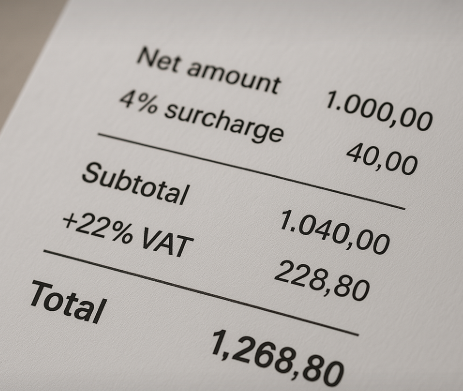
4% social security surcharge on invoices : What is it ?

4% social security surcharge on invoices : What is it ?
If you’ve received an invoice from an Italian consultant or freelancer, and there’s a 4% charge added to the net amount, here’s what it means:

It is not a tax or a penalty
The 4% line item is not a fine or extra fee. It’s a social security-related charge, required or allowed by Italian law depending on the type of professional issuing the invoice.

Two possible cases – what it means for you

Case A – The professional is part of a regulated profession (e.g. architect, lawyer)
The 4% is a mandatory contribution to their professional pension fund.

It’s called the “contributo integrativo”.

Italian law requires the professional to charge it to the client, even if the client is not in Italy.

This 4% does not increase their taxable income. On this 4% there is no witholding tax but it has VAT

You simply pay it as part of the invoice — you don’t need to do anything else.

Case B – The professional is a freelancer without a professional order (e.g. designer, consultant)
The 4% is optional and is used to partially offset their INPS social security costs.

It’s allowed by INPS (the Italian social security institute).

In this case, it is included in their taxable income. So the 4% has witholding tax , and of course VAT

Again, as the client, you just pay it as shown — no further action required on your side.

Why is it on your invoice?
In both cases, the professional is simply complying with the rules of the Italian social security system. The 4% charge helps cover pension contributions and is a standard item in many invoices from Italian professionals.

It is not VAT, and it is not negotiable if it’s mandatory. If it’s optional (INPS case), it may have been previously agreed as part of the overall fee.

What do you need to do?
Nothing special. Just:

Pay the invoice including the 4% charge.

Make sure it’s listed clearly in the invoice breakdown.

No extra forms, declarations, or withholding obligations apply — especially if you are based outside of Italy.

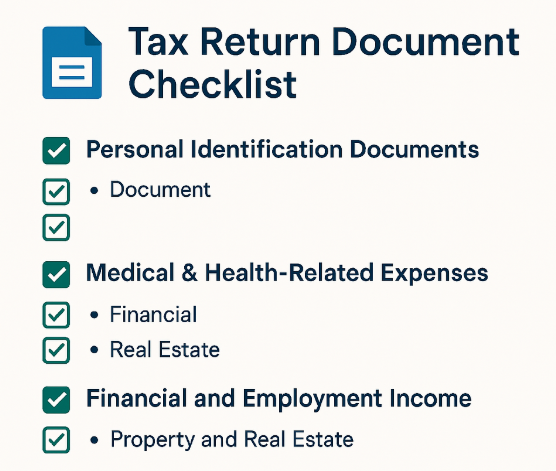
Tax Return Document Checklist

Tax Return Document Checklist

As tax season approaches, it’s essential to prepare the required documentation in a timely and organized manner. Submitting all documents promptly and in full will significantly streamline the preparation and filing process, reduce back-and-forth communication, and help ensure you benefit from all available deductions.

We recommend printing this list ( click on the PDF logo above) and using it as a checklist while gathering your documents.

Please contact us if you have any doubts or if your personal or financial situation has changed during the year.

Personal Identification Documents
() Mod. 730 or Mod. Unico from the previous year (include F24 payment forms)
() Copy of your ID or passport
() Tax ID Number (Codice Fiscale)

Medical & Health-Related Expenses
() Pharmacy receipts (with Codice Fiscale and paid by card)
() Invoices for specialist visits and health tickets
() Invoices or receipts for veterinary expenses
() Funeral expenses

Financial and Employment Income
() Bank declaration for loan interest paid
() CUD (Certificazione Unica) for employment or pension income
() Foreign income tax returns and related tax payment documents

Property and Real Estate
() Cadastral report for properties purchased during the year
() Copies of any real estate sales or purchases made during the year

Deductions & Tax Credits
() ENEA Certifications (for energy savings 55% or 65%)
() Invoices and payments for renovation work (50%)
() Invoices for deductions related to furniture and appliances
() Payment confirmations for life insurance
() School tuition payment receipts
() Proof of payments for children’s sport activities (for those under 18)
() Receipts for donations to ONLUS (non-profit organizations)

Social Security & Contributions
() Payment proof for social security contributions
() Contributions for domestic service workers (INPS)

Foreign Assets
() Value and description of assets, equity, funds, and accounts held abroad
() Foreign financial availability required for IVAFE/IVIE declarations

How to Open a Partita IVA ( individuals )

How to Open a Partita IVA ( individuals )

What Is a Partita IVA ?
The Partita IVA (VAT number) is a unique 11-digit identification number used by the Italian tax authority (Agenzia delle Entrate) to track the financial activity of self-employed individuals, freelancers, and businesses.

If you’re planning to:

Work as a freelancer or consultant

Run a sole proprietorship (ditta individuale)

Launch a small business or e-commerce site

Provide professional services in Italy,

The process to open it

  1. Choose the Type of Activity and ATECO Code
    (Each activity is classified under an ATECO code, a standard Italian business classification.)
  1. Choose Your Tax Regime
    You must select the appropriate tax regime:

Regime Forfettario (Flat-tax): for revenues up to €85,000/year. Fewer obligations, simplified taxation.

Regime Ordinario Semplificato or Ordinario: for higher revenues or more complex businesses.

  1. Register with the Agenzia delle Entrate
    Fill out and submit form AA9/12.

You can do this:

Online, through our office

In person at your local Agenzia delle Entrate office

THIS is the form

4-Register with INPS
If you are self-employed, you must register with the appropriate INPS fund:

    Gestione Separata (for freelancers without a professional register)

    Artigiani e Commercianti (for traders and artisans)

    This is essential to pay your social security contributions.

      5-(Optional) Register with the Chamber of Commerce
      Required for some activities (e.g., artisans, retailers)

      Required Documents
      Valid ID (and permesso di soggiorno if non-EU)

      Italian tax code (codice fiscale)

      ATECO code and business details

      How Long Does It Take?
      VAT certificate : same day

      INPS and Chamber of Commerce: typically a few days to a week

      Please contact our Offices for any assistance.

      Regime Forfettario in Italy (2025): The Flat-Tax Option for Expats

      Regime Forfettario in Italy (2025): The Flat-Tax Option for Expats

      If you’re an expat living in Italy and planning to work as a freelancer, consultant, or solo entrepreneur, the Regime Forfettario (Flat-Rate Tax Regime) might be an appealing option. It offers simplified taxation, fewer bureaucratic obligations, and lower overall costs — but it’s not for everyone, and it’s mutually exclusive with the Regime degli Impatriati.

      Here’s everything you need to know about this regime in 2025, including how it interacts with social security (INPS) and why choosing between tax regimes requires a strategic decision.

      What Is the Regime Forfettario?
      The Regime Forfettario is a favorable tax scheme for individuals (sole traders and freelancers) with relatively modest revenues. It simplifies compliance, eliminates many traditional tax obligations, and applies a flat-rate taxation model.

      Who Qualifies in 2025
      To be eligible for the Regime Forfettario in 2025, you must meet all of the following conditions:

      -Revenues or professional fees must not exceed €85,000 in the previous tax year.

      -Personnel costs (e.g., employees or collaborators) must stay under €20,000.

      -Additional income from employment or pensions must not exceed €35,000.

      -You must not control or participate in a company that operates in the same business sector.

      -Your activity must not be predominantly for a current or former employer.

      Who Is Excluded?


      You cannot use this regime if:

      -You surpass the income or personnel cost thresholds.

      -You operate in specific excluded sectors (e.g., real estate or financial investment).

      -You are also eligible for and using the “Regime degli Impatriati” — these two tax regimes cannot be combined.

      How Taxation Works
      – A flat tax rate of 15% is applied to a percentage of your gross income, called the “coefficiente di redditività” (profitability coefficient). This varies by activity (usually 40%–78%).

      Startups that meet certain conditions (e.g., no professional activity in the last 3 years) may qualify for a reduced 5% rate for the first 5 years.

      • No VAT obligations, no withholding tax on invoices, no IRAP (regional tax).

      INPS (Social Security) Considerations
      All self-employed workers in Italy must contribute to INPS, the national social security system. The way this works depends on your profession:

      Freelancers (without professional association)


      -Enrolled in the Gestione Separata INPS.

      -Contribution rate in 2025: approximately 26.07% of taxable income.

      -Taxable income = Gross revenue × profitability coefficient.

      Artisans and Traders
      Enrolled in the Artigiani e Commercianti INPS fund.

      – Pay a fixed minimum contribution (~€4,500–€4,800 annually), plus a 24% rate on income above €17,500.

      -Contributions are tax-deductible under the flat-rate regime.

      Example: Freelance Consultant with regular 15% tax rate
      Gross revenue: €50,000

      Coefficient of profitability (consulting): 78%

      Taxable base: €50,000 × 78% = €39,000

      Income tax (15%): €5,850

      INPS (26.07% of €39,000): €10,170

      Net income: ~€33,980

      Regime Forfettario vs. Regime degli Impatriati
      If you’re an expat recently relocated to Italy, you may also be eligible for the Regime degli Impatriati, a tax incentive offering:

      -50% tax exemption on employment or self-employment income

      -Valid for 5 years, extendable in some cases

      However, you must choose between the two — they are mutually exclusive:

      The Regime Forfettario is better suited for low to mid-income freelancers or those seeking simplicity.

      The Regime degli Impatriati may be more beneficial for higher earners or structured professionals with larger income streams.

      Key Decision Factors
      Expected gross income

      -Type of work (employment vs freelance)

      -Professional and personal tax residency status

      -Long-term plans in Italy

      Be Careful: You Might Lose Personal Tax Deductions

      One lesser-known downside of the Regime Forfettario is that you may not benefit from common tax deductions (known in Italy as oneri detraibili) if you don’t have other income subject to ordinary progressive taxation (IRPEF).

      Why?
      The Regime Forfettario applies a substitute tax (flat rate of 15% or 5%) instead of IRPEF.

      This means you’re not part of the regular income tax system, so you don’t get to offset deductible expenses like:

      Medical expenses

      Rent or mortgage interest

      University fees

      Dependent family expenses

      Contributions to pension schemes beyond INPS

      When Does This Matter?
      If you:

      Only have income under the Regime Forfettario, and

      Don’t have other income taxed under the standard IRPEF system (like employment income, pension, or property rentals),

      …then your deductible expenses can’t be used, because there’s no IRPEF to offset them against.

      How to Retain Some Deductions
      If you have dual income (e.g., freelance income under Forfettario and salaried income taxed normally), you can still benefit from deductions, but only on the IRPEF-taxed portion.

      In some cases, it might be worth evaluating whether staying in the ordinary tax regime allows you to recover more through deductions, especially if your deductible expenses are high.

      Final Advice
      The Regime Forfettario is one of the most expat-friendly options for solo professionals starting a business in Italy. However, choosing between this and the Regime degli Impatriati can significantly impact your net earnings and tax liability.

      Please consult us for any further details !

      Understanding Italy’s E-Invoicing System: A Guide to Fattura Elettronica

      What is the Fattura Elettronica?
      The Fattura Elettronica is the mandatory electronic invoicing system in Italy for transactions between businesses (B2B), consumers (B2C), and public authorities (B2G). It replaces traditional paper and PDF invoices and is part of Italy’s strategy to fight tax evasion, automate VAT reporting, and streamline compliance.

      How Does It Work?
      Invoices are issued in a specific XML format, transmitted and validated via the Sistema di Interscambio (SdI), the central invoicing platform operated by the Italian Revenue Agency.

      The process includes:
      -Generating the invoice in XML format according to official specifications

      -Transmitting the invoice to SdI via PEC, web portal, or accredited software

      -Validation and delivery by SdI to the recipient

      -Receiving notification of acceptance or rejection

      -Archiving the invoice digitally for 10 years in compliance with Italian law

      Only invoices that go through SdI are considered valid for VAT and legal purposes.

      Obligations for Foreign Businesses
      -Foreign entities with a fiscal representative in Italy: must issue e-invoices via SdI

      -Foreign entities identified via “identificazione diretta” (direct VAT registration): currently not required to use SdI, but may still choose to do so

      Our Support
      To simplify the process, our firm provides a secure online platform that allows clients to:

      -Issue compliant electronic invoices in XML format

      -Send them directly to the SdI

      -Receive electronic invoices from Italian suppliers

      -Monitor delivery statuses and notifications

      -Digitally archive invoices in compliance with the legal requirements

      This service is especially helpful for foreign entities needing assistance navigating the Italian e-invoicing system with full compliance and minimal complexity.

      Necessary documents for your yearly Tax Return

      Tax season is fast approaching, please find a list of the Documents we need to receive to prepare your Tax Return:

      Mod. 730 or Mod. Unico of the previous year and payment forms F24.
      Copy of your ID/passport and Tax ID Number ( Codice Fiscale )

      Pharmacy receipts ( with your Codice Fiscale and paid by credit/debit card)
      Invoices for specialist visits, health tickets Invoices / receipts for medicines and veterinary expenses
      Funeral expenses

      Loan interest paid ( we need the bank declaration )
      CUD attesting your employment / retirement income
      Copies of ENEA Certifications, for energy savings of 55% and 65%
      Copy of renovation costs for recovery 50% plus deductions for Furniture and Appliances.
      Payment for life insurance costs
      Payment for school tuition costs

      Expenses for sport activities for children up to the age of 18
      Payments made to Onlus

      Payment of social security contributions

      Cadastral report for properties purchased during the year
      Copies of any real estate purchases / sales occurred during the year
      Contributions for domestic service workers
      Copy of any foreign income tax returns and related tax payments
      Value and description of assets / funds / equity investments / financial availability held abroad

      That’s the general list. Please contact us for any doubt !

      How to chose and setup a Corp.

      In Italy, setting up a company follows specific legal and bureaucratic procedures. Below is a breakdown of different types of companies in Italy and how to set them up, based on Italian corporate law.


      1. Sole Proprietorship (Ditta Individuale)

      A Ditta Individuale is a one-person business where the owner is personally responsible for all debts.

      Pros:

      • Simple and low-cost to set up
      • Minimal bureaucratic requirements
      • Profits taxed as personal income

      Cons:

      • Unlimited liability (owner’s personal assets are at risk)
      • Harder to access funding and investment
      • Less credibility compared to corporations

      How to Set Up a Ditta Individuale:

      1. Choose a Business Name (optional, default is the owner’s name).
      2. Register with the Chamber of Commerce (Camera di Commercio).
      3. Obtain a Partita IVA (VAT Number) from the Agenzia delle Entrate.
      4. Register with INPS (National Social Security Institute) for pension contributions.
      5. Register with INAIL (Insurance for workplace accidents) if applicable.
      6. Open a Business Bank Account.
      7. Issue Electronic Invoices (mandatory in Italy for B2B and B2G).

      2. General Partnership (Società in Nome Collettivo – SNC)

      A SNC is a partnership where all partners share equal liability for debts.

      Pros:

      • Simple and flexible management
      • No minimum capital required
      • Direct taxation (partners pay personal income tax)

      Cons:

      • Unlimited personal liability for all partners
      • Joint responsibility for debts

      How to Set Up an SNC:

      1. Draft a Partnership Agreement (Atto Costitutivo) with a notary.
      2. Register with the Chamber of Commerce.
      3. Obtain a Partita IVA from the tax office.
      4. Register with INPS and INAIL.
      5. Deposit the company documents at the Registro delle Imprese.
      6. Open a Business Bank Account.

      3. Limited Partnership (Società in Accomandita Semplice – SAS)

      A SAS has two types of partners:

      • General partners (Soci Accomandatari): Have full liability.
      • Limited partners (Soci Accomandanti): Only liable for the amount they invested.

      Pros:

      • Allows silent investors with limited risk
      • Less strict regulations than corporations

      Cons:

      • General partners bear full liability
      • More complex structure than SNC

      How to Set Up an SAS:

      1. Draft the company statutes and sign before a notary.
      2. Register with the Chamber of Commerce.
      3. Obtain a Partita IVA.
      4. Register with INPS and INAIL.
      5. Deposit company documents with the Registro delle Imprese.

      4. Limited Liability Company (Società a Responsabilità Limitata – SRL)

      An SRL is the most common corporate structure in Italy, offering limited liability to shareholders.

      Pros:

      • Shareholders’ liability is limited to their investment
      • Easier to attract investors
      • More professional credibility

      Cons:

      • Higher setup and maintenance costs
      • Stricter regulations than partnerships
      • Mandatory accounting and annual financial statements

      How to Set Up an SRL:

      1. Draft Articles of Association (Atto Costitutivo) with a notary.
      2. Deposit Minimum Share Capital (€10,000 for a standard SRL, €1 for an SRLS).
      3. Register with the Chamber of Commerce.
      4. Obtain a Partita IVA.
      5. Register with INPS and INAIL.
      6. Open a Business Bank Account.
      7. Appoint a Legal Representative.

      5. Simplified Limited Liability Company (Società a Responsabilità Limitata Semplificata – SRLS)

      A SRLS is a simplified version of an SRL, designed to be easier and cheaper to set up.

      Pros:

      • Lower setup costs (no notary needed)
      • Minimum capital of €1
      • Faster bureaucratic process

      Cons:

      • Less flexibility in structuring the company
      • More difficult to raise capital
      • Limited credibility for large contracts

      How to Set Up an SRLS:

      1. Use the standard government-approved statute (Atto Costitutivo).
      2. Register with the Chamber of Commerce.
      3. Deposit share capital (€1 to €9,999).
      4. Obtain a Partita IVA.
      5. Register with INPS and INAIL.
      6. Open a Business Bank Account.

      6. Joint-Stock Company (Società per Azioni – SPA)

      An SPA is a large-scale company where ownership is divided into shares.

      Pros:

      • Limited liability for shareholders
      • Can raise capital from investors and public markets
      • Best suited for large businesses

      Cons:

      • High setup costs (€50,000 minimum capital)
      • Strict regulations and reporting requirements

      How to Set Up an SPA:

      1. Draft the Articles of Association with a notary.
      2. Deposit the minimum capital (€50,000).
      3. Register with the Chamber of Commerce.
      4. Appoint a Board of Directors.
      5. Register with INPS and INAIL.
      6. Open a Business Bank Account.
      7. Submit annual financial reports.

      Italy Tax system

      Understanding Taxes in Italy: A Simple Guide

      Italy has a complex tax system with different taxes at the national, regional, and local levels. If you live or work in Italy, it’s essential to understand how taxes work, what rates apply, and when you need to pay. Let’s break it down in an easy-to-understand way.


      1. Main Types of Taxes in Italy

      There are two major categories of taxes in Italy: direct taxes (on income and assets) and indirect taxes (on goods and services).

      A. Direct Taxes (Taxes on Income and Business)

      1. IRPEF (Personal Income Tax)
        • Paid by individuals based on their earnings.
        • Uses a progressive system, meaning the more you earn, the higher your tax rate.
      2. IRES (Corporate Income Tax)
        • A flat tax of 24% paid by companies and businesses.
      3. IRAP (Regional Business Tax)
        • Paid by businesses and professionals.
        • The rate depends on the region but is typically around 3.9%.
      4. IMU (Property Tax)
        • Applied to properties (except for primary residences in most cases).
        • The rate varies by municipality.

      B. Indirect Taxes (Taxes on Goods and Services)

      1. IVA (Value-Added Tax – VAT)
        • Applied to the sale of goods and services.
        • Standard rate: 22%
        • Reduced rates: 10% (e.g., food, hotels) and 4% – 5% (e.g., essential items).
      2. Other Indirect Taxes
        • Registration taxes, stamp duties, and real estate transaction fees.

      2. Personal Income Tax Rates (IRPEF)

      IRPEF is progressive, meaning higher incomes are taxed at higher rates:

      Income Bracket (€)Tax Rate (%)
      0 – 28,00023%
      28,001 – 50,00033%
      Over 50,00043%

      There are also deductions and allowances that reduce the total amount of tax you owe.


      3. How and When to Pay Taxes in Italy

      Taxes are usually paid through withholding, advance payments, and direct declarations.

      For Employees & Pensioners

      • Taxes are automatically deducted from salaries and pensions.
      • Employers and pension funds take care of payments.

      For Freelancers & Self-Employed Workers

      • Must file a tax return and pay in advance based on the previous year’s income.
      • Payments are made in two installments:
        • First installment: June 30
        • Second installment: November 30

      For Companies (IRES, IRAP)

      • Companies pay in advance, similar to personal income tax.
      • The final balance is settled the following year.

      For VAT (IVA)

      • Businesses must collect VAT from customers and pay it to the tax authorities.
      • Payments are usually quarterly or monthly.

      4. How to Pay Taxes

      Taxes in Italy are paid through:

      • F24 Form (submitted online via banks or the Italian Tax Agency).
      • Direct debit payments (for recurring taxes).
      • Online banking and tax portals.

      5. Tax Returns and Deadlines

      • Personal Tax Returns (Modello 730 or Modello Redditi PF):
        • Employees & pensioners: By September 30.
        • Freelancers & self-employed: By November 30.
      • Business Tax Returns:
        • Usually filed by April 30 for the previous year.

      6. Additional Local Taxes

      • TARI (Waste Collection Tax) – Paid to local municipalities for garbage services.
      • Regional and Municipal Surcharges – Additional small taxes applied to IRPEF, varying by location.

      Final Thoughts

      Italy’s tax system may seem complicated, but understanding the basics can help you manage your payments effectively and avoid penalties. Whether you’re an employee, freelancer, or business owner, staying informed about your tax obligations is key.

      Tax Treatment of Expense Reimbursements for Professionals in Italy: 2025 Updates

      As of January 1, 2025, significant changes have been introduced regarding the tax treatment of expense reimbursements for professionals in Italy. These changes stem primarily from Legislative Decree No. 192/2024 and the 2025 Budget Law.

      Reimbursement of Itemized Expenses for Professionals

      Expenses incurred by professionals while carrying out an assignment, when reimbursed on an itemized basis by the client, no longer contribute to taxable self-employment income. As a result, these reimbursements:

      • Are no longer subject to withholding tax.
      • Are not subject to pension fund contributions.
      • Remain subject to VAT, as they do not qualify as expenses incurred on behalf of the client under Article 15 of Presidential Decree No. 633/1972.

      To benefit from this tax treatment, expenses must be:

      • Incurred in the interest of the client.
      • Documented in a detailed and itemized manner.
      • Paid using traceable payment methods, such as credit cards, bank transfers, or other electronic payment systems.

      If the client fails to reimburse the professional, these expenses may still be deductible under specific conditions, such as in cases of client insolvency or the expiration of the credit claim.

      Mandatory Use of Traceable Payments

      The 2025 Budget Law has introduced a mandatory requirement to use traceable payment methods for the deductibility of travel and representation expenses. This requirement applies to professionals, employees, and businesses. Affected expenses include:

      • Hotel accommodations.
      • Meals and beverages.
      • Travel and transportation expenses, including taxi services and car rentals with drivers.

      If these expenses are not paid using traceable methods, they will not be deductible from taxable income. For employees, reimbursements for such expenses will become taxable for both income tax and social security purposes.

      Impact on Professionals Under the Flat-Rate Regime

      The new regulations do not appear to apply to professionals operating under the flat-rate tax regime, as the changes specifically affect Article 54 of the Italian Income Tax Code (TUIR), which governs self-employment income determination under the ordinary and simplified regimes.

      Conclusion

      These new provisions aim to enhance financial transparency and combat tax evasion by enforcing the use of traceable payment methods for the professional and business expenses.