02.4004.4318
CALL US!
8:30 - 17:30
Mon-Fri

Tag: U.S. citizens

Italy’s Flat Tax and Impatriati Regimes: The 2026 Window to Combine Both Closes from 2027

For several years, two of Italy’s most powerful inbound tax regimes — the non-dom flat tax for new residents and the new impatriati regime for inbound workers — could be applied together by the same taxpayer. That combination has produced striking outcomes for high earners: foreign passive income capped at a flat annual fee, and Italian-source employment or self-employment income taxed on only half of its amount. Decree-Law 38 of 27 March 2026 has now closed that door. From the 2027 tax year, anyone transferring tax residence to Italy must choose between the two regimes. Anyone who establishes Italian residence by 31 December 2026 keeps the combination intact for the full statutory duration of both regimes.

How the two regimes complement each other

The non-dom flat tax, governed by Article 24-bis of the Italian Income Tax Code, allows new residents to pay a fixed annual amount on all foreign-source income, regardless of size. The lump sum currently sits at €300,000 per year for the main applicant and €50,000 for each family member, for up to fifteen years. The regime targets high-net-worth individuals with significant offshore investments, dividends, capital gains, royalties, or rental income from abroad.

The new impatriati regime, introduced by Article 5 of Legislative Decree 209/2023, addresses a different tax base: Italian-source employment or self-employment income. Eligible inbound workers exclude 50% of that income from the IRPEF base for five years, with a 60% exemption available for parents who relocate with minor children. The annual income cap is €600,000.

Because the two regimes carve up the income map without overlap, combining them has been legitimate since the 2024 reform. The Italian Revenue Agency confirmed the cumulability in late-2025 guidance, treating the legislative silence on the point as an implicit green light. That silence is now over.

What the new rule actually says

DL 38/2026 introduces an explicit ban on cumulation, but only on a forward-looking basis. Taxpayers who establish Italian tax residence by 31 December 2026 continue to apply both regimes side by side for the full statutory duration of each. The protection is permanent and is not a phase-out. Taxpayers who transfer tax residence to Italy from 1 January 2027 onwards may elect either the flat tax or the impatriati regime, but not both. The election will be effectively binding for the duration of whichever regime is chosen.

The regime for professors and researchers is unaffected and remains separately combinable with other incentives.

What this means in practice

For anyone weighing an Italian move, the practical question is whether to bring it forward so the residence transfer takes effect before 2027. Italian tax residence is established when, for the majority of the tax year (more than 183 days), the individual maintains residence, domicile, or registered presence in Italy. For a 2026 move, this typically requires physical relocation by early July 2026 at the latest, supported by registration with the local anagrafe and consistent evidence that the personal and economic centre of life has shifted.

The combination is most valuable for taxpayers who have substantial foreign passive income — which the flat tax shelters at a flat €300,000 — and who will earn significant Italian-source professional or executive income, which the impatriati regime taxes on only half of its amount. For taxpayers whose profile is heavily weighted to only one of these two income streams, the choice imposed from 2027 will have a more limited financial impact, but the calculation should still be run carefully before any decision.

A Note for U.S. Citizens

U.S. citizens remain subject to worldwide taxation by the IRS regardless of where they reside. The flat tax can be treated as a creditable foreign tax in Italy, but its lump-sum nature complicates the per-country and per-basket allocation of the Foreign Tax Credit on Form 1116. Pairing it with the impatriati regime — under which half of Italian-source income is exempt from IRPEF — typically lowers the Italian tax actually paid on that portion, which in turn reduces the credit available against U.S. tax. In some scenarios this mechanically transfers part of the Italian saving into additional U.S. tax. A bilateral simulation, year by year and for the full intended duration of the regimes, is indispensable before relying on the combination as a planning strategy.

Final Considerations

The 2026 deadline is firm but the planning is not always simple. Establishing Italian tax residence, securing the flat tax election, and documenting eligibility under the impatriati regime are three distinct processes, each with its own timing and evidentiary requirements. For internationally mobile taxpayers considering Italy, this calendar year is the last opportunity to lock in the most generous version of the framework. Specialist advice that integrates both Italian and home-country tax positions is strongly recommended before any commitment is made.

U.S. Trusts and Italian Tax Residency: The 2026 Ruling That Redefines Interposition for Inbound Beneficiaries

U.S. Trusts and Italian Tax Residency: The 2026 Ruling That Redefines Interposition for Inbound Beneficiaries

A recent ruling by the Italian Revenue Agency — Response to Ruling Request No. 81 of 18 March 2026 — sets a sharper standard for how foreign trusts are treated once a beneficiary becomes tax resident in Italy. The decision concerns a Delaware irrevocable trust, classified as a “complex trust” and fiscally autonomous in the United States, whose principal beneficiary was preparing to move to Italy. The Agency concluded that the trust was fiscally interposed — meaning it does not exist as a separate taxpayer for Italian purposes — and that all of its income and assets must be reported directly by the beneficiary. The ruling is an important signal for any international family considering relocation to Italy with an existing U.S. trust structure.

The case in brief

The trust was established in 2024 under Delaware law. It held U.S. financial assets and an interest in a New York LLC owning real estate. The settlor had retained a testamentary power to designate, via will or fiduciary instrument, the ultimate recipients of the trust capital. The beneficiary, still non-resident at the time of the request, asked the Revenue Agency to confirm that — once she moved to Italy — the trust would be treated as a non-interposed entity, i.e. as a separate taxable layer between her and the underlying assets.

The Agency disagreed. Even though the trust was irrevocable, discretionary, and administered by an independent trustee, the residual powers retained around the final destination of the capital were enough, in the Agency’s view, to displace the trust’s fiscal autonomy.

Why the trust was recharacterised

The ruling confirms a principle that has been consolidating in Italian tax practice: a trust earns independent fiscal relevance only when real divestment of control has occurred — not merely when the paperwork says so. The Agency looks through the structure and tests whether any party (settlor or beneficiary) still holds meaningful influence over how the assets are managed or distributed.

Three elements proved decisive. First, the testamentary designation clause, which allowed the settlor to reshape the final destination of the trust capital. Second, the possibility that the beneficiary could indirectly influence distributions through will or fiduciary arrangements. Third, the conditioned discretion of the trustee, whose autonomy was not absolute in practice.

The ruling is significant because it extends the concept of interposition to formally correct, properly drafted structures. A trust that looks irrevocable and discretionary on paper can still be disregarded for Italian tax purposes if influence over the assets survives, even in latent or testamentary form.

What this means for an inbound beneficiary

If the Italian Revenue Agency recharacterises a foreign trust as interposed, the fiscal consequences fall squarely on the Italian-resident beneficiary. The trust effectively disappears as a taxable subject, and the beneficiary must report all trust income — interest, dividends, capital gains, rental income — in the Italian personal tax return, as if the assets were held directly; disclose the underlying foreign assets through the Quadro RW monitoring framework; and pay IVIE on the foreign real estate and IVAFE on the foreign financial assets held in the trust.

This treatment applies from the first year of Italian tax residency.

A Note for U.S. Citizens

U.S. citizens face a particularly delicate overlap. Under U.S. rules, a Delaware complex trust is typically a separate taxpayer filing Form 1041, while a grantor trust is transparent to the settlor. Italy, by contrast, may ignore both classifications and look straight through to the beneficiary. The result can be a mismatch in who is taxed on what, and when — creating friction in the Foreign Tax Credit mechanism and potentially leaving trust income unrelieved under the Italy–U.S. treaty. FBAR and FATCA obligations continue regardless of how Italy classifies the trust, and the beneficiary may end up with parallel — and partly inconsistent — reporting duties on both sides of the Atlantic. Structures set up before relocation should be stress-tested well in advance.

Practical points before moving to Italy

Anyone planning a move to Italy with an existing foreign trust should review the deed for any retained powers — including testamentary designation, letters of wishes with binding effect, or informal influence over the trustee. Removing or properly insulating these elements prior to the transfer of residence is often the difference between fiscal opacity (trust taxed as a separate entity) and full pass-through to the beneficiary.

Final Considerations

Ruling 81/2026 does not change the law, but it narrows — clearly and publicly — the space in which a foreign trust can claim fiscal autonomy once its beneficiary becomes Italian-resident. For U.S. families in particular, the interaction between Italian interposition doctrine and U.S. trust classification deserves careful, personalised review before the move. Specialist advice is strongly recommended, ideally at least twelve months ahead of the change in tax residency, to allow structural adjustments where needed.

Italy’s Inheritance and Gift Tax Reform: What International Families Need to Know

Italy’s Inheritance and Gift Tax Reform: What International Families Need to Know

Italy has overhauled its rules on inheritance and gift taxation through two legislative decrees — Decree 139/2024 and Decree 123/2025 — with the most significant changes taking effect on January 1, 2026. For expats, foreign nationals with property in Italy, and international families with cross-border estate plans, the reform introduces both meaningful opportunities and new compliance obligations.
Tax Rates Are Unchanged — But the Thresholds Just Got Better
Italy’s headline inheritance and gift tax rates remain the same: 4% for transfers to spouses and direct descendants (children, grandchildren), 6% for siblings and other relatives up to the fourth degree, and 8% for unrelated beneficiaries. What changed is how the tax-free threshold — called the franchigia — is calculated.
Under the old system, a mechanism known as the coacervo required the tax authority to aggregate all lifetime gifts made to a beneficiary with whatever they ultimately received through inheritance. A child who received a €600,000 gift from a parent during their lifetime had only €400,000 of their €1 million threshold left when the parent died. This aggregation rule, abolished as of January 1, 2026, had long been criticised as penalising families who used gifting as part of their estate plan.
From 2026 onward, gifts and inheritances each carry their own separate €1 million threshold per qualifying beneficiary (spouse or direct descendant). A child can now receive up to €1 million in lifetime gifts and still benefit from a full €1 million threshold upon inheritance. For siblings, the separate thresholds stand at €100,000 each. In practical terms, this change doubles the potential tax-free transfer capacity between generations for families who use both instruments.
Trusts: Now Expressly Addressed in Italian Succession Law
For the first time, Italy’s succession tax legislation expressly addresses the treatment of trusts. Previously, the framework had developed through administrative circulars and case law, leaving considerable uncertainty for international structures.
The new rules confirm that transfers of assets via trust are subject to inheritance and gift tax whenever they result in a gratuitous enrichment of beneficiaries. Crucially, the reform gives trustees and settlors a planning choice: they may elect to trigger the tax at the time assets are contributed to the trust, or defer it until assets are distributed to beneficiaries. Where beneficiaries are not yet identified, the 8% rate — applicable to transfers between strangers — applies by default. Once the tax is paid at either stage, subsequent distributions in the same kinship category are not taxed again.
The territorial rules for trust taxation follow the settlor’s residency at the time assets are contributed to the trust, not at distribution. If the settlor was an Italian tax resident when the assets entered the trust, Italian succession tax applies to all transferred assets, wherever located. Non-resident settlors face Italian tax only on Italian-sited assets.
Self-Assessment Is Now the Taxpayer’s Responsibility
Another structural change affects how the tax is collected. Under the previous system, the Agenzia delle Entrate calculated the tax owed and issued a formal notice. The reform shifts this obligation to the taxpayer: heirs and beneficiaries must now calculate, declare, and pay the inheritance tax themselves, within 90 days of the succession opening. The tax authority retains a two-year window to challenge the calculation. Electronic filing is required in most cases, though non-resident heirs may still submit declarations by registered mail.
This change increases the importance of getting professional advice promptly after a death, since errors in self-assessment can lead to penalties.
Cross-Border Estates: Who Is Taxed on What
Italy’s territorial scope for inheritance tax follows the residence of the deceased at the time of death, not the location of the assets. If an Italian tax resident dies, their worldwide estate — including foreign bank accounts, foreign real estate, and financial investments held abroad — is subject to Italian succession tax. Conversely, if a non-resident dies but owned property in Italy, only the Italian assets are within scope. Beneficiaries who are themselves Italian residents must report and pay tax on all assets received from an Italian-resident decedent, regardless of where those assets are physically located.
There is no bilateral inheritance or estate tax treaty between Italy and most countries, including the United States. Families with assets in multiple jurisdictions should model the combined tax exposure carefully.
A Note for U.S. Citizens
U.S. citizens are subject to U.S. federal estate and gift tax on their worldwide assets, regardless of where they live. Unlike the Italy-U.S. income tax treaty, there is no Italy-U.S. estate and gift tax treaty. This means a U.S. citizen who is an Italian tax resident may face both Italian inheritance/gift tax and U.S. estate or gift tax on the same transfer, with limited mechanisms to avoid double taxation.
Italy’s rates — 4% to 8% — are substantially lower than the U.S. federal estate tax rate of 40% on amounts above the exemption. The U.S. does provide a foreign death tax credit under Section 2014 of the Internal Revenue Code for foreign estate taxes paid on assets that are also subject to U.S. estate tax, but this credit has specific limitations and does not always provide full relief. For gifts, the interaction is more complex: Italy now taxes certain gift transactions that the U.S. would treat as taxable gifts, but the tax systems operate independently.
U.S. citizens in Italy who hold assets in trust structures — particularly grantor trusts used in U.S. estate planning — should review how the new Italian trust taxation rules interact with their existing structures.
Final Considerations
The 2026 reform makes Italy’s succession tax framework more transparent and, for many families, more generous in terms of available exemptions. The abolition of the coacervo is a genuine planning improvement. At the same time, the shift to self-assessment raises the stakes for accurate compliance, and the new trust rules introduce mandatory analysis for anyone with a trust structure linked to Italy.
For international families — particularly those with assets, heirs, or residency ties in multiple countries — the practical impact of these changes depends heavily on individual circumstances. Professional advice is recommended before making gifts, establishing trusts, or updating cross-border estate plans in light of the new framework.

Italy’s 2026 Crypto Tax: What the 33% Rate Means for Residents and Expats

Italy’s 2026 Crypto Tax: What the 33% Rate Means for Residents and Expats

Italy’s approach to taxing digital assets has shifted decisively with the 2026 Budget Law. The changes are significant enough that anyone living in Italy who holds cryptocurrency — or who is considering moving to Italy and has crypto holdings — needs to understand the new rules before the current tax year produces taxable events.

The New 33% Capital Gains Rate

From January 1, 2026, capital gains on most crypto-assets — including Bitcoin, Ether, and dollar-denominated stablecoins such as USDT and USDC — are subject to a 26% substitute tax that was already in place since 2023. That rate has now been raised to 33%. The increase was introduced by the 2026 Budget Law and applies to all disposal events: selling crypto for euros or other fiat currency, swapping one crypto for another, and using crypto to pay for goods or services.

The 33% rate aligns crypto gains more closely with the tax treatment of other speculative financial income under Italian law, a clear signal of the government’s intention to treat digital assets as a permanent and fully taxed asset class.

The €2,000 Threshold Is Gone

Until the end of fiscal year 2024, Italian tax residents could realize crypto gains of up to €2,000 per year without owing tax. That exemption was abolished from fiscal year 2025 onward. It does not return in 2026. Every euro of realized gain is now taxable, regardless of how small the transaction.

For occasional holders who previously relied on staying below the threshold, this change demands attention even for modest portfolio activity.

Euro Stablecoins: A Lower Rate

The 2026 Budget Law creates a specific carve-out for electronic money tokens (EMTs) — digital instruments that maintain a fixed parity with the euro and are issued under the EU’s MiCAR regulation. These include euro-denominated stablecoins such as EURC and EURS. Capital gains on these instruments are taxed at 26% rather than 33%, a meaningful difference for traders who regularly move between volatile assets and stable reserves.

Dollar-pegged stablecoins do not qualify. The preferential rate is limited to euro-denominated tokens that meet MiCAR’s reserve and licensing requirements.

The 18% Redetermination Option

The Budget Law also offers a one-time option to redetermine the cost basis of crypto holdings as of January 1, 2026 by paying an 18% substitute tax on the portfolio’s value at that date. This effectively resets the acquisition cost to the current market value, reducing the taxable gain on any future sale. For long-term holders sitting on large unrealized gains, this can substantially reduce the effective tax burden when they eventually sell — though it requires paying the 18% charge upfront.

The decision of whether to exercise this option requires calculating the likely future gain against the immediate cost, and it is most attractive when the existing cost basis is very low relative to current value.

Reporting: Quadro RW and Quadro RT

Italian tax residents must report foreign-held crypto assets in Quadro RW of the Redditi PF return. This form is used both for monitoring purposes and, in many cases, for calculating the IVAFE wealth tax on financial assets held abroad. The applicable IVAFE rate and whether it applies to crypto assets held on foreign platforms should be confirmed for each specific situation, as the rules in this area have been subject to revision. Where assets are held on Italian-licensed platforms, reporting requirements may differ.

Quadro RT is used to declare capital gains and losses. Losses can be carried forward to offset gains in the following four tax years, provided they are declared in the year they arise.

Failure to complete either form carries substantial penalties: non-reporting of foreign assets can result in penalties of 3% to 15% of the undisclosed amount, in addition to fixed sanctions.

A Note for U.S. Citizens

On the U.S. reporting side, crypto held on foreign exchanges may qualify as a specified foreign financial asset under FATCA, requiring disclosure on Form 8938 if aggregate foreign financial assets exceed the applicable filing threshold ($50,000 for individuals filing a return in the United States). FBAR reporting for foreign crypto accounts remains a developing area: FinCEN has signaled its intention to extend FBAR requirements to foreign virtual asset accounts, and U.S. citizens should monitor this closely given proposed rules currently pending finalization.

The combination of Italian income tax, potential IVAFE on foreign-held assets, U.S. federal tax obligations, and parallel reporting requirements under both systems makes cryptocurrency one of the more complex compliance areas for U.S. nationals in Italy.

Final Considerations

The 2026 changes mark a clear shift toward treating crypto-assets as mainstream financial instruments under Italian law, with the rates and reporting requirements now reflecting that approach. The abolition of the €2,000 exemption and the increase to 33% mean that even moderate holders face meaningful tax obligations that did not exist under prior rules.

Anyone with Italian tax residency and crypto holdings should review their position, confirm their cost basis documentation, and evaluate whether the 18% redetermination option makes sense in their individual circumstances. The interaction between Italian and foreign tax obligations — particularly for U.S. citizens — adds further layers that are best addressed with professional advice before the end of the tax year.

Foreign Assets and Italian Tax Residency: A Practical Guide to Quadro RW, IVAFE, and IVIE

Foreign Assets and Italian Tax Residency: A Practical Guide to Quadro RW, IVAFE, and IVIE

Becoming an Italian tax resident does not only affect how your income is taxed — it also triggers a set of obligations relating to assets you continue to hold abroad. Anyone who transfers their tax residency to Italy and retains a foreign bank account, investment portfolio, property, or equity stake must comply with Italy’s foreign asset monitoring and wealth tax framework. Failing to do so carries significant penalties. This article provides a practical overview of what is required and what it costs.

The Monitoring Obligation: Quadro RW

Every Italian tax resident who holds financial or non-financial assets outside Italy at any point during the tax year must disclose them in Quadro RW, a dedicated section of the Italian personal income tax return. The purpose is twofold: it gives the tax authorities visibility over assets held offshore, and it serves as the basis for calculating the two wealth taxes described below.

Assets subject to disclosure include foreign bank and deposit accounts, brokerage accounts, stocks and bonds held outside Italy, shares in foreign companies, investment funds domiciled abroad, foreign real estate, foreign pension accounts, cryptocurrencies held on foreign platforms, and precious metals or valuables kept outside Italian territory. The list is broad, and the Italian Revenue Agency interprets it expansively.

The reporting threshold for foreign bank accounts is an average annual balance exceeding €5,000. In practice, however, any account that at any point during the year exceeds a daily balance of €15,000 must also be reported for monitoring purposes, even if the average stays below the threshold. For all other financial assets — securities, funds, equity interests — there is no minimum threshold: they must be reported regardless of value.

Until recently, Quadro RW was only available in the longer Redditi PF form, which many employed workers were not required to file. From the 2024 tax period onward, the equivalent section — Quadro W — has been incorporated into the simplified 730 form, making compliance accessible to a broader group of taxpayers, including employees and pensioners.

IVAFE: Wealth Tax on Foreign Financial Assets

IVAFE (Imposta sul Valore delle Attività Finanziarie Estere) is an annual wealth tax levied on financial assets held abroad. The standard rate is 0.2% per year, applied to the market value of the assets as at 31 December of the relevant tax year, or the average value where no year-end market price is available.

For foreign current and savings accounts, the tax is calculated differently: a flat charge of €34.20 per account per year applies, rather than a percentage. IVAFE on bank accounts is not due if the average annual balance does not exceed €5,000.

Assets held in or through jurisdictions on Italy’s list of non-cooperative tax territories are subject to a higher rate of 0.4% — double the standard charge. This applies where the financial intermediary or the asset itself is located in a blacklisted country.

IVAFE is calculated and paid through the annual tax return. A credit is available for any similar wealth taxes paid to a foreign government on the same assets, avoiding outright double taxation — though the mechanics of the credit vary depending on the country and the nature of the asset.

IVIE: Wealth Tax on Foreign Real Estate

IVIE (Imposta sul Valore degli Immobili situati all’Estero) is the equivalent charge applied to real estate owned outside Italy. Since the 2024 tax year, the rate has been 1.06% per year, following an increase from the previous 0.76% introduced by the 2024 Budget Law.

The taxable base is generally the purchase price of the property, or its cadastral value if available in the relevant foreign country. Where neither is available, the market value at the relevant date is used. A reduced rate of 0.40% applies to property used as the taxpayer’s principal residence abroad, with a €200 deduction.

As with IVAFE, a credit is available for property taxes paid in the country where the real estate is located, which in many cases eliminates or substantially reduces the Italian charge.

Penalties for Non-Compliance

The consequences of failing to file Quadro RW are material. For assets held in EU or EEA countries, the penalty ranges from 3% to 15% of the undisclosed asset value. For assets held in non-EU countries, the range rises to 6% to 30%. Where the country involved is on Italy’s list of non-cooperative jurisdictions, penalties are doubled again. In addition, the statute of limitations for undisclosed foreign assets is extended beyond the ordinary term, giving the Revenue Agency more time to raise assessments.

A Note for U.S. Citizens

U.S. citizens living in Italy face a parallel disclosure system on top of the Italian obligations. FBAR (FinCEN Form 114) requires reporting any foreign financial account to the U.S. Treasury if the aggregate value of all foreign accounts exceeds $10,000 at any point during the calendar year. Form 8938 (FATCA) requires disclosure of specified foreign financial assets above thresholds that vary by filing status and residency. Both obligations exist independently of Quadro RW — the same accounts and assets may need to be reported in all three filings. The Italian and U.S. systems do not exchange information automatically in a way that substitutes for compliance on either side.

Final Considerations

For anyone who has recently moved to Italy and retains assets abroad — whether a bank account in their home country, a brokerage account, a pension fund, or a property — the RW obligation applies from the first year of Italian tax residency. The interaction between IVAFE, IVIE, and any foreign wealth taxes already paid requires careful calculation. Professional advice is strongly recommended before filing, particularly for complex asset structures or assets held in non-EU jurisdictions.

Italy’s Non-Dom Flat Tax Just Got More Expensive: What the €300,000 Lump Sum Means for New Residents in 2026


Italy’s new-resident lump sum tax regime — one of the most generous non-domicile regimes in Europe — has become significantly more expensive for anyone moving to Italy from 1 January 2026. The country’s 2026 Budget Law raised the annual substitute tax from €200,000 to €300,000, and doubled the charge for qualifying family members from €25,000 to €50,000 each. For high-net-worth individuals considering a move to Italy, this change reshapes the planning calculus — though it does not eliminate the regime’s substantial advantages.

What the Regime Offers

Introduced in 2017 under Article 24-bis of the Italian Tax Code (TUIR), the regime allows individuals who have not been Italian tax residents for at least nine of the previous ten years to replace ordinary Italian taxation on all foreign-source income with a single annual lump-sum payment. That payment is now €300,000 per year, irrespective of how much foreign income was actually earned. A British executive receiving £1 million per year in dividends from a UK holding company and a retired American collecting $80,000 in U.S. investment income both pay the same flat amount — provided they qualify.

The regime lasts for a maximum of 15 years. During that period, participants are also exempt from IVIE (the Italian wealth tax on foreign real estate) and IVAFE (the Italian wealth tax on foreign financial assets), and they have no obligation to disclose foreign assets in the annual Italian tax return. Foreign assets transferred by gift or inheritance are not subject to Italian inheritance or gift tax — only Italian-situated assets remain within scope.

Italian-source income, however, is taxed under ordinary Italian rules and is not covered by the regime.

Three Tiers, Three Cohorts

The evolution of the regime has produced three distinct cohorts of taxpayers, each grandfathered at the rate applicable when they opted in:

Individuals who established Italian tax residence and opted into the regime before 10 August 2024 continue to pay €100,000 per year for the remainder of their 15-year term. Those who opted in between 10 August 2024 and 31 December 2025 pay €200,000 per year. Anyone who transfers Italian tax residence on or after 1 January 2026 is subject to the new €300,000 rate.

Italy has consistently respected the grandfathering principle across these changes: no existing participant has been required to pay more than the amount in force at the time they opted in. This is a meaningful commitment — and one potential entrants should factor into their timing decisions.

How to Qualify and Apply

Eligibility rests on one primary condition: the individual must not have been an Italian tax resident in at least nine of the ten tax years immediately preceding their transfer to Italy. Nationality is irrelevant — U.S. citizens, UK nationals, and third-country nationals all qualify on the same basis.

The option is exercised through the Italian income tax return for the first year of Italian tax residence (or, in some cases, through a prior ruling request to the Italian Revenue Agency). Timely payment of the substitute tax by 30 June each year is an essential condition: failure to pay terminates the regime. There is no possibility of partial payment or instalment.

Family members can be included under the regime, each subject to a separate €50,000 annual charge. “Family members” for this purpose generally means spouses and dependent children, though the perimeter should be confirmed on a case-by-case basis.

The U.S. Angle: A Crucial Caveat

For U.S. citizens, the regime works differently than for most other nationalities — and the difference matters. The United States taxes its citizens on worldwide income regardless of where they live. A U.S. citizen who pays €300,000 to Italy under the lump sum regime will still owe U.S. tax on all foreign-source income under IRS rules. The Italian substitute tax is not a foreign tax credit eligible for offset against U.S. income tax in the normal way, because it is a lump sum, not a tax computed on the income itself.

This does not make the regime useless for Americans, but it does mean the analysis requires careful modelling. In practice, the regime is most advantageous for U.S. citizens with very large amounts of foreign income — where the €300,000 flat charge is modest relative to what Italian progressive rates (up to 43%) would otherwise produce — and who can structure their U.S. position efficiently. Any U.S. citizen considering the regime should obtain specialist U.S. tax advice alongside Italian advice.

For UK nationals, the picture has also changed. The abolition of the UK non-domicile regime in April 2025 removed a longstanding alternative. Italy’s lump sum regime is now one of the few credible non-dom frameworks available to UK-resident HNWIs looking to relocate, alongside Malta and Portugal. The higher €300,000 cost reduces its attractiveness at the margin, but the combination of lifestyle, the 15-year horizon, and the inheritance tax shelter on foreign assets still makes Italy competitive for those with substantial non-Italian wealth.

Is the Higher Cost Still Worth It?

At €300,000 per year, the break-even point relative to ordinary Italian taxation has moved. Under standard Italian rates, €300,000 per year in tax corresponds roughly to a taxable income of approximately €800,000 to €900,000, depending on deductions. For individuals with foreign income well above that level, the regime continues to offer substantial savings. For those with foreign income in the €300,000–€600,000 range, the calculation is more delicate and depends on income type, applicable treaties, and individual circumstances.

What the regime continues to offer that no standard tax position can replicate is certainty and simplicity: one annual payment, no ordinary IRPEF computation on foreign income, no IVIE or IVAFE filings, and no foreign asset disclosure.

Final Considerations

The €300,000 lump sum regime remains one of the most attractive non-domicile frameworks available in Europe, despite its increased cost. For high-net-worth individuals with substantial foreign income — particularly investment portfolios, passive business income, or real estate returns outside Italy — the regime can deliver significant tax savings and meaningful administrative simplicity over a 15-year horizon.

The grandfathering principle also creates a window of opportunity for individuals who are already planning a move to Italy but have not yet formalised their tax residence: the €200,000 rate is definitively closed, but understanding the rules, timing the transfer correctly, and filing the option accurately in the first tax year are all critical steps that require professional guidance.

U.S. citizens face additional layers of complexity due to U.S. citizenship-based taxation, and should not assume that the Italian treatment resolves their U.S. obligations. UK nationals navigating post-non-dom planning may find Italy’s framework worth serious consideration, but the comparison with other jurisdictions should be made with up-to-date advice on each.

Foreign Transparent Trusts and IVAFE: When the Beneficiary Is Not Taxable

Foreign Transparent Trusts and IVAFE: When the Beneficiary Is Not Taxable

Italian Revenue Agency Ruling No. 84/2026 provides important clarification on a nuanced issue in international tax: whether IVAFE (Italy’s tax on foreign financial assets) applies to Italian tax residents who are beneficiaries of foreign trusts.

The ruling is particularly relevant because it addresses a common scenario in practice—where a beneficiary of a “transparent” trust is entitled to receive income but has no control over, or ownership of, the underlying assets.

The case involves a U.S. citizen who became tax resident in Italy and is a beneficiary of an irrevocable U.S. trust. The trust is administered by an independent U.S.-based trustee, and its assets consist entirely of foreign financial investments, including funds, equities, ETFs, and bonds.

What ultimately matters, however, is not the composition of the portfolio but the beneficiary’s legal position. Under the terms of the trust deed, the beneficiary has no right to the trust capital, no management powers, no ability to influence the trustee, and no authority to dispose of the assets. His sole entitlement is to receive the income generated by the trust during his lifetime.

This distinction is crucial. The beneficiary does not hold any ownership interest or real rights over the trust assets. Instead, his position is more accurately described as a contractual or creditor-like right to receive income, rather than a proprietary interest in the underlying investments.

Against this background, the taxpayer sought confirmation that such a position does not fall within the scope of IVAFE, which applies to Italian residents holding foreign financial assets capable of generating taxable income.

In its analysis, the Revenue Agency focused on the core requirement for IVAFE to apply. The tax is triggered only where the taxpayer has a qualifying legal relationship with the assets—namely ownership, a real right, or actual holding (detention) of the financial assets.

In a trust structure, however, legal ownership of the assets rests exclusively with the trustee, who manages them and exercises powers broadly equivalent to those of an owner. The beneficiary, by contrast, has no direct relationship with the assets. He does not own them, cannot manage or dispose of them, and does not bear any investment risk.

This point is decisive. The Revenue Agency emphasizes that the beneficiary does not invest capital and is not exposed to the economic risk associated with the assets. As a result, his position cannot be treated as a financial investment for IVAFE purposes.

On this basis, the conclusion is straightforward: the beneficiary is not subject to IVAFE, as he neither owns nor holds the trust’s financial assets.

This interpretation is consistent with prior guidance concerning opaque trusts. While the ruling does not explicitly frame this as a general principle, it effectively extends the same reasoning to transparent trusts, confirming that the key factor is not how income is taxed, but who legally owns or controls the assets.

It is important to note, however, that the absence of IVAFE does not remove reporting obligations. An Italian-resident beneficiary must still disclose their interest in the trust under Italy’s foreign asset reporting rules (RW form), as it represents a relevant cross-border position.

In conclusion, Ruling No. 84/2026 reinforces a fundamental principle: wealth taxes on foreign financial assets require actual ownership or control. Where a beneficiary has no rights over the trust assets and is merely entitled to income, the basic condition for IVAFE is not met.

This clarification is particularly valuable in practice, as it sharpens the distinction between income taxation and wealth taxation and underscores the importance of carefully assessing the legal structure of a trust and the specific rights granted to its beneficiaries.

The Italian 7% Retiree Tax Regime: A Strategic Opportunity — Including for U.S. Citizens

The Italian 7% Retiree Tax Regime: A Strategic Opportunity — Including for U.S. Citizen

PDF memo here

Italy offers a highly attractive tax incentive for foreign retirees who choose to relocate to certain areas of Southern Italy. The regime, introduced by Article 24-ter of the Italian Income Tax Code, allows qualifying individuals to benefit from a 7% flat substitute tax on their foreign-source income for up to ten tax years — the year of transfer plus the following nine.

The measure was designed to attract pensioners willing to establish their tax residence in smaller municipalities located in specific Southern regions. It combines a low and predictable tax burden with simplified compliance obligations, making it one of the most competitive retiree regimes currently available within the European Union.

Under this regime, individuals who receive a foreign pension and who have not been tax resident in Italy for at least five previous tax years may opt for a substitute tax equal to 7% on all foreign-source income. This includes not only pension income, but also foreign dividends, interest, capital gains and rental income. The substitute tax replaces ordinary progressive income taxation, which in Italy can exceed 40%, as well as regional and municipal surtaxes.

Italian-source income remains subject to ordinary taxation and is not covered by the 7% regime.

A decisive element of the regime is geographic location. The taxpayer must transfer tax residence to a municipality with fewer than 30,000 inhabitants located in one of the eligible Southern regions, such as Sicily, Calabria, Sardinia, Campania, Basilicata, Abruzzo, Molise or Puglia. If this territorial requirement is not met, the regime cannot be applied. The policy objective is clearly linked to encouraging demographic and economic revitalization in smaller Southern communities.Under Law No. 34 of March 11, 2026 (Article 26), the population threshold for eligible municipalities has been increased:

  • From 20,000 inhabitants ( previous ) → to 30,000 inhabitants (now)

This seemingly technical adjustment has a substantial practical impact:

  • Around eighty additional municipalities became eligible, bringing the total to more than 2,400. No official list is published, so each address should be checked against the relevant year’s population figures
  • Broader geographic coverage across Southern Italy
  • Access to more developed towns with better infrastructure

Regions benefiting from the expansion include Campania, Sicily, Puglia, Sardinia, Abruzzo, Calabria and Molise.

Notably, newly eligible municipalities include internationally recognised locations such as:

  • Pompei
  • Noto
  • Ostuni
  • Milazzo

This marks a clear shift: the regime is no longer limited to small, often remote towns, but now includes fully functional urban centres.

An additional advantage of the regime concerns compliance obligations. During the period of application, foreign assets are exempt from Italian wealth taxes (IVIE on foreign real estate and IVAFE on foreign financial assets), and the taxpayer is exempt from the foreign asset reporting obligation normally required under Italian monitoring rules. This considerably simplifies annual tax compliance for retirees with diversified international holdings.

The regime can apply for up to ten consecutive years. It may be revoked by the taxpayer and automatically ceases if the eligibility conditions are no longer satisfied. Once terminated, it cannot be reactivated.

From a planning perspective, the regime can produce substantial tax savings. A retiree receiving significant foreign pension and investment income may reduce the effective Italian tax burden to a small fraction of what would otherwise apply under the ordinary progressive system. However, careful analysis remains essential. Double tax treaty interaction, foreign withholding taxes, and the timing of relocation during the tax year should all be evaluated before moving.

Special Considerations for U.S. Citizens

For U.S. citizens, the analysis becomes more complex because the United States taxes its citizens on worldwide income regardless of residence. A U.S. retiree relocating to Southern Italy under the 7% regime will still be required to file annual U.S. federal tax returns and report worldwide income.

The 7% Italian substitute tax does not eliminate U.S. taxation. Instead, coordination depends on the foreign tax credit (FTC) mechanism and the Italy–U.S. tax treaty.

In principle, the Italian 7% substitute tax qualifies as an income tax and may be creditable for U.S. purposes. However, the credit is subject to U.S. limitation rules. The foreign tax credit cannot exceed the portion of U.S. tax attributable to the same category of income. If the U.S. effective rate on that pension income exceeds 7%, a residual U.S. tax liability may remain.

In addition, differences in taxable base calculations between the two systems can affect the amount of usable credit. Each case requires modeling based on the nature of the pension (private pension versus U.S. Social Security), overall income levels, and treaty allocation rules.

A common misconception deserves correction here. Under the Italy–U.S. tax treaty, private pensions are taxable only in the State of residence, and the Protocol expressly confirms that social security payments not covered by Article 19 fall under the same rule. An Italian resident receiving U.S. Social Security is therefore taxable on it in Italy — which means it can fall within the 7% regime, not outside it. This is the opposite of the position often assumed, and it is one of the features that makes the regime attractive for retirees arriving from the United States.

Two qualifications apply. First, the saving clause means U.S. citizens remain taxable in the United States on their worldwide income regardless of treaty allocation, so the practical outcome depends on the foreign tax credit rather than on the allocation alone. Second, Article 19 governs pensions arising from government service, which stay taxable in the paying State unless the recipient is both a resident and a national of the other State — so federal, state, military and other public-service pensions follow a different rule from Social Security and must be classified individually.

For U.S. retirees, therefore, the real question is not whether Italy taxes at 7%, but what the combined Italy–U.S. effective burden will be after applying treaty provisions and foreign tax credit limitations.

Final Considerations

The 7% Retiree Regime represents a powerful and predictable tax incentive for foreign pensioners willing to relocate to eligible Southern municipalities. For many non-U.S. retirees, it can significantly reduce overall taxation while simplifying compliance.

For U.S. citizens, the regime can still be attractive, but it requires coordinated cross-border planning. The headline 7% rate is only one part of the analysis. A proper evaluation must consider treaty interaction, U.S. foreign tax credit mechanics, and the overall combined tax position.

As with any international relocation, detailed planning is essential before making the move.

Forfettario vs. Impatriati for U.S. Citizens in Italy: How Dual Taxation Shapes Expat Choices

Forfettario vs. Impatriati for U.S. Citizens in Italy: How Dual Taxation Shapes Expat Choices

For professionals and employees relocating to Italy, the regime forfettario and the regime degli impatriati are often seen as the two most attractive tax incentives.
From a purely Italian perspective, both regimes offer significant advantages.
However, for U.S. citizens, the decisive factor is not domestic taxation alone, but the interaction between Italian incentives and U.S. worldwide taxation.
This interaction profoundly affects the real economic outcome and, therefore, the strategic choices of expatriates.

The Dual Tax Framework
A U.S. citizen resident in Italy is subject to two tax authorities:
• The Italian system, administered by Agenzia delle Entrate, based on residence
• The U.S. system, administered by the Internal Revenue Service, based on citizenship
Both systems require the declaration of worldwide income.
As a result, any Italian tax benefit must be evaluated in light of its impact on U.S. taxation.

The Forfettario Regime in an International Context
Domestic Logic
The forfettario regime is designed as a simplified system for small professionals.
It applies a substitute tax and removes the need for detailed accounting.
Its structure is built around income containment and administrative ease.
Interaction with U.S. Rules
From the U.S. perspective:
• Income remains fully visible
• The substitute tax is largely ignored
• Taxation follows ordinary federal rules
However, the forfettario regime operates within an income ceiling that is structurally compatible with U.S. foreign income exclusions (FIE).
When residency requirements are met and currency conversion remains favorable, the entire Italian professional income may fall within U.S. exclusion mechanisms.
In these cases, the Italian benefit can be preserved at a global level.


The Impatriati Regime in an International Context
Domestic Logic
The impatriati regime reduces the taxable base of employment or professional income.
Only part of the income is subject to ordinary Italian taxation.
It is intended to attract skilled workers and managers.
Interaction with U.S. Rules
From the U.S. perspective:
• The full gross income is taxable
• The Italian reduction is ignored
• No structural coordination exists
The IRS does not recognize partial exemptions granted by foreign law.
It taxes economic income, not domestically reduced bases.
As a consequence, the portion exempted in Italy often becomes fully taxable in the United States, if above the FIE threshold.
Practical Implication
Under the impatriati regime:
• Italian taxes decrease
• U.S. taxes tend to increase proportionally
• Foreign tax credits weaken
In many cases, the Italian benefit is largely transferred to the U.S. tax base.
This makes the regime internationally inefficient for most U.S. citizens.

The Role of Exchange Rates
For both regimes, income must be converted into U.S. dollars for tax purposes.
Fluctuations in the EUR/USD rate may:
• Reduce the effectiveness of U.S. exclusions
• Increase residual U.S. taxation
• Destabilize long-term planning
This risk is more relevant for forfettario cases, where alignment with U.S. exclusions is essential.

Compliance and Risk Exposure
Both regimes require full U.S. reporting.
Relying solely on Italian compliance exposes expatriates to:
• Underreporting risks
• Accumulated liabilities
• Penalties and interest
• Difficult regularization procedures
The risk is structurally higher under the impatriati regime, where income levels are typically higher and credits weaker.

Conclusion
For U.S. citizens in Italy, the choice between forfettario and impatriati cannot be made on domestic grounds alone.
The forfettario regime may preserve its advantage when carefully integrated with U.S. exclusions and currency management.
The impatriati regime, while powerful domestically, is often neutralized internationally.
As a result:
• Forfettario supports globally efficient self-employment models
• Impatriati supports career-driven relocation with limited tax efficiency
For expatriates, the optimal decision depends less on Italian tax rates and more on long-term international coordination.
Without such coordination, both regimes risk becoming attractive on paper but ineffective in practice.

Please contact us for any further info !

Italy’s 2026 New-Resident Tax Regime: Key Changes for International Taxpayers

Italy’s 2026 New-Resident Tax Regime: Key Changes for International Taxpayers

Italy continues to offer a special tax regime for individuals transferring their tax residence to the country after a prolonged period abroad. Commonly referred to as the new-resident flat tax regime, this incentive is designed to attract high-net-worth individuals and internationally mobile taxpayers by providing certainty and simplification in the taxation of foreign income.

With the 2026 Budget Law, the regime has been confirmed but significantly recalibrated.

Eligibility

The regime is available to individuals who:

  • become tax resident in Italy; and
  • have not been Italian tax residents for at least 9 of the previous 10 years.

Once elected, the regime may apply for a maximum period of 15 years.

How the regime operates

Taxpayers opting for the regime are subject to:

  • a fixed annual substitute tax on foreign-source income;
  • ordinary taxation on Italian-source income.

Foreign assets and income covered by the regime are excluded from Italian wealth taxes and related reporting obligations, offering a high degree of administrative simplicity.

What changes from 2026

For individuals transferring tax residence from 1 January 2026, the annual flat tax amounts are increased as follows:

  • €300,000 per year for the main taxpayer;
  • €50,000 per year for each qualifying family member included in the election.

The increase represents a substantial adjustment compared to prior years and directly affects the overall cost of accessing the regime.

What remains unchanged

The reform does not alter:

  • the eligibility criteria;
  • the duration of the regime;
  • the scope of income covered, which remains limited to foreign-source income.

Strategic considerations

The 2026 changes confirm Italy’s intention to maintain the new-resident regime while narrowing its focus. The regime remains attractive for individuals with significant foreign income or complex international structures, but the higher fixed tax requires a careful evaluation of expected benefits versus cost.

For prospective new residents, advance tax planning is essential to assess:

  • effective tax savings compared to ordinary Italian taxation;
  • interaction with double tax treaties;
  • timing of the transfer of residence.

Conclusion

Italy’s new-resident tax regime remains a key instrument in international tax planning, but from 2026 it is clearly positioned as a selective regime for high-income taxpayers. Proper structuring and professional advice are crucial to ensure that the regime is both accessible and advantageous under the updated framework.

Italy Confirms: Early Redemption of Pension Funds Is Taxable in Italy, Even for Expats

Italy Confirms: Early Redemption of Pension Funds Is Taxable in Italy, Even for Expats

In November 2025, the Italian Revenue Agency published Ruling No. 296/2025, which clarifies a crucial point for anyone living abroad with an Italian complementary pension fund. According to the Agency, when a taxpayer requests a full early redemption of the fund — before reaching the pension age required to access the actual pension benefit — this payment cannot be treated as a “pension” under international tax treaties.

The ruling explains that, in such cases, the payout is considered income similar to employment income, because the individual has not yet matured a true pension right. As a consequence, the payment falls under the treaty article governing employment income, not the article governing pensions. This means that even if the person now lives abroad and is registered with AIRE, the amount remains taxable in Italy, since the underlying work that generated the fund contributions was carried out in Italy.

For expatriates, the practical implication is very clear: an early redemption of an Italian complementary pension fund is not taxed exclusively in the foreign country of residence. Unless you have already reached pension age and matured the right to an actual pension benefit, Italy keeps its taxing rights. In short, an “early cash-out” does not transfer taxation abroad.

You can read the full official text of Ruling No. 296/2025 here:
https://www.agenziaentrate.gov.it/portale/documents/20143/9425539/Risposta+n.+296_2025.pdf/a2df818f-0e04-cc48-3757-7820dcf30b3c

Thinking of Moving to Italy? New Rules Favor Applicants from the U.S. with Italian Heritage

Thinking of Moving to Italy? New Rules Favor Applicants from the U.S. with Italian Heritage

Italy has updated the Decreto Flussi to create an easier pathway for descendants of Italian citizens to enter Italy for work outside the annual immigration quotas. The reform targets people of Italian origin who live in countries with a significant Italian diaspora, including the United States, and makes it simpler for them to relocate to Italy for employment.

The key change is that these individuals are no longer subject to the tight quota system that traditionally limits non-EU entries for work. For those in the USA with Italian ancestry, this means the process becomes more accessible, faster, and less uncertain, because the quota cap no longer applies to them.

The exemption, however, does not eliminate the standard employment requirements. To benefit from this channel, the person must still have a valid job offer from an employer in Italy. The employer must request the nulla osta (work authorization) through the official immigration portal. Once approved, the worker must enter Italy and sign the employment contract within the legally required timeframe.

In practice, the reform removes the hardest bureaucratic barrier—the quota limitation—while keeping intact the need for a genuine employment relationship. It is designed to encourage the return or relocation of people with Italian roots, especially from countries like the United States, by streamlining entry procedures and reducing administrative bottlenecks.

Cross-Border Pensions and Inheritance: Insights from Italy’s Ruling 290/2025

Cross-Border Pensions and Inheritance: Insights from Italy’s Ruling 290/2025

The Italian Revenue Agency, through Ruling No. 290/2025, has clarified the tax treatment of a lump-sum payout received in 2024 by an Italian tax resident as the heir of a U.S. voluntary pension account.
The full ruling is available here:

In the ruling, the Agency explains that the liquidation of the U.S. pension account—despite being funded entirely through voluntary contributions and unrelated to the Italian pension system—must be treated in Italy as pension income. Consequently, the amount received by the heir is subject to separate taxation, following the same rules that would have applied had the payment been made to the deceased person.

A central aspect of the ruling concerns the Italy–U.S. tax treaty. The Agency concludes that this type of lump-sum payout does not fall under the treaty article on employment-related pensions but under the article on “Other Income.” This provision assigns exclusive taxing rights to the country of residence of the beneficiary, meaning that Italy alone has the right to tax the payment.

For this reason, the U.S. withholding tax applied to the distribution should not have been charged. The Agency instructs the beneficiary to request a refund from the U.S. tax authorities and, if the refund is denied, to consider starting the treaty’s Mutual Agreement Procedure.

In essence, the ruling confirms that the entire gross amount of the distribution is taxable only in Italy under separate taxation, and any U.S. withholding must be reclaimed.

Residence Registration: A Legal Obligation vs. a Voluntary Practice (like in the U.S)

Residence Registration: A Legal Obligation vs. a Voluntary Practice ( like in the U.S )

In many European countries (e.g., Germany, France, Italy), registering with the city or municipality is a legal obligation for all residents. This process, typically done shortly after moving into a new address, is essential because:

-It establishes your legal residence, which determines eligibility for public services (healthcare, education, local benefits).

-It allows local governments to maintain accurate population records.

-It connects you to local taxation systems and the correct voting district.

-It ensures you can receive official correspondence and perform key bureaucratic tasks (e.g., getting an ID, enrolling children in school).

Failure to register often results in administrative fines, difficulty accessing services, or even legal issues for residency-related processes (e.g., immigration compliance).

Contrast with the United States
In the U.S., there is no mandatory city registration system. The government does not maintain a centralized database of where every person lives. As a result:

-Proof of residency, as known in Europe, does not officially exist in a standardized way in the U.S.

-There’s no legal requirement to inform city or municipal authorities when you move.

-Instead, individuals must update their address with specific agencies when relevant (e.g., the DMV for driver’s licenses, local election boards for voting, IRS for taxes).

These updates are decentralized and rely on self-reporting, with little oversight unless fraud or benefits are involved.

This system is more flexible but creates gaps in population tracking and administrative coordination. It also means that residency is often “proven” by using ( usually more than one document is requested ) utility bills, lease agreements, or bank statements, since there’s no official certificate issued by a city.

When to Register
Within 20 days of moving to a new municipality (comune)

Where to Register
At the Ufficio Anagrafe (registry office) of the local municipality

Required Documents
-Valid ID or passport

-Tax code (Codice Fiscale)

-Proof of housing (rental contract, property deed, or hosting declaration)

-Proof of health insurance (for EU and non-EU citizens)

-Residence permit (for non-EU nationals)

Outcome
You are entered into the Anagrafe dei Residenti, Italy’s civil registry

-You receive a certificate of residence (certificato di residenza)

-Police verification may follow (they check if you actually live there)

NOTE : The above process does not automatically make you fiscally resident for the same year !

Fiscal Residency (Residenza Fiscale)
This refers to your tax residency status, governed by the Italian Revenue Agency (Agenzia delle Entrate). You are considered a fiscal resident if any one of the following is true for more than 183 days per solar year:

-Your registered legal residence is in Italy (from the Anagrafe – the process described above)

-Your habitual abode (physical presence) is in Italy

-Your center of economic or personal interests is in Italy

This determines:

-Where you pay income tax

-Whether you are taxed on worldwide income (if resident) or only Italian income (if non-resident)

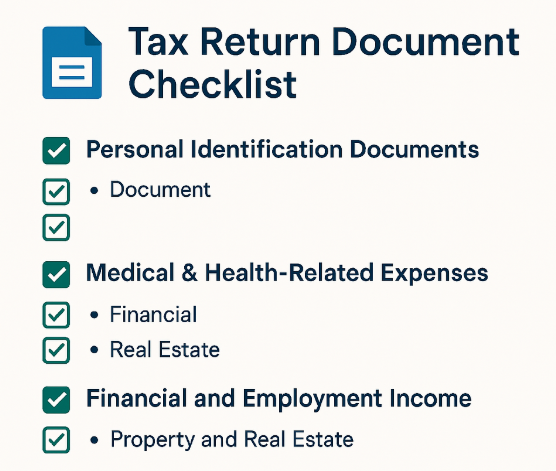
Tax Return Document Checklist

Tax Return Document Checklist

As tax season approaches, it’s essential to prepare the required documentation in a timely and organized manner. Submitting all documents promptly and in full will significantly streamline the preparation and filing process, reduce back-and-forth communication, and help ensure you benefit from all available deductions.

We recommend printing this list ( click on the PDF logo above) and using it as a checklist while gathering your documents.

Please contact us if you have any doubts or if your personal or financial situation has changed during the year.

Personal Identification Documents
() Mod. 730 or Mod. Unico from the previous year (include F24 payment forms)
() Copy of your ID or passport
() Tax ID Number (Codice Fiscale)

Medical & Health-Related Expenses
() Pharmacy receipts (with Codice Fiscale and paid by card)
() Invoices for specialist visits and health tickets
() Invoices or receipts for veterinary expenses
() Funeral expenses

Financial and Employment Income
() Bank declaration for loan interest paid
() CUD (Certificazione Unica) for employment or pension income
() Foreign income tax returns and related tax payment documents

Property and Real Estate
() Cadastral report for properties purchased during the year
() Copies of any real estate sales or purchases made during the year

Deductions & Tax Credits
() ENEA Certifications (for energy savings 55% or 65%)
() Invoices and payments for renovation work (50%)
() Invoices for deductions related to furniture and appliances
() Payment confirmations for life insurance
() School tuition payment receipts
() Proof of payments for children’s sport activities (for those under 18)
() Receipts for donations to ONLUS (non-profit organizations)

Social Security & Contributions
() Payment proof for social security contributions
() Contributions for domestic service workers (INPS)

Foreign Assets
() Value and description of assets, equity, funds, and accounts held abroad
() Foreign financial availability required for IVAFE/IVIE declarations

Regime Forfettario in Italy (2025): The Flat-Tax Option for Expats

Regime Forfettario in Italy (2025): The Flat-Tax Option for Expats

If you’re an expat living in Italy and planning to work as a freelancer, consultant, or solo entrepreneur, the Regime Forfettario (Flat-Rate Tax Regime) might be an appealing option. It offers simplified taxation, fewer bureaucratic obligations, and lower overall costs — but it’s not for everyone, and it’s mutually exclusive with the Regime degli Impatriati.

Here’s everything you need to know about this regime in 2025, including how it interacts with social security (INPS) and why choosing between tax regimes requires a strategic decision.

What Is the Regime Forfettario?
The Regime Forfettario is a favorable tax scheme for individuals (sole traders and freelancers) with relatively modest revenues. It simplifies compliance, eliminates many traditional tax obligations, and applies a flat-rate taxation model.

Who Qualifies in 2025
To be eligible for the Regime Forfettario in 2025, you must meet all of the following conditions:

-Revenues or professional fees must not exceed €85,000 in the previous tax year.

-Personnel costs (e.g., employees or collaborators) must stay under €20,000.

-Additional income from employment or pensions must not exceed €35,000.

-You must not control or participate in a company that operates in the same business sector.

-Your activity must not be predominantly for a current or former employer.

Who Is Excluded?


You cannot use this regime if:

-You surpass the income or personnel cost thresholds.

-You operate in specific excluded sectors (e.g., real estate or financial investment).

-You are also eligible for and using the “Regime degli Impatriati” — these two tax regimes cannot be combined.

How Taxation Works
– A flat tax rate of 15% is applied to a percentage of your gross income, called the “coefficiente di redditività” (profitability coefficient). This varies by activity (usually 40%–78%).

Startups that meet certain conditions (e.g., no professional activity in the last 3 years) may qualify for a reduced 5% rate for the first 5 years.

  • No VAT obligations, no withholding tax on invoices, no IRAP (regional tax).

INPS (Social Security) Considerations
All self-employed workers in Italy must contribute to INPS, the national social security system. The way this works depends on your profession:

Freelancers (without professional association)


-Enrolled in the Gestione Separata INPS.

-Contribution rate in 2025: approximately 26.07% of taxable income.

-Taxable income = Gross revenue × profitability coefficient.

Artisans and Traders
Enrolled in the Artigiani e Commercianti INPS fund.

– Pay a fixed minimum contribution (~€4,500–€4,800 annually), plus a 24% rate on income above €17,500.

-Contributions are tax-deductible under the flat-rate regime.

Example: Freelance Consultant with regular 15% tax rate
Gross revenue: €50,000

Coefficient of profitability (consulting): 78%

Taxable base: €50,000 × 78% = €39,000

Income tax (15%): €5,850

INPS (26.07% of €39,000): €10,170

Net income: ~€33,980

Regime Forfettario vs. Regime degli Impatriati
If you’re an expat recently relocated to Italy, you may also be eligible for the Regime degli Impatriati, a tax incentive offering:

-50% tax exemption on employment or self-employment income

-Valid for 5 years, extendable in some cases

However, you must choose between the two — they are mutually exclusive:

The Regime Forfettario is better suited for low to mid-income freelancers or those seeking simplicity.

The Regime degli Impatriati may be more beneficial for higher earners or structured professionals with larger income streams.

Key Decision Factors
Expected gross income

-Type of work (employment vs freelance)

-Professional and personal tax residency status

-Long-term plans in Italy

Be Careful: You Might Lose Personal Tax Deductions

One lesser-known downside of the Regime Forfettario is that you may not benefit from common tax deductions (known in Italy as oneri detraibili) if you don’t have other income subject to ordinary progressive taxation (IRPEF).

Why?
The Regime Forfettario applies a substitute tax (flat rate of 15% or 5%) instead of IRPEF.

This means you’re not part of the regular income tax system, so you don’t get to offset deductible expenses like:

Medical expenses

Rent or mortgage interest

University fees

Dependent family expenses

Contributions to pension schemes beyond INPS

When Does This Matter?
If you:

Only have income under the Regime Forfettario, and

Don’t have other income taxed under the standard IRPEF system (like employment income, pension, or property rentals),

…then your deductible expenses can’t be used, because there’s no IRPEF to offset them against.

How to Retain Some Deductions
If you have dual income (e.g., freelance income under Forfettario and salaried income taxed normally), you can still benefit from deductions, but only on the IRPEF-taxed portion.

In some cases, it might be worth evaluating whether staying in the ordinary tax regime allows you to recover more through deductions, especially if your deductible expenses are high.

Final Advice
The Regime Forfettario is one of the most expat-friendly options for solo professionals starting a business in Italy. However, choosing between this and the Regime degli Impatriati can significantly impact your net earnings and tax liability.

Please consult us for any further details !

Necessary documents for your yearly Tax Return

Tax season is fast approaching, please find a list of the Documents we need to receive to prepare your Tax Return:

Mod. 730 or Mod. Unico of the previous year and payment forms F24.
Copy of your ID/passport and Tax ID Number ( Codice Fiscale )

Pharmacy receipts ( with your Codice Fiscale and paid by credit/debit card)
Invoices for specialist visits, health tickets Invoices / receipts for medicines and veterinary expenses
Funeral expenses

Loan interest paid ( we need the bank declaration )
CUD attesting your employment / retirement income
Copies of ENEA Certifications, for energy savings of 55% and 65%
Copy of renovation costs for recovery 50% plus deductions for Furniture and Appliances.
Payment for life insurance costs
Payment for school tuition costs

Expenses for sport activities for children up to the age of 18
Payments made to Onlus

Payment of social security contributions

Cadastral report for properties purchased during the year
Copies of any real estate purchases / sales occurred during the year
Contributions for domestic service workers
Copy of any foreign income tax returns and related tax payments
Value and description of assets / funds / equity investments / financial availability held abroad

That’s the general list. Please contact us for any doubt !

Taxation of Income for Italian Residents Who Are U.S. Citizens

Understanding Tax Obligations for Dual Tax Residents

Italian residents who are also U.S. citizens face a unique and complex tax situation, as they are subject to taxation by both Italy and the United States. This article provides an overview of the key aspects of their tax obligations, double taxation treaties, and potential tax planning strategies.

1. The U.S. Tax System and Its Implications

The United States follows a citizenship-based taxation system, meaning that all U.S. citizens, regardless of where they reside, must file and potentially pay U.S. taxes. This includes Italian residents who hold U.S. citizenship.

Key U.S. tax obligations include:

  • Filing an annual U.S. tax return (Form 1040), reporting worldwide income.
  • Declaring foreign bank accounts via FBAR (FinCEN Form 114) if the total value of all foreign accounts exceeds $10,000.
  • Filing Form 8938 (FATCA requirements) if foreign financial assets exceed certain thresholds.
  • Reporting foreign business interests through Form 5471 or Form 8865, if applicable.

2. The Italian Tax System and Residency Rules

Italy imposes taxes based on residency, meaning individuals who are considered Italian tax residents must pay taxes on their worldwide income. A person is considered a resident for tax purposes if they meet any of the following criteria:

  • They are registered in the Anagrafe (Resident Registry) for most of the tax year.
  • They spend more than 183 days in Italy within a calendar year.
  • Their principal place of business or economic interests is in Italy.

As a result, U.S. citizens residing in Italy are subject to Italian income tax (IRPEF), which applies progressively, as follows:

Income Bracket (€)Tax Rate (%)
0 – 28,00023%
28,001 – 50,00033%
Over 50,00043%

3. The U.S.-Italy Tax Treaty and Avoiding Double Taxation

To prevent double taxation, the U.S.-Italy Tax Treaty offers mechanisms to mitigate tax burdens:

  • Foreign Tax Credit (FTC): The U.S. allows citizens to credit taxes paid to Italy against their U.S. tax liability, reducing the risk of double taxation.
  • Foreign Earned Income Exclusion (FEIE): U.S. citizens who meet the physical presence or bona fide residence test can exclude up to a specified amount of foreign-earned income, indexed annually — $132,900 for the 2026 tax year.
  • Totalization Agreement: This determines which country’s social security system applies to a taxpayer, depending on employment circumstances.

4. Special Tax Regimes for Foreigners in Italy

Certain foreign residents, including U.S. citizens moving to Italy, may benefit from preferential tax regimes, such as:

  • Regime Impatriati: Exempts 50% of qualifying employment and professional income from Italian tax — 60% for those with a minor child — up to €600,000 a year, for five years, for those transferring their residence from 2024 onwards. The earlier version of the regime, with reductions of 70% to 90%, continues to apply only to those who moved before that date.
  • Flat Tax Regime for New Residents: A fixed annual substitute tax on all foreign income, available to individuals who have not been Italian tax resident in at least nine of the previous ten years. The amount is €300,000 a year for those transferring their residence from 1 January 2026, plus €50,000 for each family member. Earlier figures of €100,000 and €200,000 remain in force for those who transferred before the respective increases.
  • Pensioner Tax Regime: Retired individuals with a foreign pension who move to a municipality of up to 30,000 inhabitants in specified southern regions may benefit from a 7% flat tax on all their foreign income, for ten tax years. The population threshold was raised from 20,000 in April 2026.

5. Practical Tax Planning Considerations

To navigate these complex obligations efficiently, U.S. citizens residing in Italy should consider the following:

  • Work with tax professionals who understand both U.S. and Italian tax laws.
  • Monitor foreign financial accounts to comply with FATCA and FBAR rules.
  • Optimize tax credits and exclusions to minimize overall tax liability.
  • Plan for social security contributions, as Italy and the U.S. have different systems.

Conclusion

Italian residents who are also U.S. citizens must carefully manage their tax responsibilities to avoid penalties and optimize their tax situation. By leveraging tax treaties, special regimes, and professional advice, they can ensure compliance while minimizing double taxation.

Italy Tax system

Understanding Taxes in Italy: A Simple Guide

Italy has a complex tax system with different taxes at the national, regional, and local levels. If you live or work in Italy, it’s essential to understand how taxes work, what rates apply, and when you need to pay. Let’s break it down in an easy-to-understand way.


1. Main Types of Taxes in Italy

There are two major categories of taxes in Italy: direct taxes (on income and assets) and indirect taxes (on goods and services).

A. Direct Taxes (Taxes on Income and Business)

  1. IRPEF (Personal Income Tax)
    • Paid by individuals based on their earnings.
    • Uses a progressive system, meaning the more you earn, the higher your tax rate.
  2. IRES (Corporate Income Tax)
    • A flat tax of 24% paid by companies and businesses.
  3. IRAP (Regional Business Tax)
    • Paid by businesses and professionals.
    • The rate depends on the region but is typically around 3.9%.
  4. IMU (Property Tax)
    • Applied to properties (except for primary residences in most cases).
    • The rate varies by municipality.

B. Indirect Taxes (Taxes on Goods and Services)

  1. IVA (Value-Added Tax – VAT)
    • Applied to the sale of goods and services.
    • Standard rate: 22%
    • Reduced rates: 10% (e.g., food, hotels) and 4% – 5% (e.g., essential items).
  2. Other Indirect Taxes
    • Registration taxes, stamp duties, and real estate transaction fees.

2. Personal Income Tax Rates (IRPEF)

IRPEF is progressive, meaning higher incomes are taxed at higher rates:

Income Bracket (€)Tax Rate (%)
0 – 28,00023%
28,001 – 50,00033%
Over 50,00043%

There are also deductions and allowances that reduce the total amount of tax you owe.


3. How and When to Pay Taxes in Italy

Taxes are usually paid through withholding, advance payments, and direct declarations.

For Employees & Pensioners

  • Taxes are automatically deducted from salaries and pensions.
  • Employers and pension funds take care of payments.

For Freelancers & Self-Employed Workers

  • Must file a tax return and pay in advance based on the previous year’s income.
  • Payments are made in two installments:
    • First installment: June 30
    • Second installment: November 30

For Companies (IRES, IRAP)

  • Companies pay in advance, similar to personal income tax.
  • The final balance is settled the following year.

For VAT (IVA)

  • Businesses must collect VAT from customers and pay it to the tax authorities.
  • Payments are usually quarterly or monthly.

4. How to Pay Taxes

Taxes in Italy are paid through:

  • F24 Form (submitted online via banks or the Italian Tax Agency).
  • Direct debit payments (for recurring taxes).
  • Online banking and tax portals.

5. Tax Returns and Deadlines

  • Personal Tax Returns (Modello 730 or Modello Redditi PF):
    • Employees & pensioners: By September 30.
    • Freelancers & self-employed: By November 30.
  • Business Tax Returns:
    • Usually filed by April 30 for the previous year.

6. Additional Local Taxes

  • TARI (Waste Collection Tax) – Paid to local municipalities for garbage services.
  • Regional and Municipal Surcharges – Additional small taxes applied to IRPEF, varying by location.

Final Thoughts

Italy’s tax system may seem complicated, but understanding the basics can help you manage your payments effectively and avoid penalties. Whether you’re an employee, freelancer, or business owner, staying informed about your tax obligations is key.

USA – Beneficial Ownership Information (BOI) Report

Beneficial Ownership Information (BOI) Report: Overview & Due Date

The Beneficial Ownership Information (BOI) Report is a filing requirement introduced under anti-money laundering (AML) laws to increase transparency in corporate structures. It mandates companies to disclose details about individuals who ultimately own or control them.

Who Needs to File the BOI Report?

Entities subject to the BOI reporting requirement typically include:

  • Corporations
  • Limited liability companies (LLCs)
  • Other entities registered with government authorities
  • Some trusts and partnerships (depending on jurisdictional rules)

What is Beneficial Ownership?

A beneficial owner is an individual who:

  1. Directly or indirectly owns 25% or more of the entity’s shares, voting rights, or capital; OR
  2. Exercises significant control over the entity, even without direct ownership.

Information Required in the BOI Report

Entities must provide:

  • Full name of each beneficial owner
  • Date of birth
  • Address (residential or business)
  • Government-issued ID number (e.g., passport, tax ID)
  • Details of ownership interest or control over the entity

BOI Report Due Date

  • For existing entities: Due by December 31, 2024 (varies by jurisdiction).
  • For new entities (formed in 2024 or later): Filing is required within 30 days of registration.
  • Updates/Changes: Any changes in beneficial ownership must be reported within 30 days of the change.

With the February 18, 2025, decision by the U.S. District Court for the Eastern District of Texas in Smith, et al. v. U.S. Department of the Treasury, et al., 6:24-cv-00336 (E.D. Tex.), beneficial ownership information (BOI) reporting requirements under the Corporate Transparency Act (CTA) are once again back in effect. However, because the Department of the Treasury recognizes that reporting companies may need additional time to comply with their BOI reporting obligations, FinCEN is generally extending the deadline 30 calendar days from February 19, 2025, for most companies.

Tax regime for new residents – 2024 version

Italy’s “Regime Impatriati” is a special tax incentive designed to attract professionals to relocate to Italy by offering significant tax benefits. Recent legislative changes have modified the requirements and benefits of this regime, effective from January 1, 2024. Here’s an overview of how the regime functions starting in 2025:

Eligibility Criteria:

  1. Non-Residency Requirement: Individuals must not have been tax residents in Italy for at least three tax periods prior to the year they become Italian tax residents.
  2. Employment in Italy: The individual must be employed or self-employed in Italy.
  3. Duration of Stay: The individual must commit to residing in Italy for at least four years.

Tax Benefits:

  • Income Tax Reduction: Eligible individuals can benefit from a 50% reduction in taxable employment or self-employment income, with a maximum cap of €600,000 per year.
  • Duration of Benefits: The tax benefit applies for the tax year in which the individual transfers their tax residency to Italy and extends for the following four years, totaling five years of tax incentives.

Additional Considerations:

  • Highly Qualified Professionals: The regime is particularly aimed at highly qualified or specialized individuals, aligning with definitions similar to those for a Schengen Blue Card.
  • Inter-Company Transfers: The regime also applies to individuals transferring within the same corporate group, provided specific conditions are met.

These changes aim to attract international talent and encourage the return of Italian citizens by offering substantial tax incentives.