02.4004.4318
CALL US!
8:30 - 17:30
Mon-Fri

Archivio: Aprile 18, 2025

Healthcare Transparency Under the Spotlight: Navigating the Sunshine Act

Healthcare Transparency Under the Spotlight: Navigating the Sunshine Act
The Italian Sunshine Act, introduced by Law 62/2022, is a major step forward in promoting transparency in the healthcare sector. It is designed to regulate and make public the economic relationships between companies operating in the health industry and healthcare professionals or organizations. Inspired by similar legislation in the United States and Europe, the law aims to:

Prevent corruption and conflicts of interest

Reinforce public trust in the healthcare system

Guarantee the right to access information on financial ties that may influence clinical or administrative decisions

At the heart of the law is the “Sanità Trasparente” (Transparent Healthcare) registry, an open-access platform managed by the Ministry of Health, where companies must publish detailed reports on all transfers of value (ToV) made to healthcare professionals or organizations.

📘 Legal Background: How the Law Evolved
The law came into force in June 2022, with a phased implementation plan. Within a few months, the Ministry was tasked with setting up the registry and defining its technical specifications. Public consultations followed in 2023, and by 2025 the first pilot tests of the online platform were initiated.

The official activation of the registry is expected by the end of 2025, triggering the obligation for companies to begin reporting data on a semiannual or annual basis, depending on the type of relationship.

🧑‍⚕️ Who Is Involved?
The legislation affects three main categories of stakeholders:

Producing Companies: Businesses that manufacture, distribute, or organize events in the human or veterinary health sector—including suppliers of goods and services, even if not strictly medical.

Healthcare Professionals: Not only doctors and nurses, but also administrative personnel and decision-makers who influence procurement or use of medical technologies and resources.

Healthcare Organizations: Hospitals, universities, research institutes, ECM providers, professional bodies, patient associations, and scientific societies.

💬 What Must Be Reported?
Companies must report electronically the following:

Transfers of value (money, goods, services, or other benefits) if they exceed certain thresholds:

Over €100 (single) or €1,000 annually for individuals

Over €1,000 (single) or €2,500 annually for organizations

Agreements that provide economic benefit (direct or indirect): participation in events, consultancy, training, research, etc.

Financial relationships: shareholdings, bonds, royalties related to intellectual property

Each report must include key data: beneficiary identity, value, reason, nature of the transfer, and intermediaries if applicable.

📅 Deadlines and Reporting Cycles
The law establishes two types of reporting cycles:

Semiannual reporting for agreements, transfers, and sponsorships

Annual reporting for shareholdings and royalties

Reports must be submitted in the period following the one in which the transaction took place. For example, a sponsorship in the first half of 2026 must be reported by December 2026.

🌐 The “Sanità Trasparente” Portal
The portal has two distinct user views:

A public area, accessible to anyone, where it is possible to search by beneficiary, agreement, or sanction

A company dashboard, for uploading XML files, validating data, checking for errors, and managing submissions

It is a comprehensive monitoring and transparency tool managed by the Ministry of Health.

🚨 Enforcement and Penalties
The Ministry of Health is responsible for enforcement, supported by the Carabinieri NAS (Health Protection Unit) and the Guardia di Finanza.

Companies are fully accountable for the accuracy and completeness of the information submitted.

Penalties include:

€1,000 + 20x the unreported value for missing ToV disclosures

€5,000 to €100,000 for false or incomplete information

50% reduction in fines for companies with annual revenue under €1 million

Names of fined companies will be published in the registry for at least 90 days

🛠️ Becoming Compliant: An Operational Approach
Complying with the Sunshine Act is not just about sending XML files. It requires an organizational shift:

Mapping all types of value transfers

Updating SOPs, contracts, and compliance models (e.g., 231 Model)

Involving key departments (legal, marketing, CRM, finance, compliance)

Digitalizing approval workflows and data collection

As one speaker emphasized: “Start from the organization, not the tool.”

✅ Digital Tools and Real-World Examples
The presentation showcased companies already investing in dedicated platforms to manage:

ToV tracking

Workflow approvals

XML reporting

Budget control and event oversight

A case study of Theras Group was highlighted. Starting in 2019, they built a full internal platform for managing transparency-related processes. By 2025, all ToV and event-related workflows were fully digital, compliant, and efficiently controlled.

🎯 Conclusion
The Sunshine Act presents a significant challenge—but also a unique opportunity. It invites companies to strengthen their internal governance, align with evolving ethical standards, and demonstrate a clear commitment to transparency and integrity.

Those who act early will not only comply with the law, but also enhance their reputation, competitiveness, and trustworthiness in the healthcare ecosystem.
Residence Registration: A Legal Obligation vs. a Voluntary Practice (like in the U.S)

Residence Registration: A Legal Obligation vs. a Voluntary Practice ( like in the U.S )

In many European countries (e.g., Germany, France, Italy), registering with the city or municipality is a legal obligation for all residents. This process, typically done shortly after moving into a new address, is essential because:

-It establishes your legal residence, which determines eligibility for public services (healthcare, education, local benefits).

-It allows local governments to maintain accurate population records.

-It connects you to local taxation systems and the correct voting district.

-It ensures you can receive official correspondence and perform key bureaucratic tasks (e.g., getting an ID, enrolling children in school).

Failure to register often results in administrative fines, difficulty accessing services, or even legal issues for residency-related processes (e.g., immigration compliance).

Contrast with the United States
In the U.S., there is no mandatory city registration system. The government does not maintain a centralized database of where every person lives. As a result:

-Proof of residency, as known in Europe, does not officially exist in a standardized way in the U.S.

-There’s no legal requirement to inform city or municipal authorities when you move.

-Instead, individuals must update their address with specific agencies when relevant (e.g., the DMV for driver’s licenses, local election boards for voting, IRS for taxes).

These updates are decentralized and rely on self-reporting, with little oversight unless fraud or benefits are involved.

This system is more flexible but creates gaps in population tracking and administrative coordination. It also means that residency is often “proven” by using ( usually more than one document is requested ) utility bills, lease agreements, or bank statements, since there’s no official certificate issued by a city.

When to Register
Within 20 days of moving to a new municipality (comune)

Where to Register
At the Ufficio Anagrafe (registry office) of the local municipality

Required Documents
-Valid ID or passport

-Tax code (Codice Fiscale)

-Proof of housing (rental contract, property deed, or hosting declaration)

-Proof of health insurance (for EU and non-EU citizens)

-Residence permit (for non-EU nationals)

Outcome
You are entered into the Anagrafe dei Residenti, Italy’s civil registry

-You receive a certificate of residence (certificato di residenza)

-Police verification may follow (they check if you actually live there)

NOTE : The above process does not automatically make you fiscally resident for the same year !

Fiscal Residency (Residenza Fiscale)
This refers to your tax residency status, governed by the Italian Revenue Agency (Agenzia delle Entrate). You are considered a fiscal resident if any one of the following is true for more than 183 days per solar year:

-Your registered legal residence is in Italy (from the Anagrafe – the process described above)

-Your habitual abode (physical presence) is in Italy

-Your center of economic or personal interests is in Italy

This determines:

-Where you pay income tax

-Whether you are taxed on worldwide income (if resident) or only Italian income (if non-resident)

Contrabbando di fatto? L’utilizzo in Italia di aeromobili immatricolati FAA tra normativa e realtà

Contrabbando di fatto? L’utilizzo in Italia di aeromobili immatricolati FAA tra normativa e realtà

Sintesi ragionata della sentenza Cass. Pen. n. 4980/2022
La vicenda ruota attorno all’utilizzo in Italia di elicotteri registrati negli Stati Uniti, attraverso strutture di trust, per i quali il Pubblico Ministero aveva disposto il sequestro preventivo. L’ipotesi era quella di contrabbando e mancato versamento dell’IVA all’importazione. Tuttavia, il Tribunale del Riesame di Asti ha annullato i sequestri, ritenendo che non sussistesse alcun reato.

A questa ordinanza si è opposto il PM, ricorrendo in Cassazione e sostenendo che vi fossero gli elementi per configurare almeno il fumus commissi delicti. Il suo ricorso si basa su due presupposti normativi fondamentali: l’art. 36, comma 4 del Testo Unico delle Leggi Doganali e l’art. 760 del Codice della Navigazione. Secondo questa impostazione, la cancellazione di un velivolo dal registro italiano (o da altro registro UE) e la sua iscrizione nel registro statunitense comporta automaticamente la perdita della qualifica di bene unionale, facendolo ricadere nella categoria di “merce estera”. Di conseguenza, se tale velivolo permane in Italia per più di sei mesi, si configura un obbligo di sdoganamento, e l’eventuale omissione equivale a evasione dell’IVA all’importazione, in violazione dell’art. 70 del DPR 633/1972.

La Corte di Cassazione ha accolto il ricorso, annullando l’ordinanza del Riesame e rinviando per un nuovo esame. Nella sua motivazione, la Corte ha evidenziato più criticità nella decisione di merito:

Qualificazione giuridica dell’IVA all’importazione
Sebbene l’IVA all’importazione sia tecnicamente un tributo interno, essa presenta tratti comuni con i dazi doganali. In quanto collegata all’ingresso fisico del bene nel territorio dell’Unione, la sua evasione rientra nella disciplina penalistica del contrabbando.

Significato dell’immatricolazione estera
La Corte ha ritenuto centrale il fatto che gli elicotteri fossero immatricolati negli Stati Uniti. Questo elemento, in assenza di iscrizione in un registro UE, è stato interpretato come prova che il bene non era mai stato nazionalizzato. L’utilizzo stabile sul territorio italiano non può quindi considerarsi legittimo senza aver prima assolto gli obblighi doganali e IVA.

I riferimenti normativi rilevanti

L’art. 760 del Codice della Navigazione prevede la cancellazione di un aeromobile dal registro italiano se viene iscritto in un registro estero.

L’art. 36, comma 4 del TULD stabilisce che l’iscrizione in un registro nazionale equivale a destinazione al consumo, mentre la cancellazione ne determina la perdita di tale status.

Prova dell’immissione in consumo
Secondo la giurisprudenza richiamata dalla Corte (sentenze n. 11976/2014, 25765/2021), l’immissione in consumo può ritenersi avvenuta solo con l’iscrizione nei registri pubblici di un Paese UE. In mancanza di questa iscrizione, l’IVA si considera non versata, anche se il bene è stato sdoganato altrove.

Durata della permanenza e ammissione temporanea
La normativa UE prevede che un velivolo immatricolato extra-UE possa restare in Italia in regime di “ammissione temporanea” per un massimo di sei mesi. Trascorso questo periodo, deve essere nazionalizzato. La Corte ha rilevato che i velivoli erano rimasti oltre tale limite, senza sdoganamento né regolarizzazione fiscale.

Doppia imposizione e principio di proporzionalità
Il Riesame aveva escluso la doppia imposizione, ma la Cassazione ha precisato che per invocare il principio occorre fornire prova concreta dell’avvenuto assolvimento dell’IVA in un altro Stato membro. In questo caso, tale prova mancava.

Una conclusione paradossale
Ciò che emerge da questa sentenza è un quadro giuridico in cui il rispetto formale delle registrazioni prevale sulla sostanza economica dell’operazione. Un aeromobile regolarmente acquistato e sdoganato in un Paese UE, ma poi immatricolato negli Stati Uniti, viene considerato “merce estera” e soggetto a nuove imposizioni fiscali solo per una questione di marche November.

Si crea così un paradosso: anche se il bene ha già assolto l’IVA e viene usato esclusivamente in Italia da soggetti italiani, è considerato come se non fosse mai entrato legalmente nell’Unione. In questo scenario, l’immatricolazione FAA viene trattata come una sorta di “re-importazione abusiva”, ignorando il fatto che spesso tale registrazione è dettata da esigenze tecniche o operative, non da intenti elusivi.

Il sistema, in definitiva, si rivela incapace di distinguere tra vera evasione e uso legittimo, finendo per colpire chi ha già assolto i propri obblighi in un altro Stato UE. Ne risulta un impianto normativo incoerente, che punisce la sostanza economica a favore di un formalismo rigido e scollegato dalla realtà del mercato aeronautico globale.


Aggiornamento — agosto 2026: il quadro sanzionatorio è stato riscritto

Le considerazioni che precedono restano valide nella sostanza, ma i riferimenti normativi in materia di contrabbando sono cambiati e vanno aggiornati.

Le norme del TULD non ci sono più. Il D.Lgs. 26 settembre 2024, n. 141, in vigore dal 4 ottobre 2024, ha abrogato gli artt. 282 e 301 del Testo Unico delle Leggi Doganali, sostituendoli con gli artt. 78, 94 e 96 delle Disposizioni Nazionali Complementari al Codice doganale dell’Unione. L’IVA all’importazione conserva la natura di diritto di confine.

La soglia penale è stata alzata. Il D.Lgs. 12 giugno 2025, n. 81, ha portato a 100.000 euro la soglia di rilevanza penale per i diritti di confine diversi dai dazi — quindi per l’IVA all’importazione — lasciando a 10.000 euro quella relativa ai dazi, con applicazione retroattiva per favor rei. Nei casi in cui l’unico diritto evaso sia l’IVA, ipotesi ordinaria per gli aeromobili civili il cui dazio è nella generalità dei casi nullo (da riscontrare sulla voce TARIC applicabile), la conseguenza pratica è rilevante: al di sotto di quella soglia la condotta resta illecito amministrativo e non integra reato. Con IVA al 22%, i 100.000 euro corrispondono a un valore in dogana nell’ordine dei 455.000 euro: gran parte dell’aviazione generale vi rientra, un business jet no.

La confisca non è più automatica. Con la sentenza n. 93 del 3 luglio 2025 la Corte costituzionale ha dichiarato l’illegittimità parziale della disciplina nella parte in cui imponeva la confisca anche a fronte del pagamento integrale dell’imposta evasa, degli accessori e della sanzione. L’Agenzia delle Dogane e dei Monopoli ha recepito il principio con la circolare n. 18 del 25 luglio 2025: se è stata evasa la sola IVA e il contribuente paga integralmente, si procede allo svincolo del bene. La confisca resta invece obbligatoria quando siano stati evasi anche dazi.

La sanzione amministrativa prevista dall’art. 96 DNC va dal 100% al 200% dei diritti di confine evasi, con un minimo di 2.000 euro.

Che cosa cambia per il proprietario. Il combinato disposto di questi interventi apre una finestra che prima non esisteva: la regolarizzazione volontaria, attivata prima dell’inizio di accessi, ispezioni o verifiche, è oggi la strada tecnicamente più efficiente per chiudere una posizione irregolare. Resta il fatto che l’ammissione temporanea per un aeromobile ad uso privato ha una durata di sei mesi — non i diciotto previsti per le unità da diporto — e che, a norma dell’art. 16, comma 14-bis, del D.L. 201/2011, la permanenza in Italia superiore a sei mesi nell’arco di dodici fa scattare l’imposta erariale sugli aeromobili privati anche per i velivoli non iscritti al RAN.

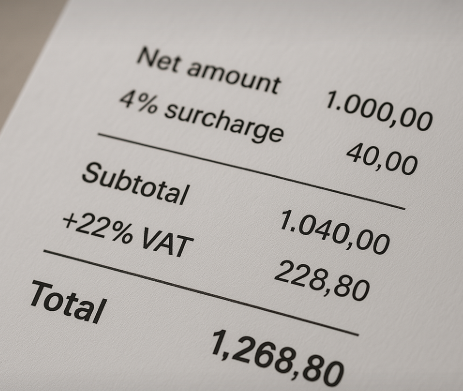
4% social security surcharge on invoices : What is it ?

4% social security surcharge on invoices : What is it ?
If you’ve received an invoice from an Italian consultant or freelancer, and there’s a 4% charge added to the net amount, here’s what it means:

It is not a tax or a penalty
The 4% line item is not a fine or extra fee. It’s a social security-related charge, required or allowed by Italian law depending on the type of professional issuing the invoice.

Two possible cases – what it means for you

Case A – The professional is part of a regulated profession (e.g. architect, lawyer)
The 4% is a mandatory contribution to their professional pension fund.

It’s called the “contributo integrativo”.

Italian law requires the professional to charge it to the client, even if the client is not in Italy.

This 4% does not increase their taxable income. On this 4% there is no witholding tax but it has VAT

You simply pay it as part of the invoice — you don’t need to do anything else.

Case B – The professional is a freelancer without a professional order (e.g. designer, consultant)
The 4% is optional and is used to partially offset their INPS social security costs.

It’s allowed by INPS (the Italian social security institute).

In this case, it is included in their taxable income. So the 4% has witholding tax , and of course VAT

Again, as the client, you just pay it as shown — no further action required on your side.

Why is it on your invoice?
In both cases, the professional is simply complying with the rules of the Italian social security system. The 4% charge helps cover pension contributions and is a standard item in many invoices from Italian professionals.

It is not VAT, and it is not negotiable if it’s mandatory. If it’s optional (INPS case), it may have been previously agreed as part of the overall fee.

What do you need to do?
Nothing special. Just:

Pay the invoice including the 4% charge.

Make sure it’s listed clearly in the invoice breakdown.

No extra forms, declarations, or withholding obligations apply — especially if you are based outside of Italy.

Lista dei Documenti per la Dichiarazione dei Redditi

Lista dei Documenti per la Dichiarazione dei Redditi

Con l’avvicinarsi della stagione dichiarativa, è fondamentale preparare in modo tempestivo e ordinato tutta la documentazione necessaria. Fornire i documenti completi e in tempo faciliterà notevolmente il processo di compilazione e invio della dichiarazione, ridurrà la necessità di chiarimenti e ti permetterà di beneficiare di tutte le detrazioni disponibili.

Consigliamo di stampare questo elenco e utilizzarlo come checklist durante la raccolta dei documenti.

In caso di dubbi o se durante l’anno ci sono stati cambiamenti nella situazione personale o finanziaria, chiediamo di farcelo sapere tempestivamente

Documenti di Identificazione Personale ( non necessari se gia’ Clienti dello Studio)
() Modello 730 o Modello Unico dell’anno precedente (inclusi modelli F24 di pagamento)
() Copia di un documento di identità (carta d’identità o passaporto)
() Codice Fiscale

Spese Mediche e Sanitarie
() Scontrini della farmacia (con Codice Fiscale e pagati con carta)
() Fatture per visite specialistiche e ticket sanitari
() Fatture o ricevute per spese veterinarie
() Spese funebri (con documentazione giustificativa)

Redditi da Lavoro e Situazione Finanziaria
() Dichiarazione bancaria degli interessi su mutui o prestiti
() CUD (Certificazione Unica) per redditi da lavoro o pensione
() Dichiarazioni dei redditi esteri con relativi pagamenti d’imposta

Immobili e Proprietà
() Visura catastale per immobili acquistati durante l’anno
() Copie di atti di compravendita di immobili effettuati nell’anno

Detrazioni e Crediti d’Imposta
() Certificazioni ENEA (per risparmio energetico 55% o 65%)
() Fatture e pagamenti per lavori di ristrutturazione edilizia (50%)
() Spese per mobili ed elettrodomestici legate alla ristrutturazione
() Quietanze di pagamento per assicurazioni sulla vita
() Ricevute di pagamento per rette scolastiche
() Spese per attività sportive dei figli (fino a 18 anni)
() Ricevute per donazioni ad ONLUS

Contributi e Previdenza
() Prove di pagamento per contributi previdenziali (INPS)
() Contributi per lavoratori domestici

Beni e Attività all’Estero
() Valore e descrizione di beni, partecipazioni, fondi o conti detenuti all’estero
() Disponibilità finanziarie estere ai fini delle imposte IVAFE/IVIE ( valore ad inizio e a fine anno)

Ringraziamo, e restiamo a disposizione per ogni chiarimento.

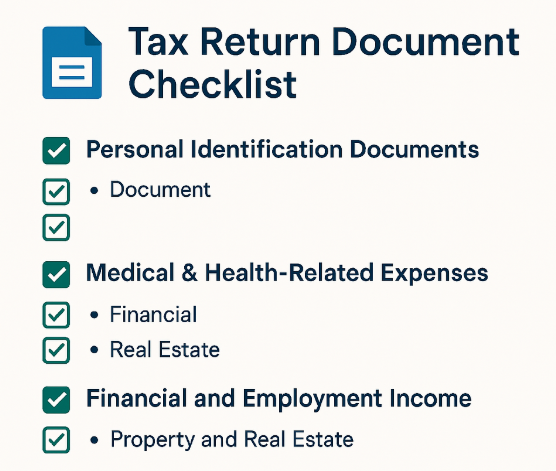
Tax Return Document Checklist

Tax Return Document Checklist

As tax season approaches, it’s essential to prepare the required documentation in a timely and organized manner. Submitting all documents promptly and in full will significantly streamline the preparation and filing process, reduce back-and-forth communication, and help ensure you benefit from all available deductions.

We recommend printing this list ( click on the PDF logo above) and using it as a checklist while gathering your documents.

Please contact us if you have any doubts or if your personal or financial situation has changed during the year.

Personal Identification Documents
() Mod. 730 or Mod. Unico from the previous year (include F24 payment forms)
() Copy of your ID or passport
() Tax ID Number (Codice Fiscale)

Medical & Health-Related Expenses
() Pharmacy receipts (with Codice Fiscale and paid by card)
() Invoices for specialist visits and health tickets
() Invoices or receipts for veterinary expenses
() Funeral expenses

Financial and Employment Income
() Bank declaration for loan interest paid
() CUD (Certificazione Unica) for employment or pension income
() Foreign income tax returns and related tax payment documents

Property and Real Estate
() Cadastral report for properties purchased during the year
() Copies of any real estate sales or purchases made during the year

Deductions & Tax Credits
() ENEA Certifications (for energy savings 55% or 65%)
() Invoices and payments for renovation work (50%)
() Invoices for deductions related to furniture and appliances
() Payment confirmations for life insurance
() School tuition payment receipts
() Proof of payments for children’s sport activities (for those under 18)
() Receipts for donations to ONLUS (non-profit organizations)

Social Security & Contributions
() Payment proof for social security contributions
() Contributions for domestic service workers (INPS)

Foreign Assets
() Value and description of assets, equity, funds, and accounts held abroad
() Foreign financial availability required for IVAFE/IVIE declarations

How to Open a Partita IVA ( individuals )

How to Open a Partita IVA ( individuals )

What Is a Partita IVA ?
The Partita IVA (VAT number) is a unique 11-digit identification number used by the Italian tax authority (Agenzia delle Entrate) to track the financial activity of self-employed individuals, freelancers, and businesses.

If you’re planning to:

Work as a freelancer or consultant

Run a sole proprietorship (ditta individuale)

Launch a small business or e-commerce site

Provide professional services in Italy,

The process to open it

  1. Choose the Type of Activity and ATECO Code
    (Each activity is classified under an ATECO code, a standard Italian business classification.)
  1. Choose Your Tax Regime
    You must select the appropriate tax regime:

Regime Forfettario (Flat-tax): for revenues up to €85,000/year. Fewer obligations, simplified taxation.

Regime Ordinario Semplificato or Ordinario: for higher revenues or more complex businesses.

  1. Register with the Agenzia delle Entrate
    Fill out and submit form AA9/12.

You can do this:

Online, through our office

In person at your local Agenzia delle Entrate office

THIS is the form

4-Register with INPS
If you are self-employed, you must register with the appropriate INPS fund:

    Gestione Separata (for freelancers without a professional register)

    Artigiani e Commercianti (for traders and artisans)

    This is essential to pay your social security contributions.

      5-(Optional) Register with the Chamber of Commerce
      Required for some activities (e.g., artisans, retailers)

      Required Documents
      Valid ID (and permesso di soggiorno if non-EU)

      Italian tax code (codice fiscale)

      ATECO code and business details

      How Long Does It Take?
      VAT certificate : same day

      INPS and Chamber of Commerce: typically a few days to a week

      Please contact our Offices for any assistance.

      Regime Forfettario in Italy (2025): The Flat-Tax Option for Expats

      Regime Forfettario in Italy (2025): The Flat-Tax Option for Expats

      If you’re an expat living in Italy and planning to work as a freelancer, consultant, or solo entrepreneur, the Regime Forfettario (Flat-Rate Tax Regime) might be an appealing option. It offers simplified taxation, fewer bureaucratic obligations, and lower overall costs — but it’s not for everyone, and it’s mutually exclusive with the Regime degli Impatriati.

      Here’s everything you need to know about this regime in 2025, including how it interacts with social security (INPS) and why choosing between tax regimes requires a strategic decision.

      What Is the Regime Forfettario?
      The Regime Forfettario is a favorable tax scheme for individuals (sole traders and freelancers) with relatively modest revenues. It simplifies compliance, eliminates many traditional tax obligations, and applies a flat-rate taxation model.

      Who Qualifies in 2025
      To be eligible for the Regime Forfettario in 2025, you must meet all of the following conditions:

      -Revenues or professional fees must not exceed €85,000 in the previous tax year.

      -Personnel costs (e.g., employees or collaborators) must stay under €20,000.

      -Additional income from employment or pensions must not exceed €35,000.

      -You must not control or participate in a company that operates in the same business sector.

      -Your activity must not be predominantly for a current or former employer.

      Who Is Excluded?


      You cannot use this regime if:

      -You surpass the income or personnel cost thresholds.

      -You operate in specific excluded sectors (e.g., real estate or financial investment).

      -You are also eligible for and using the “Regime degli Impatriati” — these two tax regimes cannot be combined.

      How Taxation Works
      – A flat tax rate of 15% is applied to a percentage of your gross income, called the “coefficiente di redditività” (profitability coefficient). This varies by activity (usually 40%–78%).

      Startups that meet certain conditions (e.g., no professional activity in the last 3 years) may qualify for a reduced 5% rate for the first 5 years.

      • No VAT obligations, no withholding tax on invoices, no IRAP (regional tax).

      INPS (Social Security) Considerations
      All self-employed workers in Italy must contribute to INPS, the national social security system. The way this works depends on your profession:

      Freelancers (without professional association)


      -Enrolled in the Gestione Separata INPS.

      -Contribution rate in 2025: approximately 26.07% of taxable income.

      -Taxable income = Gross revenue × profitability coefficient.

      Artisans and Traders
      Enrolled in the Artigiani e Commercianti INPS fund.

      – Pay a fixed minimum contribution (~€4,500–€4,800 annually), plus a 24% rate on income above €17,500.

      -Contributions are tax-deductible under the flat-rate regime.

      Example: Freelance Consultant with regular 15% tax rate
      Gross revenue: €50,000

      Coefficient of profitability (consulting): 78%

      Taxable base: €50,000 × 78% = €39,000

      Income tax (15%): €5,850

      INPS (26.07% of €39,000): €10,170

      Net income: ~€33,980

      Regime Forfettario vs. Regime degli Impatriati
      If you’re an expat recently relocated to Italy, you may also be eligible for the Regime degli Impatriati, a tax incentive offering:

      -50% tax exemption on employment or self-employment income

      -Valid for 5 years, extendable in some cases

      However, you must choose between the two — they are mutually exclusive:

      The Regime Forfettario is better suited for low to mid-income freelancers or those seeking simplicity.

      The Regime degli Impatriati may be more beneficial for higher earners or structured professionals with larger income streams.

      Key Decision Factors
      Expected gross income

      -Type of work (employment vs freelance)

      -Professional and personal tax residency status

      -Long-term plans in Italy

      Be Careful: You Might Lose Personal Tax Deductions

      One lesser-known downside of the Regime Forfettario is that you may not benefit from common tax deductions (known in Italy as oneri detraibili) if you don’t have other income subject to ordinary progressive taxation (IRPEF).

      Why?
      The Regime Forfettario applies a substitute tax (flat rate of 15% or 5%) instead of IRPEF.

      This means you’re not part of the regular income tax system, so you don’t get to offset deductible expenses like:

      Medical expenses

      Rent or mortgage interest

      University fees

      Dependent family expenses

      Contributions to pension schemes beyond INPS

      When Does This Matter?
      If you:

      Only have income under the Regime Forfettario, and

      Don’t have other income taxed under the standard IRPEF system (like employment income, pension, or property rentals),

      …then your deductible expenses can’t be used, because there’s no IRPEF to offset them against.

      How to Retain Some Deductions
      If you have dual income (e.g., freelance income under Forfettario and salaried income taxed normally), you can still benefit from deductions, but only on the IRPEF-taxed portion.

      In some cases, it might be worth evaluating whether staying in the ordinary tax regime allows you to recover more through deductions, especially if your deductible expenses are high.

      Final Advice
      The Regime Forfettario is one of the most expat-friendly options for solo professionals starting a business in Italy. However, choosing between this and the Regime degli Impatriati can significantly impact your net earnings and tax liability.

      Please consult us for any further details !

      L’uso di aeromobili immatricolati extra-UE da parte di residenti in Italia: aspetti legali, fiscali e doganali

      Introduzione
      Nel contesto dell’aviazione generale europea, l’utilizzo di aeromobili immatricolati al di fuori dell’Unione Europea (come quelli con marche svizzere per restare vicino a noi ) solleva numerose problematiche di natura fiscale, doganale e operativa, soprattutto quando tali velivoli sono pilotati o utilizzati da soggetti fiscalmente residenti nell’UE.

      Regole doganali per beni extra-UE
      L’Unione Europea considera gli aeromobili immatricolati in paesi terzi (non UE) come “beni esteri”. Quando questi aeromobili entrano nel territorio doganale dell’UE, sono soggetti al pagamento di dazi doganali (se applicabili) e all’IVA sull’importazione, salvo che beneficino di specifiche esenzioni.

      Secondo il Codice Doganale dell’Unione (Reg. UE 952/2013), l’unica deroga significativa a questo obbligo è l’ammissione temporanea. Tuttavia, l’art. 212 e seguenti del regolamento prevedono che tale regime si applichi solo se il bene è introdotto da un soggetto stabilito fuori dall’UE e utilizzato da persona anch’essa non residente.

      Quindi, un residente fiscale italiano non può utilizzare un aereo immatricolato extra-UE in ammissione temporanea (AT) ,proprio in quanto in questo caso l’ ingresso nel territorio doganale NON configura una AT .
      Se l’aereo è noleggiato (affittato) da un soggetto residente in Italia, il solo fatto che sia in leasing o affitto non elimina l’obbligo doganale. Anche in caso di contratto di locazione, se il velivolo viene introdotto e usato nel territorio dell’UE da un soggetto residente, si presume che debba essere importato, a meno che:
      il locatore sia effettivamente stabilito fuori dall’UE;
      il leasing sia operativo e reale;
      e sia possibile dimostrare l’uso limitato nel tempo, non continuativo, e senza disponibilità esclusiva.

      In pratica, il noleggio non esclude il rischio di sequestro se non accompagnato da un’effettiva struttura commerciale e da una tracciabilità conforme alle regole doganali. Le autorità valuteranno in particolare chi ha la disponibilità effettiva del mezzo e chi ne trae l’utilità economica.
      Conseguenze legali dell’uso irregolare
      L’uso di un aeromobile extra-UE da parte di un residente italiano senza importazione regolare è considerato una violazione doganale.
      Ai sensi del DPR 43/1973 (Testo Unico delle Leggi Doganali – TULD), può configurarsi il reato di contrabbando doganale (art. 292), con conseguente:
      sequestro del velivolo;
      applicazione di sanzioni amministrative o penali;
      obbligo di versamento dell’IVA dovuta e dei relativi interessi.

      Casi pratici e giurisprudenza
      L’Operazione “Icaro” del 2021 ha visto il sequestro di 17 velivoli ( con marche americane), ritenuti introdotti nel territorio nazionale senza pagamento dell’IVA. Tuttavia, è importante segnalare l’assurdità di alcuni sequestri avvenuti nonostante l’IVA fosse stata regolarmente versata, sulla base della contestazione che l’aeromobile fosse rimasto in Italia per un periodo superiore a sei mesi, come se si fosse trattato di un caso di ammissione temporanea – istituto che, come visto, non è applicabile ai residenti UE. Inoltre, in molti casi i velivoli erano intestati a trust statunitensi, struttura obbligatoria secondo la normativa FAA per l’immatricolazione negli Stati Uniti, e non necessariamente indice di elusione fiscale ( taanto piu’ se la disponibilita’ degli aereomobili era stata indicata nel quadro RW della dichiarazione dei redditi) .
      Conclusione
      L’utilizzo di aeromobili extra-UE da parte di residenti italiani (o UE) è soggetto a regole stringenti. Il rispetto delle normative doganali e fiscali è fondamentale per evitare sequestri, sanzioni e accertamenti. La consulenza preventiva è essenziale per operare in modo legittimo e sicuro nel contesto dell’aviazione generale europea.


      Aggiornamento — agosto 2026: il quadro sanzionatorio è stato riscritto

      Le considerazioni che precedono restano valide nella sostanza, ma i riferimenti normativi in materia di contrabbando sono cambiati e vanno aggiornati.

      Le norme del TULD non ci sono più. Il D.Lgs. 26 settembre 2024, n. 141, in vigore dal 4 ottobre 2024, ha abrogato gli artt. 282 e 301 del Testo Unico delle Leggi Doganali, sostituendoli con gli artt. 78, 94 e 96 delle Disposizioni Nazionali Complementari al Codice doganale dell’Unione. L’IVA all’importazione conserva la natura di diritto di confine.

      La soglia penale è stata alzata. Il D.Lgs. 12 giugno 2025, n. 81, ha portato a 100.000 euro la soglia di rilevanza penale per i diritti di confine diversi dai dazi — quindi per l’IVA all’importazione — lasciando a 10.000 euro quella relativa ai dazi, con applicazione retroattiva per favor rei. Nei casi in cui l’unico diritto evaso sia l’IVA, ipotesi ordinaria per gli aeromobili civili il cui dazio è nella generalità dei casi nullo (da riscontrare sulla voce TARIC applicabile), la conseguenza pratica è rilevante: al di sotto di quella soglia la condotta resta illecito amministrativo e non integra reato. Con IVA al 22%, i 100.000 euro corrispondono a un valore in dogana nell’ordine dei 455.000 euro: gran parte dell’aviazione generale vi rientra, un business jet no.

      La confisca non è più automatica. Con la sentenza n. 93 del 3 luglio 2025 la Corte costituzionale ha dichiarato l’illegittimità parziale della disciplina nella parte in cui imponeva la confisca anche a fronte del pagamento integrale dell’imposta evasa, degli accessori e della sanzione. L’Agenzia delle Dogane e dei Monopoli ha recepito il principio con la circolare n. 18 del 25 luglio 2025: se è stata evasa la sola IVA e il contribuente paga integralmente, si procede allo svincolo del bene. La confisca resta invece obbligatoria quando siano stati evasi anche dazi.

      La sanzione amministrativa prevista dall’art. 96 DNC va dal 100% al 200% dei diritti di confine evasi, con un minimo di 2.000 euro.

      Che cosa cambia per il proprietario. Il combinato disposto di questi interventi apre una finestra che prima non esisteva: la regolarizzazione volontaria, attivata prima dell’inizio di accessi, ispezioni o verifiche, è oggi la strada tecnicamente più efficiente per chiudere una posizione irregolare. Resta il fatto che l’ammissione temporanea per un aeromobile ad uso privato ha una durata di sei mesi — non i diciotto previsti per le unità da diporto — e che, a norma dell’art. 16, comma 14-bis, del D.L. 201/2011, la permanenza in Italia superiore a sei mesi nell’arco di dodici fa scattare l’imposta erariale sugli aeromobili privati anche per i velivoli non iscritti al RAN.

      Understanding Italy’s E-Invoicing System: A Guide to Fattura Elettronica

      What is the Fattura Elettronica?
      The Fattura Elettronica is the mandatory electronic invoicing system in Italy for transactions between businesses (B2B), consumers (B2C), and public authorities (B2G). It replaces traditional paper and PDF invoices and is part of Italy’s strategy to fight tax evasion, automate VAT reporting, and streamline compliance.

      How Does It Work?
      Invoices are issued in a specific XML format, transmitted and validated via the Sistema di Interscambio (SdI), the central invoicing platform operated by the Italian Revenue Agency.

      The process includes:
      -Generating the invoice in XML format according to official specifications

      -Transmitting the invoice to SdI via PEC, web portal, or accredited software

      -Validation and delivery by SdI to the recipient

      -Receiving notification of acceptance or rejection

      -Archiving the invoice digitally for 10 years in compliance with Italian law

      Only invoices that go through SdI are considered valid for VAT and legal purposes.

      Obligations for Foreign Businesses
      -Foreign entities with a fiscal representative in Italy: must issue e-invoices via SdI

      -Foreign entities identified via “identificazione diretta” (direct VAT registration): currently not required to use SdI, but may still choose to do so

      Our Support
      To simplify the process, our firm provides a secure online platform that allows clients to:

      -Issue compliant electronic invoices in XML format

      -Send them directly to the SdI

      -Receive electronic invoices from Italian suppliers

      -Monitor delivery statuses and notifications

      -Digitally archive invoices in compliance with the legal requirements

      This service is especially helpful for foreign entities needing assistance navigating the Italian e-invoicing system with full compliance and minimal complexity.

      Italy 2025: Tax Incentives and Opportunities for Foreign Companies Investing or Expanding in Italy

      Italy 2025: Tax Incentives and Opportunities for Foreign Companies Investing or Expanding in Italy

      • Introduction

      Italy continues to position itself as an attractive gateway for international business.
      The 2025 Budget Law introduces new tax measures designed to attract foreign investors, support innovation, and reward reinvestment and employment growth.
      For companies planning to establish operations in Italy — or to reorganize their EU presence — these incentives can make a measurable difference in effective taxation and strategic planning.

      • Key Measures for Foreign Companies

      🔹 Reduced Corporate Income Tax (IRES) at 20% for 2025
      The Italian 2025 Budget Law (Law No. 207/2024) introduces a temporary reduced corporate tax rate of 20% (instead of the standard 24%) for companies that:

      Allocate at least 80% of their 2024 profits to legal or special reserves;

      Reinvest those profits in eligible “Transition 4.0 / 5.0” assets (digital, energy-efficient or green technologies);

      Increase or maintain employment levels.

      This measure rewards companies that keep profits in Italy and reinvest in productivity and innovation rather than distributing dividends abroad.

      🔹 R&D and Innovation Tax Credits
      Companies (including subsidiaries of foreign groups) can benefit from:

      A 5% tax credit on qualifying R&D and innovation expenditures for FY 2024-2025;

      A cap on eligible costs per year, depending on the type of innovation activity (green, digital, or design).

      The credit is deductible from corporate income tax and can be combined with regional incentives.

      • Strategic and Operational Implications

      🔹 Investment Incentives in Southern Italy (ZES – Special Economic Zones)
      Foreign or Italian companies investing in Southern regions — such as Puglia, Calabria, Sicily, Campania, Basilicata, Sardinia — may qualify for a tax credit up to 40% of eligible investments in tangible assets (buildings, plants, machinery).
      To qualify, the investment must be made within a defined ZES area and aligned with regional development objectives.

      For foreign businesses evaluating an Italian entry or expansion, tax benefits must be balanced with compliance and operational considerations:

      Entity choice: decide between an Italian subsidiary (S.r.l. or S.p.A.) or a branch, depending on activity level and exposure.

      Accessing incentives: ensure investments meet the technical requirements under the “Transition 4.0 / 5.0” guidelines.

      Profit allocation strategy: reinvestment and reserve allocation are key to qualify for the 20% IRES.

      ZES opportunities: choosing a location within a Special Economic Zone can drastically reduce effective investment costs.

      Ruling and certainty: large foreign investors may seek advance tax rulings with the Italian Revenue Agency to confirm eligibility and avoid disputes.

      • Compliance and Due Diligene Checklist

      Before an investment, a professional adviser should verify:

      Corporate structure: branch vs subsidiary, permanent establishment risk.

      Profit use: at least 80% allocated to reserves (for IRES reduction).

      Type of investment: ensure assets qualify under Transition 4.0/5.0 criteria.

      Location: confirm if the site falls inside a ZES eligible area.

      Employment impact: increase or maintain workforce level.

      Interaction with double tax treaties and foreign tax credit positions.

      Advance ruling opportunities with the Italian Revenue Agency.

      • Why Italy Now

      Italy is modernizing its fiscal framework to compete with Spain, Portugal, and Eastern Europe in attracting capital and expertise.

      The combination of reduced corporate tax, ZES incentives, and innovation credits offers a real advantage for companies that integrate investment and employment plans.

      The challenge lies in navigating Italy’s formal compliance environment — where proactive tax planning and legal alignment are crucial.

      • Conclusion

      Italy in 2025 represents a renewed opportunity for foreign enterprises seeking both market access and fiscal competitiveness in Europe.
      The system rewards stability, reinvestment, and innovation.
      Yet each case requires a tailored evaluation, considering:

      the nature of the investment,

      the group’s international tax position, and

      the evolving Italian regulatory landscape.

      For investors and advisors alike, this is the right time to explore Italy’s new business incentives — before the expected revision of rates in 2026.