
Italy’s Flat Tax and Impatriati Regimes: The 2026 Window to Combine Both Closes from 2027

For several years, two of Italy’s most powerful inbound tax regimes — the non-dom flat tax for new residents and the new impatriati regime for inbound workers — could be applied together by the same taxpayer. That combination has produced striking outcomes for high earners: foreign passive income capped at a flat annual fee, and Italian-source employment or self-employment income taxed on only half of its amount. Decree-Law 38 of 27 March 2026 has now closed that door. From the 2027 tax year, anyone transferring tax residence to Italy must choose between the two regimes. Anyone who establishes Italian residence by 31 December 2026 keeps the combination intact for the full statutory duration of both regimes.
How the two regimes complement each other
The non-dom flat tax, governed by Article 24-bis of the Italian Income Tax Code, allows new residents to pay a fixed annual amount on all foreign-source income, regardless of size. The lump sum currently sits at €300,000 per year for the main applicant and €50,000 for each family member, for up to fifteen years. The regime targets high-net-worth individuals with significant offshore investments, dividends, capital gains, royalties, or rental income from abroad.
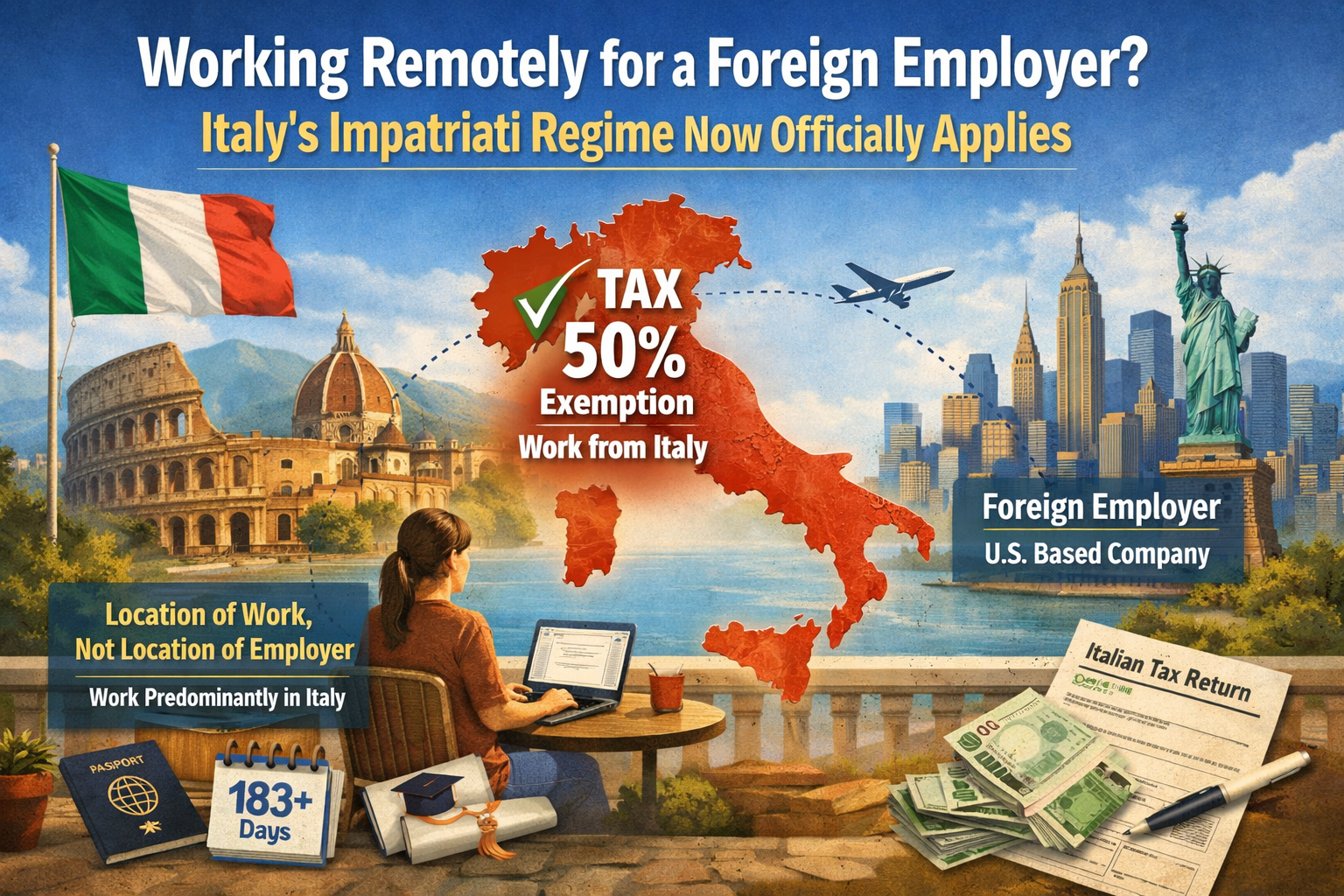
The new impatriati regime, introduced by Article 5 of Legislative Decree 209/2023, addresses a different tax base: Italian-source employment or self-employment income. Eligible inbound workers exclude 50% of that income from the IRPEF base for five years, with a 60% exemption available for parents who relocate with minor children. The annual income cap is €600,000.
Because the two regimes carve up the income map without overlap, combining them has been legitimate since the 2024 reform. The Italian Revenue Agency confirmed the cumulability in late-2025 guidance, treating the legislative silence on the point as an implicit green light. That silence is now over.
What the new rule actually says
DL 38/2026 introduces an explicit ban on cumulation, but only on a forward-looking basis. Taxpayers who establish Italian tax residence by 31 December 2026 continue to apply both regimes side by side for the full statutory duration of each. The protection is permanent and is not a phase-out. Taxpayers who transfer tax residence to Italy from 1 January 2027 onwards may elect either the flat tax or the impatriati regime, but not both. The election will be effectively binding for the duration of whichever regime is chosen.
The regime for professors and researchers is unaffected and remains separately combinable with other incentives.
What this means in practice
For anyone weighing an Italian move, the practical question is whether to bring it forward so the residence transfer takes effect before 2027. Italian tax residence is established when, for the majority of the tax year (more than 183 days), the individual maintains residence, domicile, or registered presence in Italy. For a 2026 move, this typically requires physical relocation by early July 2026 at the latest, supported by registration with the local anagrafe and consistent evidence that the personal and economic centre of life has shifted.
The combination is most valuable for taxpayers who have substantial foreign passive income — which the flat tax shelters at a flat €300,000 — and who will earn significant Italian-source professional or executive income, which the impatriati regime taxes on only half of its amount. For taxpayers whose profile is heavily weighted to only one of these two income streams, the choice imposed from 2027 will have a more limited financial impact, but the calculation should still be run carefully before any decision.
A Note for U.S. Citizens
U.S. citizens remain subject to worldwide taxation by the IRS regardless of where they reside. The flat tax can be treated as a creditable foreign tax in Italy, but its lump-sum nature complicates the per-country and per-basket allocation of the Foreign Tax Credit on Form 1116. Pairing it with the impatriati regime — under which half of Italian-source income is exempt from IRPEF — typically lowers the Italian tax actually paid on that portion, which in turn reduces the credit available against U.S. tax. In some scenarios this mechanically transfers part of the Italian saving into additional U.S. tax. A bilateral simulation, year by year and for the full intended duration of the regimes, is indispensable before relying on the combination as a planning strategy.
Final Considerations
The 2026 deadline is firm but the planning is not always simple. Establishing Italian tax residence, securing the flat tax election, and documenting eligibility under the impatriati regime are three distinct processes, each with its own timing and evidentiary requirements. For internationally mobile taxpayers considering Italy, this calendar year is the last opportunity to lock in the most generous version of the framework. Specialist advice that integrates both Italian and home-country tax positions is strongly recommended before any commitment is made.