
02.4004.4318
CALL US!
8:30 - 17:30
Mon-Fri

Categoria: Business setup

Use of Cash for Travel Expense Reimbursements Incurred by Professionals and Billed to Clients ?

Use of cash for Travel Expense Reimbursements Incurred by Professionals and Billed to Clients?

1. Regulatory Premise

Starting from the 2025 tax period, the legislator introduced significant changes to the tax treatment of expense reimbursements billed by professionals to their clients. These updates affect two key areas:

  • the tax treatment for the professional;
  • the deductibility of the cost for the client (enterprise).

2. Tax Aspects for the Professional

2.1 Tax Relevance of the Reimbursement

Under Article 54, paragraph 2, letter b) of the Italian Income Tax Code (TUIR), reimbursements analytically billed by the client for expenses incurred by the professional do not contribute to taxable self-employment income. This means:

  • such reimbursements are not subject to income tax;
  • no withholding tax is due from the client.

2.2 Traceability Condition (new paragraph 2-bis)

The newly introduced paragraph 2-bis, added by Decree-Law 84/2025, states that the tax-exempt status of the reimbursement is conditional on the professional having paid the original expense using traceable payment methods. This condition is especially relevant when:

  • the reimbursement is not actually received (e.g. client insolvency);
  • the professional wishes to deduct the unreimbursed cost.

3. Tax Aspects for the Client

3.1 New Deductibility Rules (Article 108 TUIR)

Revised by the same Decree-Law 84/2025, Article 108 TUIR sets out in paragraphs 5-bis and 5-ter that:

  • Paragraph 5-bis: travel, lodging, and transportation expenses (including taxi services) incurred directly by the business are deductible only if paid using traceable means (e.g., bank transfers, credit cards, or systems listed in Article 23 of Legislative Decree 241/1997).
  • Paragraph 5-ter: this rule also applies to analytical reimbursements paid to professionals for expenses incurred during the execution of contracted services. Again, deductibility is conditional upon the client paying the professional via a traceable method.

3.2 Who Must Ensure Traceability?

The law refers generically to “payments”, but:

  • for expenses directly incurred by the enterprise (paragraph 5-bis), traceability concerns payments to the service provider;
  • for reimbursements to professionals (paragraph 5-ter), traceability applies to the payment made by the client to the professional, not to the original payment made by the professional.

4. Coordination with Article 54 TUIR

The rules align coherently:

  • Article 54 TUIR regulates the professional’s side, requiring them to use traceable methods only if they wish to avoid taxation or deduct unreimbursed expenses;
  • Article 108 TUIR applies exclusively to the client (enterprise) and requires traceability of the invoice payment.

There is no need for the professional to have used traceable methods for the client to claim the deduction.


5. Operational Considerations and Simplifications

5.1 No Verification Obligations for the Client

The client is not required to:

  • verify how the professional paid the expenses;
  • collect or store evidence related to the professional’s original payments.

It is sufficient that the invoice is paid using a traceable method, in order for the expense to be deductible.

5.2 Documentation Obligations for the Professional

Only the professional has an interest in ensuring payment traceability:

  • to exclude the reimbursement from their taxable income;
  • to deduct unreimbursed costs when applicable.

6. Final Remarks

  • The regulatory framework clearly distinguishes between the roles of the professional and the client.
  • Traceability is a condition for the client’s deduction, but it only applies to the invoice payment.
  • There is no obligation for the professional to use traceable payments to enable the client’s deduction.
  • The traceability obligation is relevant only for the professional’s own tax treatment.
  • The rules aim to simplify compliance for businesses, avoiding burdensome documentation of how the professional originally paid the expenses.
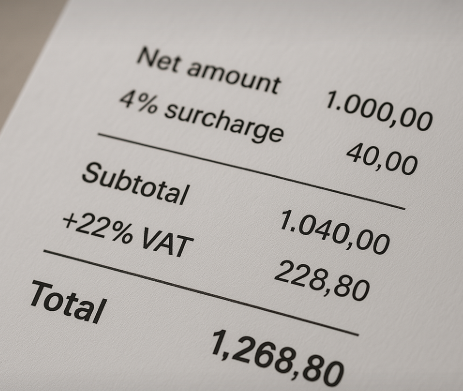
4% social security surcharge on invoices : What is it ?

4% social security surcharge on invoices : What is it ?
If you’ve received an invoice from an Italian consultant or freelancer, and there’s a 4% charge added to the net amount, here’s what it means:

It is not a tax or a penalty
The 4% line item is not a fine or extra fee. It’s a social security-related charge, required or allowed by Italian law depending on the type of professional issuing the invoice.

Two possible cases – what it means for you

Case A – The professional is part of a regulated profession (e.g. architect, lawyer)
The 4% is a mandatory contribution to their professional pension fund.

It’s called the “contributo integrativo”.

Italian law requires the professional to charge it to the client, even if the client is not in Italy.

This 4% does not increase their taxable income. On this 4% there is no witholding tax but it has VAT

You simply pay it as part of the invoice — you don’t need to do anything else.

Case B – The professional is a freelancer without a professional order (e.g. designer, consultant)
The 4% is optional and is used to partially offset their INPS social security costs.

It’s allowed by INPS (the Italian social security institute).

In this case, it is included in their taxable income. So the 4% has witholding tax , and of course VAT

Again, as the client, you just pay it as shown — no further action required on your side.

Why is it on your invoice?
In both cases, the professional is simply complying with the rules of the Italian social security system. The 4% charge helps cover pension contributions and is a standard item in many invoices from Italian professionals.

It is not VAT, and it is not negotiable if it’s mandatory. If it’s optional (INPS case), it may have been previously agreed as part of the overall fee.

What do you need to do?
Nothing special. Just:

Pay the invoice including the 4% charge.

Make sure it’s listed clearly in the invoice breakdown.

No extra forms, declarations, or withholding obligations apply — especially if you are based outside of Italy.

How to Open a Partita IVA ( individuals )

How to Open a Partita IVA ( individuals )

What Is a Partita IVA ?
The Partita IVA (VAT number) is a unique 11-digit identification number used by the Italian tax authority (Agenzia delle Entrate) to track the financial activity of self-employed individuals, freelancers, and businesses.

If you’re planning to:

Work as a freelancer or consultant

Run a sole proprietorship (ditta individuale)

Launch a small business or e-commerce site

Provide professional services in Italy,

The process to open it

  1. Choose the Type of Activity and ATECO Code
    (Each activity is classified under an ATECO code, a standard Italian business classification.)
  1. Choose Your Tax Regime
    You must select the appropriate tax regime:

Regime Forfettario (Flat-tax): for revenues up to €85,000/year. Fewer obligations, simplified taxation.

Regime Ordinario Semplificato or Ordinario: for higher revenues or more complex businesses.

  1. Register with the Agenzia delle Entrate
    Fill out and submit form AA9/12.

You can do this:

Online, through our office

In person at your local Agenzia delle Entrate office

THIS is the form

4-Register with INPS
If you are self-employed, you must register with the appropriate INPS fund:

    Gestione Separata (for freelancers without a professional register)

    Artigiani e Commercianti (for traders and artisans)

    This is essential to pay your social security contributions.

      5-(Optional) Register with the Chamber of Commerce
      Required for some activities (e.g., artisans, retailers)

      Required Documents
      Valid ID (and permesso di soggiorno if non-EU)

      Italian tax code (codice fiscale)

      ATECO code and business details

      How Long Does It Take?
      VAT certificate : same day

      INPS and Chamber of Commerce: typically a few days to a week

      Please contact our Offices for any assistance.

      How to chose and setup a Corp.

      In Italy, setting up a company follows specific legal and bureaucratic procedures. Below is a breakdown of different types of companies in Italy and how to set them up, based on Italian corporate law.


      1. Sole Proprietorship (Ditta Individuale)

      A Ditta Individuale is a one-person business where the owner is personally responsible for all debts.

      Pros:

      • Simple and low-cost to set up
      • Minimal bureaucratic requirements
      • Profits taxed as personal income

      Cons:

      • Unlimited liability (owner’s personal assets are at risk)
      • Harder to access funding and investment
      • Less credibility compared to corporations

      How to Set Up a Ditta Individuale:

      1. Choose a Business Name (optional, default is the owner’s name).
      2. Register with the Chamber of Commerce (Camera di Commercio).
      3. Obtain a Partita IVA (VAT Number) from the Agenzia delle Entrate.
      4. Register with INPS (National Social Security Institute) for pension contributions.
      5. Register with INAIL (Insurance for workplace accidents) if applicable.
      6. Open a Business Bank Account.
      7. Issue Electronic Invoices (mandatory in Italy for B2B and B2G).

      2. General Partnership (Società in Nome Collettivo – SNC)

      A SNC is a partnership where all partners share equal liability for debts.

      Pros:

      • Simple and flexible management
      • No minimum capital required
      • Direct taxation (partners pay personal income tax)

      Cons:

      • Unlimited personal liability for all partners
      • Joint responsibility for debts

      How to Set Up an SNC:

      1. Draft a Partnership Agreement (Atto Costitutivo) with a notary.
      2. Register with the Chamber of Commerce.
      3. Obtain a Partita IVA from the tax office.
      4. Register with INPS and INAIL.
      5. Deposit the company documents at the Registro delle Imprese.
      6. Open a Business Bank Account.

      3. Limited Partnership (Società in Accomandita Semplice – SAS)

      A SAS has two types of partners:

      • General partners (Soci Accomandatari): Have full liability.
      • Limited partners (Soci Accomandanti): Only liable for the amount they invested.

      Pros:

      • Allows silent investors with limited risk
      • Less strict regulations than corporations

      Cons:

      • General partners bear full liability
      • More complex structure than SNC

      How to Set Up an SAS:

      1. Draft the company statutes and sign before a notary.
      2. Register with the Chamber of Commerce.
      3. Obtain a Partita IVA.
      4. Register with INPS and INAIL.
      5. Deposit company documents with the Registro delle Imprese.

      4. Limited Liability Company (Società a Responsabilità Limitata – SRL)

      An SRL is the most common corporate structure in Italy, offering limited liability to shareholders.

      Pros:

      • Shareholders’ liability is limited to their investment
      • Easier to attract investors
      • More professional credibility

      Cons:

      • Higher setup and maintenance costs
      • Stricter regulations than partnerships
      • Mandatory accounting and annual financial statements

      How to Set Up an SRL:

      1. Draft Articles of Association (Atto Costitutivo) with a notary.
      2. Deposit Minimum Share Capital (€10,000 for a standard SRL, €1 for an SRLS).
      3. Register with the Chamber of Commerce.
      4. Obtain a Partita IVA.
      5. Register with INPS and INAIL.
      6. Open a Business Bank Account.
      7. Appoint a Legal Representative.

      5. Simplified Limited Liability Company (Società a Responsabilità Limitata Semplificata – SRLS)

      A SRLS is a simplified version of an SRL, designed to be easier and cheaper to set up.

      Pros:

      • Lower setup costs (no notary needed)
      • Minimum capital of €1
      • Faster bureaucratic process

      Cons:

      • Less flexibility in structuring the company
      • More difficult to raise capital
      • Limited credibility for large contracts

      How to Set Up an SRLS:

      1. Use the standard government-approved statute (Atto Costitutivo).
      2. Register with the Chamber of Commerce.
      3. Deposit share capital (€1 to €9,999).
      4. Obtain a Partita IVA.
      5. Register with INPS and INAIL.
      6. Open a Business Bank Account.

      6. Joint-Stock Company (Società per Azioni – SPA)

      An SPA is a large-scale company where ownership is divided into shares.

      Pros:

      • Limited liability for shareholders
      • Can raise capital from investors and public markets
      • Best suited for large businesses

      Cons:

      • High setup costs (€50,000 minimum capital)
      • Strict regulations and reporting requirements

      How to Set Up an SPA:

      1. Draft the Articles of Association with a notary.
      2. Deposit the minimum capital (€50,000).
      3. Register with the Chamber of Commerce.
      4. Appoint a Board of Directors.
      5. Register with INPS and INAIL.
      6. Open a Business Bank Account.
      7. Submit annual financial reports.

      Tax Treatment of Expense Reimbursements for Professionals in Italy: 2025 Updates

      As of January 1, 2025, significant changes have been introduced regarding the tax treatment of expense reimbursements for professionals in Italy. These changes stem primarily from Legislative Decree No. 192/2024 and the 2025 Budget Law.

      Reimbursement of Itemized Expenses for Professionals

      Expenses incurred by professionals while carrying out an assignment, when reimbursed on an itemized basis by the client, no longer contribute to taxable self-employment income. As a result, these reimbursements:

      • Are no longer subject to withholding tax.
      • Are not subject to pension fund contributions.
      • Remain subject to VAT, as they do not qualify as expenses incurred on behalf of the client under Article 15 of Presidential Decree No. 633/1972.

      To benefit from this tax treatment, expenses must be:

      • Incurred in the interest of the client.
      • Documented in a detailed and itemized manner.
      • Paid using traceable payment methods, such as credit cards, bank transfers, or other electronic payment systems.

      If the client fails to reimburse the professional, these expenses may still be deductible under specific conditions, such as in cases of client insolvency or the expiration of the credit claim.

      Mandatory Use of Traceable Payments

      The 2025 Budget Law has introduced a mandatory requirement to use traceable payment methods for the deductibility of travel and representation expenses. This requirement applies to professionals, employees, and businesses. Affected expenses include:

      • Hotel accommodations.
      • Meals and beverages.
      • Travel and transportation expenses, including taxi services and car rentals with drivers.

      If these expenses are not paid using traceable methods, they will not be deductible from taxable income. For employees, reimbursements for such expenses will become taxable for both income tax and social security purposes.

      Impact on Professionals Under the Flat-Rate Regime

      The new regulations do not appear to apply to professionals operating under the flat-rate tax regime, as the changes specifically affect Article 54 of the Italian Income Tax Code (TUIR), which governs self-employment income determination under the ordinary and simplified regimes.

      Conclusion

      These new provisions aim to enhance financial transparency and combat tax evasion by enforcing the use of traceable payment methods for the professional and business expenses.