
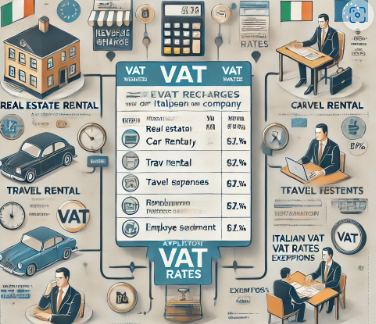

VAT Treatment of Expense Recharges Incurred by an Italian Company to Its European Parent Company
With Ruling No. 6/E of February 11, 1998, the Tax Administration reaffirmed that, from a civil law perspective, the relationship between the active party and the passive party in the recharging of costs should be classified as a mandate without representation. However, for VAT purposes, the operation falls within the scope of Article 3, third paragraph, of Presidential Decree No. 633/72, which states that the services rendered or received by agents without representation (SIT) are considered services even in the relationship between the principal and the agent
What is the correct VAT treatment for this service (i.e., how should the invoice be issued)?
In theory, the cost recharge could be treated in two different ways:
- As a general service, autonomously subject to VAT and unrelated to the nature of the individual services received.
- As a specific service, maintaining the same nature as the services originally received.
If we adopt Option (1), the situation would be relatively simple:
We would issue an invoice for “general cost recharge incurred in relation to the seconded employee” (or a similar description), out of scope for VAT under Article 7-ter of Presidential Decree 633/1972, with the statement “reverse charge” included on the invoice.
However, the Tax Administration has a different view.
According to the aforementioned Ruling No. 6/E of February 11, 1998:
It is considered that this provision not only qualifies the transaction carried out by the agent without representation as a service but also achieves the broader purpose of establishing a VAT framework based on a “fictio iuris” (legal fiction). This legal fiction fully aligns the services rendered or received by the agent with those rendered by the agent to the principal. The alignment also extends to the nature of the services, meaning that the services rendered by the agent to the principal cannot be considered a simple intermediary role but must have the same nature as the original services received or provided by the agent on behalf of the principal.
By reaffirming that the cost recharge constitutes a service, the ruling clarifies that the recharged cost retains the same intrinsic nature as the service originally received by the agent (SIT) and subsequently recharged to the principal (SEU).
Implications
This ruling has significant implications, as it requires us to analyze each individual service received, determine its correct VAT treatment, and then apply the corresponding VAT treatment to the recharge.
- General Rule: Generic services follow the VAT territoriality rule, meaning they are subject to VAT in the country of the recipient (SEU).
- In this case, the services should be re-invoiced as an out-of-scope VAT transaction under Article 7-ter of Presidential Decree 633/1972, with the mention “reverse charge” on the invoice.
However, subsequent articles of Presidential Decree 633/72 introduce exceptions for specific types of transactions:
VAT Treatment of Different Types of Costs in the Recharge
Real Estate Rental
- VAT territoriality rule: Rental of real estate follows the territoriality principle of the location of the property (Article 7-quater, paragraph 1, letter a, DPR 633/72).
- Since the property is in Italy, the service is subject to Italian VAT (generally exempt under Article 10, DPR 633/72).
- Recharge to the German parent company: It could be considered out of scope for VAT under Article 7-ter (if classified as a generic service provided to an EU taxpayer).
Long-Term Car Rental (Article 7-sexies, DPR 633/72)
- VAT territoriality: Determined by the location of the recipient.
- In this case, the recharge is subject to the reverse charge mechanism.
Travel Expenses (fuel, tolls, train, flight, taxi, etc.)
- Same VAT treatment: Reverse charge applies.
Restaurant Expenses
- Meals are classified as services tied to the place of performance (Article 7-quater, letter c, DPR 633/72).
- If the meal is consumed in Italy: The service is subject to Italian VAT.
- Recharge to the parent company: The recharge does not change VAT territoriality, so it remains subject to Italian VAT (reverse charge does not apply).
Hotel Expenses
- Hotel services are subject to VAT where they are provided (Article 7-quater, letter a, DPR 633/72).
- If the stay is in Italy: The service is subject to Italian VAT.
- Recharge to the parent company: The cost remains subject to Italian VAT.
Final Consideration: Salary/Wage Recharges
With Tax Ruling No. 38 published on February 18, 2025, the Italian Tax Authority confirmed the new VAT framework for personnel secondment.
- Article 16-ter of Decree Law 131/2024 establishes that secondment of personnel is considered a service subject to VAT when there is a direct link between the service provided and the consideration received.
- This law abolishes Article 8, paragraph 35 of Law 67/88, which previously excluded personnel secondment from VAT when the reimbursement only covered actual costs without a “mark-up.”
- The new rule applies only to secondment agreements signed or renewed from January 1, 2025.