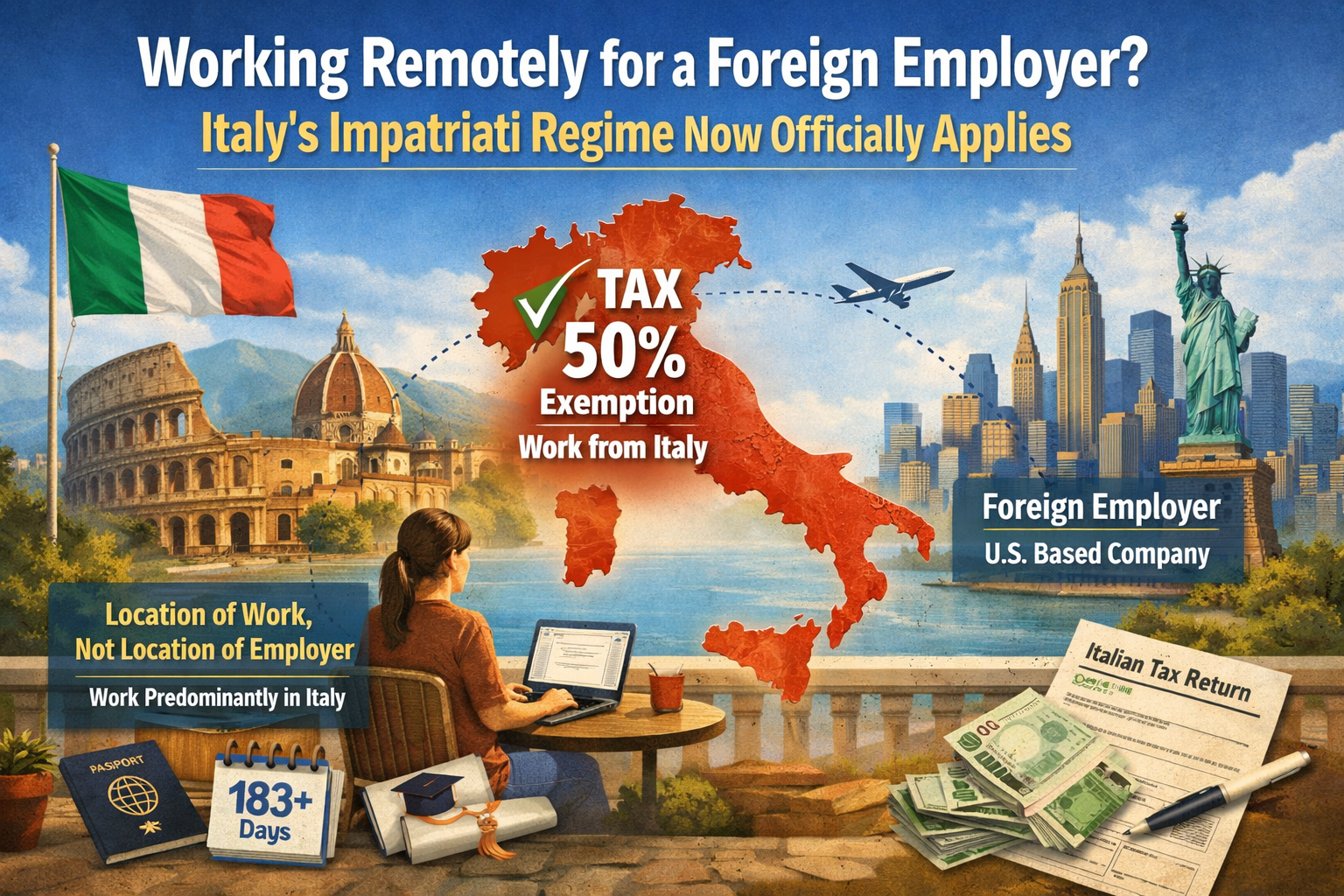
Working Remotely for a Foreign Employer? Italy’s Impatriati Regime Now Officially Applies
One of the most frequent questions we receive from professionals considering a move to Italy is whether the impatriati regime — Italy’s 50% income tax exemption for inbound workers — applies when their employer is based abroad and they plan to work from home in Italy. In January 2026, the Italian Revenue Agency answered that question clearly.
The Ruling: Location of Work, Not of Employer
The Revenue Agency confirmed that the impatriati regime is fully available to employees who transfer tax residence to Italy and continue working remotely for a foreign employer, provided the activity is carried out predominantly from Italian territory.
The principle is straightforward: what counts is where the work is actually performed, not where the employer is located. If you live and work in Italy — even if your contract is governed by foreign law or your payslips come from a company headquartered abroad — you can claim the 50% IRPEF exemption on your qualifying income for five years.
This applies to the new impatriati regime in force since 2024. Qualifying workers who transfer residence to Italy can exclude 50% of their Italian-source employment or self-employment income from IRPEF, up to €600,000 per year, for five consecutive tax years.
Key Requirements
Under the reformed regime, the worker must transfer Italian tax residence and not have been resident in Italy for at least the three years immediately preceding the transfer. A degree (bachelor level or equivalent) is required for highly qualified or specialised roles. Work must be performed predominantly in Italy, meaning more than 183 days per year physically working from Italian territory.
Notably, the new regime no longer requires the old “functional link” between the transfer of residence and the start of the qualifying work activity — making it easier for workers who return to Italy independently of any job change.
A Note for U.S. Citizens
U.S. citizens are taxed by the United States on their worldwide income regardless of where they live. Moving to Italy and claiming the impatriati exemption does not reduce the U.S. tax bill directly. However, Italian income taxes paid should in principle generate Foreign Tax Credits against U.S. liability — though the precise mechanics depend on how the income is characterised and on the applicable treaty provisions. U.S. citizens in this situation should seek advice from a professional experienced in both Italian and U.S. taxation before assuming the credits will offset in full.
Practical Points
Remote workers should keep records to demonstrate they worked predominantly from Italian territory: diary entries, travel records, and any documentation from the employer confirming the remote arrangement. If the foreign employer does not apply Italian payroll withholding, the worker self-declares the income and the impatriati exemption in their Italian annual tax return — the Revenue Agency has confirmed this is the standard approach.
One consideration for employers: if a senior employee habitually concludes contracts on behalf of a foreign company from Italian soil, that company could inadvertently create a taxable presence in Italy. This is a corporate structuring question the employer’s own advisers should evaluate.
Final Considerations
The ruling removes a practical ambiguity that had discouraged many remote professionals from claiming a benefit they were entitled to. For professionals already resident in Italy and working remotely for a foreign employer — or planning such a move — the five-year clock starts from the first year of Italian tax residence, so timing matters.
As always, cross-border situations require coordinated advice. The Italian regime is generous, but it does not operate in isolation from a taxpayer’s home-country obligations.
Need more information? We offer a complimentary 15-minute video call, in English or Italian, to help you quickly determine whether our financial and tax expertise is the right fit for your needs.
Need more info ?
Interested in our services ? Leave us your email and we'll contact you !