02.4004.4318
CALL US!
8:30 - 17:30
Mon-Fri

Categoria: Impatriati

Italy’s Flat Tax and Impatriati Regimes: The 2026 Window to Combine Both Closes from 2027

For several years, two of Italy’s most powerful inbound tax regimes — the non-dom flat tax for new residents and the new impatriati regime for inbound workers — could be applied together by the same taxpayer. That combination has produced striking outcomes for high earners: foreign passive income capped at a flat annual fee, and Italian-source employment or self-employment income taxed on only half of its amount. Decree-Law 38 of 27 March 2026 has now closed that door. From the 2027 tax year, anyone transferring tax residence to Italy must choose between the two regimes. Anyone who establishes Italian residence by 31 December 2026 keeps the combination intact for the full statutory duration of both regimes.

How the two regimes complement each other

The non-dom flat tax, governed by Article 24-bis of the Italian Income Tax Code, allows new residents to pay a fixed annual amount on all foreign-source income, regardless of size. The lump sum currently sits at €300,000 per year for the main applicant and €50,000 for each family member, for up to fifteen years. The regime targets high-net-worth individuals with significant offshore investments, dividends, capital gains, royalties, or rental income from abroad.

The new impatriati regime, introduced by Article 5 of Legislative Decree 209/2023, addresses a different tax base: Italian-source employment or self-employment income. Eligible inbound workers exclude 50% of that income from the IRPEF base for five years, with a 60% exemption available for parents who relocate with minor children. The annual income cap is €600,000.

Because the two regimes carve up the income map without overlap, combining them has been legitimate since the 2024 reform. The Italian Revenue Agency confirmed the cumulability in late-2025 guidance, treating the legislative silence on the point as an implicit green light. That silence is now over.

What the new rule actually says

DL 38/2026 introduces an explicit ban on cumulation, but only on a forward-looking basis. Taxpayers who establish Italian tax residence by 31 December 2026 continue to apply both regimes side by side for the full statutory duration of each. The protection is permanent and is not a phase-out. Taxpayers who transfer tax residence to Italy from 1 January 2027 onwards may elect either the flat tax or the impatriati regime, but not both. The election will be effectively binding for the duration of whichever regime is chosen.

The regime for professors and researchers is unaffected and remains separately combinable with other incentives.

What this means in practice

For anyone weighing an Italian move, the practical question is whether to bring it forward so the residence transfer takes effect before 2027. Italian tax residence is established when, for the majority of the tax year (more than 183 days), the individual maintains residence, domicile, or registered presence in Italy. For a 2026 move, this typically requires physical relocation by early July 2026 at the latest, supported by registration with the local anagrafe and consistent evidence that the personal and economic centre of life has shifted.

The combination is most valuable for taxpayers who have substantial foreign passive income — which the flat tax shelters at a flat €300,000 — and who will earn significant Italian-source professional or executive income, which the impatriati regime taxes on only half of its amount. For taxpayers whose profile is heavily weighted to only one of these two income streams, the choice imposed from 2027 will have a more limited financial impact, but the calculation should still be run carefully before any decision.

A Note for U.S. Citizens

U.S. citizens remain subject to worldwide taxation by the IRS regardless of where they reside. The flat tax can be treated as a creditable foreign tax in Italy, but its lump-sum nature complicates the per-country and per-basket allocation of the Foreign Tax Credit on Form 1116. Pairing it with the impatriati regime — under which half of Italian-source income is exempt from IRPEF — typically lowers the Italian tax actually paid on that portion, which in turn reduces the credit available against U.S. tax. In some scenarios this mechanically transfers part of the Italian saving into additional U.S. tax. A bilateral simulation, year by year and for the full intended duration of the regimes, is indispensable before relying on the combination as a planning strategy.

Final Considerations

The 2026 deadline is firm but the planning is not always simple. Establishing Italian tax residence, securing the flat tax election, and documenting eligibility under the impatriati regime are three distinct processes, each with its own timing and evidentiary requirements. For internationally mobile taxpayers considering Italy, this calendar year is the last opportunity to lock in the most generous version of the framework. Specialist advice that integrates both Italian and home-country tax positions is strongly recommended before any commitment is made.

The Italian Impatriati Regime in 2026: A Practical Overview for Workers Relocating to Italy

The Impatriati Regime is Italy’s main preferential tax incentive for qualified professionals who move their tax residence to the country. Restructured in 2024 and confirmed for 2026, it reduces the taxable base of Italian-source employment and self-employment income for a set number of years. Compared with the pre-2024 version, the current regime is more selective: lower exemption, shorter duration, stricter eligibility, and an income cap. ( FOR FULL DETAILS CLICK HERE )

Who Can Access the Regime

To qualify in 2026, an individual must simultaneously meet five conditions. The first is the transfer of tax residence to Italy under Italian domestic rules. The second is not having been an Italian tax resident in the three tax years preceding the transfer; this look-back period is extended to six years, or seven in some cases, if the worker continues to work in Italy for the same employer or the same group they worked for abroad.

The third condition is a commitment to remain an Italian tax resident for at least four years: losing residence earlier triggers recapture of the benefit with interest. The fourth is that work must be performed mainly in Italy — more than 183 days in the tax year. The fifth, and most restrictive, is the high qualification or specialization requirement: the worker must hold a qualification recognised under EU rules on regulated professions or on highly qualified employment (the EU Blue Card framework), or have equivalent specialised competences. Generic or low-skill roles are excluded.

Eligible Income

The regime applies to Italian-source employment income and self-employment income from arts and professions, including directors’ fees for duties performed in Italy. Business income from sole traders and partnerships, as well as passive income such as dividends, interest, capital gains and rental income, is not eligible and is taxed under the ordinary rules.

Benefits and Duration

The standard benefit is a 50 percent exemption of eligible income from IRPEF: only half is subject to Italian progressive income tax, and the same reduced base also applies to regional and municipal surtaxes. The exemption increases to 60 percent if the worker has a minor dependent child at the time of transfer or becomes a parent during the benefit period, provided the child resides in Italy.

The regime is capped at 600,000 euro of eligible income per year; any excess is fully taxed at ordinary rates. The duration is five tax years, starting from the year of transfer. Unlike the previous version, no extensions are available, not even where children or real estate purchases previously triggered a five-year extension.

Practical Points Before the Move

Eligibility turns on documentation. Returning Italian nationals must formally cancel their AIRE registration; foreign nationals must complete anagraphic registration with the Italian municipality. A codice fiscale is required, as is evidence of foreign residence during the look-back period — foreign tax returns, contracts, utility bills, AIRE certificates. Employees then submit a written request to the Italian employer, who applies the reduced withholding on monthly payroll; self-employed professionals apply the reduction directly in the annual tax return.

Common pitfalls include missing the 183-day test because of frequent remote working abroad, miscalculating the extended six- or seven-year look-back for those staying with the same group, and failing to document the high qualification requirement, which the Italian Revenue Agency is increasingly auditing. The regime is not combinable with the forfettario flat-tax regime, the 7 percent retiree regime for Southern Italy, or the lump-sum flat tax for new residents.

A Note for U.S. Citizens

U.S. citizens and green card holders continue to be taxed by the United States on worldwide income regardless of residence, and must keep filing Form 1040, FBAR and, where applicable, Form 8938. Because the Italian exemption reduces the Italian tax paid, the Foreign Tax Credit available to offset U.S. liability is lower, and residual U.S. tax may actually increase. The Italy–U.S. treaty’s saving clause preserves U.S. taxing rights over its citizens, so treaty relief is limited. Italian mutual funds and certain insurance wrappers are typically classified as PFICs and trigger punitive U.S. taxation and heavy reporting, and Italian complementary pensions may not qualify as tax-favoured plans under U.S. rules. A coordinated U.S./Italy projection before relocating is essential to model FTC, FEIE, state tax exit, and investment restructuring options.

Final Considerations

The 2026 Impatriati Regime remains a powerful incentive, but it rewards careful planning. Residence timing, documentation, the high qualification test and the interaction with other regimes can materially change the net benefit — and for U.S. persons the analysis must always be run on both sides of the Atlantic. Professional advice before the move is strongly recommended.

Impatriati Regime: Moving from Southern to Northern Italy Has Retroactive Tax Consequences

Impatriati Regime: Moving from Southern to Northern Italy Has Retroactive Tax Consequences

Italy’s inbound workers tax regime (regime degli impatriati) offers significant income tax relief to professionals and employees who transfer their residency to Italy after a qualifying period abroad. For those who settle in one of Italy’s southern regions, the benefit is even greater — but a ruling issued by the Italian Revenue Agency in March 2026 makes clear that relocating north mid-way through the relief period comes at a cost, and that cost runs backwards in time.

The Enhanced Benefit for Southern Regions

Under the rules applicable to workers who returned to Italy before 2024, the standard impatriati regime exempts 70% of qualifying income from IRPEF — meaning only 30% is subject to ordinary income taxation. For workers who transfer their residency to one of eight specified southern regions (Abruzzo, Molise, Campania, Puglia, Basilicata, Calabria, Sardinia, and Sicily), the exemption rises to 90%, with only 10% of qualifying income taxed. This enhanced relief was designed not just to attract workers to Italy, but to channel them specifically into regions where the economy needs a boost.

The legislation conditions this 90% rate on one key requirement: the worker must maintain residency in the qualifying southern region for the entire five-year duration of the benefit. What happens if they don’t was, until recently, less clear in practice.

What Ruling 76/2026 Decides

The case underlying the ruling involved a professional who returned to Italy in 2023 and established residency in Puglia, applying the 90% exemption from the outset. In 2024 they began a new employment with a Rome-based employer, and in 2025 they transferred their registered residency to Lazio. They asked the Revenue Agency three questions: does the move end all impatriati benefits, when exactly does the change take effect, and must prior years be corrected?

The Agency’s answer, issued on 11 March 2026, addresses all three points.

On the first question, the news is positive: moving to a non-qualifying region does not terminate the entire impatriati regime. The worker retains the standard 70% exemption for the remaining years of their five-year window. Only the enhanced 90% tier is lost.

On the second and third questions, the answer is considerably harsher. The Agency holds that the loss of the 90% benefit does not operate only from the date of the move, nor only for future tax years. It applies retroactively from the very first year of Italian residency. The reasoning is that the enhanced rate was never truly earned: the legislation requires uninterrupted southern residency throughout the entire benefit period, and since that condition was not ultimately met, the taxpayer never had the right to the 90% rate in the first place.

The Practical Consequence: Amending Prior Returns

For the worker in the ruling, this means the 90% rate applied to 2023 — the year of return, when they genuinely lived in Puglia — must be unwound. An amended tax return (dichiarazione integrativa) is required for that year, recalculating taxable income at the 30% standard level rather than the 10% enhanced level. The resulting additional tax, plus interest and penalties under Art. 1, comma 2, D.Lgs. 471/1997, must be paid. The voluntary disclosure mechanism (ravvedimento operoso) is available if the conditions are met, which can reduce the penalties.

The Agency adds a further, final point: a subsequent move back to a southern region would not restore the 90% exemption. What matters is continuous and unbroken residency in a qualifying region from the moment of first return. Once that continuity is broken, it cannot be reconstructed.

A Note for U.S. Citizens

U.S. citizens who applied the 90% exemption and claimed Italian taxes paid as a Foreign Tax Credit on their U.S. returns will need to consider the knock-on effect. Amending an Italian return to report higher taxable income and pay more Italian tax also means revisiting the U.S. returns for the relevant year — the FTC calculation will change. Depending on the amounts involved and whether the taxpayer was in an excess credit or excess limitation position, the U.S. tax impact could go in either direction. Professional advice covering both jurisdictions is essential before filing any amended return.

Final Considerations

Ruling 76/2026 draws a strict line: the enhanced southern-region benefit is all-or-nothing over the full five years. Workers who chose their Italian location partly with the 90% exemption in mind should treat any planned internal relocation as a tax event requiring prior analysis, not just a change of address. If a move north is under consideration, calculating the retroactive adjustment and the cost of regularising prior years before committing is strongly advisable. A specialist review at the planning stage is far less costly than correcting the position after the fact.

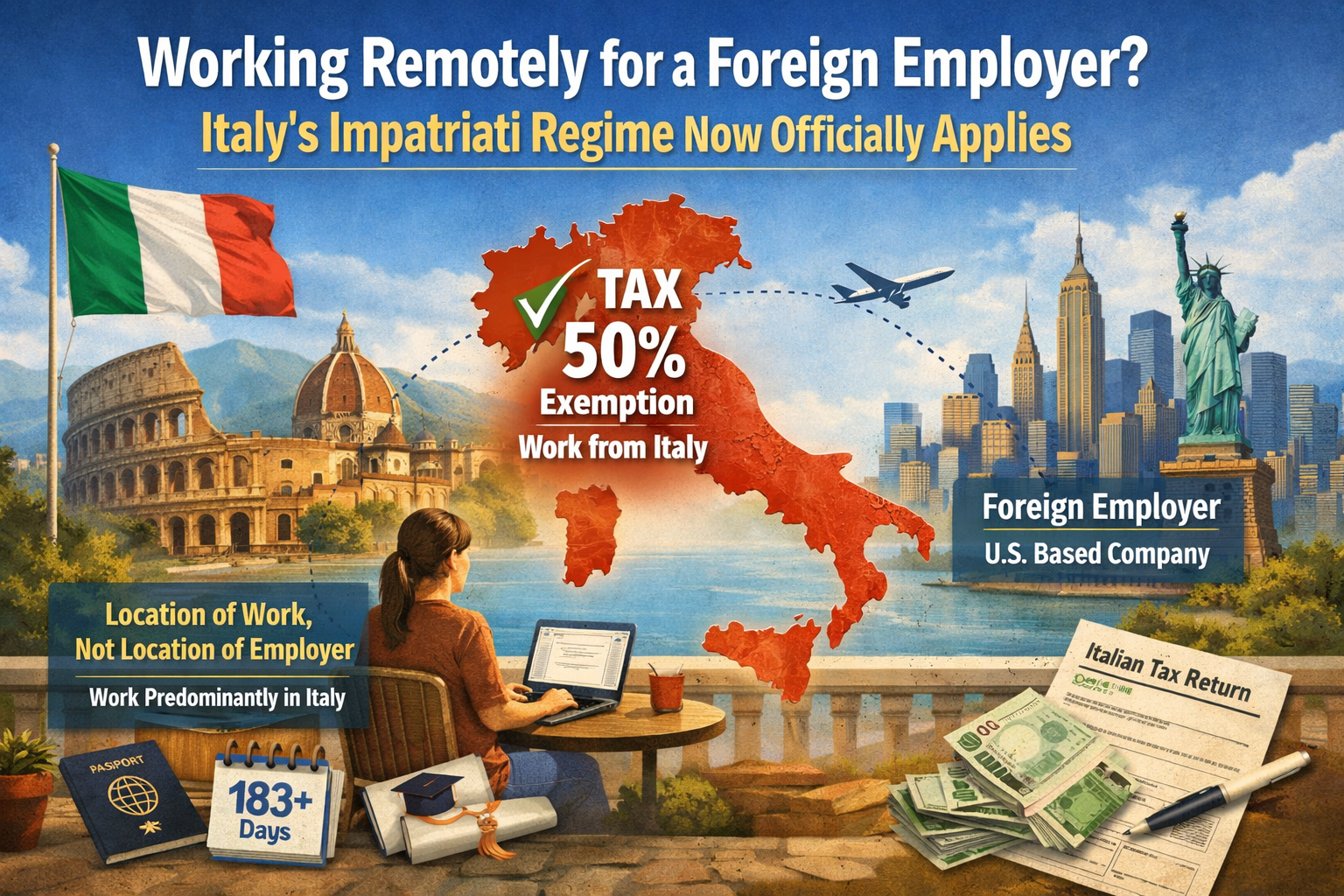
Working Remotely for a Foreign Employer? Italy’s Impatriati Regime Now Officially Applies

Working Remotely for a Foreign Employer? Italy’s Impatriati Regime Now Officially Applies

One of the most frequent questions we receive from professionals considering a move to Italy is whether the impatriati regime — Italy’s 50% income tax exemption for inbound workers — applies when their employer is based abroad and they plan to work from home in Italy. In January 2026, the Italian Revenue Agency answered that question clearly.

The Ruling: Location of Work, Not of Employer

The Revenue Agency confirmed that the impatriati regime is fully available to employees who transfer tax residence to Italy and continue working remotely for a foreign employer, provided the activity is carried out predominantly from Italian territory. The principle is straightforward: what counts is where the work is actually performed, not where the employer is located. If you live and work in Italy — even if your contract is governed by foreign law or your payslips come from a company headquartered abroad — you can claim the 50% IRPEF exemption on your qualifying income for five years. This applies to the new impatriati regime in force since 2024. Qualifying workers who transfer residence to Italy can exclude 50% of their Italian-source employment or self-employment income from IRPEF, up to €600,000 per year, for five consecutive tax years.

Key Requirements

Under the reformed regime, the worker must transfer Italian tax residence and not have been resident in Italy for at least the three years immediately preceding the transfer. A degree (bachelor level or equivalent) is required for highly qualified or specialised roles. Work must be performed predominantly in Italy, meaning more than 183 days per year physically working from Italian territory. Notably, the new regime no longer requires the old “functional link” between the transfer of residence and the start of the qualifying work activity — making it easier for workers who return to Italy independently of any job change.

A Note for U.S. Citizens

U.S. citizens are taxed by the United States on their worldwide income regardless of where they live. Moving to Italy and claiming the impatriati exemption does not reduce the U.S. tax bill directly. However, Italian income taxes paid should in principle generate Foreign Tax Credits against U.S. liability — though the precise mechanics depend on how the income is characterised and on the applicable treaty provisions. U.S. citizens in this situation should seek advice from a professional experienced in both Italian and U.S. taxation before assuming the credits will offset in full.

Practical Points

Remote workers should keep records to demonstrate they worked predominantly from Italian territory: diary entries, travel records, and any documentation from the employer confirming the remote arrangement. If the foreign employer does not apply Italian payroll withholding, the worker self-declares the income and the impatriati exemption in their Italian annual tax return — the Revenue Agency has confirmed this is the standard approach. One consideration for employers: if a senior employee habitually concludes contracts on behalf of a foreign company from Italian soil, that company could inadvertently create a taxable presence in Italy. This is a corporate structuring question the employer’s own advisers should evaluate.

Final Considerations

The ruling removes a practical ambiguity that had discouraged many remote professionals from claiming a benefit they were entitled to. For professionals already resident in Italy and working remotely for a foreign employer — or planning such a move — the five-year clock starts from the first year of Italian tax residence, so timing matters. As always, cross-border situations require coordinated advice. The Italian regime is generous, but it does not operate in isolation from a taxpayer’s home-country obligations.

New Italian Inbound Workers Regime: Employer of Record Continuity and Extended Foreign Residence Requirement

New Italian Inbound Workers Regime: Employer of Record Continuity and Extended Foreign Residence Requirement

Italian Revenue Agency – Ruling No. 54/2026

The Italian Revenue Agency examined the application of the new inbound workers tax regime (Article 5, Legislative Decree No. 209/2023) in a case involving:

An Italian citizen resident in Switzerland for three tax years;

Employment abroad through a Swiss Employer of Record (EoR);

Relocation to Italy in 2025;

New employment in Italy for a different foreign operating company;

Formal employment contract signed with an Italian Employer of Record belonging to the same corporate group as the Swiss EoR.

The operating companies benefiting from the employee’s services were not related to each other.

The taxpayer argued that the ordinary three-year foreign residence requirement should apply, since the EoR performed only administrative/payroll functions and had no managerial authority.

Legal Framework

Under Article 5 of Legislative Decree No. 209/2023, the new inbound workers regime provides:

A 50% exemption on Italian-source employment income (up to EUR 600,000 annually);

A minimum foreign residence requirement of three tax years;

An extended requirement of six or seven tax years if, upon return, the employee works:

for the same employer, or

for a company belonging to the same corporate group (as defined under Article 2359 of the Italian Civil Code).

Position of the Revenue Agency

The Revenue Agency clarified that:

Continuity is assessed based on whether the employer (or group) before and after the relocation is the same;

This principle also applies when the formal employer is an Employer of Record;

It is irrelevant that the EoR performs only administrative functions;

It is irrelevant that the operating companies benefiting from the services are different and unrelated.

Since the Swiss and Italian Employers of Record belonged to the same corporate group, the Agency considered that continuity existed.

Conclusion

The ordinary three-year foreign residence requirement does not apply.

The taxpayer must satisfy the extended six-year foreign residence requirement to qualify for the new inbound workers regime.

Practical Implications

The ruling confirms a formal and structural interpretation of “group continuity,” focusing on corporate control relationships rather than on the substantive nature of the employment relationship.

This interpretation is particularly relevant for:

International mobility structures involving Employers of Record;

Multinational groups using payroll intermediaries;

Cross-border employment planning under the new Italian inbound workers regime.

Forfettario vs. Impatriati for U.S. Citizens in Italy: How Dual Taxation Shapes Expat Choices

Forfettario vs. Impatriati for U.S. Citizens in Italy: How Dual Taxation Shapes Expat Choices

For professionals and employees relocating to Italy, the regime forfettario and the regime degli impatriati are often seen as the two most attractive tax incentives.
From a purely Italian perspective, both regimes offer significant advantages.
However, for U.S. citizens, the decisive factor is not domestic taxation alone, but the interaction between Italian incentives and U.S. worldwide taxation.
This interaction profoundly affects the real economic outcome and, therefore, the strategic choices of expatriates.

The Dual Tax Framework
A U.S. citizen resident in Italy is subject to two tax authorities:
• The Italian system, administered by Agenzia delle Entrate, based on residence
• The U.S. system, administered by the Internal Revenue Service, based on citizenship
Both systems require the declaration of worldwide income.
As a result, any Italian tax benefit must be evaluated in light of its impact on U.S. taxation.

The Forfettario Regime in an International Context
Domestic Logic
The forfettario regime is designed as a simplified system for small professionals.
It applies a substitute tax and removes the need for detailed accounting.
Its structure is built around income containment and administrative ease.
Interaction with U.S. Rules
From the U.S. perspective:
• Income remains fully visible
• The substitute tax is largely ignored
• Taxation follows ordinary federal rules
However, the forfettario regime operates within an income ceiling that is structurally compatible with U.S. foreign income exclusions (FIE).
When residency requirements are met and currency conversion remains favorable, the entire Italian professional income may fall within U.S. exclusion mechanisms.
In these cases, the Italian benefit can be preserved at a global level.


The Impatriati Regime in an International Context
Domestic Logic
The impatriati regime reduces the taxable base of employment or professional income.
Only part of the income is subject to ordinary Italian taxation.
It is intended to attract skilled workers and managers.
Interaction with U.S. Rules
From the U.S. perspective:
• The full gross income is taxable
• The Italian reduction is ignored
• No structural coordination exists
The IRS does not recognize partial exemptions granted by foreign law.
It taxes economic income, not domestically reduced bases.
As a consequence, the portion exempted in Italy often becomes fully taxable in the United States, if above the FIE threshold.
Practical Implication
Under the impatriati regime:
• Italian taxes decrease
• U.S. taxes tend to increase proportionally
• Foreign tax credits weaken
In many cases, the Italian benefit is largely transferred to the U.S. tax base.
This makes the regime internationally inefficient for most U.S. citizens.

The Role of Exchange Rates
For both regimes, income must be converted into U.S. dollars for tax purposes.
Fluctuations in the EUR/USD rate may:
• Reduce the effectiveness of U.S. exclusions
• Increase residual U.S. taxation
• Destabilize long-term planning
This risk is more relevant for forfettario cases, where alignment with U.S. exclusions is essential.

Compliance and Risk Exposure
Both regimes require full U.S. reporting.
Relying solely on Italian compliance exposes expatriates to:
• Underreporting risks
• Accumulated liabilities
• Penalties and interest
• Difficult regularization procedures
The risk is structurally higher under the impatriati regime, where income levels are typically higher and credits weaker.

Conclusion
For U.S. citizens in Italy, the choice between forfettario and impatriati cannot be made on domestic grounds alone.
The forfettario regime may preserve its advantage when carefully integrated with U.S. exclusions and currency management.
The impatriati regime, while powerful domestically, is often neutralized internationally.
As a result:
• Forfettario supports globally efficient self-employment models
• Impatriati supports career-driven relocation with limited tax efficiency
For expatriates, the optimal decision depends less on Italian tax rates and more on long-term international coordination.
Without such coordination, both regimes risk becoming attractive on paper but ineffective in practice.

Please contact us for any further info !

Deferred bonuses and the end of the impatriate regime: the Italian Revenue Agency clarifies timing and taxation

Deferred bonuses and the end of the impatriate regime: the Italian Revenue Agency clarifies timing and taxation

The Italian Revenue Agency, through Ruling No. 274/2025, examined whether the impatriate regime can apply to deferred compensation — such as long-term incentive plans, stock options, or deferred cash bonuses — that are paid after the end of the preferential period and after the worker has moved abroad.
The question concerns employees who benefited from the impatriate regime while working in Italy but later left the country, receiving at a later stage certain deferred payments linked to their previous Italian employment. The key issue is whether such income, although economically connected to work performed in Italy during the eligible period, can still enjoy the tax relief once the regime has expired and the worker is no longer an Italian tax resident.

Agency’s reasoning and position
The Revenue Agency reaffirmed two guiding principles:

Cash principle: employment income is taxed when it is actually paid, not when it is earned. Therefore, if a deferred bonus or incentive is paid after the end of the five-year (or extended) impatriate period, or after the individual becomes non-resident, the preferential regime can no longer apply.

Source principle: even though the worker is no longer resident in Italy, the portion of income linked to work performed on Italian territory remains taxable in Italy as Italian-source income. In such cases, the Italian employer must operate the ordinary withholding tax, while the foreign country of residence will grant relief for any double taxation under the relevant tax treaty.

In summary
The Agency concluded that the impatriate regime is strictly temporal: it applies only to income received while the worker is both tax resident in Italy and within the benefit period. Deferred bonuses or stock plans paid later are still taxable in Italy — if connected to Italian work activity — but under ordinary taxation, without the impatriate exemption.

Extension of the “Impatriate Regime” for workers who moved to Italy in 2020: what happens after the first 5 years


🌍 Extension of the “Impatriate Regime” for workers who moved to Italy in 2020: what happens after the first 5 years

The so-called “impatriate regime” (Regime degli impatriati), ,aims to attract highly skilled workers to Italy by offering a significant tax incentive: partial tax exemption on employment, self-employment, and business income produced in Italy.


🔎 Standard duration: first 5 years

  • Workers who transferred their tax residence to Italy in 2020 benefited from the regime for five years, starting from the year they became tax residents in Italy.
  • For them, the last year of the initial benefit period was 2024.

📌 What happens after 2024?

As a rule, the regime expires after five years. However, Italian law allows an extension for an additional five years (up to a total of ten years), under specific conditions.


Conditions for the 5-year extension

To continue benefiting from a tax reduction from 2025 to 2029, the worker must meet at least one of the following conditions before the end of 2024:

1️⃣ Have at least one minor or dependent child, including those in pre-adoptive foster care.

2️⃣ Purchase a residential property in Italy after the move (or within the 12 months before the transfer).


💰 Tax benefit during the extension

  • During the first five years, eligible workers benefited from a 70% exemption on qualifying income (or even 90% for those working in southern Italy).
  • During the extension period, the tax exemption is reduced to 50%.
  • No lump-sum payment or additional contributions are required to access this extension (unlike the special rules for professional athletes).

📊 Summary table

PeriodExemptionConditionsPayment required?
First 5 years (2020–2024)70% (or 90% south)Residence abroad for ≥ 2 years + move to Italy + work mainly in ItalyNo
Additional 5 years (2025–2029)50%At least one minor child or residential property purchaseNo

💼 Procedural requirements

  • The worker must opt for the extension by indicating it in their 2025 Italian tax return (submitted in 2026).
  • It is advisable to inform the employer to ensure correct application of reduced tax withholdings.
  • Documentation proving the existence of the child or property ownership must be retained for potential tax audits.

📈 Example

Let’s assume:

  • A worker moved to Italy in 2020.
  • They have a minor child born in 2023.
  • Their last year of standard benefit is 2024.

In this case, they qualify to extend the regime from 2025 to 2029 with a 50% tax exemption, without paying any extra fee.


⚖️ Conclusion

✔️ Workers who moved to Italy in 2020 will see their initial 5-year benefit end in 2024.
✔️ If they have a minor child or bought a home in Italy, they can extend the benefit for another 5 years (2025–2029) at a 50% exemption rate.
✔️ No lump-sum contributions or additional costs are required.
✔️ Timely option and proper documentation are crucial to continue enjoying the benefit safely.


💬 Need support?

If you or your clients are eligible for the extension, it is highly recommended to plan in advance, check compliance, and prepare the necessary documentation.

No special Tax regime for those who return in Italy to perform the same Job

For Taxpayers who return in Italy after a period abroad , there is no tax benefit in the presence of the same contract, same job and with the same employer. This was clarified by the Agenzia delle Entrate  with the response to ruling no. 42 of 18 January 2021.

If however the impatriate assumes a different corporate role than the original one, with a new contract that does not constitute a mere  the continuation of the previous work, the benefits will be granted.

Special attention should thus be paid for those contract terms  that could indicate a mere prosecution of the previous Job  , as :

– recognition of seniority from the date of first hiring;

– the absence of the trial period;

– clauses aimed at not paying the accrued thirteenth (and possibly fourteenth) accrued monthly salaries .

We are as usual here for any further assistance .