02.4004.4318
CALL US!
8:30 - 17:30
Mon-Fri

Tag: Working in Italy

Italy’s New VAT Rule on Staff Secondments: The 2026 Roll-Over Risk for Foreign Groups

For decades, Italy treated the secondment of personnel between group companies as outside the scope of VAT whenever the recipient simply reimbursed the seconding entity for the employee’s gross cost. That rule has now been repealed. From 1 January 2025, every cross-charge for seconded staff is a VAT-relevant supply of services, regardless of whether a markup is applied. Throughout 2026, foreign groups with pre-existing secondment agreements are reaching the moment when those legacy contracts expire or get renewed — and that is precisely when the new regime kicks in for them.

What changed and why

The change was driven by the Court of Justice of the European Union. In San Domenico Vetraria (Case C-94/19, 11 March 2020), the Court ruled that an Italian subsidiary’s reimbursement of the parent’s cost for a seconded director constituted consideration for a service, and that Italy’s exemption was incompatible with EU VAT law. Italy resisted alignment for almost five years.

The legislative fix arrived with Article 16-ter of Decree-Law 131/2024 (the so-called Salva-infrazioni decree), converted into law by Law 166/2024. It repeals the old domestic carve-out (Article 8, paragraph 35 of Law 67/1988) and brings Italy fully in line with the EU framework. The Italian Revenue Agency then issued Circular 5/E of 16 May 2025, which is now the operational reference for both groups and their auditors.

The transitional regime — and why 2026 is the pinch point

The new rule does not retroactively rewrite contracts. It applies to secondment agreements entered into, or renewed, on or after 1 January 2025. Agreements signed up to 31 December 2024 continue to be governed by the old VAT-out treatment until they expire.

In practice, this creates a rolling cliff edge. A foreign group that signed an intercompany secondment agreement in mid-2024 may have lived through 2025 untouched, but every renewal date in 2026 — common for annual or biennial contracts — flips that arrangement into the new regime. Many treasury and tax teams will only discover the change when they receive the first VAT-charged invoice from their Italian counterparty.

What VAT now applies to

Under the new regime, the entire cross-charge for a seconded employee — gross salary, social security contributions, severance accruals, fringe benefits — is subject to standard 22% Italian VAT. The presence or absence of a markup is irrelevant. Even purely cost-neutral arrangements, historically very common between European parent companies and their Italian subsidiaries, are now caught.

The supply qualifies as a B2B service governed by Article 7-ter of the Italian VAT Code. Where the recipient is a foreign business, the supplier issues an invoice without Italian VAT and the recipient applies VAT in its own country under reverse charge. Where the recipient is an Italian VAT-registered company receiving staff from abroad, the Italian recipient self-applies VAT under the reverse-charge mechanism.

Where the real cost lands

For groups whose Italian recipient entity has full VAT recovery, the cash impact is timing-only — VAT is debited and credited in the same period. The pain point is for sectors with limited input VAT recovery: banks, insurance companies, asset managers, healthcare operators, education providers, and pure holding entities. For them, the secondment VAT becomes a real, non-recoverable cost — an immediate margin compression that did not exist a year ago.

There is also a documentation cost. Circular 5/E confirms that proper intercompany secondment agreements, with clearly defined remuneration, duration, and scope, are essential to avoid requalification by tax inspectors as either a different type of service (which may have different place-of-supply rules) or, in worst cases, as evidence of a hidden permanent establishment.

Final Considerations

Foreign groups operating in Italy should treat 2026 as a year of contract renewal triage. Every legacy intercompany secondment arrangement should be reviewed: when does it expire, what is the renewal mechanism, who absorbs the VAT, and does the Italian recipient have full VAT recovery. Where the Italian counterparty has restricted recovery, the entire economic logic of using a secondment instead of a local hire — or a service contract — should be revisited. As always, this is a context where general comfort is no substitute for tailored advice.

Foreign Employers and Italy’s Permanent Establishment Risk: What Hiring an Italian Remote Worker Really Means

A foreign company that allows even a single employee to work from Italy on a regular basis can, under Italian rules, end up with a permanent establishment (PE) in the country — and with it, Italian corporate tax, VAT registration, payroll obligations, and a tax filing footprint it never planned for. After several years of post-pandemic remote-work normalisation, the Italian Revenue Agency has made clear that home-based work for a foreign employer is not a neutral arrangement: it is a fact pattern that must be analysed carefully before anyone signs a contract.

The legal framework starts with Article 162 of the Italian Income Tax Code (TUIR) and the OECD Model Tax Convention’s PE definition embedded in Italy’s treaties. A PE arises whenever a foreign enterprise has a fixed place of business in Italy through which its activity is carried on in whole or in part — or whenever a person habitually concludes contracts on its behalf in Italy (the so-called agency PE). Both routes are now actively scrutinised in remote-work scenarios.

When Does a Home Office Become a Fixed Place of Business?

Italian Tax Authority guidance — most notably Circular Letter 33/E of 2020 and Ruling 596/2021, repeatedly cited in subsequent practice — sets out the framework. A home office is not automatically a PE, but it can become one if four conditions converge: the worker carries out core revenue-generating activities (not just preparatory or auxiliary support); the employer effectively has the home at its disposal (for instance, by reimbursing rent, requiring its use, or providing office equipment that turns the space into a de-facto branch); the activity is sufficiently continuous; and there is no genuine alternative workplace abroad.

What this means in practice is that the substance of the role matters far more than its label. A back-office IT engineer running internal systems is unlikely to create a PE. A sales director negotiating contracts with Italian or European clients from her Milan apartment almost certainly does. The Italian Revenue Agency consistently applies a “substance over form” test during audits, and Italian tax courts have followed suit.

The Agency PE Trap

Even more dangerous than the fixed-place test is the agency PE route. A foreign company can be deemed to have a PE in Italy if a person — even one without formal signing power — habitually plays the principal role in the conclusion of contracts that are then routinely approved by the foreign head office without material change. Post-2017 OECD updates, transposed into Italy’s recent treaties, deliberately broadened this concept to capture commissionaire and similar arrangements. A remote sales manager living in Italy who manages the customer pipeline end-to-end is exposed even if all paperwork is signed abroad.

What an Italian PE Triggers

Once a PE is found, the consequences cascade. The foreign company must register a branch in Italy, allocate profits to it under transfer pricing principles, file Italian corporate tax (IRES at 24% plus IRAP at around 3.9%), register for Italian VAT and issue Italian e-invoices, and operate Italian payroll withholding for the local employee. Penalties for unregistered PEs are severe: undeclared income is subject to assessments going back up to seven years where no return was filed at all. Following the 2024 reform of the Italian penalty system (Legislative Decree 87/2024), the applicable penalties are now fixed rather than banded: 70% of the tax due for an understated return and 120% for an omitted return, replacing the former 90%–180% and 120%–240% ranges, which continue to apply only to violations committed before 1 September 2024. Criminal exposure remains once the omitted-tax threshold is crossed.

Practical Risk Mitigation

There is no single bullet-proof shield, but several measures materially reduce exposure: a written employment contract that confines the Italian role to internal or auxiliary functions; explicit prohibition on negotiating, finalising, or signing contracts with clients from Italy; absence of any “Italy office” designation on business cards, websites, or LinkedIn profiles; a clear alternative workplace abroad that the employee uses regularly; and avoidance of employer-paid rent or dedicated office equipment that could anchor a “fixed place” finding. For higher-risk roles, an Employer of Record (EOR) structure or a properly registered Italian branch is often the cleanest answer.

A Note for U.S. Citizens and U.S. Companies

The Italy–U.S. tax treaty contains its own PE article that broadly tracks the OECD model, but the U.S. dimension adds layers. A U.S. company with a hidden Italian PE has filing obligations on Form 8858 (for the Italian branch) and may face overlapping U.S. and Italian taxation that the foreign tax credit only partly resolves — particularly when state income tax is in play. For the U.S. citizen working remotely from Italy, the issue is reversed: even if the employer is shielded from PE because of careful role design, the individual still faces full Italian residence-based taxation on worldwide income, which is why the Impatriati regime, the new-resident lump-sum, or the 7% retiree regime are usually evaluated alongside the PE analysis.

Final Considerations

Italian PE risk is a quiet but expensive trap for foreign companies that adopt remote-work flexibility without legal review. The arrangement that looks costless to HR can produce a seven-year tax exposure for the parent. Before authorising an employee to work from Italy — even occasionally — foreign companies should obtain a written PE risk assessment, document the role boundaries, and revisit the analysis whenever the worker’s responsibilities expand. Specialist Italian tax advice is not optional in this area; it is the difference between a clean cross-border arrangement and a multi-year reconstruction.

Italy’s Flat Tax and Impatriati Regimes: The 2026 Window to Combine Both Closes from 2027

For several years, two of Italy’s most powerful inbound tax regimes — the non-dom flat tax for new residents and the new impatriati regime for inbound workers — could be applied together by the same taxpayer. That combination has produced striking outcomes for high earners: foreign passive income capped at a flat annual fee, and Italian-source employment or self-employment income taxed on only half of its amount. Decree-Law 38 of 27 March 2026 has now closed that door. From the 2027 tax year, anyone transferring tax residence to Italy must choose between the two regimes. Anyone who establishes Italian residence by 31 December 2026 keeps the combination intact for the full statutory duration of both regimes.

How the two regimes complement each other

The non-dom flat tax, governed by Article 24-bis of the Italian Income Tax Code, allows new residents to pay a fixed annual amount on all foreign-source income, regardless of size. The lump sum currently sits at €300,000 per year for the main applicant and €50,000 for each family member, for up to fifteen years. The regime targets high-net-worth individuals with significant offshore investments, dividends, capital gains, royalties, or rental income from abroad.

The new impatriati regime, introduced by Article 5 of Legislative Decree 209/2023, addresses a different tax base: Italian-source employment or self-employment income. Eligible inbound workers exclude 50% of that income from the IRPEF base for five years, with a 60% exemption available for parents who relocate with minor children. The annual income cap is €600,000.

Because the two regimes carve up the income map without overlap, combining them has been legitimate since the 2024 reform. The Italian Revenue Agency confirmed the cumulability in late-2025 guidance, treating the legislative silence on the point as an implicit green light. That silence is now over.

What the new rule actually says

DL 38/2026 introduces an explicit ban on cumulation, but only on a forward-looking basis. Taxpayers who establish Italian tax residence by 31 December 2026 continue to apply both regimes side by side for the full statutory duration of each. The protection is permanent and is not a phase-out. Taxpayers who transfer tax residence to Italy from 1 January 2027 onwards may elect either the flat tax or the impatriati regime, but not both. The election will be effectively binding for the duration of whichever regime is chosen.

The regime for professors and researchers is unaffected and remains separately combinable with other incentives.

What this means in practice

For anyone weighing an Italian move, the practical question is whether to bring it forward so the residence transfer takes effect before 2027. Italian tax residence is established when, for the majority of the tax year (more than 183 days), the individual maintains residence, domicile, or registered presence in Italy. For a 2026 move, this typically requires physical relocation by early July 2026 at the latest, supported by registration with the local anagrafe and consistent evidence that the personal and economic centre of life has shifted.

The combination is most valuable for taxpayers who have substantial foreign passive income — which the flat tax shelters at a flat €300,000 — and who will earn significant Italian-source professional or executive income, which the impatriati regime taxes on only half of its amount. For taxpayers whose profile is heavily weighted to only one of these two income streams, the choice imposed from 2027 will have a more limited financial impact, but the calculation should still be run carefully before any decision.

A Note for U.S. Citizens

U.S. citizens remain subject to worldwide taxation by the IRS regardless of where they reside. The flat tax can be treated as a creditable foreign tax in Italy, but its lump-sum nature complicates the per-country and per-basket allocation of the Foreign Tax Credit on Form 1116. Pairing it with the impatriati regime — under which half of Italian-source income is exempt from IRPEF — typically lowers the Italian tax actually paid on that portion, which in turn reduces the credit available against U.S. tax. In some scenarios this mechanically transfers part of the Italian saving into additional U.S. tax. A bilateral simulation, year by year and for the full intended duration of the regimes, is indispensable before relying on the combination as a planning strategy.

Final Considerations

The 2026 deadline is firm but the planning is not always simple. Establishing Italian tax residence, securing the flat tax election, and documenting eligibility under the impatriati regime are three distinct processes, each with its own timing and evidentiary requirements. For internationally mobile taxpayers considering Italy, this calendar year is the last opportunity to lock in the most generous version of the framework. Specialist advice that integrates both Italian and home-country tax positions is strongly recommended before any commitment is made.

The Italian Impatriati Regime in 2026: A Practical Overview for Workers Relocating to Italy

The Impatriati Regime is Italy’s main preferential tax incentive for qualified professionals who move their tax residence to the country. Restructured in 2024 and confirmed for 2026, it reduces the taxable base of Italian-source employment and self-employment income for a set number of years. Compared with the pre-2024 version, the current regime is more selective: lower exemption, shorter duration, stricter eligibility, and an income cap. ( FOR FULL DETAILS CLICK HERE )

Who Can Access the Regime

To qualify in 2026, an individual must simultaneously meet five conditions. The first is the transfer of tax residence to Italy under Italian domestic rules. The second is not having been an Italian tax resident in the three tax years preceding the transfer; this look-back period is extended to six years, or seven in some cases, if the worker continues to work in Italy for the same employer or the same group they worked for abroad.

The third condition is a commitment to remain an Italian tax resident for at least four years: losing residence earlier triggers recapture of the benefit with interest. The fourth is that work must be performed mainly in Italy — more than 183 days in the tax year. The fifth, and most restrictive, is the high qualification or specialization requirement: the worker must hold a qualification recognised under EU rules on regulated professions or on highly qualified employment (the EU Blue Card framework), or have equivalent specialised competences. Generic or low-skill roles are excluded.

Eligible Income

The regime applies to Italian-source employment income and self-employment income from arts and professions, including directors’ fees for duties performed in Italy. Business income from sole traders and partnerships, as well as passive income such as dividends, interest, capital gains and rental income, is not eligible and is taxed under the ordinary rules.

Benefits and Duration

The standard benefit is a 50 percent exemption of eligible income from IRPEF: only half is subject to Italian progressive income tax, and the same reduced base also applies to regional and municipal surtaxes. The exemption increases to 60 percent if the worker has a minor dependent child at the time of transfer or becomes a parent during the benefit period, provided the child resides in Italy.

The regime is capped at 600,000 euro of eligible income per year; any excess is fully taxed at ordinary rates. The duration is five tax years, starting from the year of transfer. Unlike the previous version, no extensions are available, not even where children or real estate purchases previously triggered a five-year extension.

Practical Points Before the Move

Eligibility turns on documentation. Returning Italian nationals must formally cancel their AIRE registration; foreign nationals must complete anagraphic registration with the Italian municipality. A codice fiscale is required, as is evidence of foreign residence during the look-back period — foreign tax returns, contracts, utility bills, AIRE certificates. Employees then submit a written request to the Italian employer, who applies the reduced withholding on monthly payroll; self-employed professionals apply the reduction directly in the annual tax return.

Common pitfalls include missing the 183-day test because of frequent remote working abroad, miscalculating the extended six- or seven-year look-back for those staying with the same group, and failing to document the high qualification requirement, which the Italian Revenue Agency is increasingly auditing. The regime is not combinable with the forfettario flat-tax regime, the 7 percent retiree regime for Southern Italy, or the lump-sum flat tax for new residents.

A Note for U.S. Citizens

U.S. citizens and green card holders continue to be taxed by the United States on worldwide income regardless of residence, and must keep filing Form 1040, FBAR and, where applicable, Form 8938. Because the Italian exemption reduces the Italian tax paid, the Foreign Tax Credit available to offset U.S. liability is lower, and residual U.S. tax may actually increase. The Italy–U.S. treaty’s saving clause preserves U.S. taxing rights over its citizens, so treaty relief is limited. Italian mutual funds and certain insurance wrappers are typically classified as PFICs and trigger punitive U.S. taxation and heavy reporting, and Italian complementary pensions may not qualify as tax-favoured plans under U.S. rules. A coordinated U.S./Italy projection before relocating is essential to model FTC, FEIE, state tax exit, and investment restructuring options.

Final Considerations

The 2026 Impatriati Regime remains a powerful incentive, but it rewards careful planning. Residence timing, documentation, the high qualification test and the interaction with other regimes can materially change the net benefit — and for U.S. persons the analysis must always be run on both sides of the Atlantic. Professional advice before the move is strongly recommended.

Impatriati Regime and Minor Children: Why Families Moving to Italy Can Now Access the 60% Exemption More Easily

A recent clarification from the Italian Revenue Agency has expanded how the impatriati regime interacts with one of its most attractive features: the enhanced exemption for taxpayers with minor children. Response No. 82 of March 20, 2026 addressed a practical question that had been troubling international families and their advisors — whether the enhanced benefit applies when the children are already tax resident in Italy before the parent actually returns. The answer is yes, with significant consequences for planning a family relocation.

The current inbound workers regime, set out in Legislative Decree 209/2023, reduces the taxable base on Italian-source employment and self-employment income. The standard benefit cuts the taxable portion to 50% of income produced in Italy, applied for five tax years and capped at a maximum eligible income of €600,000 per year. For a worker returning under qualifying conditions, this halves the IRPEF burden on Italian earnings for half a decade, which is why the regime has become central to relocation planning for international professionals.

The Enhanced Benefit for Families

Where the taxpayer has at least one minor child who is tax resident in Italy, the taxable base falls further, from 50% to 40%. In practical terms, this means 60% of Italian-source income is exempt from IRPEF instead of 50%. The enhanced benefit is also triggered by the birth or adoption of a child during the five-year incentive window — in which case the improved treatment applies from the tax period in which the event occurs and continues for the remaining eligible years.

The benefit requires the child to be tax resident in Italy, and that residence must be maintained throughout the benefit period. If the child later leaves Italy, the enhanced treatment ceases from the year in which that condition is no longer satisfied.

t requires the child to be tax resident in Italy, and that residence must be maintained throughout the benefit period. If the child later leaves Italy, the enhanced treatment ceases from the year in which that condition is no longer satisfied.

What the March 2026 Clarification Adds

The key point in Response No. 82/2026 is the timing of the child’s residence. The Revenue Agency confirmed that it is not necessary for the child’s transfer to Italy to coincide with, or follow, the parent’s relocation. A minor child who was already resident in Italy before the incoming worker actually qualifies as a resident triggers the enhanced benefit, provided Italian residence is preserved for the duration of the regime.

This matters in real-life patterns the firm sees often: a parent who spent recent years working abroad while the family remained in Italy; a couple where one spouse relocated ahead of the other with the children; or international families who sent children to Italian schools before committing to a full household move. Under the previous reading, some practitioners were cautious about claiming the enhanced 60% exemption in these scenarios. The 2026 clarification removes that uncertainty.

The same ruling reaffirms a second important point: the regime is compatible with smart working for a foreign employer. A worker who returns to Italy while continuing the same employment relationship with a non-Italian company may still qualify, provided the activity is performed predominantly from Italian territory and the other statutory conditions — including the foreign residence requirement prior to transfer — are satisfied.

A Note for U.S. Citizens

Because the United States taxes its citizens on worldwide income regardless of residence, a U.S. citizen benefiting from the Italian impatriati regime still files a U.S. return. The enhanced 60% Italian exemption means a smaller amount of Italian tax is paid on the same gross Italian income, which in turn reduces the Foreign Tax Credit available on the U.S. return. The practical result is that the Italian saving can translate into a higher residual U.S. liability rather than a straightforward net reduction in total tax. FBAR and FATCA obligations remain unchanged. A coordinated U.S.–Italy projection is essential before assuming the headline benefit will flow through to cash savings.

Final Considerations

The impatriati regime is one of the most powerful tools Italy offers to international workers, and the enhanced rate for families makes it particularly relevant to households planning a long-term move. The March 2026 clarification opens the door to a broader set of scenarios, but the rules on tax residence, timing of the transfer, and the child’s continued Italian residence leave no room for improvisation. Anyone considering a move — or already inside the five-year window — should have the family’s situation reviewed before filing decisions are locked in.

Italy’s Avviso Bonario: What It Is and What to Do When You Receive One

An avviso bonario is a preliminary notice issued by the Italian Revenue Agency (Agenzia delle Entrate) when automated or formal checks of a tax return reveal possible irregularities. It is not yet a formal assessment and not yet a tax bill — it is an invitation to either pay what the Agency believes is due, or demonstrate why the Agency is wrong, at substantially reduced penalties. For foreign residents and international businesses operating in Italy, handling it correctly is essential: ignoring the notice almost always leads to enforcement action at a much higher cost.

When and How It Arrives

The avviso bonario is generated after one of two types of control performed on a return already filed:

The automated check (controllo automatizzato), under Article 36-bis of Presidential Decree 600/1973 for direct taxes and Article 54-bis of Presidential Decree 633/1972 for VAT, is a computerised matching between what was declared and what was actually paid or withheld.

The formal check (controllo formale), under Article 36-ter, is a deeper review where the Agency verifies supporting documentation for deductions, tax credits, withholdings and other specific items on the return.

The notice usually arrives two to three years after the return was filed. For taxpayers who filed independently, it is delivered by registered post or made available in the taxpayer’s online tax account (cassetto fiscale). For those who filed through an accountant or a CAF, the notice is transmitted electronically via the Entratel channel directly to the intermediary, who is expected to forward it promptly.

Which Taxes and Contributions Are Covered

Avvisi bonari can concern virtually every tax or contribution managed through the Italian tax return: IRPEF and IRES (personal and corporate income tax), IRAP, VAT, cedolare secca on rental income, IVIE and IVAFE on foreign real estate and financial assets, regional and municipal surcharges, substitute taxes on investment income, and withholding taxes. They also cover INPS social security contributions reported through the tax return, which is particularly relevant for self-employed professionals and holders of a partita IVA.

Payment Terms and Reduced Penalties

The key advantage of resolving an avviso bonario is a significant reduction of the statutory penalty.

For automated checks, the penalty is reduced to one-third of the ordinary amount. For formal checks, the reduction is to two-thirds. Following the 2024 reform of the Italian penalty system, the base penalty for omitted or insufficient payment is 25 percent for violations committed from 1 September 2024 onwards (it was 30 percent before that date). In practice, the effective penalty after reduction is approximately 8.3 percent for automated controls and 16.7 percent for formal ones, plus interest accrued from the original deadline to the date of payment.

To benefit from the reduction, the taxpayer must pay within 30 days from receipt of the notice. When the notice is routed through a tax intermediary, the effective deadline is 90 days from the Agency’s transmission date.

Since January 2025, installment plans have been standardised: up to 20 quarterly installments are now available regardless of the amount due. Missing the first installment — or any two later ones in a row — causes the entire balance to become immediately payable with full penalties.

What to Do If You Receive One

The first step is to check whether the figures are correct. Common triggers include F24 payments not properly matched to the return, missing or misreported withholdings, documentation not transmitted by third parties (for example, medical expenses or mortgage interest), and double-counting of tax credits.

If the notice is correct, payment is made with the pre-filled F24 form attached to the communication, or through an installment request submitted via the taxpayer’s online account.

If the notice contains errors, the taxpayer or their advisor can file a CIVIS request — an online service dedicated to the review of avvisi bonari — attaching documentation that supports the original return. The 30-day payment deadline is not automatically suspended, so the request should be filed immediately. In the majority of cases, a well-documented CIVIS submission leads to full or partial cancellation of the notice.

Ignoring the avviso bonario is the worst possible option. After the deadline, the sum is referred to Agenzia delle Entrate Riscossione, and a formal cartella di pagamento is issued with full penalties, statutory interest and collection fees. At that point, the reduced-penalty benefit is permanently lost, and recovery may include wage or bank account attachments.

A Note for U.S. Citizens and Other Foreign Taxpayers

Expats frequently receive avvisi bonari because of mismatches in the reporting of foreign income, foreign tax credits, or assets held abroad (quadro RW). Before paying, it is always worth checking whether the underlying issue is a genuine additional liability or a reporting mismatch that can be corrected. In many cross-border situations, the notice can be cancelled by producing evidence of foreign withholding tax actually paid or of treaty-based relief. U.S. citizens should be especially careful: an Italian adjustment can change the Foreign Tax Credit position on Form 1116, and any correction on the Italian side may require a corresponding amendment in the U.S. return to preserve the credit.

Final Considerations

An avviso bonario is not yet a legal dispute — it is the final opportunity to resolve a tax position at a reduced cost and without litigation. The 30-day window is short, but it is almost always enough either to pay, to request installments, or to challenge the figures through CIVIS. Given the cross-border complexity that typically affects expats and foreign companies in Italy, the most effective course of action is to involve a qualified Italian tax professional as soon as the notice is received — well before the deadline, rather than after.

Italy’s Digital Nomad Visa: What Remote Workers Need to Know About Tax and Social Security

Italy formally launched its Digital Nomad Visa under Legislative Decree 4/2022, and in early March 2026 the government published long-awaited implementing guidelines that clarify who qualifies, what documentation is required, and — crucially — how Italian tax and social security rules apply. If you are working remotely for a client or employer based outside Italy and considering a move, understanding the tax framework is at least as important as securing the visa itself.

Who the Visa Is For

The framework distinguishes between two categories of applicant. Self-employed digital nomads are freelancers or sole traders who provide services to clients outside Italy. Remote workers are employees of a foreign company who carry out their duties entirely from Italy. Both categories require an initial residence permit valid for up to one year, renewable, but the documentation and compliance obligations differ.

To qualify, applicants must demonstrate a minimum annual income of approximately €28,000 — some consulates apply a stricter threshold in practice — along with private health insurance covering at least €30,000, a confirmed rental contract or property deed, and evidence of at least six months of relevant professional experience. Family members (spouse and dependent children) receive co-terminous residence permits and gain access to Italy’s national health service once the principal permit is issued.

How Italian Tax Works for Digital Nomads

Contrary to what some online guides suggest, Italy does not have a dedicated tax regime for digital nomad visa holders. Ordinary Italian tax rules apply from the moment you become an Italian tax resident — which occurs once you spend more than 183 days in Italy in a calendar year, register at the municipal registry office, or establish your habitual abode in Italy.

For self-employed digital nomads, the most immediately useful structure is the flat-rate regime (regime forfettario). Eligible freelancers pay a substitutive tax of 5% on a deemed percentage of gross revenues for the first five years, rising to 15% thereafter, provided annual income does not exceed €85,000. Compliance is significantly simplified, as there is no VAT to charge clients abroad and accounting requirements are minimal.

Employees or those who do not qualify for the flat-rate regime are subject to ordinary progressive income tax (IRPEF) at rates up to 43%. Some remote workers who relocate to Italy may separately qualify for the inbound workers regime (regime impatriati), which exempts 50% of qualifying employment or professional income from IRPEF for five years. However, this regime has its own eligibility conditions — including prior foreign residence of at least two of the previous three years, a commitment to remain in Italy for at least four years, and a qualification or specialisation requirement — and it must be applied for separately. Holding the digital nomad visa does not automatically confer access to it.

Social Security: A Frequently Overlooked Obligation

Self-employed visa holders must register with INPS and pay contributions to the Gestione Separata (separate social security fund) at a rate of approximately 26% on net taxable income. This adds substantially to the cost of working in Italy as a freelancer and is often underestimated at the planning stage.

For employees of foreign companies, the applicable social security framework depends on whether Italy has a totalization agreement with the employer’s home country. Where such an agreement exists — as it does with the United States — contributions may remain payable in the home country rather than in Italy for a defined period.

The Permanent Establishment Risk for Employers

One of the most significant tax risks of the digital nomad framework does not fall on the individual at all: it falls on the foreign employer. When an employee works from Italy continuously and at the employer’s direction, Italian tax authorities may classify the worker’s home office as a fixed place of business — creating a permanent establishment of the foreign company in Italy and exposing the employer’s profits to Italian corporate tax. This risk is particularly acute for employees who set up Italian tax residency on a long-term basis. Foreign employers with staff relocating under the digital nomad visa should assess their permanent establishment exposure before approving the arrangement.

A Note for U.S. Citizens

U.S. citizens are taxed by the United States on their worldwide income regardless of where they live, so moving to Italy does not eliminate the U.S. filing obligation. Italy and the United States have a double tax treaty, and Italian taxes paid on income also subject to U.S. tax are generally creditable against U.S. federal tax via the Foreign Tax Credit (Form 1116). However, the flat-rate regime (forfettario) presents a complication: because it operates as a substitutive tax rather than a standard income tax, the IRS may not treat it as a creditable foreign income tax, meaning forfettario users could face both Italian and U.S. tax on the same income without full offset. This point deserves specific analysis before choosing the forfettario option. FBAR and FATCA reporting obligations for Italian financial accounts also continue to apply regardless of which Italian tax regime is chosen.

Final Considerations

Italy’s Digital Nomad Visa gives remote workers a clear legal pathway to live and work in Italy that did not exist before. The tax picture is more complex than the visa rules alone suggest: choosing the right Italian tax structure, understanding the social security obligations, assessing the permanent establishment risk to your employer, and managing any home-country obligations simultaneously all require careful planning. The interaction between the digital nomad visa and Italy’s various incentive regimes is an evolving area, and proposed changes to the Budget Law could alter the landscape further in the near term. Professional advice tailored to your specific situation — covering both Italian and home-country tax — is essential before making the move.

Foreign Assets and Italian Tax Residency: A Practical Guide to Quadro RW, IVAFE, and IVIE

Foreign Assets and Italian Tax Residency: A Practical Guide to Quadro RW, IVAFE, and IVIE

Becoming an Italian tax resident does not only affect how your income is taxed — it also triggers a set of obligations relating to assets you continue to hold abroad. Anyone who transfers their tax residency to Italy and retains a foreign bank account, investment portfolio, property, or equity stake must comply with Italy’s foreign asset monitoring and wealth tax framework. Failing to do so carries significant penalties. This article provides a practical overview of what is required and what it costs.

The Monitoring Obligation: Quadro RW

Every Italian tax resident who holds financial or non-financial assets outside Italy at any point during the tax year must disclose them in Quadro RW, a dedicated section of the Italian personal income tax return. The purpose is twofold: it gives the tax authorities visibility over assets held offshore, and it serves as the basis for calculating the two wealth taxes described below.

Assets subject to disclosure include foreign bank and deposit accounts, brokerage accounts, stocks and bonds held outside Italy, shares in foreign companies, investment funds domiciled abroad, foreign real estate, foreign pension accounts, cryptocurrencies held on foreign platforms, and precious metals or valuables kept outside Italian territory. The list is broad, and the Italian Revenue Agency interprets it expansively.

The reporting threshold for foreign bank accounts is an average annual balance exceeding €5,000. In practice, however, any account that at any point during the year exceeds a daily balance of €15,000 must also be reported for monitoring purposes, even if the average stays below the threshold. For all other financial assets — securities, funds, equity interests — there is no minimum threshold: they must be reported regardless of value.

Until recently, Quadro RW was only available in the longer Redditi PF form, which many employed workers were not required to file. From the 2024 tax period onward, the equivalent section — Quadro W — has been incorporated into the simplified 730 form, making compliance accessible to a broader group of taxpayers, including employees and pensioners.

IVAFE: Wealth Tax on Foreign Financial Assets

IVAFE (Imposta sul Valore delle Attività Finanziarie Estere) is an annual wealth tax levied on financial assets held abroad. The standard rate is 0.2% per year, applied to the market value of the assets as at 31 December of the relevant tax year, or the average value where no year-end market price is available.

For foreign current and savings accounts, the tax is calculated differently: a flat charge of €34.20 per account per year applies, rather than a percentage. IVAFE on bank accounts is not due if the average annual balance does not exceed €5,000.

Assets held in or through jurisdictions on Italy’s list of non-cooperative tax territories are subject to a higher rate of 0.4% — double the standard charge. This applies where the financial intermediary or the asset itself is located in a blacklisted country.

IVAFE is calculated and paid through the annual tax return. A credit is available for any similar wealth taxes paid to a foreign government on the same assets, avoiding outright double taxation — though the mechanics of the credit vary depending on the country and the nature of the asset.

IVIE: Wealth Tax on Foreign Real Estate

IVIE (Imposta sul Valore degli Immobili situati all’Estero) is the equivalent charge applied to real estate owned outside Italy. Since the 2024 tax year, the rate has been 1.06% per year, following an increase from the previous 0.76% introduced by the 2024 Budget Law.

The taxable base is generally the purchase price of the property, or its cadastral value if available in the relevant foreign country. Where neither is available, the market value at the relevant date is used. A reduced rate of 0.40% applies to property used as the taxpayer’s principal residence abroad, with a €200 deduction.

As with IVAFE, a credit is available for property taxes paid in the country where the real estate is located, which in many cases eliminates or substantially reduces the Italian charge.

Penalties for Non-Compliance

The consequences of failing to file Quadro RW are material. For assets held in EU or EEA countries, the penalty ranges from 3% to 15% of the undisclosed asset value. For assets held in non-EU countries, the range rises to 6% to 30%. Where the country involved is on Italy’s list of non-cooperative jurisdictions, penalties are doubled again. In addition, the statute of limitations for undisclosed foreign assets is extended beyond the ordinary term, giving the Revenue Agency more time to raise assessments.

A Note for U.S. Citizens

U.S. citizens living in Italy face a parallel disclosure system on top of the Italian obligations. FBAR (FinCEN Form 114) requires reporting any foreign financial account to the U.S. Treasury if the aggregate value of all foreign accounts exceeds $10,000 at any point during the calendar year. Form 8938 (FATCA) requires disclosure of specified foreign financial assets above thresholds that vary by filing status and residency. Both obligations exist independently of Quadro RW — the same accounts and assets may need to be reported in all three filings. The Italian and U.S. systems do not exchange information automatically in a way that substitutes for compliance on either side.

Final Considerations

For anyone who has recently moved to Italy and retains assets abroad — whether a bank account in their home country, a brokerage account, a pension fund, or a property — the RW obligation applies from the first year of Italian tax residency. The interaction between IVAFE, IVIE, and any foreign wealth taxes already paid requires careful calculation. Professional advice is strongly recommended before filing, particularly for complex asset structures or assets held in non-EU jurisdictions.

Impatriati Regime: Moving from Southern to Northern Italy Has Retroactive Tax Consequences

Impatriati Regime: Moving from Southern to Northern Italy Has Retroactive Tax Consequences

Italy’s inbound workers tax regime (regime degli impatriati) offers significant income tax relief to professionals and employees who transfer their residency to Italy after a qualifying period abroad. For those who settle in one of Italy’s southern regions, the benefit is even greater — but a ruling issued by the Italian Revenue Agency in March 2026 makes clear that relocating north mid-way through the relief period comes at a cost, and that cost runs backwards in time.

The Enhanced Benefit for Southern Regions

Under the rules applicable to workers who returned to Italy before 2024, the standard impatriati regime exempts 70% of qualifying income from IRPEF — meaning only 30% is subject to ordinary income taxation. For workers who transfer their residency to one of eight specified southern regions (Abruzzo, Molise, Campania, Puglia, Basilicata, Calabria, Sardinia, and Sicily), the exemption rises to 90%, with only 10% of qualifying income taxed. This enhanced relief was designed not just to attract workers to Italy, but to channel them specifically into regions where the economy needs a boost.

The legislation conditions this 90% rate on one key requirement: the worker must maintain residency in the qualifying southern region for the entire five-year duration of the benefit. What happens if they don’t was, until recently, less clear in practice.

What Ruling 76/2026 Decides

The case underlying the ruling involved a professional who returned to Italy in 2023 and established residency in Puglia, applying the 90% exemption from the outset. In 2024 they began a new employment with a Rome-based employer, and in 2025 they transferred their registered residency to Lazio. They asked the Revenue Agency three questions: does the move end all impatriati benefits, when exactly does the change take effect, and must prior years be corrected?

The Agency’s answer, issued on 11 March 2026, addresses all three points.

On the first question, the news is positive: moving to a non-qualifying region does not terminate the entire impatriati regime. The worker retains the standard 70% exemption for the remaining years of their five-year window. Only the enhanced 90% tier is lost.

On the second and third questions, the answer is considerably harsher. The Agency holds that the loss of the 90% benefit does not operate only from the date of the move, nor only for future tax years. It applies retroactively from the very first year of Italian residency. The reasoning is that the enhanced rate was never truly earned: the legislation requires uninterrupted southern residency throughout the entire benefit period, and since that condition was not ultimately met, the taxpayer never had the right to the 90% rate in the first place.

The Practical Consequence: Amending Prior Returns

For the worker in the ruling, this means the 90% rate applied to 2023 — the year of return, when they genuinely lived in Puglia — must be unwound. An amended tax return (dichiarazione integrativa) is required for that year, recalculating taxable income at the 30% standard level rather than the 10% enhanced level. The resulting additional tax, plus interest and penalties under Art. 1, comma 2, D.Lgs. 471/1997, must be paid. The voluntary disclosure mechanism (ravvedimento operoso) is available if the conditions are met, which can reduce the penalties.

The Agency adds a further, final point: a subsequent move back to a southern region would not restore the 90% exemption. What matters is continuous and unbroken residency in a qualifying region from the moment of first return. Once that continuity is broken, it cannot be reconstructed.

A Note for U.S. Citizens

U.S. citizens who applied the 90% exemption and claimed Italian taxes paid as a Foreign Tax Credit on their U.S. returns will need to consider the knock-on effect. Amending an Italian return to report higher taxable income and pay more Italian tax also means revisiting the U.S. returns for the relevant year — the FTC calculation will change. Depending on the amounts involved and whether the taxpayer was in an excess credit or excess limitation position, the U.S. tax impact could go in either direction. Professional advice covering both jurisdictions is essential before filing any amended return.

Final Considerations

Ruling 76/2026 draws a strict line: the enhanced southern-region benefit is all-or-nothing over the full five years. Workers who chose their Italian location partly with the 90% exemption in mind should treat any planned internal relocation as a tax event requiring prior analysis, not just a change of address. If a move north is under consideration, calculating the retroactive adjustment and the cost of regularising prior years before committing is strongly advisable. A specialist review at the planning stage is far less costly than correcting the position after the fact.

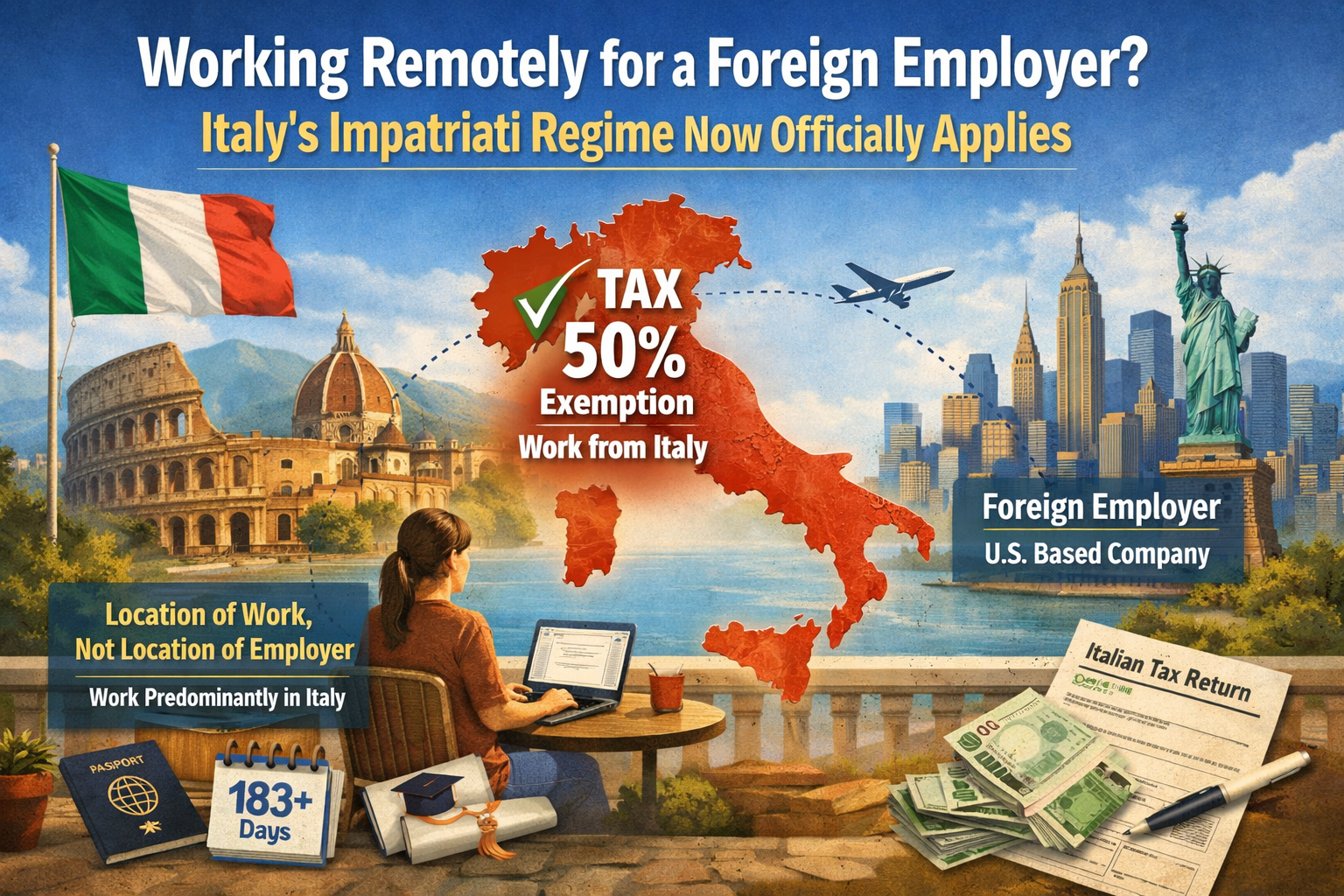
Working Remotely for a Foreign Employer? Italy’s Impatriati Regime Now Officially Applies

Working Remotely for a Foreign Employer? Italy’s Impatriati Regime Now Officially Applies

One of the most frequent questions we receive from professionals considering a move to Italy is whether the impatriati regime — Italy’s 50% income tax exemption for inbound workers — applies when their employer is based abroad and they plan to work from home in Italy. In January 2026, the Italian Revenue Agency answered that question clearly.

The Ruling: Location of Work, Not of Employer

The Revenue Agency confirmed that the impatriati regime is fully available to employees who transfer tax residence to Italy and continue working remotely for a foreign employer, provided the activity is carried out predominantly from Italian territory. The principle is straightforward: what counts is where the work is actually performed, not where the employer is located. If you live and work in Italy — even if your contract is governed by foreign law or your payslips come from a company headquartered abroad — you can claim the 50% IRPEF exemption on your qualifying income for five years. This applies to the new impatriati regime in force since 2024. Qualifying workers who transfer residence to Italy can exclude 50% of their Italian-source employment or self-employment income from IRPEF, up to €600,000 per year, for five consecutive tax years.

Key Requirements

Under the reformed regime, the worker must transfer Italian tax residence and not have been resident in Italy for at least the three years immediately preceding the transfer. A degree (bachelor level or equivalent) is required for highly qualified or specialised roles. Work must be performed predominantly in Italy, meaning more than 183 days per year physically working from Italian territory. Notably, the new regime no longer requires the old “functional link” between the transfer of residence and the start of the qualifying work activity — making it easier for workers who return to Italy independently of any job change.

A Note for U.S. Citizens

U.S. citizens are taxed by the United States on their worldwide income regardless of where they live. Moving to Italy and claiming the impatriati exemption does not reduce the U.S. tax bill directly. However, Italian income taxes paid should in principle generate Foreign Tax Credits against U.S. liability — though the precise mechanics depend on how the income is characterised and on the applicable treaty provisions. U.S. citizens in this situation should seek advice from a professional experienced in both Italian and U.S. taxation before assuming the credits will offset in full.

Practical Points

Remote workers should keep records to demonstrate they worked predominantly from Italian territory: diary entries, travel records, and any documentation from the employer confirming the remote arrangement. If the foreign employer does not apply Italian payroll withholding, the worker self-declares the income and the impatriati exemption in their Italian annual tax return — the Revenue Agency has confirmed this is the standard approach. One consideration for employers: if a senior employee habitually concludes contracts on behalf of a foreign company from Italian soil, that company could inadvertently create a taxable presence in Italy. This is a corporate structuring question the employer’s own advisers should evaluate.

Final Considerations

The ruling removes a practical ambiguity that had discouraged many remote professionals from claiming a benefit they were entitled to. For professionals already resident in Italy and working remotely for a foreign employer — or planning such a move — the five-year clock starts from the first year of Italian tax residence, so timing matters. As always, cross-border situations require coordinated advice. The Italian regime is generous, but it does not operate in isolation from a taxpayer’s home-country obligations.

New Italian Inbound Workers Regime: Employer of Record Continuity and Extended Foreign Residence Requirement

New Italian Inbound Workers Regime: Employer of Record Continuity and Extended Foreign Residence Requirement

Italian Revenue Agency – Ruling No. 54/2026

The Italian Revenue Agency examined the application of the new inbound workers tax regime (Article 5, Legislative Decree No. 209/2023) in a case involving:

An Italian citizen resident in Switzerland for three tax years;

Employment abroad through a Swiss Employer of Record (EoR);

Relocation to Italy in 2025;

New employment in Italy for a different foreign operating company;

Formal employment contract signed with an Italian Employer of Record belonging to the same corporate group as the Swiss EoR.

The operating companies benefiting from the employee’s services were not related to each other.

The taxpayer argued that the ordinary three-year foreign residence requirement should apply, since the EoR performed only administrative/payroll functions and had no managerial authority.

Legal Framework

Under Article 5 of Legislative Decree No. 209/2023, the new inbound workers regime provides:

A 50% exemption on Italian-source employment income (up to EUR 600,000 annually);

A minimum foreign residence requirement of three tax years;

An extended requirement of six or seven tax years if, upon return, the employee works:

for the same employer, or

for a company belonging to the same corporate group (as defined under Article 2359 of the Italian Civil Code).

Position of the Revenue Agency

The Revenue Agency clarified that:

Continuity is assessed based on whether the employer (or group) before and after the relocation is the same;

This principle also applies when the formal employer is an Employer of Record;

It is irrelevant that the EoR performs only administrative functions;

It is irrelevant that the operating companies benefiting from the services are different and unrelated.

Since the Swiss and Italian Employers of Record belonged to the same corporate group, the Agency considered that continuity existed.

Conclusion

The ordinary three-year foreign residence requirement does not apply.

The taxpayer must satisfy the extended six-year foreign residence requirement to qualify for the new inbound workers regime.

Practical Implications

The ruling confirms a formal and structural interpretation of “group continuity,” focusing on corporate control relationships rather than on the substantive nature of the employment relationship.

This interpretation is particularly relevant for:

International mobility structures involving Employers of Record;

Multinational groups using payroll intermediaries;

Cross-border employment planning under the new Italian inbound workers regime.

Forfettario vs. Impatriati for U.S. Citizens in Italy: How Dual Taxation Shapes Expat Choices

Forfettario vs. Impatriati for U.S. Citizens in Italy: How Dual Taxation Shapes Expat Choices

For professionals and employees relocating to Italy, the regime forfettario and the regime degli impatriati are often seen as the two most attractive tax incentives.
From a purely Italian perspective, both regimes offer significant advantages.
However, for U.S. citizens, the decisive factor is not domestic taxation alone, but the interaction between Italian incentives and U.S. worldwide taxation.
This interaction profoundly affects the real economic outcome and, therefore, the strategic choices of expatriates.

The Dual Tax Framework
A U.S. citizen resident in Italy is subject to two tax authorities:
• The Italian system, administered by Agenzia delle Entrate, based on residence
• The U.S. system, administered by the Internal Revenue Service, based on citizenship
Both systems require the declaration of worldwide income.
As a result, any Italian tax benefit must be evaluated in light of its impact on U.S. taxation.

The Forfettario Regime in an International Context
Domestic Logic
The forfettario regime is designed as a simplified system for small professionals.
It applies a substitute tax and removes the need for detailed accounting.
Its structure is built around income containment and administrative ease.
Interaction with U.S. Rules
From the U.S. perspective:
• Income remains fully visible
• The substitute tax is largely ignored
• Taxation follows ordinary federal rules
However, the forfettario regime operates within an income ceiling that is structurally compatible with U.S. foreign income exclusions (FIE).
When residency requirements are met and currency conversion remains favorable, the entire Italian professional income may fall within U.S. exclusion mechanisms.
In these cases, the Italian benefit can be preserved at a global level.


The Impatriati Regime in an International Context
Domestic Logic
The impatriati regime reduces the taxable base of employment or professional income.
Only part of the income is subject to ordinary Italian taxation.
It is intended to attract skilled workers and managers.
Interaction with U.S. Rules
From the U.S. perspective:
• The full gross income is taxable
• The Italian reduction is ignored
• No structural coordination exists
The IRS does not recognize partial exemptions granted by foreign law.
It taxes economic income, not domestically reduced bases.
As a consequence, the portion exempted in Italy often becomes fully taxable in the United States, if above the FIE threshold.
Practical Implication
Under the impatriati regime:
• Italian taxes decrease
• U.S. taxes tend to increase proportionally
• Foreign tax credits weaken
In many cases, the Italian benefit is largely transferred to the U.S. tax base.
This makes the regime internationally inefficient for most U.S. citizens.

The Role of Exchange Rates
For both regimes, income must be converted into U.S. dollars for tax purposes.
Fluctuations in the EUR/USD rate may:
• Reduce the effectiveness of U.S. exclusions
• Increase residual U.S. taxation
• Destabilize long-term planning
This risk is more relevant for forfettario cases, where alignment with U.S. exclusions is essential.

Compliance and Risk Exposure
Both regimes require full U.S. reporting.
Relying solely on Italian compliance exposes expatriates to:
• Underreporting risks
• Accumulated liabilities
• Penalties and interest
• Difficult regularization procedures
The risk is structurally higher under the impatriati regime, where income levels are typically higher and credits weaker.

Conclusion
For U.S. citizens in Italy, the choice between forfettario and impatriati cannot be made on domestic grounds alone.
The forfettario regime may preserve its advantage when carefully integrated with U.S. exclusions and currency management.
The impatriati regime, while powerful domestically, is often neutralized internationally.
As a result:
• Forfettario supports globally efficient self-employment models
• Impatriati supports career-driven relocation with limited tax efficiency
For expatriates, the optimal decision depends less on Italian tax rates and more on long-term international coordination.
Without such coordination, both regimes risk becoming attractive on paper but ineffective in practice.

Please contact us for any further info !

Deferred bonuses and the end of the impatriate regime: the Italian Revenue Agency clarifies timing and taxation

Deferred bonuses and the end of the impatriate regime: the Italian Revenue Agency clarifies timing and taxation

The Italian Revenue Agency, through Ruling No. 274/2025, examined whether the impatriate regime can apply to deferred compensation — such as long-term incentive plans, stock options, or deferred cash bonuses — that are paid after the end of the preferential period and after the worker has moved abroad.
The question concerns employees who benefited from the impatriate regime while working in Italy but later left the country, receiving at a later stage certain deferred payments linked to their previous Italian employment. The key issue is whether such income, although economically connected to work performed in Italy during the eligible period, can still enjoy the tax relief once the regime has expired and the worker is no longer an Italian tax resident.

Agency’s reasoning and position
The Revenue Agency reaffirmed two guiding principles:

Cash principle: employment income is taxed when it is actually paid, not when it is earned. Therefore, if a deferred bonus or incentive is paid after the end of the five-year (or extended) impatriate period, or after the individual becomes non-resident, the preferential regime can no longer apply.

Source principle: even though the worker is no longer resident in Italy, the portion of income linked to work performed on Italian territory remains taxable in Italy as Italian-source income. In such cases, the Italian employer must operate the ordinary withholding tax, while the foreign country of residence will grant relief for any double taxation under the relevant tax treaty.

In summary
The Agency concluded that the impatriate regime is strictly temporal: it applies only to income received while the worker is both tax resident in Italy and within the benefit period. Deferred bonuses or stock plans paid later are still taxable in Italy — if connected to Italian work activity — but under ordinary taxation, without the impatriate exemption.

Phantom Share Plans in Italy

Phantom Share Plans in Italy

Nature and Legal Framework

Phantom share plans, also called virtual or shadow share plans, are long-term incentive arrangements that replicate the economic advantages of share ownership without involving the transfer of real equity. Participants do not receive actual shares or voting rights but are promised a future cash payment whose value depends on the increase in the company’s share value over a certain period.

These plans are typically used to reward and retain key employees, directors, or consultants, aligning their interests with the company’s performance while avoiding dilution of ownership. From a legal standpoint, phantom shares are contractual rights, not financial instruments, and are governed by general civil and employment law principles rather than by corporate law.


Tax Treatment in Italy

The tax classification of phantom share income depends on the beneficiary’s relationship with the company. For employees, the payment is treated as employment income under Article 49 of the Italian Income Tax Code (TUIR). For directors, it qualifies as income assimilated to employment income under Article 50, while for self-employed professionals or consultants it constitutes professional income under Article 53.

Taxation arises at the time of payment, not upon grant or vesting. The amount received is subject to ordinary IRPEF and related regional and municipal surcharges. When the recipient is an employee or director, the company acts as withholding agent and applies the corresponding social security contributions to INPS.

For professionals operating under a partita IVA, the income forms part of their professional earnings and is subject to social contributions either to Gestione Separata INPS or, where applicable, to the relevant Cassa di Previdenza professionale (for example, CPAs, lawyers and other regulated professions). VAT applies if the incentive is paid in connection with an activity performed under a VAT-registered business.

For the company, the cost of the phantom share payout is deductible for corporate income tax (IRES) purposes in the fiscal year in which the payment is made, pursuant to Article 95 TUIR. Since no actual shares are issued and no capital movement occurs, the plan does not trigger registration or capital duties.

Although the value of the payment is linked to share performance, the gain is always treated as income from employment or self-employment, never as a capital gain. This distinction determines both the applicable tax and social-security framework.


Interaction with the “Impatriate Regime”

Phantom share payments may, in some circumstances, benefit from Italy’s “regime degli impatriati” (the special tax regime for individuals transferring their tax residence to Italy). This regime provides for a partial exemption from IRPEF on income derived from employment or self-employment performed in Italy, at the percentage applicable under current law.

Because phantom share payments are considered remuneration directly connected with work activity, they may qualify for this favorable treatment if they relate to services performed in Italy after the individual has become an Italian tax resident and if payment occurs during the valid period of the regime.

If the phantom share plan instead relates to work carried out abroad before the transfer of residence, or if payment is made after the regime’s expiration, the incentive would fall outside the scope of the benefit and be fully subject to ordinary taxation. For this reason, it is crucial to document the link between the incentive and the Italian employment or professional activity, as well as to plan the timing of payment carefully.

Extension of the “Impatriate Regime” for workers who moved to Italy in 2020: what happens after the first 5 years


🌍 Extension of the “Impatriate Regime” for workers who moved to Italy in 2020: what happens after the first 5 years

The so-called “impatriate regime” (Regime degli impatriati), ,aims to attract highly skilled workers to Italy by offering a significant tax incentive: partial tax exemption on employment, self-employment, and business income produced in Italy.


🔎 Standard duration: first 5 years

  • Workers who transferred their tax residence to Italy in 2020 benefited from the regime for five years, starting from the year they became tax residents in Italy.
  • For them, the last year of the initial benefit period was 2024.

📌 What happens after 2024?

As a rule, the regime expires after five years. However, Italian law allows an extension for an additional five years (up to a total of ten years), under specific conditions.


Conditions for the 5-year extension

To continue benefiting from a tax reduction from 2025 to 2029, the worker must meet at least one of the following conditions before the end of 2024:

1️⃣ Have at least one minor or dependent child, including those in pre-adoptive foster care.

2️⃣ Purchase a residential property in Italy after the move (or within the 12 months before the transfer).


💰 Tax benefit during the extension

  • During the first five years, eligible workers benefited from a 70% exemption on qualifying income (or even 90% for those working in southern Italy).
  • During the extension period, the tax exemption is reduced to 50%.
  • No lump-sum payment or additional contributions are required to access this extension (unlike the special rules for professional athletes).

📊 Summary table

PeriodExemptionConditionsPayment required?
First 5 years (2020–2024)70% (or 90% south)Residence abroad for ≥ 2 years + move to Italy + work mainly in ItalyNo
Additional 5 years (2025–2029)50%At least one minor child or residential property purchaseNo

💼 Procedural requirements

  • The worker must opt for the extension by indicating it in their 2025 Italian tax return (submitted in 2026).
  • It is advisable to inform the employer to ensure correct application of reduced tax withholdings.
  • Documentation proving the existence of the child or property ownership must be retained for potential tax audits.

📈 Example

Let’s assume:

  • A worker moved to Italy in 2020.
  • They have a minor child born in 2023.
  • Their last year of standard benefit is 2024.

In this case, they qualify to extend the regime from 2025 to 2029 with a 50% tax exemption, without paying any extra fee.


⚖️ Conclusion

✔️ Workers who moved to Italy in 2020 will see their initial 5-year benefit end in 2024.
✔️ If they have a minor child or bought a home in Italy, they can extend the benefit for another 5 years (2025–2029) at a 50% exemption rate.
✔️ No lump-sum contributions or additional costs are required.
✔️ Timely option and proper documentation are crucial to continue enjoying the benefit safely.


💬 Need support?

If you or your clients are eligible for the extension, it is highly recommended to plan in advance, check compliance, and prepare the necessary documentation.

Residence Registration: A Legal Obligation vs. a Voluntary Practice (like in the U.S)

Residence Registration: A Legal Obligation vs. a Voluntary Practice ( like in the U.S )

In many European countries (e.g., Germany, France, Italy), registering with the city or municipality is a legal obligation for all residents. This process, typically done shortly after moving into a new address, is essential because:

-It establishes your legal residence, which determines eligibility for public services (healthcare, education, local benefits).

-It allows local governments to maintain accurate population records.

-It connects you to local taxation systems and the correct voting district.

-It ensures you can receive official correspondence and perform key bureaucratic tasks (e.g., getting an ID, enrolling children in school).

Failure to register often results in administrative fines, difficulty accessing services, or even legal issues for residency-related processes (e.g., immigration compliance).

Contrast with the United States
In the U.S., there is no mandatory city registration system. The government does not maintain a centralized database of where every person lives. As a result:

-Proof of residency, as known in Europe, does not officially exist in a standardized way in the U.S.

-There’s no legal requirement to inform city or municipal authorities when you move.

-Instead, individuals must update their address with specific agencies when relevant (e.g., the DMV for driver’s licenses, local election boards for voting, IRS for taxes).

These updates are decentralized and rely on self-reporting, with little oversight unless fraud or benefits are involved.

This system is more flexible but creates gaps in population tracking and administrative coordination. It also means that residency is often “proven” by using ( usually more than one document is requested ) utility bills, lease agreements, or bank statements, since there’s no official certificate issued by a city.

When to Register
Within 20 days of moving to a new municipality (comune)

Where to Register
At the Ufficio Anagrafe (registry office) of the local municipality

Required Documents
-Valid ID or passport

-Tax code (Codice Fiscale)

-Proof of housing (rental contract, property deed, or hosting declaration)

-Proof of health insurance (for EU and non-EU citizens)

-Residence permit (for non-EU nationals)

Outcome
You are entered into the Anagrafe dei Residenti, Italy’s civil registry

-You receive a certificate of residence (certificato di residenza)

-Police verification may follow (they check if you actually live there)

NOTE : The above process does not automatically make you fiscally resident for the same year !

Fiscal Residency (Residenza Fiscale)
This refers to your tax residency status, governed by the Italian Revenue Agency (Agenzia delle Entrate). You are considered a fiscal resident if any one of the following is true for more than 183 days per solar year:

-Your registered legal residence is in Italy (from the Anagrafe – the process described above)

-Your habitual abode (physical presence) is in Italy

-Your center of economic or personal interests is in Italy

This determines:

-Where you pay income tax

-Whether you are taxed on worldwide income (if resident) or only Italian income (if non-resident)

Tax Return Document Checklist

Tax Return Document Checklist

As tax season approaches, it’s essential to prepare the required documentation in a timely and organized manner. Submitting all documents promptly and in full will significantly streamline the preparation and filing process, reduce back-and-forth communication, and help ensure you benefit from all available deductions.

We recommend printing this list ( click on the PDF logo above) and using it as a checklist while gathering your documents.

Please contact us if you have any doubts or if your personal or financial situation has changed during the year.

Personal Identification Documents
() Mod. 730 or Mod. Unico from the previous year (include F24 payment forms)
() Copy of your ID or passport
() Tax ID Number (Codice Fiscale)

Medical & Health-Related Expenses
() Pharmacy receipts (with Codice Fiscale and paid by card)
() Invoices for specialist visits and health tickets
() Invoices or receipts for veterinary expenses
() Funeral expenses

Financial and Employment Income
() Bank declaration for loan interest paid
() CUD (Certificazione Unica) for employment or pension income
() Foreign income tax returns and related tax payment documents

Property and Real Estate
() Cadastral report for properties purchased during the year
() Copies of any real estate sales or purchases made during the year

Deductions & Tax Credits
() ENEA Certifications (for energy savings 55% or 65%)
() Invoices and payments for renovation work (50%)
() Invoices for deductions related to furniture and appliances
() Payment confirmations for life insurance
() School tuition payment receipts
() Proof of payments for children’s sport activities (for those under 18)
() Receipts for donations to ONLUS (non-profit organizations)

Social Security & Contributions
() Payment proof for social security contributions
() Contributions for domestic service workers (INPS)

Foreign Assets
() Value and description of assets, equity, funds, and accounts held abroad
() Foreign financial availability required for IVAFE/IVIE declarations

Necessary documents for your yearly Tax Return

Tax season is fast approaching, please find a list of the Documents we need to receive to prepare your Tax Return:

Mod. 730 or Mod. Unico of the previous year and payment forms F24.
Copy of your ID/passport and Tax ID Number ( Codice Fiscale )

Pharmacy receipts ( with your Codice Fiscale and paid by credit/debit card)
Invoices for specialist visits, health tickets Invoices / receipts for medicines and veterinary expenses
Funeral expenses

Loan interest paid ( we need the bank declaration )
CUD attesting your employment / retirement income
Copies of ENEA Certifications, for energy savings of 55% and 65%
Copy of renovation costs for recovery 50% plus deductions for Furniture and Appliances.
Payment for life insurance costs
Payment for school tuition costs

Expenses for sport activities for children up to the age of 18
Payments made to Onlus

Payment of social security contributions

Cadastral report for properties purchased during the year
Copies of any real estate purchases / sales occurred during the year
Contributions for domestic service workers
Copy of any foreign income tax returns and related tax payments
Value and description of assets / funds / equity investments / financial availability held abroad

That’s the general list. Please contact us for any doubt !

How a Mortgage Works in Italy: Legal Aspects

A mortgage in Italy (mutuo ipotecario) is a legal contract between a borrower and a lender, typically a bank, to finance the purchase of real estate. The process is regulated by Italian civil and banking laws, ensuring transparency and security for both parties. Below is a breakdown of how a mortgage legally works in Italy.


1. Legal Framework & Regulations

In Italy, mortgages are primarily governed by:

  • Italian Civil Code (Codice Civile) – Establishes the legal principles of contracts, property rights, and obligations.
  • Consolidated Banking Act (Testo Unico Bancario – TUB) – Regulates financial institutions and banking operations.
  • Consumer Credit and Mortgage Directives (EU Regulations) – Ensures fairness and transparency in lending practices.

Banks must comply with these regulations when offering mortgages to individuals and businesses.


2. Mortgage Structure & Key Elements

A mortgage in Italy is legally composed of the following elements:

A. Loan Agreement (Contratto di Mutuo)

This is a legally binding contract between the borrower (mutuatario) and the lender (mutuante), specifying:
✔️ Loan amount (capitale)
✔️ Interest rate (fixed, variable, or mixed)
✔️ Repayment period (durata del mutuo)
✔️ Installments & payment schedule
✔️ Any penalties for late payment or early repayment

B. Mortgage Registration (Ipoteca)

A mortgage is secured by a lien on the property. This means:
🏡 The bank registers a first-degree mortgage on the property at the Land Registry (Conservatoria dei Registri Immobiliari).
⚖️ If the borrower defaults, the bank has the right to foreclose and sell the property to recover the debt.
📝 The mortgage remains registered until the loan is fully repaid.

C. Notary Role (Notaio)

A public notary plays a crucial legal role in the mortgage process:
📜 Drafts and authenticates the mortgage deed (atto di mutuo ipotecario).
🔎 Performs due diligence on the property, ensuring no legal disputes or outstanding debts.
🏛 Registers the mortgage at the Land Registry.

Without the intervention of a notary, the mortgage is not legally valid.


3. Legal Steps to Obtain a Mortgage

Step 1: Pre-Approval & Financial Evaluation

  • The borrower submits financial documents to the bank (income proof, credit history, tax returns).
  • The bank assesses the borrower’s financial stability and loan eligibility.

Step 2: Property Due Diligence & Appraisal

  • A property valuation (perizia immobiliare) is conducted by a bank-appointed surveyor.
  • The notary checks the property’s legal status and ensures it has a clean title.

Step 3: Signing the Mortgage Deed

  • The borrower and lender sign the mortgage contract (atto di mutuo) in front of a notary.
  • The contract is registered with the Land Registry, officially establishing the mortgage.

Step 4: Funds Disbursement & Property Transfer

  • Once the mortgage is registered, the bank disburses the loan.
  • If the loan is for purchasing a home, the funds are typically transferred directly to the seller.

4. Default & Legal Consequences

If a borrower fails to meet repayment obligations:
⚠️ The bank can initiate judicial foreclosure (pignoramento immobiliare).
⚠️ The property may be auctioned through the court to recover the outstanding debt.
⚠️ In some cases, the borrower may negotiate debt restructuring (rinegoziazione del mutuo) with the bank.


5. Early Repayment & Loan Portability

  • Early Repayment (Estinzione Anticipata) – Under Italian law, borrowers can repay their mortgage early, often without penalties (except for older contracts).
  • Mortgage Portability (Surroga del Mutuo) – Allows borrowers to transfer their mortgage to another bank for better terms, free of charge.

Final Thoughts

A mortgage in Italy is a well-regulated financial product that involves strict legal procedures to protect both the borrower and the lender. The presence of a notary, mortgage registration, and banking regulations ensures transparency and compliance. Anyone considering a mortgage in Italy should seek legal and financial advice to navigate the process effectively.

How to Get a Mortgage in Italy: A Step-by-Step Guide

Buying property in Italy is an exciting journey, whether you’re moving there, looking for a second home, or making an investment. If you need a mortgage (mutuo), the process can seem a bit daunting, especially if you’re not familiar with the Italian banking system. This guide will walk you through everything you need to know, in a clear and simple way.


1. Understanding Mortgages in Italy

Mortgages in Italy come in different types, so it’s important to choose the right one based on your financial situation and long-term plans.

🏡 Fixed-rate mortgage – The interest rate stays the same for the entire loan term, making it a safer option if you prefer stability.
📉 Variable-rate mortgage – The interest rate fluctuates based on market trends, which can mean lower payments at times but also potential increases.
🔄 Mixed-rate mortgage – A combination of fixed and variable rates, usually starting as fixed and switching to variable after a few years.
💰 Interest-only mortgage – This is less common, but some banks allow you to pay only the interest initially, with the full amount due later.


2. Who Can Apply for a Mortgage in Italy?

Both residents and non-residents can apply for a mortgage, but the conditions vary:

Italian residents – Usually get the best terms, with loans covering up to 80% of the property’s value.
EU citizens & foreigners with Italian residency – Similar advantages to residents, as long as they have stable income in Italy.
Non-residents – Can still get a mortgage, but banks are more cautious. Typically, they finance only 50%-60% of the property value, and interest rates may be slightly higher.

💡 Tip: Some Italian banks specialize in mortgages for foreigners, so it’s worth shopping around!


3. What You Need to Apply for a Mortgage

Italian banks require a set of documents to evaluate your mortgage application. Here’s what you’ll typically need:

📌 Valid ID – A passport or Italian ID card.
📌 Codice Fiscale (Italian Tax Code) – Essential for any financial transactions in Italy. You can get it from the Agenzia delle Entrate or your consulate.
📌 Proof of Income – Recent salary slips, an employment contract, or tax returns if you’re self-employed.
📌 Bank Statements – Usually from the last 3-6 months, to prove financial stability.
📌 Credit History – Some banks check your credit score, especially if you’re applying from abroad.
📌 Deposit – You’ll typically need at least 20%-50% of the property’s value, depending on your residency status.
📌 Property Documents – The seller must provide official paperwork confirming the property’s legal standing.

💡 Tip: Some banks might require life insurance as part of the mortgage agreement, so be prepared for that possibility.


4. How to Apply for a Mortgage

Once you’ve found the perfect home, here’s how the mortgage process works:

Step 1: Choose the Right Lender & Get Pre-Approval

🏦 Compare different banks or work with a mortgage broker who can help you find the best deal.
📋 Getting pre-approval (approvazione preventiva) gives you an idea of how much you can borrow before committing to a property.

Step 2: Submit Your Application

📑 Provide all the required documents, including proof of income, tax records, and details about the property.
🔎 The bank will analyze your financial situation to determine if you qualify.

Step 3: Property Valuation & Legal Checks

🏡 A surveyor (appointed by the bank) will inspect the property to confirm its value.
📝 The bank will check for any legal issues, such as outstanding debts or disputes on the property.

Step 4: Approval & Signing the Mortgage Contract

✅ Once approved, the bank will issue a binding offer, detailing the loan amount, interest rate, and repayment terms.
✍️ You will sign the final mortgage agreement in front of a notary (notaio), along with the property purchase deed.

Step 5: Funds Transfer & Final Steps

💰 The bank releases the loan amount—either directly to the seller or through an escrow process with the notary.
🏡 Congratulations! The property is officially yours, and the mortgage is now active.


5. Costs & Fees to Consider

In addition to your deposit and monthly payments, here are some extra costs to keep in mind:

💶 Bank fees – Usually 1%-2% of the loan amount.
📜 Notary fees – Typically 1%-2% of the property price.
🏛 Registration taxes & stamp duty – Costs vary based on the property type and whether you’re a resident.
🏡 Surveyor fees – Around €300-€500 for the property valuation.
💼 Mortgage broker fees – If you use a broker, they may charge a commission.

💡 Tip: Some banks offer special deals for first-time buyers, so ask about any promotions or fee reductions!


6. Tips for a Successful Mortgage Application

✔️ Show stable income – Banks prefer applicants with a steady job or a well-established business.
✔️ Improve your credit history – If possible, pay off any debts before applying.
✔️ Work with a local expert – A mortgage broker or real estate agent can help navigate the process, especially if you’re a foreign buyer.
✔️ Consider a higher deposit – Offering more upfront can improve your chances of approval and may secure better interest rates.

Italy Tax system

Understanding Taxes in Italy: A Simple Guide

Italy has a complex tax system with different taxes at the national, regional, and local levels. If you live or work in Italy, it’s essential to understand how taxes work, what rates apply, and when you need to pay. Let’s break it down in an easy-to-understand way.


1. Main Types of Taxes in Italy

There are two major categories of taxes in Italy: direct taxes (on income and assets) and indirect taxes (on goods and services).

A. Direct Taxes (Taxes on Income and Business)

  1. IRPEF (Personal Income Tax)
    • Paid by individuals based on their earnings.
    • Uses a progressive system, meaning the more you earn, the higher your tax rate.
  2. IRES (Corporate Income Tax)
    • A flat tax of 24% paid by companies and businesses.
  3. IRAP (Regional Business Tax)
    • Paid by businesses and professionals.
    • The rate depends on the region but is typically around 3.9%.
  4. IMU (Property Tax)
    • Applied to properties (except for primary residences in most cases).
    • The rate varies by municipality.

B. Indirect Taxes (Taxes on Goods and Services)

  1. IVA (Value-Added Tax – VAT)
    • Applied to the sale of goods and services.
    • Standard rate: 22%
    • Reduced rates: 10% (e.g., food, hotels) and 4% – 5% (e.g., essential items).
  2. Other Indirect Taxes
    • Registration taxes, stamp duties, and real estate transaction fees.

2. Personal Income Tax Rates (IRPEF)

IRPEF is progressive, meaning higher incomes are taxed at higher rates:

Income Bracket (€)Tax Rate (%)
0 – 28,00023%
28,001 – 50,00033%
Over 50,00043%

There are also deductions and allowances that reduce the total amount of tax you owe.


3. How and When to Pay Taxes in Italy

Taxes are usually paid through withholding, advance payments, and direct declarations.

For Employees & Pensioners

  • Taxes are automatically deducted from salaries and pensions.
  • Employers and pension funds take care of payments.

For Freelancers & Self-Employed Workers

  • Must file a tax return and pay in advance based on the previous year’s income.
  • Payments are made in two installments:
    • First installment: June 30
    • Second installment: November 30

For Companies (IRES, IRAP)

  • Companies pay in advance, similar to personal income tax.
  • The final balance is settled the following year.

For VAT (IVA)

  • Businesses must collect VAT from customers and pay it to the tax authorities.
  • Payments are usually quarterly or monthly.

4. How to Pay Taxes

Taxes in Italy are paid through:

  • F24 Form (submitted online via banks or the Italian Tax Agency).
  • Direct debit payments (for recurring taxes).
  • Online banking and tax portals.

5. Tax Returns and Deadlines

  • Personal Tax Returns (Modello 730 or Modello Redditi PF):
    • Employees & pensioners: By September 30.
    • Freelancers & self-employed: By November 30.
  • Business Tax Returns:
    • Usually filed by April 30 for the previous year.

6. Additional Local Taxes

  • TARI (Waste Collection Tax) – Paid to local municipalities for garbage services.
  • Regional and Municipal Surcharges – Additional small taxes applied to IRPEF, varying by location.

Final Thoughts

Italy’s tax system may seem complicated, but understanding the basics can help you manage your payments effectively and avoid penalties. Whether you’re an employee, freelancer, or business owner, staying informed about your tax obligations is key.

Special Italian TAX regime for University Professors and Researchers : just 10% is taxed

The special Tax Regime ( art. 44 L. n 78/10 ) refers  to the income from employment (or self-employment) produced in Italy for University teaching and research activities. For such income, just its 10% is taxable.

The regime applies from the tax period when  the teacher or researcher becomes fiscally resident in Italy, with these further conditions for access:

• Be in possession of a university degree or equivalent;

• Have not been occasionally resident abroad;

• Have carried out documented research or teaching abroad at public / private research centers or universities for at least 2 continuous years;

• Carry out teaching or research activities in Italy;

• Acquire tax residence in the Italian territory.

Duration of the regime : year of return + 5 more years . In the case of more children and / or property purchases , it can reach up to 13years

In the event that the person moves his residence in Italy, but continues to carry out research or teaching activities abroad, the benefit is limited to the  income received in Italy as a teacher or researcher. Foreign income will thus  ordinarily be subject to Italian taxation, with a  tax credit for taxes paid abroad . ( Article 165 DPR 917/86.)

Please do not hesitate to contact us for any further details.

No special Tax regime for those who return in Italy to perform the same Job

For Taxpayers who return in Italy after a period abroad , there is no tax benefit in the presence of the same contract, same job and with the same employer. This was clarified by the Agenzia delle Entrate  with the response to ruling no. 42 of 18 January 2021.

If however the impatriate assumes a different corporate role than the original one, with a new contract that does not constitute a mere  the continuation of the previous work, the benefits will be granted.

Special attention should thus be paid for those contract terms  that could indicate a mere prosecution of the previous Job  , as :

– recognition of seniority from the date of first hiring;

– the absence of the trial period;

– clauses aimed at not paying the accrued thirteenth (and possibly fourteenth) accrued monthly salaries .

We are as usual here for any further assistance .