02.4004.4318
CALL US!
8:30 - 17:30
Mon-Fri

Categoria: Expats

The Italian 7% Retiree Tax Regime: A Strategic Opportunity — Including for U.S. Citizens

The Italian 7% Retiree Tax Regime: A Strategic Opportunity — Including for U.S. Citizens

Italy offers a highly attractive tax incentive for foreign retirees who choose to relocate to certain areas of Southern Italy. The regime, introduced by Article 24-ter of the Italian Income Tax Code, allows qualifying individuals to benefit from a 7% flat substitute tax on their foreign-source income for up to ten years.

The measure was designed to attract pensioners willing to establish their tax residence in smaller municipalities located in specific Southern regions. It combines a low and predictable tax burden with simplified compliance obligations, making it one of the most competitive retiree regimes currently available within the European Union.

Under this regime, individuals who receive a foreign pension and who have not been tax resident in Italy for at least five previous tax years may opt for a substitute tax equal to 7% on all foreign-source income. This includes not only pension income, but also foreign dividends, interest, capital gains and rental income. The substitute tax replaces ordinary progressive income taxation, which in Italy can exceed 40%, as well as regional and municipal surtaxes.

Italian-source income remains subject to ordinary taxation and is not covered by the 7% regime.

A decisive element of the regime is geographic location. The taxpayer must transfer tax residence to a municipality with fewer than 20,000 inhabitants located in one of the eligible Southern regions, such as Sicily, Calabria, Sardinia, Campania, Basilicata, Abruzzo, Molise or Puglia. If this territorial requirement is not met, the regime cannot be applied. The policy objective is clearly linked to encouraging demographic and economic revitalization in smaller Southern communities.

An additional advantage of the regime concerns compliance obligations. During the period of application, foreign assets are exempt from Italian wealth taxes (IVIE on foreign real estate and IVAFE on foreign financial assets), and the taxpayer is exempt from the foreign asset reporting obligation normally required under Italian monitoring rules. This considerably simplifies annual tax compliance for retirees with diversified international holdings.

The regime can apply for up to ten consecutive years. It may be revoked by the taxpayer and automatically ceases if the eligibility conditions are no longer satisfied. Once terminated, it cannot be reactivated.

From a planning perspective, the regime can produce substantial tax savings. A retiree receiving significant foreign pension and investment income may reduce the effective Italian tax burden to a small fraction of what would otherwise apply under the ordinary progressive system. However, careful analysis remains essential. Double tax treaty interaction, foreign withholding taxes, and the timing of relocation during the tax year should all be evaluated before moving.

Special Considerations for U.S. Citizens

For U.S. citizens, the analysis becomes more complex because the United States taxes its citizens on worldwide income regardless of residence. A U.S. retiree relocating to Southern Italy under the 7% regime will still be required to file annual U.S. federal tax returns and report worldwide income.

The 7% Italian substitute tax does not eliminate U.S. taxation. Instead, coordination depends on the foreign tax credit (FTC) mechanism and the Italy–U.S. tax treaty.

In principle, the Italian 7% substitute tax qualifies as an income tax and may be creditable for U.S. purposes. However, the credit is subject to U.S. limitation rules. The foreign tax credit cannot exceed the portion of U.S. tax attributable to the same category of income. If the U.S. effective rate on that pension income exceeds 7%, a residual U.S. tax liability may remain.

In addition, differences in taxable base calculations between the two systems can affect the amount of usable credit. Each case requires modeling based on the nature of the pension (private pension versus U.S. Social Security), overall income levels, and treaty allocation rules.

Under the Italy–U.S. tax treaty, U.S. Social Security is generally taxable only in the United States. In such cases, the 7% regime would not override treaty allocation. Private pensions, however, may be taxed in Italy, triggering foreign tax credit considerations in the United States.

For U.S. retirees, therefore, the real question is not whether Italy taxes at 7%, but what the combined Italy–U.S. effective burden will be after applying treaty provisions and foreign tax credit limitations.

Final Considerations

The 7% Retiree Regime represents a powerful and predictable tax incentive for foreign pensioners willing to relocate to eligible Southern municipalities. For many non-U.S. retirees, it can significantly reduce overall taxation while simplifying compliance.

For U.S. citizens, the regime can still be attractive, but it requires coordinated cross-border planning. The headline 7% rate is only one part of the analysis. A proper evaluation must consider treaty interaction, U.S. foreign tax credit mechanics, and the overall combined tax position.

As with any international relocation, detailed planning is essential before making the move.

New Italian Inbound Workers Regime: Employer of Record Continuity and Extended Foreign Residence Requirement

New Italian Inbound Workers Regime: Employer of Record Continuity and Extended Foreign Residence Requirement

Italian Revenue Agency – Ruling No. 54/2026

The Italian Revenue Agency examined the application of the new inbound workers tax regime (Article 5, Legislative Decree No. 209/2023) in a case involving:

An Italian citizen resident in Switzerland for three tax years;

Employment abroad through a Swiss Employer of Record (EoR);

Relocation to Italy in 2025;

New employment in Italy for a different foreign operating company;

Formal employment contract signed with an Italian Employer of Record belonging to the same corporate group as the Swiss EoR.

The operating companies benefiting from the employee’s services were not related to each other.

The taxpayer argued that the ordinary three-year foreign residence requirement should apply, since the EoR performed only administrative/payroll functions and had no managerial authority.

Legal Framework

Under Article 5 of Legislative Decree No. 209/2023, the new inbound workers regime provides:

A 50% exemption on Italian-source employment income (up to EUR 600,000 annually);

A minimum foreign residence requirement of three tax years;

An extended requirement of six or seven tax years if, upon return, the employee works:

for the same employer, or

for a company belonging to the same corporate group (as defined under Article 2359 of the Italian Civil Code).

Position of the Revenue Agency

The Revenue Agency clarified that:

Continuity is assessed based on whether the employer (or group) before and after the relocation is the same;

This principle also applies when the formal employer is an Employer of Record;

It is irrelevant that the EoR performs only administrative functions;

It is irrelevant that the operating companies benefiting from the services are different and unrelated.

Since the Swiss and Italian Employers of Record belonged to the same corporate group, the Agency considered that continuity existed.

Conclusion

The ordinary three-year foreign residence requirement does not apply.

The taxpayer must satisfy the extended six-year foreign residence requirement to qualify for the new inbound workers regime.

Practical Implications

The ruling confirms a formal and structural interpretation of “group continuity,” focusing on corporate control relationships rather than on the substantive nature of the employment relationship.

This interpretation is particularly relevant for:

International mobility structures involving Employers of Record;

Multinational groups using payroll intermediaries;

Cross-border employment planning under the new Italian inbound workers regime.

Forfettario vs. Impatriati for U.S. Citizens in Italy: How Dual Taxation Shapes Expat Choices

Forfettario vs. Impatriati for U.S. Citizens in Italy: How Dual Taxation Shapes Expat Choices

For professionals and employees relocating to Italy, the regime forfettario and the regime degli impatriati are often seen as the two most attractive tax incentives.
From a purely Italian perspective, both regimes offer significant advantages.
However, for U.S. citizens, the decisive factor is not domestic taxation alone, but the interaction between Italian incentives and U.S. worldwide taxation.
This interaction profoundly affects the real economic outcome and, therefore, the strategic choices of expatriates.

The Dual Tax Framework
A U.S. citizen resident in Italy is subject to two tax authorities:
• The Italian system, administered by Agenzia delle Entrate, based on residence
• The U.S. system, administered by the Internal Revenue Service, based on citizenship
Both systems require the declaration of worldwide income.
As a result, any Italian tax benefit must be evaluated in light of its impact on U.S. taxation.

The Forfettario Regime in an International Context
Domestic Logic
The forfettario regime is designed as a simplified system for small professionals.
It applies a substitute tax and removes the need for detailed accounting.
Its structure is built around income containment and administrative ease.
Interaction with U.S. Rules
From the U.S. perspective:
• Income remains fully visible
• The substitute tax is largely ignored
• Taxation follows ordinary federal rules
However, the forfettario regime operates within an income ceiling that is structurally compatible with U.S. foreign income exclusions (FIE).
When residency requirements are met and currency conversion remains favorable, the entire Italian professional income may fall within U.S. exclusion mechanisms.
In these cases, the Italian benefit can be preserved at a global level.


The Impatriati Regime in an International Context
Domestic Logic
The impatriati regime reduces the taxable base of employment or professional income.
Only part of the income is subject to ordinary Italian taxation.
It is intended to attract skilled workers and managers.
Interaction with U.S. Rules
From the U.S. perspective:
• The full gross income is taxable
• The Italian reduction is ignored
• No structural coordination exists
The IRS does not recognize partial exemptions granted by foreign law.
It taxes economic income, not domestically reduced bases.
As a consequence, the portion exempted in Italy often becomes fully taxable in the United States, if above the FIE threshold.
Practical Implication
Under the impatriati regime:
• Italian taxes decrease
• U.S. taxes tend to increase proportionally
• Foreign tax credits weaken
In many cases, the Italian benefit is largely transferred to the U.S. tax base.
This makes the regime internationally inefficient for most U.S. citizens.

The Role of Exchange Rates
For both regimes, income must be converted into U.S. dollars for tax purposes.
Fluctuations in the EUR/USD rate may:
• Reduce the effectiveness of U.S. exclusions
• Increase residual U.S. taxation
• Destabilize long-term planning
This risk is more relevant for forfettario cases, where alignment with U.S. exclusions is essential.

Compliance and Risk Exposure
Both regimes require full U.S. reporting.
Relying solely on Italian compliance exposes expatriates to:
• Underreporting risks
• Accumulated liabilities
• Penalties and interest
• Difficult regularization procedures
The risk is structurally higher under the impatriati regime, where income levels are typically higher and credits weaker.

Conclusion
For U.S. citizens in Italy, the choice between forfettario and impatriati cannot be made on domestic grounds alone.
The forfettario regime may preserve its advantage when carefully integrated with U.S. exclusions and currency management.
The impatriati regime, while powerful domestically, is often neutralized internationally.
As a result:
• Forfettario supports globally efficient self-employment models
• Impatriati supports career-driven relocation with limited tax efficiency
For expatriates, the optimal decision depends less on Italian tax rates and more on long-term international coordination.
Without such coordination, both regimes risk becoming attractive on paper but ineffective in practice.

Please contact us for any further info !

Italy’s 2026 New-Resident Tax Regime: Key Changes for International Taxpayers

Italy’s 2026 New-Resident Tax Regime: Key Changes for International Taxpayers

Italy continues to offer a special tax regime for individuals transferring their tax residence to the country after a prolonged period abroad. Commonly referred to as the new-resident flat tax regime, this incentive is designed to attract high-net-worth individuals and internationally mobile taxpayers by providing certainty and simplification in the taxation of foreign income.

With the 2026 Budget Law, the regime has been confirmed but significantly recalibrated.

Eligibility

The regime is available to individuals who:

  • become tax resident in Italy; and
  • have not been Italian tax residents for at least 9 of the previous 10 years.

Once elected, the regime may apply for a maximum period of 15 years.

How the regime operates

Taxpayers opting for the regime are subject to:

  • a fixed annual substitute tax on foreign-source income;
  • ordinary taxation on Italian-source income.

Foreign assets and income covered by the regime are excluded from Italian wealth taxes and related reporting obligations, offering a high degree of administrative simplicity.

What changes from 2026

For individuals transferring tax residence from 1 January 2026, the annual flat tax amounts are increased as follows:

  • €300,000 per year for the main taxpayer;
  • €50,000 per year for each qualifying family member included in the election.

The increase represents a substantial adjustment compared to prior years and directly affects the overall cost of accessing the regime.

What remains unchanged

The reform does not alter:

  • the eligibility criteria;
  • the duration of the regime;
  • the scope of income covered, which remains limited to foreign-source income.

Strategic considerations

The 2026 changes confirm Italy’s intention to maintain the new-resident regime while narrowing its focus. The regime remains attractive for individuals with significant foreign income or complex international structures, but the higher fixed tax requires a careful evaluation of expected benefits versus cost.

For prospective new residents, advance tax planning is essential to assess:

  • effective tax savings compared to ordinary Italian taxation;
  • interaction with double tax treaties;
  • timing of the transfer of residence.

Conclusion

Italy’s new-resident tax regime remains a key instrument in international tax planning, but from 2026 it is clearly positioned as a selective regime for high-income taxpayers. Proper structuring and professional advice are crucial to ensure that the regime is both accessible and advantageous under the updated framework.

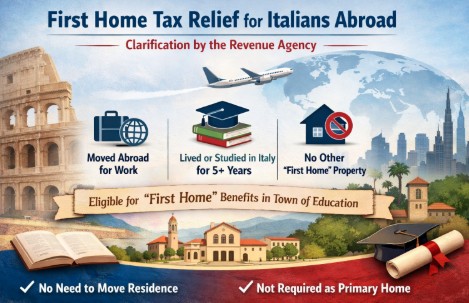
Italian “First Home” Tax Relief for Italian Nationals Abroad: Clarification by the Revenue Agency

With Ruling No. 312/2025, the Italian Revenue Agency clarified the scope of the “first home” tax relief for individuals who have transferred their residence abroad for work purposes and are registered with AIRE.

Following the amendments introduced by Decree-Law No. 69/2023, the tax benefit is no longer linked to citizenship but to objective criteria, focusing on the individual’s personal and professional connection with Italy.

The ruling confirms that a person who:

  • moved abroad for work reasons,
  • previously lived or carried out any form of activity in Italy for at least five years (not necessarily continuously),
  • does not own other residential properties purchased with first-home benefits,

may apply the “first home” tax relief even if the property is not located in the municipality of birth or last Italian residence.

In particular, the Revenue Agency recognizes that the concept of “activity” includes education and university studies, even if unpaid. Therefore, purchasing a residential property in the municipality where the taxpayer completed their entire educational and university path qualifies for the tax relief, provided all other legal requirements are met.

Importantly, in these cases:

  • there is no obligation to transfer residence to the municipality where the property is located,
  • the property does not need to be used as a primary residence.

This interpretation significantly broadens access to the “first home” tax relief for Italians working abroad, strengthening the relevance of substantial personal and formative ties with a specific Italian municipality

Italy Confirms: Early Redemption of Pension Funds Is Taxable in Italy, Even for Expats

Italy Confirms: Early Redemption of Pension Funds Is Taxable in Italy, Even for Expats

In November 2025, the Italian Revenue Agency published Ruling No. 296/2025, which clarifies a crucial point for anyone living abroad with an Italian complementary pension fund. According to the Agency, when a taxpayer requests a full early redemption of the fund — before reaching the pension age required to access the actual pension benefit — this payment cannot be treated as a “pension” under international tax treaties.

The ruling explains that, in such cases, the payout is considered income similar to employment income, because the individual has not yet matured a true pension right. As a consequence, the payment falls under the treaty article governing employment income, not the article governing pensions. This means that even if the person now lives abroad and is registered with AIRE, the amount remains taxable in Italy, since the underlying work that generated the fund contributions was carried out in Italy.

For expatriates, the practical implication is very clear: an early redemption of an Italian complementary pension fund is not taxed exclusively in the foreign country of residence. Unless you have already reached pension age and matured the right to an actual pension benefit, Italy keeps its taxing rights. In short, an “early cash-out” does not transfer taxation abroad.

You can read the full official text of Ruling No. 296/2025 here:
https://www.agenziaentrate.gov.it/portale/documents/20143/9425539/Risposta+n.+296_2025.pdf/a2df818f-0e04-cc48-3757-7820dcf30b3c

Thinking of Moving to Italy? New Rules Favor Applicants from the U.S. with Italian Heritage

Thinking of Moving to Italy? New Rules Favor Applicants from the U.S. with Italian Heritage

Italy has updated the Decreto Flussi to create an easier pathway for descendants of Italian citizens to enter Italy for work outside the annual immigration quotas. The reform targets people of Italian origin who live in countries with a significant Italian diaspora, including the United States, and makes it simpler for them to relocate to Italy for employment.

The key change is that these individuals are no longer subject to the tight quota system that traditionally limits non-EU entries for work. For those in the USA with Italian ancestry, this means the process becomes more accessible, faster, and less uncertain, because the quota cap no longer applies to them.

The exemption, however, does not eliminate the standard employment requirements. To benefit from this channel, the person must still have a valid job offer from an employer in Italy. The employer must request the nulla osta (work authorization) through the official immigration portal. Once approved, the worker must enter Italy and sign the employment contract within the legally required timeframe.

In practice, the reform removes the hardest bureaucratic barrier—the quota limitation—while keeping intact the need for a genuine employment relationship. It is designed to encourage the return or relocation of people with Italian roots, especially from countries like the United States, by streamlining entry procedures and reducing administrative bottlenecks.

Cross-Border Pensions and Inheritance: Insights from Italy’s Ruling 290/2025

Cross-Border Pensions and Inheritance: Insights from Italy’s Ruling 290/2025

The Italian Revenue Agency, through Ruling No. 290/2025, has clarified the tax treatment of a lump-sum payout received in 2024 by an Italian tax resident as the heir of a U.S. voluntary pension account.
The full ruling is available here:

In the ruling, the Agency explains that the liquidation of the U.S. pension account—despite being funded entirely through voluntary contributions and unrelated to the Italian pension system—must be treated in Italy as pension income. Consequently, the amount received by the heir is subject to separate taxation, following the same rules that would have applied had the payment been made to the deceased person.

A central aspect of the ruling concerns the Italy–U.S. tax treaty. The Agency concludes that this type of lump-sum payout does not fall under the treaty article on employment-related pensions but under the article on “Other Income.” This provision assigns exclusive taxing rights to the country of residence of the beneficiary, meaning that Italy alone has the right to tax the payment.

For this reason, the U.S. withholding tax applied to the distribution should not have been charged. The Agency instructs the beneficiary to request a refund from the U.S. tax authorities and, if the refund is denied, to consider starting the treaty’s Mutual Agreement Procedure.

In essence, the ruling confirms that the entire gross amount of the distribution is taxable only in Italy under separate taxation, and any U.S. withholding must be reclaimed.

Psychologist Bonus 2025: How It Works, Who Can Apply, and What’s New

Psychologist Bonus 2025: How It Works, Who Can Apply, and What’s New

Applications for the so-called “psychologist bonus” can be submitted until November 14, 2025. This incentive, managed by INPS (the Italian National Social Security Institute), aims to support individuals who wish to begin psychotherapy but face financial difficulties.

Applications must be submitted exclusively online, either through the INPS portal (“Contribution for Psychotherapy Sessions – 2025 Applications”) or via the Multichannel Contact Center.

The measure was introduced in response to the growing psychological distress that emerged after the COVID-19 pandemic and the ongoing social and economic challenges. Established in 2022 under Decree-Law No. 228/2021 (Article 1-quater, paragraph 3), the bonus became a permanent measure in 2023 through Law 197/2022.

Eligible applicants are Italian residents with a valid ISEE (Equivalent Economic Situation Indicator) not exceeding €50,000. The benefit can be requested only once per year.

The amount granted varies according to income level:

ISEE up to €15,000 → maximum contribution of €1,500;

ISEE between €15,000 and €30,000 → maximum contribution of €1,000;

ISEE between €30,000 and €50,000 → maximum contribution of €500.

Once the application period closes, INPS will draw up regional and provincial rankings, ordered by ISEE value (from lowest to highest). In the event of a tie, priority is given to the earliest application submitted.

Beneficiaries will receive an INPS notification specifying the amount granted and a unique personal code. The accredited psychotherapist will use this code when issuing the invoice, and INPS will pay the professional directly — not the applicant.

The bonus must be used within 270 days from the publication of the ranking; after that period, the assigned code and related amount will be automatically cancelled.

Understanding the Italian ISEE – Equivalent Economic Situation Indicator

Understanding the Italian ISEE – Equivalent Economic Situation Indicator

What is the ISEE?

The ISEE (Indicatore della Situazione Economica Equivalente) is the Equivalent Economic Situation Indicator, a tool used in Italy to assess a household’s overall financial condition.
It combines information about income, assets, family composition, and property ownership to produce a standardized index.

The ISEE does not represent an amount of money, but a score that reflects a family’s economic capability.
It is widely used by public authorities to determine eligibility for social benefits, tax reductions, and subsidized services.


What is it used for?

The ISEE is required in many situations, including:

  • Access to public childcare, schools, and universities (e.g., reduced tuition fees).
  • Applications for healthcare benefits and social assistance programs.
  • Discounts on utility bills (electricity, gas, water).
  • Applications for housing benefits or rent contributions.
  • Access to bonuses or economic aid (such as the Assegno Unico per i figli, “Universal Child Allowance,” or the Bonus Psicologo).

In short, the ISEE allows the government to ensure that financial aid and benefits are granted fairly — based on real economic need.


How the ISEE is calculated

The ISEE is based on two key components:

  1. Family income, including salaries, pensions, business income, unemployment benefits, etc.
  2. Family assets, including bank accounts, real estate, vehicles, and investments.

Both are adjusted according to the number and composition of family members (the so-called scala di equivalenza), which gives greater weight to families with more dependents or special conditions (such as disabilities).


How to obtain the ISEE

To get an ISEE certificate, you must complete a DSU (Dichiarazione Sostitutiva Unica) — a self-declaration that collects all relevant data.

You can obtain your ISEE in three main ways:

  1. Through a CAF (Tax Assistance Center):
    Bring your identification documents, fiscal code, latest tax return, and bank/property details.
    The CAF will prepare and submit the DSU on your behalf.
  2. Online through INPS (Italian Social Security Institute):
    • Access the INPS portal with your SPID, CIE, or CNS credentials.
    • Select “ISEE precompilato” (pre-filled ISEE).
    • Review or confirm pre-loaded data and submit.
    • The ISEE certificate is usually available within a few days.
  3. Through your accountant or authorized professional, who can file the DSU digitally and retrieve the ISEE for you.

Validity and updates

  • The ISEE certificate is valid until December 31 of the year in which it is issued.
  • It must be renewed every year, especially when applying for benefits or scholarships.
  • You can request an updated version (ISEE corrente) if your income changes significantly (e.g., job loss).

Final remarks

The ISEE is a cornerstone of Italy’s social and welfare system.
It ensures that public support is targeted and equitable, reflecting the real financial status of families.

For expats, students, and residents planning to apply for any kind of public benefit in Italy, obtaining the ISEE is a fundamental step — and often the first document required by public institutions.

Deferred bonuses and the end of the impatriate regime: the Italian Revenue Agency clarifies timing and taxation

Deferred bonuses and the end of the impatriate regime: the Italian Revenue Agency clarifies timing and taxation

The Italian Revenue Agency, through Ruling No. 274/2025, examined whether the impatriate regime can apply to deferred compensation — such as long-term incentive plans, stock options, or deferred cash bonuses — that are paid after the end of the preferential period and after the worker has moved abroad.
The question concerns employees who benefited from the impatriate regime while working in Italy but later left the country, receiving at a later stage certain deferred payments linked to their previous Italian employment. The key issue is whether such income, although economically connected to work performed in Italy during the eligible period, can still enjoy the tax relief once the regime has expired and the worker is no longer an Italian tax resident.

Agency’s reasoning and position
The Revenue Agency reaffirmed two guiding principles:

Cash principle: employment income is taxed when it is actually paid, not when it is earned. Therefore, if a deferred bonus or incentive is paid after the end of the five-year (or extended) impatriate period, or after the individual becomes non-resident, the preferential regime can no longer apply.

Source principle: even though the worker is no longer resident in Italy, the portion of income linked to work performed on Italian territory remains taxable in Italy as Italian-source income. In such cases, the Italian employer must operate the ordinary withholding tax, while the foreign country of residence will grant relief for any double taxation under the relevant tax treaty.

In summary
The Agency concluded that the impatriate regime is strictly temporal: it applies only to income received while the worker is both tax resident in Italy and within the benefit period. Deferred bonuses or stock plans paid later are still taxable in Italy — if connected to Italian work activity — but under ordinary taxation, without the impatriate exemption.

Phantom Share Plans in Italy

Phantom Share Plans in Italy

Nature and Legal Framework

Phantom share plans, also called virtual or shadow share plans, are long-term incentive arrangements that replicate the economic advantages of share ownership without involving the transfer of real equity. Participants do not receive actual shares or voting rights but are promised a future cash payment whose value depends on the increase in the company’s share value over a certain period.

These plans are typically used to reward and retain key employees, directors, or consultants, aligning their interests with the company’s performance while avoiding dilution of ownership. From a legal standpoint, phantom shares are contractual rights, not financial instruments, and are governed by general civil and employment law principles rather than by corporate law.


Tax Treatment in Italy

The tax classification of phantom share income depends on the beneficiary’s relationship with the company. For employees, the payment is treated as employment income under Article 49 of the Italian Income Tax Code (TUIR). For directors, it qualifies as income assimilated to employment income under Article 50, while for self-employed professionals or consultants it constitutes professional income under Article 53.

Taxation arises at the time of payment, not upon grant or vesting. The amount received is subject to ordinary IRPEF and related regional and municipal surcharges. When the recipient is an employee or director, the company acts as withholding agent and applies the corresponding social security contributions to INPS.

For professionals operating under a partita IVA, the income forms part of their professional earnings and is subject to social contributions either to Gestione Separata INPS or, where applicable, to the relevant Cassa di Previdenza professionale (for example, CPAs, lawyers and other regulated professions). VAT applies if the incentive is paid in connection with an activity performed under a VAT-registered business.

For the company, the cost of the phantom share payout is deductible for corporate income tax (IRES) purposes in the fiscal year in which the payment is made, pursuant to Article 95 TUIR. Since no actual shares are issued and no capital movement occurs, the plan does not trigger registration or capital duties.

Although the value of the payment is linked to share performance, the gain is always treated as income from employment or self-employment, never as a capital gain. This distinction determines both the applicable tax and social-security framework.


Interaction with the “Impatriate Regime”

Phantom share payments may, in some circumstances, benefit from Italy’s “regime degli impatriati” (the special tax regime for individuals transferring their tax residence to Italy). This regime provides for a partial exemption from IRPEF on income derived from employment or self-employment performed in Italy, at the percentage applicable under current law.

Because phantom share payments are considered remuneration directly connected with work activity, they may qualify for this favorable treatment if they relate to services performed in Italy after the individual has become an Italian tax resident and if payment occurs during the valid period of the regime.

If the phantom share plan instead relates to work carried out abroad before the transfer of residence, or if payment is made after the regime’s expiration, the incentive would fall outside the scope of the benefit and be fully subject to ordinary taxation. For this reason, it is crucial to document the link between the incentive and the Italian employment or professional activity, as well as to plan the timing of payment carefully.

Use of Cash for Travel Expense Reimbursements Incurred by Professionals and Billed to Clients ?

Use of cash for Travel Expense Reimbursements Incurred by Professionals and Billed to Clients?

1. Regulatory Premise

Starting from the 2025 tax period, the legislator introduced significant changes to the tax treatment of expense reimbursements billed by professionals to their clients. These updates affect two key areas:

  • the tax treatment for the professional;
  • the deductibility of the cost for the client (enterprise).

2. Tax Aspects for the Professional

2.1 Tax Relevance of the Reimbursement

Under Article 54, paragraph 2, letter b) of the Italian Income Tax Code (TUIR), reimbursements analytically billed by the client for expenses incurred by the professional do not contribute to taxable self-employment income. This means:

  • such reimbursements are not subject to income tax;
  • no withholding tax is due from the client.

2.2 Traceability Condition (new paragraph 2-bis)

The newly introduced paragraph 2-bis, added by Decree-Law 84/2025, states that the tax-exempt status of the reimbursement is conditional on the professional having paid the original expense using traceable payment methods. This condition is especially relevant when:

  • the reimbursement is not actually received (e.g. client insolvency);
  • the professional wishes to deduct the unreimbursed cost.

3. Tax Aspects for the Client

3.1 New Deductibility Rules (Article 108 TUIR)

Revised by the same Decree-Law 84/2025, Article 108 TUIR sets out in paragraphs 5-bis and 5-ter that:

  • Paragraph 5-bis: travel, lodging, and transportation expenses (including taxi services) incurred directly by the business are deductible only if paid using traceable means (e.g., bank transfers, credit cards, or systems listed in Article 23 of Legislative Decree 241/1997).
  • Paragraph 5-ter: this rule also applies to analytical reimbursements paid to professionals for expenses incurred during the execution of contracted services. Again, deductibility is conditional upon the client paying the professional via a traceable method.

3.2 Who Must Ensure Traceability?

The law refers generically to “payments”, but:

  • for expenses directly incurred by the enterprise (paragraph 5-bis), traceability concerns payments to the service provider;
  • for reimbursements to professionals (paragraph 5-ter), traceability applies to the payment made by the client to the professional, not to the original payment made by the professional.

4. Coordination with Article 54 TUIR

The rules align coherently:

  • Article 54 TUIR regulates the professional’s side, requiring them to use traceable methods only if they wish to avoid taxation or deduct unreimbursed expenses;
  • Article 108 TUIR applies exclusively to the client (enterprise) and requires traceability of the invoice payment.

There is no need for the professional to have used traceable methods for the client to claim the deduction.


5. Operational Considerations and Simplifications

5.1 No Verification Obligations for the Client

The client is not required to:

  • verify how the professional paid the expenses;
  • collect or store evidence related to the professional’s original payments.

It is sufficient that the invoice is paid using a traceable method, in order for the expense to be deductible.

5.2 Documentation Obligations for the Professional

Only the professional has an interest in ensuring payment traceability:

  • to exclude the reimbursement from their taxable income;
  • to deduct unreimbursed costs when applicable.

6. Final Remarks

  • The regulatory framework clearly distinguishes between the roles of the professional and the client.
  • Traceability is a condition for the client’s deduction, but it only applies to the invoice payment.
  • There is no obligation for the professional to use traceable payments to enable the client’s deduction.
  • The traceability obligation is relevant only for the professional’s own tax treatment.
  • The rules aim to simplify compliance for businesses, avoiding burdensome documentation of how the professional originally paid the expenses.

Extension of the “Impatriate Regime” for workers who moved to Italy in 2020: what happens after the first 5 years


🌍 Extension of the “Impatriate Regime” for workers who moved to Italy in 2020: what happens after the first 5 years

The so-called “impatriate regime” (Regime degli impatriati), ,aims to attract highly skilled workers to Italy by offering a significant tax incentive: partial tax exemption on employment, self-employment, and business income produced in Italy.


🔎 Standard duration: first 5 years

  • Workers who transferred their tax residence to Italy in 2020 benefited from the regime for five years, starting from the year they became tax residents in Italy.
  • For them, the last year of the initial benefit period was 2024.

📌 What happens after 2024?

As a rule, the regime expires after five years. However, Italian law allows an extension for an additional five years (up to a total of ten years), under specific conditions.


Conditions for the 5-year extension

To continue benefiting from a tax reduction from 2025 to 2029, the worker must meet at least one of the following conditions before the end of 2024:

1️⃣ Have at least one minor or dependent child, including those in pre-adoptive foster care.

2️⃣ Purchase a residential property in Italy after the move (or within the 12 months before the transfer).


💰 Tax benefit during the extension

  • During the first five years, eligible workers benefited from a 70% exemption on qualifying income (or even 90% for those working in southern Italy).
  • During the extension period, the tax exemption is reduced to 50%.
  • No lump-sum payment or additional contributions are required to access this extension (unlike the special rules for professional athletes).

📊 Summary table

PeriodExemptionConditionsPayment required?
First 5 years (2020–2024)70% (or 90% south)Residence abroad for ≥ 2 years + move to Italy + work mainly in ItalyNo
Additional 5 years (2025–2029)50%At least one minor child or residential property purchaseNo

💼 Procedural requirements

  • The worker must opt for the extension by indicating it in their 2025 Italian tax return (submitted in 2026).
  • It is advisable to inform the employer to ensure correct application of reduced tax withholdings.
  • Documentation proving the existence of the child or property ownership must be retained for potential tax audits.

📈 Example

Let’s assume:

  • A worker moved to Italy in 2020.
  • They have a minor child born in 2023.
  • Their last year of standard benefit is 2024.

In this case, they qualify to extend the regime from 2025 to 2029 with a 50% tax exemption, without paying any extra fee.


⚖️ Conclusion

✔️ Workers who moved to Italy in 2020 will see their initial 5-year benefit end in 2024.
✔️ If they have a minor child or bought a home in Italy, they can extend the benefit for another 5 years (2025–2029) at a 50% exemption rate.
✔️ No lump-sum contributions or additional costs are required.
✔️ Timely option and proper documentation are crucial to continue enjoying the benefit safely.


💬 Need support?

If you or your clients are eligible for the extension, it is highly recommended to plan in advance, check compliance, and prepare the necessary documentation.

Residence Registration: A Legal Obligation vs. a Voluntary Practice (like in the U.S)

Residence Registration: A Legal Obligation vs. a Voluntary Practice ( like in the U.S )

In many European countries (e.g., Germany, France, Italy), registering with the city or municipality is a legal obligation for all residents. This process, typically done shortly after moving into a new address, is essential because:

-It establishes your legal residence, which determines eligibility for public services (healthcare, education, local benefits).

-It allows local governments to maintain accurate population records.

-It connects you to local taxation systems and the correct voting district.

-It ensures you can receive official correspondence and perform key bureaucratic tasks (e.g., getting an ID, enrolling children in school).

Failure to register often results in administrative fines, difficulty accessing services, or even legal issues for residency-related processes (e.g., immigration compliance).

Contrast with the United States
In the U.S., there is no mandatory city registration system. The government does not maintain a centralized database of where every person lives. As a result:

-Proof of residency, as known in Europe, does not officially exist in a standardized way in the U.S.

-There’s no legal requirement to inform city or municipal authorities when you move.

-Instead, individuals must update their address with specific agencies when relevant (e.g., the DMV for driver’s licenses, local election boards for voting, IRS for taxes).

These updates are decentralized and rely on self-reporting, with little oversight unless fraud or benefits are involved.

This system is more flexible but creates gaps in population tracking and administrative coordination. It also means that residency is often “proven” by using ( usually more than one document is requested ) utility bills, lease agreements, or bank statements, since there’s no official certificate issued by a city.

When to Register
Within 20 days of moving to a new municipality (comune)

Where to Register
At the Ufficio Anagrafe (registry office) of the local municipality

Required Documents
-Valid ID or passport

-Tax code (Codice Fiscale)

-Proof of housing (rental contract, property deed, or hosting declaration)

-Proof of health insurance (for EU and non-EU citizens)

-Residence permit (for non-EU nationals)

Outcome
You are entered into the Anagrafe dei Residenti, Italy’s civil registry

-You receive a certificate of residence (certificato di residenza)

-Police verification may follow (they check if you actually live there)

NOTE : The above process does not automatically make you fiscally resident for the same year !

Fiscal Residency (Residenza Fiscale)
This refers to your tax residency status, governed by the Italian Revenue Agency (Agenzia delle Entrate). You are considered a fiscal resident if any one of the following is true for more than 183 days per solar year:

-Your registered legal residence is in Italy (from the Anagrafe – the process described above)

-Your habitual abode (physical presence) is in Italy

-Your center of economic or personal interests is in Italy

This determines:

-Where you pay income tax

-Whether you are taxed on worldwide income (if resident) or only Italian income (if non-resident)

4% social security surcharge on invoices : What is it ?

4% social security surcharge on invoices : What is it ?
If you’ve received an invoice from an Italian consultant or freelancer, and there’s a 4% charge added to the net amount, here’s what it means:

It is not a tax or a penalty
The 4% line item is not a fine or extra fee. It’s a social security-related charge, required or allowed by Italian law depending on the type of professional issuing the invoice.

Two possible cases – what it means for you

Case A – The professional is part of a regulated profession (e.g. architect, lawyer)
The 4% is a mandatory contribution to their professional pension fund.

It’s called the “contributo integrativo”.

Italian law requires the professional to charge it to the client, even if the client is not in Italy.

This 4% does not increase their taxable income. On this 4% there is no witholding tax but it has VAT

You simply pay it as part of the invoice — you don’t need to do anything else.

Case B – The professional is a freelancer without a professional order (e.g. designer, consultant)
The 4% is optional and is used to partially offset their INPS social security costs.

It’s allowed by INPS (the Italian social security institute).

In this case, it is included in their taxable income. So the 4% has witholding tax , and of course VAT

Again, as the client, you just pay it as shown — no further action required on your side.

Why is it on your invoice?
In both cases, the professional is simply complying with the rules of the Italian social security system. The 4% charge helps cover pension contributions and is a standard item in many invoices from Italian professionals.

It is not VAT, and it is not negotiable if it’s mandatory. If it’s optional (INPS case), it may have been previously agreed as part of the overall fee.

What do you need to do?
Nothing special. Just:

Pay the invoice including the 4% charge.

Make sure it’s listed clearly in the invoice breakdown.

No extra forms, declarations, or withholding obligations apply — especially if you are based outside of Italy.

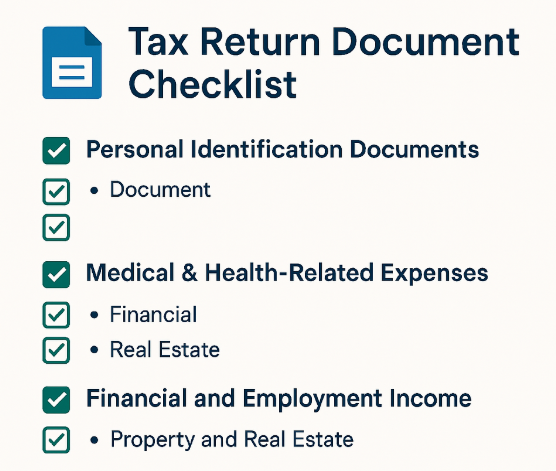
Tax Return Document Checklist

Tax Return Document Checklist

As tax season approaches, it’s essential to prepare the required documentation in a timely and organized manner. Submitting all documents promptly and in full will significantly streamline the preparation and filing process, reduce back-and-forth communication, and help ensure you benefit from all available deductions.

We recommend printing this list ( click on the PDF logo above) and using it as a checklist while gathering your documents.

Please contact us if you have any doubts or if your personal or financial situation has changed during the year.

Personal Identification Documents
() Mod. 730 or Mod. Unico from the previous year (include F24 payment forms)
() Copy of your ID or passport
() Tax ID Number (Codice Fiscale)

Medical & Health-Related Expenses
() Pharmacy receipts (with Codice Fiscale and paid by card)
() Invoices for specialist visits and health tickets
() Invoices or receipts for veterinary expenses
() Funeral expenses

Financial and Employment Income
() Bank declaration for loan interest paid
() CUD (Certificazione Unica) for employment or pension income
() Foreign income tax returns and related tax payment documents

Property and Real Estate
() Cadastral report for properties purchased during the year
() Copies of any real estate sales or purchases made during the year

Deductions & Tax Credits
() ENEA Certifications (for energy savings 55% or 65%)
() Invoices and payments for renovation work (50%)
() Invoices for deductions related to furniture and appliances
() Payment confirmations for life insurance
() School tuition payment receipts
() Proof of payments for children’s sport activities (for those under 18)
() Receipts for donations to ONLUS (non-profit organizations)

Social Security & Contributions
() Payment proof for social security contributions
() Contributions for domestic service workers (INPS)

Foreign Assets
() Value and description of assets, equity, funds, and accounts held abroad
() Foreign financial availability required for IVAFE/IVIE declarations

How to Open a Partita IVA ( individuals )

How to Open a Partita IVA ( individuals )

What Is a Partita IVA ?
The Partita IVA (VAT number) is a unique 11-digit identification number used by the Italian tax authority (Agenzia delle Entrate) to track the financial activity of self-employed individuals, freelancers, and businesses.

If you’re planning to:

Work as a freelancer or consultant

Run a sole proprietorship (ditta individuale)

Launch a small business or e-commerce site

Provide professional services in Italy,

The process to open it

  1. Choose the Type of Activity and ATECO Code
    (Each activity is classified under an ATECO code, a standard Italian business classification.)
  1. Choose Your Tax Regime
    You must select the appropriate tax regime:

Regime Forfettario (Flat-tax): for revenues up to €85,000/year. Fewer obligations, simplified taxation.

Regime Ordinario Semplificato or Ordinario: for higher revenues or more complex businesses.

  1. Register with the Agenzia delle Entrate
    Fill out and submit form AA9/12.

You can do this:

Online, through our office

In person at your local Agenzia delle Entrate office

THIS is the form

4-Register with INPS
If you are self-employed, you must register with the appropriate INPS fund:

    Gestione Separata (for freelancers without a professional register)

    Artigiani e Commercianti (for traders and artisans)

    This is essential to pay your social security contributions.

      5-(Optional) Register with the Chamber of Commerce
      Required for some activities (e.g., artisans, retailers)

      Required Documents
      Valid ID (and permesso di soggiorno if non-EU)

      Italian tax code (codice fiscale)

      ATECO code and business details

      How Long Does It Take?
      VAT certificate : same day

      INPS and Chamber of Commerce: typically a few days to a week

      Please contact our Offices for any assistance.

      Regime Forfettario in Italy (2025): The Flat-Tax Option for Expats

      Regime Forfettario in Italy (2025): The Flat-Tax Option for Expats

      If you’re an expat living in Italy and planning to work as a freelancer, consultant, or solo entrepreneur, the Regime Forfettario (Flat-Rate Tax Regime) might be an appealing option. It offers simplified taxation, fewer bureaucratic obligations, and lower overall costs — but it’s not for everyone, and it’s mutually exclusive with the Regime degli Impatriati.

      Here’s everything you need to know about this regime in 2025, including how it interacts with social security (INPS) and why choosing between tax regimes requires a strategic decision.

      What Is the Regime Forfettario?
      The Regime Forfettario is a favorable tax scheme for individuals (sole traders and freelancers) with relatively modest revenues. It simplifies compliance, eliminates many traditional tax obligations, and applies a flat-rate taxation model.

      Who Qualifies in 2025
      To be eligible for the Regime Forfettario in 2025, you must meet all of the following conditions:

      -Revenues or professional fees must not exceed €85,000 in the previous tax year.

      -Personnel costs (e.g., employees or collaborators) must stay under €20,000.

      -Additional income from employment or pensions must not exceed €35,000.

      -You must not control or participate in a company that operates in the same business sector.

      -Your activity must not be predominantly for a current or former employer.

      Who Is Excluded?


      You cannot use this regime if:

      -You surpass the income or personnel cost thresholds.

      -You operate in specific excluded sectors (e.g., real estate or financial investment).

      -You are also eligible for and using the “Regime degli Impatriati” — these two tax regimes cannot be combined.

      How Taxation Works
      – A flat tax rate of 15% is applied to a percentage of your gross income, called the “coefficiente di redditività” (profitability coefficient). This varies by activity (usually 40%–78%).

      Startups that meet certain conditions (e.g., no professional activity in the last 3 years) may qualify for a reduced 5% rate for the first 5 years.

      • No VAT obligations, no withholding tax on invoices, no IRAP (regional tax).

      INPS (Social Security) Considerations
      All self-employed workers in Italy must contribute to INPS, the national social security system. The way this works depends on your profession:

      Freelancers (without professional association)


      -Enrolled in the Gestione Separata INPS.

      -Contribution rate in 2025: approximately 26.07% of taxable income.

      -Taxable income = Gross revenue × profitability coefficient.

      Artisans and Traders
      Enrolled in the Artigiani e Commercianti INPS fund.

      – Pay a fixed minimum contribution (~€4,500–€4,800 annually), plus a 24% rate on income above €17,500.

      -Contributions are tax-deductible under the flat-rate regime.

      Example: Freelance Consultant with regular 15% tax rate
      Gross revenue: €50,000

      Coefficient of profitability (consulting): 78%

      Taxable base: €50,000 × 78% = €39,000

      Income tax (15%): €5,850

      INPS (26.07% of €39,000): €10,170

      Net income: ~€33,980

      Regime Forfettario vs. Regime degli Impatriati
      If you’re an expat recently relocated to Italy, you may also be eligible for the Regime degli Impatriati, a tax incentive offering:

      -50% tax exemption on employment or self-employment income

      -Valid for 5 years, extendable in some cases

      However, you must choose between the two — they are mutually exclusive:

      The Regime Forfettario is better suited for low to mid-income freelancers or those seeking simplicity.

      The Regime degli Impatriati may be more beneficial for higher earners or structured professionals with larger income streams.

      Key Decision Factors
      Expected gross income

      -Type of work (employment vs freelance)

      -Professional and personal tax residency status

      -Long-term plans in Italy

      Be Careful: You Might Lose Personal Tax Deductions

      One lesser-known downside of the Regime Forfettario is that you may not benefit from common tax deductions (known in Italy as oneri detraibili) if you don’t have other income subject to ordinary progressive taxation (IRPEF).

      Why?
      The Regime Forfettario applies a substitute tax (flat rate of 15% or 5%) instead of IRPEF.

      This means you’re not part of the regular income tax system, so you don’t get to offset deductible expenses like:

      Medical expenses

      Rent or mortgage interest

      University fees

      Dependent family expenses

      Contributions to pension schemes beyond INPS

      When Does This Matter?
      If you:

      Only have income under the Regime Forfettario, and

      Don’t have other income taxed under the standard IRPEF system (like employment income, pension, or property rentals),

      …then your deductible expenses can’t be used, because there’s no IRPEF to offset them against.

      How to Retain Some Deductions
      If you have dual income (e.g., freelance income under Forfettario and salaried income taxed normally), you can still benefit from deductions, but only on the IRPEF-taxed portion.

      In some cases, it might be worth evaluating whether staying in the ordinary tax regime allows you to recover more through deductions, especially if your deductible expenses are high.

      Final Advice
      The Regime Forfettario is one of the most expat-friendly options for solo professionals starting a business in Italy. However, choosing between this and the Regime degli Impatriati can significantly impact your net earnings and tax liability.

      Please consult us for any further details !

      Understanding Italy’s E-Invoicing System: A Guide to Fattura Elettronica

      What is the Fattura Elettronica?
      The Fattura Elettronica is the mandatory electronic invoicing system in Italy for transactions between businesses (B2B), consumers (B2C), and public authorities (B2G). It replaces traditional paper and PDF invoices and is part of Italy’s strategy to fight tax evasion, automate VAT reporting, and streamline compliance.

      How Does It Work?
      Invoices are issued in a specific XML format, transmitted and validated via the Sistema di Interscambio (SdI), the central invoicing platform operated by the Italian Revenue Agency.

      The process includes:
      -Generating the invoice in XML format according to official specifications

      -Transmitting the invoice to SdI via PEC, web portal, or accredited software

      -Validation and delivery by SdI to the recipient

      -Receiving notification of acceptance or rejection

      -Archiving the invoice digitally for 10 years in compliance with Italian law

      Only invoices that go through SdI are considered valid for VAT and legal purposes.

      Obligations for Foreign Businesses
      -Foreign entities with a fiscal representative in Italy: must issue e-invoices via SdI

      -Foreign entities identified via “identificazione diretta” (direct VAT registration): currently not required to use SdI, but may still choose to do so

      Our Support
      To simplify the process, our firm provides a secure online platform that allows clients to:

      -Issue compliant electronic invoices in XML format

      -Send them directly to the SdI

      -Receive electronic invoices from Italian suppliers

      -Monitor delivery statuses and notifications

      -Digitally archive invoices in compliance with the legal requirements

      This service is especially helpful for foreign entities needing assistance navigating the Italian e-invoicing system with full compliance and minimal complexity.

      Necessary documents for your yearly Tax Return

      Tax season is fast approaching, please find a list of the Documents we need to receive to prepare your Tax Return:

      Mod. 730 or Mod. Unico of the previous year and payment forms F24.
      Copy of your ID/passport and Tax ID Number ( Codice Fiscale )

      Pharmacy receipts ( with your Codice Fiscale and paid by credit/debit card)
      Invoices for specialist visits, health tickets Invoices / receipts for medicines and veterinary expenses
      Funeral expenses

      Loan interest paid ( we need the bank declaration )
      CUD attesting your employment / retirement income
      Copies of ENEA Certifications, for energy savings of 55% and 65%
      Copy of renovation costs for recovery 50% plus deductions for Furniture and Appliances.
      Payment for life insurance costs
      Payment for school tuition costs

      Expenses for sport activities for children up to the age of 18
      Payments made to Onlus

      Payment of social security contributions

      Cadastral report for properties purchased during the year
      Copies of any real estate purchases / sales occurred during the year
      Contributions for domestic service workers
      Copy of any foreign income tax returns and related tax payments
      Value and description of assets / funds / equity investments / financial availability held abroad

      That’s the general list. Please contact us for any doubt !

      How to chose and setup a Corp.

      In Italy, setting up a company follows specific legal and bureaucratic procedures. Below is a breakdown of different types of companies in Italy and how to set them up, based on Italian corporate law.


      1. Sole Proprietorship (Ditta Individuale)

      A Ditta Individuale is a one-person business where the owner is personally responsible for all debts.

      Pros:

      • Simple and low-cost to set up
      • Minimal bureaucratic requirements
      • Profits taxed as personal income

      Cons:

      • Unlimited liability (owner’s personal assets are at risk)
      • Harder to access funding and investment
      • Less credibility compared to corporations

      How to Set Up a Ditta Individuale:

      1. Choose a Business Name (optional, default is the owner’s name).
      2. Register with the Chamber of Commerce (Camera di Commercio).
      3. Obtain a Partita IVA (VAT Number) from the Agenzia delle Entrate.
      4. Register with INPS (National Social Security Institute) for pension contributions.
      5. Register with INAIL (Insurance for workplace accidents) if applicable.
      6. Open a Business Bank Account.
      7. Issue Electronic Invoices (mandatory in Italy for B2B and B2G).

      2. General Partnership (Società in Nome Collettivo – SNC)

      A SNC is a partnership where all partners share equal liability for debts.

      Pros:

      • Simple and flexible management
      • No minimum capital required
      • Direct taxation (partners pay personal income tax)

      Cons:

      • Unlimited personal liability for all partners
      • Joint responsibility for debts

      How to Set Up an SNC:

      1. Draft a Partnership Agreement (Atto Costitutivo) with a notary.
      2. Register with the Chamber of Commerce.
      3. Obtain a Partita IVA from the tax office.
      4. Register with INPS and INAIL.
      5. Deposit the company documents at the Registro delle Imprese.
      6. Open a Business Bank Account.

      3. Limited Partnership (Società in Accomandita Semplice – SAS)

      A SAS has two types of partners:

      • General partners (Soci Accomandatari): Have full liability.
      • Limited partners (Soci Accomandanti): Only liable for the amount they invested.

      Pros:

      • Allows silent investors with limited risk
      • Less strict regulations than corporations

      Cons:

      • General partners bear full liability
      • More complex structure than SNC

      How to Set Up an SAS:

      1. Draft the company statutes and sign before a notary.
      2. Register with the Chamber of Commerce.
      3. Obtain a Partita IVA.
      4. Register with INPS and INAIL.
      5. Deposit company documents with the Registro delle Imprese.

      4. Limited Liability Company (Società a Responsabilità Limitata – SRL)

      An SRL is the most common corporate structure in Italy, offering limited liability to shareholders.

      Pros:

      • Shareholders’ liability is limited to their investment
      • Easier to attract investors
      • More professional credibility

      Cons:

      • Higher setup and maintenance costs
      • Stricter regulations than partnerships
      • Mandatory accounting and annual financial statements

      How to Set Up an SRL:

      1. Draft Articles of Association (Atto Costitutivo) with a notary.
      2. Deposit Minimum Share Capital (€10,000 for a standard SRL, €1 for an SRLS).
      3. Register with the Chamber of Commerce.
      4. Obtain a Partita IVA.
      5. Register with INPS and INAIL.
      6. Open a Business Bank Account.
      7. Appoint a Legal Representative.

      5. Simplified Limited Liability Company (Società a Responsabilità Limitata Semplificata – SRLS)

      A SRLS is a simplified version of an SRL, designed to be easier and cheaper to set up.

      Pros:

      • Lower setup costs (no notary needed)
      • Minimum capital of €1
      • Faster bureaucratic process

      Cons:

      • Less flexibility in structuring the company
      • More difficult to raise capital
      • Limited credibility for large contracts

      How to Set Up an SRLS:

      1. Use the standard government-approved statute (Atto Costitutivo).
      2. Register with the Chamber of Commerce.
      3. Deposit share capital (€1 to €9,999).
      4. Obtain a Partita IVA.
      5. Register with INPS and INAIL.
      6. Open a Business Bank Account.

      6. Joint-Stock Company (Società per Azioni – SPA)

      An SPA is a large-scale company where ownership is divided into shares.

      Pros:

      • Limited liability for shareholders
      • Can raise capital from investors and public markets
      • Best suited for large businesses

      Cons:

      • High setup costs (€50,000 minimum capital)
      • Strict regulations and reporting requirements

      How to Set Up an SPA:

      1. Draft the Articles of Association with a notary.
      2. Deposit the minimum capital (€50,000).
      3. Register with the Chamber of Commerce.
      4. Appoint a Board of Directors.
      5. Register with INPS and INAIL.
      6. Open a Business Bank Account.
      7. Submit annual financial reports.

      Tax Updates – February 2025

      We would like to inform you about the main tax updates introduced in February 2025. Below is a summary of the most relevant provisions:

      1. 2025 Tax Reform
        • IRPEF Tax Brackets: The three-tier system has been confirmed, with tax rates set at 23%, 35%, and 43%.
        • Tax Burden Reduction: Tax-free allowances have been introduced for incomes up to €20,000, with decreasing deductions for incomes between €20,000 and €40,000.
        • Corporate Welfare: The tax exemption threshold for fringe benefits has been increased to €1,000 for all employees and €2,000 for those with dependent children.
        • Additional Income Support: The tax credit of up to €1,200 has been confirmed for individuals earning up to €28,000 per year.
        • Social Security Contribution Exemption for Mothers: Extended to mothers with at least two children, up to the age of 10 of the youngest child, and self-employed women meeting specific income requirements.
      2. 2025 “Milleproroghe” Decree (Extension Decree)
        • Reinstatement of Tax Debt Settlement Program (Rottamazione Quater): Taxpayers who lost eligibility by December 31, 2024, can reapply by April 30, 2025, to regularize outstanding debts with a waiver of penalties and interest.
        • Electronic Invoicing Exemption for Healthcare Services: The prohibition on electronic invoicing for healthcare professionals obligated to report data to the Health Card System has been extended until December 31, 2025.
      3. Tax Credit for the “Transition 5.0” Program
        • Recognized for investments made from January 1, 2024, even before the application was submitted. The credit rates are set at 35% for investments up to €10 million and 5% for amounts exceeding that up to €50 million.
      4. Update of the Inheritance Tax Declaration Form
        • The Italian Revenue Agency has updated the inheritance tax declaration form and the related cadastral transfer request, along with the instructions and technical specifications.
      5. Tax Credit for Tourism and Hospitality Operators
        • The deadline for completing investments aimed at enhancing the national tourism sector has been extended to October 31, 2025, with contributions covering up to 80% of the expenses incurred.

      These measures aim to support workers, families, and businesses while fostering economic growth and innovation across the country.

      For further details or assistance, please do not hesitate to contact us.

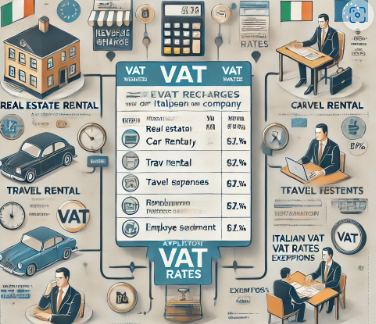
      VAT Treatment of Expense Recharges Incurred by an Italian Company to Its European Parent Company

      VAT Treatment of Expense Recharges Incurred by an Italian Company to Its European Parent Company

      With Ruling No. 6/E of February 11, 1998, the Tax Administration reaffirmed that, from a civil law perspective, the relationship between the active party and the passive party in the recharging of costs should be classified as a mandate without representation. However, for VAT purposes, the operation falls within the scope of Article 3, third paragraph, of Presidential Decree No. 633/72, which states that the services rendered or received by agents without representation (SIT) are considered services even in the relationship between the principal and the agent

      What is the correct VAT treatment for this service (i.e., how should the invoice be issued)?

      In theory, the cost recharge could be treated in two different ways:

      1. As a general service, autonomously subject to VAT and unrelated to the nature of the individual services received.
      2. As a specific service, maintaining the same nature as the services originally received.

      If we adopt Option (1), the situation would be relatively simple:
      We would issue an invoice for “general cost recharge incurred in relation to the seconded employee” (or a similar description), out of scope for VAT under Article 7-ter of Presidential Decree 633/1972, with the statement “reverse charge” included on the invoice.

      However, the Tax Administration has a different view.

      According to the aforementioned Ruling No. 6/E of February 11, 1998:

      It is considered that this provision not only qualifies the transaction carried out by the agent without representation as a service but also achieves the broader purpose of establishing a VAT framework based on a “fictio iuris” (legal fiction). This legal fiction fully aligns the services rendered or received by the agent with those rendered by the agent to the principal. The alignment also extends to the nature of the services, meaning that the services rendered by the agent to the principal cannot be considered a simple intermediary role but must have the same nature as the original services received or provided by the agent on behalf of the principal.

      By reaffirming that the cost recharge constitutes a service, the ruling clarifies that the recharged cost retains the same intrinsic nature as the service originally received by the agent (SIT) and subsequently recharged to the principal (SEU).

      Implications

      This ruling has significant implications, as it requires us to analyze each individual service received, determine its correct VAT treatment, and then apply the corresponding VAT treatment to the recharge.

      • General Rule: Generic services follow the VAT territoriality rule, meaning they are subject to VAT in the country of the recipient (SEU).
        • In this case, the services should be re-invoiced as an out-of-scope VAT transaction under Article 7-ter of Presidential Decree 633/1972, with the mention “reverse charge” on the invoice.

      However, subsequent articles of Presidential Decree 633/72 introduce exceptions for specific types of transactions:


      VAT Treatment of Different Types of Costs in the Recharge

      Real Estate Rental

      • VAT territoriality rule: Rental of real estate follows the territoriality principle of the location of the property (Article 7-quater, paragraph 1, letter a, DPR 633/72).
      • Since the property is in Italy, the service is subject to Italian VAT (generally exempt under Article 10, DPR 633/72).
      • Recharge to the German parent company: It could be considered out of scope for VAT under Article 7-ter (if classified as a generic service provided to an EU taxpayer).

      Long-Term Car Rental (Article 7-sexies, DPR 633/72)

      • VAT territoriality: Determined by the location of the recipient.
      • In this case, the recharge is subject to the reverse charge mechanism.

      Travel Expenses (fuel, tolls, train, flight, taxi, etc.)

      • Same VAT treatment: Reverse charge applies.

      Restaurant Expenses

      • Meals are classified as services tied to the place of performance (Article 7-quater, letter c, DPR 633/72).
      • If the meal is consumed in Italy: The service is subject to Italian VAT.
      • Recharge to the parent company: The recharge does not change VAT territoriality, so it remains subject to Italian VAT (reverse charge does not apply).

      Hotel Expenses

      • Hotel services are subject to VAT where they are provided (Article 7-quater, letter a, DPR 633/72).
      • If the stay is in Italy: The service is subject to Italian VAT.
      • Recharge to the parent company: The cost remains subject to Italian VAT.


      Final Consideration: Salary/Wage Recharges

      With Tax Ruling No. 38 published on February 18, 2025, the Italian Tax Authority confirmed the new VAT framework for personnel secondment.

      • Article 16-ter of Decree Law 131/2024 establishes that secondment of personnel is considered a service subject to VAT when there is a direct link between the service provided and the consideration received.
      • This law abolishes Article 8, paragraph 35 of Law 67/88, which previously excluded personnel secondment from VAT when the reimbursement only covered actual costs without a “mark-up.”
      • The new rule applies only to secondment agreements signed or renewed from January 1, 2025.

      If further clarification is required, a detailed case-by-case assessment is recommended.

      How a Mortgage Works in Italy: Legal Aspects

      A mortgage in Italy (mutuo ipotecario) is a legal contract between a borrower and a lender, typically a bank, to finance the purchase of real estate. The process is regulated by Italian civil and banking laws, ensuring transparency and security for both parties. Below is a breakdown of how a mortgage legally works in Italy.


      1. Legal Framework & Regulations

      In Italy, mortgages are primarily governed by:

      • Italian Civil Code (Codice Civile) – Establishes the legal principles of contracts, property rights, and obligations.
      • Consolidated Banking Act (Testo Unico Bancario – TUB) – Regulates financial institutions and banking operations.
      • Consumer Credit and Mortgage Directives (EU Regulations) – Ensures fairness and transparency in lending practices.

      Banks must comply with these regulations when offering mortgages to individuals and businesses.


      2. Mortgage Structure & Key Elements

      A mortgage in Italy is legally composed of the following elements:

      A. Loan Agreement (Contratto di Mutuo)

      This is a legally binding contract between the borrower (mutuatario) and the lender (mutuante), specifying:
      ✔️ Loan amount (capitale)
      ✔️ Interest rate (fixed, variable, or mixed)
      ✔️ Repayment period (durata del mutuo)
      ✔️ Installments & payment schedule
      ✔️ Any penalties for late payment or early repayment

      B. Mortgage Registration (Ipoteca)

      A mortgage is secured by a lien on the property. This means:
      🏡 The bank registers a first-degree mortgage on the property at the Land Registry (Conservatoria dei Registri Immobiliari).
      ⚖️ If the borrower defaults, the bank has the right to foreclose and sell the property to recover the debt.
      📝 The mortgage remains registered until the loan is fully repaid.

      C. Notary Role (Notaio)

      A public notary plays a crucial legal role in the mortgage process:
      📜 Drafts and authenticates the mortgage deed (atto di mutuo ipotecario).
      🔎 Performs due diligence on the property, ensuring no legal disputes or outstanding debts.
      🏛 Registers the mortgage at the Land Registry.

      Without the intervention of a notary, the mortgage is not legally valid.


      3. Legal Steps to Obtain a Mortgage

      Step 1: Pre-Approval & Financial Evaluation

      • The borrower submits financial documents to the bank (income proof, credit history, tax returns).
      • The bank assesses the borrower’s financial stability and loan eligibility.

      Step 2: Property Due Diligence & Appraisal

      • A property valuation (perizia immobiliare) is conducted by a bank-appointed surveyor.
      • The notary checks the property’s legal status and ensures it has a clean title.

      Step 3: Signing the Mortgage Deed

      • The borrower and lender sign the mortgage contract (atto di mutuo) in front of a notary.
      • The contract is registered with the Land Registry, officially establishing the mortgage.

      Step 4: Funds Disbursement & Property Transfer

      • Once the mortgage is registered, the bank disburses the loan.
      • If the loan is for purchasing a home, the funds are typically transferred directly to the seller.

      4. Default & Legal Consequences

      If a borrower fails to meet repayment obligations:
      ⚠️ The bank can initiate judicial foreclosure (pignoramento immobiliare).
      ⚠️ The property may be auctioned through the court to recover the outstanding debt.
      ⚠️ In some cases, the borrower may negotiate debt restructuring (rinegoziazione del mutuo) with the bank.


      5. Early Repayment & Loan Portability

      • Early Repayment (Estinzione Anticipata) – Under Italian law, borrowers can repay their mortgage early, often without penalties (except for older contracts).
      • Mortgage Portability (Surroga del Mutuo) – Allows borrowers to transfer their mortgage to another bank for better terms, free of charge.

      Final Thoughts

      A mortgage in Italy is a well-regulated financial product that involves strict legal procedures to protect both the borrower and the lender. The presence of a notary, mortgage registration, and banking regulations ensures transparency and compliance. Anyone considering a mortgage in Italy should seek legal and financial advice to navigate the process effectively.

      Taxation of Income for Italian Residents Who Are U.S. Citizens

      Understanding Tax Obligations for Dual Tax Residents

      Italian residents who are also U.S. citizens face a unique and complex tax situation, as they are subject to taxation by both Italy and the United States. This article provides an overview of the key aspects of their tax obligations, double taxation treaties, and potential tax planning strategies.

      1. The U.S. Tax System and Its Implications

      The United States follows a citizenship-based taxation system, meaning that all U.S. citizens, regardless of where they reside, must file and potentially pay U.S. taxes. This includes Italian residents who hold U.S. citizenship.

      Key U.S. tax obligations include:

      • Filing an annual U.S. tax return (Form 1040), reporting worldwide income.
      • Declaring foreign bank accounts via FBAR (FinCEN Form 114) if the total value of all foreign accounts exceeds $10,000.
      • Filing Form 8938 (FATCA requirements) if foreign financial assets exceed certain thresholds.
      • Reporting foreign business interests through Form 5471 or Form 8865, if applicable.

      2. The Italian Tax System and Residency Rules

      Italy imposes taxes based on residency, meaning individuals who are considered Italian tax residents must pay taxes on their worldwide income. A person is considered a resident for tax purposes if they meet any of the following criteria:

      • They are registered in the Anagrafe (Resident Registry) for most of the tax year.
      • They spend more than 183 days in Italy within a calendar year.
      • Their principal place of business or economic interests is in Italy.

      As a result, U.S. citizens residing in Italy are subject to Italian income tax (IRPEF), which applies progressively, as follows:

      Income Bracket (€)Tax Rate (%)
      0 – 28,00023%
      28,001 – 50,00035%
      Over 50,00043%

      3. The U.S.-Italy Tax Treaty and Avoiding Double Taxation

      To prevent double taxation, the U.S.-Italy Tax Treaty offers mechanisms to mitigate tax burdens:

      • Foreign Tax Credit (FTC): The U.S. allows citizens to credit taxes paid to Italy against their U.S. tax liability, reducing the risk of double taxation.
      • Foreign Earned Income Exclusion (FEIE): U.S. citizens who meet the physical presence or bona fide residence test can exclude up to a specified amount ($120,000 in 2023) of foreign-earned income.
      • Totalization Agreement: This determines which country’s social security system applies to a taxpayer, depending on employment circumstances.

      4. Special Tax Regimes for Foreigners in Italy

      Certain foreign residents, including U.S. citizens moving to Italy, may benefit from preferential tax regimes, such as:

      • Regime Impatriati: Offers a tax reduction (70-90%) on employment income for highly skilled workers relocating to Italy.
      • Flat Tax Regime for New Residents: A fixed tax of €100,000 per year on foreign income, available for wealthy individuals.
      • Pensioner Tax Regime: Retired individuals moving to specific southern Italian regions may benefit from a 7% flat tax on their foreign income.

      5. Practical Tax Planning Considerations

      To navigate these complex obligations efficiently, U.S. citizens residing in Italy should consider the following:

      • Work with tax professionals who understand both U.S. and Italian tax laws.
      • Monitor foreign financial accounts to comply with FATCA and FBAR rules.
      • Optimize tax credits and exclusions to minimize overall tax liability.
      • Plan for social security contributions, as Italy and the U.S. have different systems.

      Conclusion

      Italian residents who are also U.S. citizens must carefully manage their tax responsibilities to avoid penalties and optimize their tax situation. By leveraging tax treaties, special regimes, and professional advice, they can ensure compliance while minimizing double taxation.

      How to Get a Mortgage in Italy: A Step-by-Step Guide

      Buying property in Italy is an exciting journey, whether you’re moving there, looking for a second home, or making an investment. If you need a mortgage (mutuo), the process can seem a bit daunting, especially if you’re not familiar with the Italian banking system. This guide will walk you through everything you need to know, in a clear and simple way.


      1. Understanding Mortgages in Italy

      Mortgages in Italy come in different types, so it’s important to choose the right one based on your financial situation and long-term plans.

      🏡 Fixed-rate mortgage – The interest rate stays the same for the entire loan term, making it a safer option if you prefer stability.
      📉 Variable-rate mortgage – The interest rate fluctuates based on market trends, which can mean lower payments at times but also potential increases.
      🔄 Mixed-rate mortgage – A combination of fixed and variable rates, usually starting as fixed and switching to variable after a few years.
      💰 Interest-only mortgage – This is less common, but some banks allow you to pay only the interest initially, with the full amount due later.


      2. Who Can Apply for a Mortgage in Italy?

      Both residents and non-residents can apply for a mortgage, but the conditions vary:

      Italian residents – Usually get the best terms, with loans covering up to 80% of the property’s value.
      EU citizens & foreigners with Italian residency – Similar advantages to residents, as long as they have stable income in Italy.
      Non-residents – Can still get a mortgage, but banks are more cautious. Typically, they finance only 50%-60% of the property value, and interest rates may be slightly higher.

      💡 Tip: Some Italian banks specialize in mortgages for foreigners, so it’s worth shopping around!


      3. What You Need to Apply for a Mortgage

      Italian banks require a set of documents to evaluate your mortgage application. Here’s what you’ll typically need:

      📌 Valid ID – A passport or Italian ID card.
      📌 Codice Fiscale (Italian Tax Code) – Essential for any financial transactions in Italy. You can get it from the Agenzia delle Entrate or your consulate.
      📌 Proof of Income – Recent salary slips, an employment contract, or tax returns if you’re self-employed.
      📌 Bank Statements – Usually from the last 3-6 months, to prove financial stability.
      📌 Credit History – Some banks check your credit score, especially if you’re applying from abroad.
      📌 Deposit – You’ll typically need at least 20%-50% of the property’s value, depending on your residency status.
      📌 Property Documents – The seller must provide official paperwork confirming the property’s legal standing.

      💡 Tip: Some banks might require life insurance as part of the mortgage agreement, so be prepared for that possibility.


      4. How to Apply for a Mortgage

      Once you’ve found the perfect home, here’s how the mortgage process works:

      Step 1: Choose the Right Lender & Get Pre-Approval

      🏦 Compare different banks or work with a mortgage broker who can help you find the best deal.
      📋 Getting pre-approval (approvazione preventiva) gives you an idea of how much you can borrow before committing to a property.

      Step 2: Submit Your Application

      📑 Provide all the required documents, including proof of income, tax records, and details about the property.
      🔎 The bank will analyze your financial situation to determine if you qualify.

      Step 3: Property Valuation & Legal Checks

      🏡 A surveyor (appointed by the bank) will inspect the property to confirm its value.
      📝 The bank will check for any legal issues, such as outstanding debts or disputes on the property.

      Step 4: Approval & Signing the Mortgage Contract

      ✅ Once approved, the bank will issue a binding offer, detailing the loan amount, interest rate, and repayment terms.
      ✍️ You will sign the final mortgage agreement in front of a notary (notaio), along with the property purchase deed.

      Step 5: Funds Transfer & Final Steps

      💰 The bank releases the loan amount—either directly to the seller or through an escrow process with the notary.
      🏡 Congratulations! The property is officially yours, and the mortgage is now active.


      5. Costs & Fees to Consider

      In addition to your deposit and monthly payments, here are some extra costs to keep in mind:

      💶 Bank fees – Usually 1%-2% of the loan amount.
      📜 Notary fees – Typically 1%-2% of the property price.
      🏛 Registration taxes & stamp duty – Costs vary based on the property type and whether you’re a resident.
      🏡 Surveyor fees – Around €300-€500 for the property valuation.
      💼 Mortgage broker fees – If you use a broker, they may charge a commission.

      💡 Tip: Some banks offer special deals for first-time buyers, so ask about any promotions or fee reductions!


      6. Tips for a Successful Mortgage Application

      ✔️ Show stable income – Banks prefer applicants with a steady job or a well-established business.
      ✔️ Improve your credit history – If possible, pay off any debts before applying.
      ✔️ Work with a local expert – A mortgage broker or real estate agent can help navigate the process, especially if you’re a foreign buyer.
      ✔️ Consider a higher deposit – Offering more upfront can improve your chances of approval and may secure better interest rates.

      USA – Beneficial Ownership Information (BOI) Report

      Beneficial Ownership Information (BOI) Report: Overview & Due Date

      The Beneficial Ownership Information (BOI) Report is a filing requirement introduced under anti-money laundering (AML) laws to increase transparency in corporate structures. It mandates companies to disclose details about individuals who ultimately own or control them.

      Who Needs to File the BOI Report?

      Entities subject to the BOI reporting requirement typically include:

      • Corporations
      • Limited liability companies (LLCs)
      • Other entities registered with government authorities
      • Some trusts and partnerships (depending on jurisdictional rules)

      What is Beneficial Ownership?

      A beneficial owner is an individual who:

      1. Directly or indirectly owns 25% or more of the entity’s shares, voting rights, or capital; OR
      2. Exercises significant control over the entity, even without direct ownership.

      Information Required in the BOI Report

      Entities must provide:

      • Full name of each beneficial owner
      • Date of birth
      • Address (residential or business)
      • Government-issued ID number (e.g., passport, tax ID)
      • Details of ownership interest or control over the entity

      BOI Report Due Date

      • For existing entities: Due by December 31, 2024 (varies by jurisdiction).
      • For new entities (formed in 2024 or later): Filing is required within 30 days of registration.
      • Updates/Changes: Any changes in beneficial ownership must be reported within 30 days of the change.

      With the February 18, 2025, decision by the U.S. District Court for the Eastern District of Texas in Smith, et al. v. U.S. Department of the Treasury, et al., 6:24-cv-00336 (E.D. Tex.), beneficial ownership information (BOI) reporting requirements under the Corporate Transparency Act (CTA) are once again back in effect. However, because the Department of the Treasury recognizes that reporting companies may need additional time to comply with their BOI reporting obligations, FinCEN is generally extending the deadline 30 calendar days from February 19, 2025, for most companies.

      Tax regime for new residents – 2024 version

      Italy’s “Regime Impatriati” is a special tax incentive designed to attract professionals to relocate to Italy by offering significant tax benefits. Recent legislative changes have modified the requirements and benefits of this regime, effective from January 1, 2024. Here’s an overview of how the regime functions starting in 2025:

      Eligibility Criteria:

      1. Non-Residency Requirement: Individuals must not have been tax residents in Italy for at least three tax periods prior to the year they become Italian tax residents.
      2. Employment in Italy: The individual must be employed or self-employed in Italy.
      3. Duration of Stay: The individual must commit to residing in Italy for at least four years.

      Tax Benefits:

      • Income Tax Reduction: Eligible individuals can benefit from a 50% reduction in taxable employment or self-employment income, with a maximum cap of €600,000 per year.
      • Duration of Benefits: The tax benefit applies for the tax year in which the individual transfers their tax residency to Italy and extends for the following four years, totaling five years of tax incentives.

      Additional Considerations:

      • Highly Qualified Professionals: The regime is particularly aimed at highly qualified or specialized individuals, aligning with definitions similar to those for a Schengen Blue Card.
      • Inter-Company Transfers: The regime also applies to individuals transferring within the same corporate group, provided specific conditions are met.

      These changes aim to attract international talent and encourage the return of Italian citizens by offering substantial tax incentives.

      Tax Treatment of Expense Reimbursements for Professionals in Italy: 2025 Updates

      As of January 1, 2025, significant changes have been introduced regarding the tax treatment of expense reimbursements for professionals in Italy. These changes stem primarily from Legislative Decree No. 192/2024 and the 2025 Budget Law.

      Reimbursement of Itemized Expenses for Professionals

      Expenses incurred by professionals while carrying out an assignment, when reimbursed on an itemized basis by the client, no longer contribute to taxable self-employment income. As a result, these reimbursements:

      • Are no longer subject to withholding tax.
      • Are not subject to pension fund contributions.
      • Remain subject to VAT, as they do not qualify as expenses incurred on behalf of the client under Article 15 of Presidential Decree No. 633/1972.

      To benefit from this tax treatment, expenses must be:

      • Incurred in the interest of the client.
      • Documented in a detailed and itemized manner.
      • Paid using traceable payment methods, such as credit cards, bank transfers, or other electronic payment systems.

      If the client fails to reimburse the professional, these expenses may still be deductible under specific conditions, such as in cases of client insolvency or the expiration of the credit claim.

      Mandatory Use of Traceable Payments

      The 2025 Budget Law has introduced a mandatory requirement to use traceable payment methods for the deductibility of travel and representation expenses. This requirement applies to professionals, employees, and businesses. Affected expenses include:

      • Hotel accommodations.
      • Meals and beverages.
      • Travel and transportation expenses, including taxi services and car rentals with drivers.

      If these expenses are not paid using traceable methods, they will not be deductible from taxable income. For employees, reimbursements for such expenses will become taxable for both income tax and social security purposes.

      Impact on Professionals Under the Flat-Rate Regime

      The new regulations do not appear to apply to professionals operating under the flat-rate tax regime, as the changes specifically affect Article 54 of the Italian Income Tax Code (TUIR), which governs self-employment income determination under the ordinary and simplified regimes.

      Conclusion

      These new provisions aim to enhance financial transparency and combat tax evasion by enforcing the use of traceable payment methods for the professional and business expenses.

      Special Italian TAX regime for University Professors and Researchers : just 10% is taxed

      The special Tax Regime ( art. 44 L. n 78/10 ) refers  to the income from employment (or self-employment) produced in Italy for University teaching and research activities. For such income, just its 10% is taxable.

      The regime applies from the tax period when  the teacher or researcher becomes fiscally resident in Italy, with these further conditions for access:

      • Be in possession of a university degree or equivalent;

      • Have not been occasionally resident abroad;

      • Have carried out documented research or teaching abroad at public / private research centers or universities for at least 2 continuous years;

      • Carry out teaching or research activities in Italy;

      • Acquire tax residence in the Italian territory.

      Duration of the regime : year of return + 5 more years . In the case of more children and / or property purchases , it can reach up to 13years

      In the event that the person moves his residence in Italy, but continues to carry out research or teaching activities abroad, the benefit is limited to the  income received in Italy as a teacher or researcher. Foreign income will thus  ordinarily be subject to Italian taxation, with a  tax credit for taxes paid abroad . ( Article 165 DPR 917/86.)

      Please do not hesitate to contact us for any further details.

      No special Tax regime for those who return in Italy to perform the same Job

      For Taxpayers who return in Italy after a period abroad , there is no tax benefit in the presence of the same contract, same job and with the same employer. This was clarified by the Agenzia delle Entrate  with the response to ruling no. 42 of 18 January 2021.

      If however the impatriate assumes a different corporate role than the original one, with a new contract that does not constitute a mere  the continuation of the previous work, the benefits will be granted.

      Special attention should thus be paid for those contract terms  that could indicate a mere prosecution of the previous Job  , as :

      – recognition of seniority from the date of first hiring;

      – the absence of the trial period;

      – clauses aimed at not paying the accrued thirteenth (and possibly fourteenth) accrued monthly salaries .

      We are as usual here for any further assistance .